Henri de Toulouse-Lautrec
He lived among the people he painted — the performers, the prostitutes, the drinkers — and never condescended to them.
Style and technique
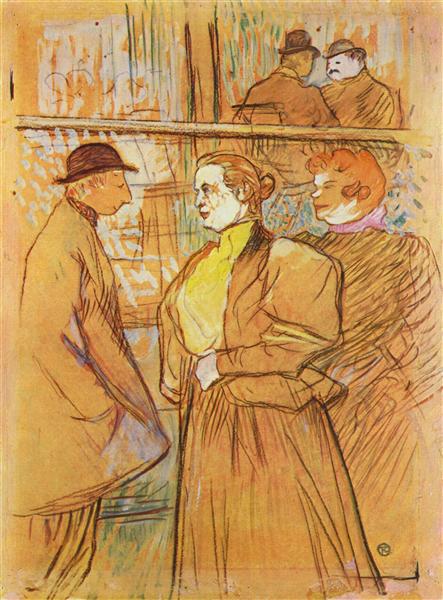
Toulouse-Lautrec learned two things from Japanese printmaking and one thing from Degas, and combined them into a style so immediately recognisable that it defined an era of Parisian visual culture. From the Japanese he took flat areas of unmodulated colour and strong, expressive outline — the drawing that encloses form without modelling it in the conventional painterly sense. From Degas he took the unexpected angle — the cropped figure, the view from above or from the wings, the observer's vantage point that places the viewer inside the scene rather than facing it as an audience.
The result is a visual language perfectly suited to its subject: the accelerated, artificial world of Montmartre's cabarets, music halls, and brothels, where light was gaslit and then electric, movement was fast and performative, and the human figure was always doing something rather than posing. His subjects are caught in action — dancing, drinking, performing, making up their faces — rather than arranged for contemplation.
His poster work extended these qualities into a commercial medium with enormous reach. The Moulin Rouge posters of the early 1890s — which used his painterly economy of line and flat colour in a format designed to be read at a glance on a street wall — were transformative for the history of graphic design. He essentially invented the modern entertainment poster.
Four fingerprints: bold, curved outline derived from Japanese printmaking, flat areas of colour without modelling or shading, Montmartre's performers and working women as primary subjects, and the integration of text and image in his poster work, where the lettering is part of the composition rather than a caption.
Life and legacy
Toulouse-Lautrec was born on 24 November 1864 in Albi, in the south of France, into one of the oldest aristocratic families in the country. The family had practiced close marriages within its own nobility for generations, and Lautrec suffered from a genetic condition — pycnodysostosis — that left him with brittle bones and stunted growth in his legs.
He broke both legs in falls at the ages of thirteen and fourteen, and the breaks never healed properly. His legs stopped growing while his torso continued to develop normally, so as an adult he stood about 1.52 metres tall, with a child's legs and an adult's body. The condition caused him physical pain throughout his life and shaped his relationship to the world in ways both obvious and subtle.
He moved to Paris in 1882 to study painting and arrived in Montmartre — the bohemian and entertainment district of the city — where he would spend essentially the rest of his life. He studied with the academic painter Léon Bonnat and then with Fernand Cormon, where he met Van Gogh and Émile Bernard. But his real education was in the streets, cafés, dance halls, and brothels of the neighbourhood.
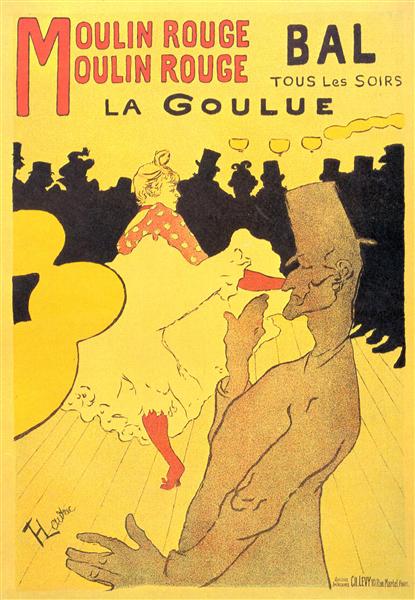
He was a regular at the Moulin Rouge from its opening in 1889, and the proprietors gave him a table by the wall and free access in exchange for the publicity his posters generated. The first Moulin Rouge poster, featuring La Goulue and Valentin le Désossé, appeared in 1891 and was immediately recognised as a work of extraordinary visual intelligence. It made him famous.
Through the 1890s he produced paintings, drawings, lithographs, and posters at an astonishing rate, working quickly and with great precision, frequenting the music halls and theatres and brothels that were his subject matter. He was an acute observer and a warm presence in the world he depicted — invited into the backstage, the dressing rooms, the private spaces that most observers were not admitted to.
His health deteriorated sharply in the late 1890s under the combined effects of alcoholism and syphilis. He had his first breakdown in 1899 and was briefly confined to a sanitarium. He recovered enough to return to Paris and work for another year, but a stroke in August 1901 left him paralysed, and he died on 9 September 1901 at the family estate in Saint-André-du-Bois, aged thirty-six.
Five famous paintings
Moulin Rouge: La Goulue 1891
The first Moulin Rouge poster and one of the most important works in the history of graphic design. La Goulue — Louise Weber, the most popular dancer at the Moulin Rouge — is shown in the distance, her white petticoats raised, surrounded by the dark silhouette crowd. Valentin le Désossé, her dancing partner, occupies the foreground as a flat black shape. The design uses a limited palette of orange, yellow, black, and white, with bold outlines and flat areas of colour derived from Japanese woodblock prints. The text — Moulin Rouge, La Goulue, the performance times — is integrated into the composition as visual element rather than added caption. It is in the Bibliothèque nationale de France.
At the Moulin Rouge 1892
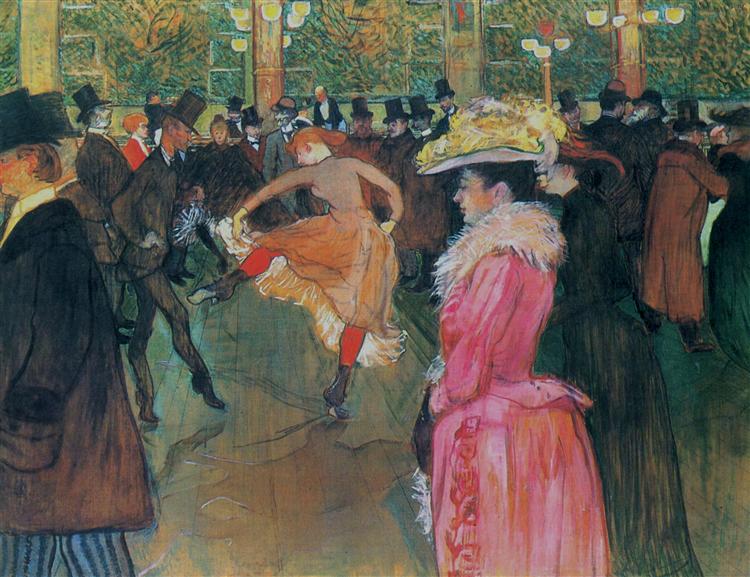
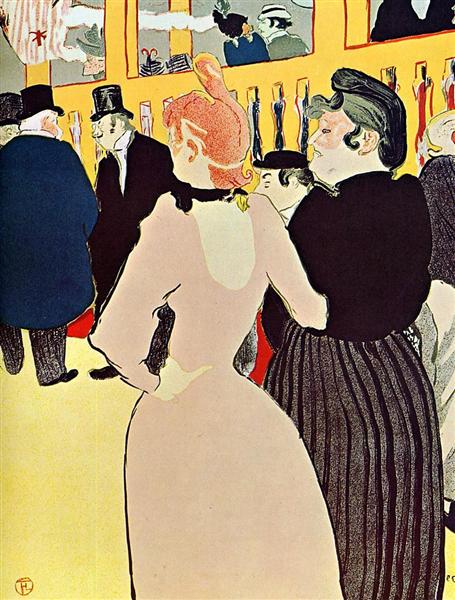
A painting of the Moulin Rouge interior — a table of identifiable figures, the dance floor behind them, the gas lights reflected in the mirrors on the far wall. Toulouse-Lautrec himself appears in the background, short, walking with a taller companion. The composition is cut at unexpected angles: a face at the right edge is cropped by the frame, the perspective is oblique, the sense of being inside the social scene rather than observing it is complete. The artificial light gives everything a slightly lurid, slightly unreal quality. The figures are portraits of specific people in a specific place, but the painting is also about the particular atmosphere of that world. It is in the Art Institute of Chicago.
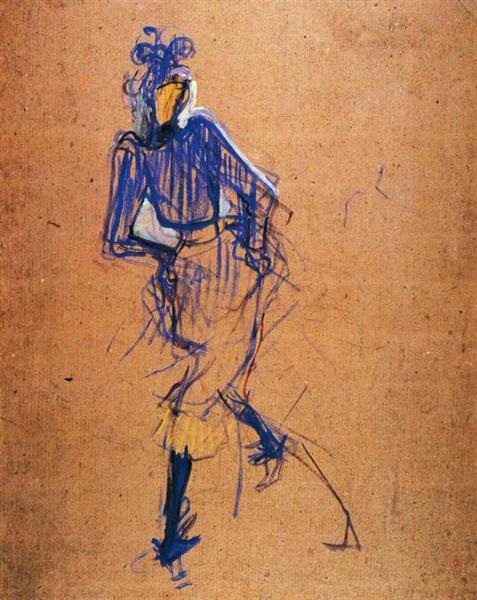
Jane Avril Dancing 1892
Jane Avril, one of the Moulin Rouge's most celebrated performers and one of his most frequent subjects, photographed mid-dance — one leg raised, the other grounded, her face absorbed in the movement. The paint is applied loosely, the figure emerging from thin washes of colour rather than built up with solid paint. The drawing is everything: the line that describes the raised leg, the angular posture of the dancer caught at an extreme of her movement. Jane Avril was more refined and more intelligent than most of the Moulin Rouge performers, and Toulouse-Lautrec returned to her dozens of times, each portrait slightly different in emotional register.
The Toilette 1889
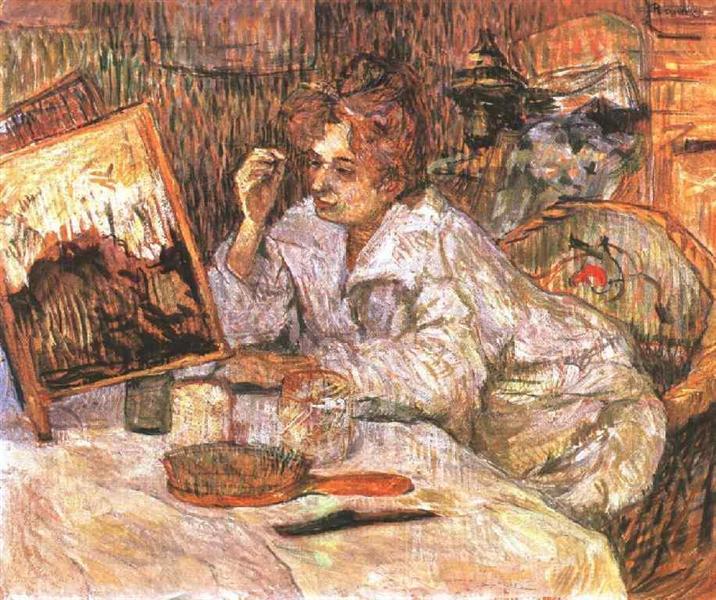
A woman seen from behind, seated on the floor of what appears to be a brothel room, combing or arranging her hair. The figure is rendered in his characteristic economical style — a few decisive lines and areas of flat colour define the position and posture. The subject is taken from Degas's series of bathing women, but where Degas's women are absorbed in their own bodies, this figure has a quality of quiet fatigue that belongs to the world Toulouse-Lautrec inhabited. The painting is not prurient and not sympathetic in the condescending sense; it simply records what he saw with accuracy and respect. It is in the Musée d'Orsay in Paris.
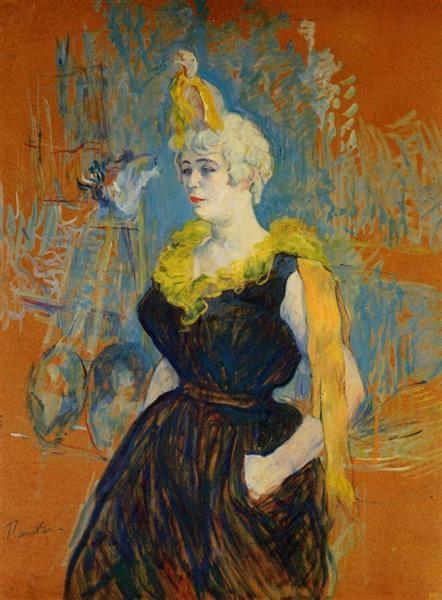
Cha-U-Kao, Female Clown 1895
A female performer at the Moulin Rouge — known as Cha-U-Kao — is shown adjusting her costume before a performance, her yellow tutu and ruffled collar in the process of being arranged. Her face, seen in three-quarter view, is without performance; she is between her professional self and her private one. Toulouse-Lautrec was fascinated by the moment between roles — the performer before the mask goes on. Cha-U-Kao appears in several of his works; she was one of the few subjects he pursued specifically because of her ambiguous public identity, which included performing as a lesbian attraction. It is in the Musée d'Orsay.