Claude Monet
He spent thirty years painting the same garden — and gave a whole movement its name.
Style and technique
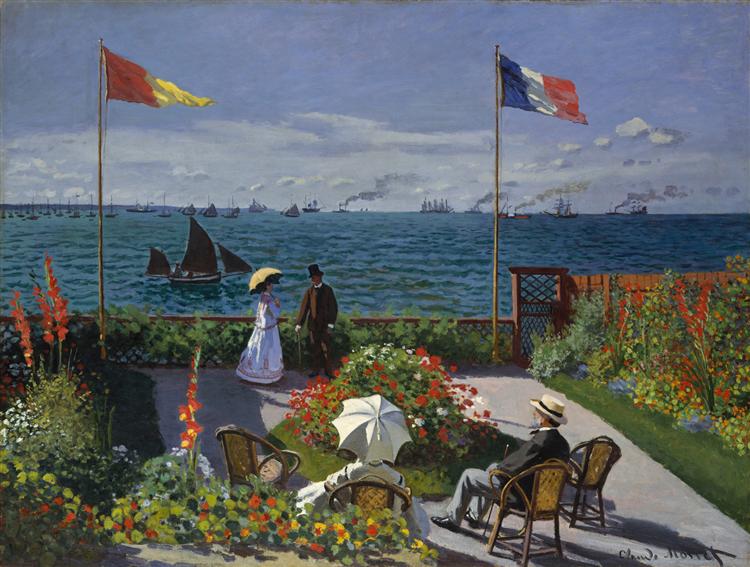
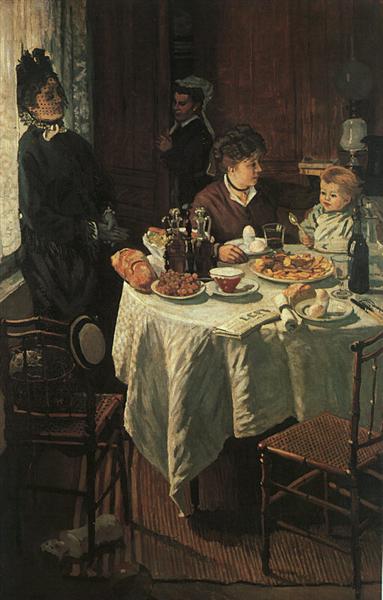
Monet painted the moment. Not a story, not an allegory, not a saint — just the specific quality of light falling on a specific thing at a specific minute of a specific day. That sounds simple; in 1872 it was almost incomprehensible.
The academic painters of the Paris Salon worked in studios from sketches and memory, building scenes layer by patient layer in glazes of brown. Monet packed his easel onto a train, stood in a wheatfield or beside a river, and painted wet on wet, as fast as the light was changing — sometimes finishing a canvas in a single morning, sometimes setting up six canvases in a row and rotating between them as the sun moved.
The word Impressionism itself came from one of his paintings. In 1874 he showed 'Impression, Sunrise' at the first independent exhibition organised by him and his friends. A critic named Louis Leroy mocked the title — 'an impression, not a finished picture' — and the name stuck. Monet and his circle adopted the insult and made it the banner of the movement.
Four fingerprints make a Monet recognisable.
Short, broken brushstrokes. He laid colour next to colour rather than mixing it on the palette. From three metres away, your eye does the mixing. Up close, the canvas dissolves into a patchwork.
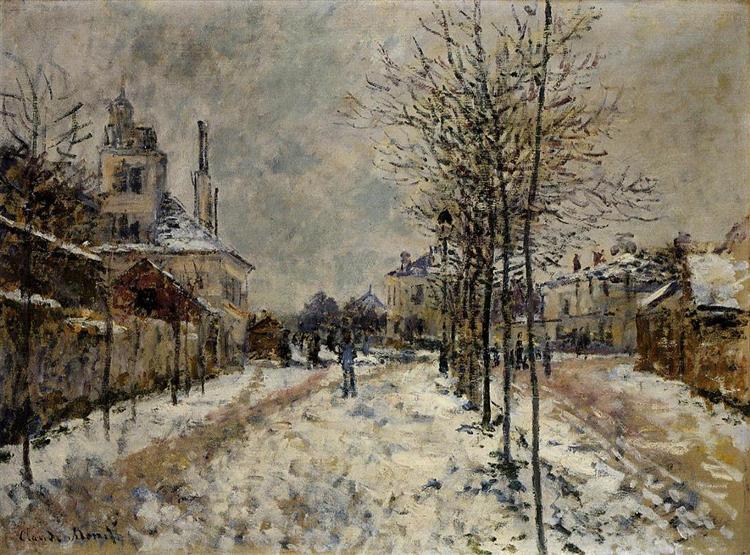
No black. The Impressionists were almost obsessed with banishing black from the palette. Monet's shadows are blue, violet, green — never the brown-black of traditional painting.
Modern subjects, no narrative. A train station. A bridge. A woman walking through grass. A field of poppies. The painting is not 'about' anything except how that thing looks in that light.
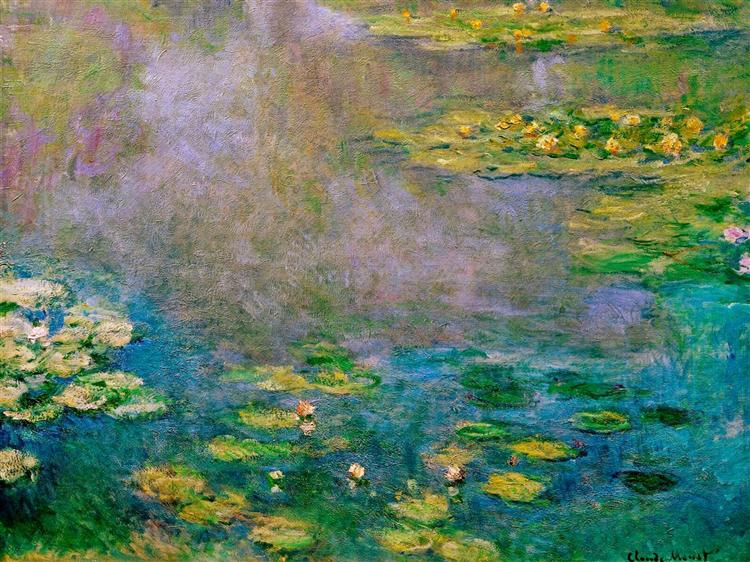
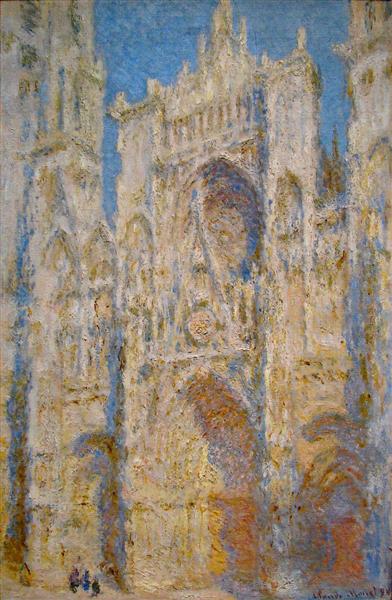
Series. Late in his career he stopped moving the subject and started moving the light. He painted the same haystack thirty times, the same cathedral facade thirty times, the same lily pond more than 250 times. Each canvas was a different hour, a different season, a different mood.
Monet did not invent painting outdoors — Constable and the Barbizon school were doing that decades earlier. What he did was push the logic of it to its extreme. By the time he died, painting had been changed completely: the subject of a picture was no longer the only thing in it. Light, weather, time of day had become subjects in their own right.
Life and legacy
Oscar-Claude Monet was born in Paris on 14 November 1840, the second son of a small grocer. The family moved to Le Havre, on the Normandy coast, when he was five. The sea, the sky and the changing North Atlantic light would mark almost every painting he ever made.
As a boy he was a celebrity caricaturist around Le Havre — he charged 20 francs a head and sold dozens. The local landscape painter Eugène Boudin noticed his talent and took him along on outdoor painting trips. Boudin was the first person who told Monet that you could paint the sea by going to the sea. The lesson lasted.
In 1859, aged 18, Monet went to Paris to study art. His father, who wanted him to take over the family grocery, was furious. Monet drifted, drew at the Académie Suisse, met other ambitious young painters — Pissarro, Renoir, Sisley, Bazille — and was conscripted into the army for two years in Algeria, where he caught typhoid and was sent home. He went back to Paris.
In 1865 he met Camille Doncieux, his model and the love of his early life. They had a son, Jean, in 1867; his family disowned him for having a child out of wedlock. They married in 1870, fled to London during the Franco-Prussian War, and on the way home Monet sat in a tiny boat and painted his first major Argenteuil river canvas. London showed him Turner's atmospheric experiments and changed his palette forever.
The first Impressionist exhibition was held on 15 April 1874, in the studio of the photographer Nadar at 35 Boulevard des Capucines, Paris. Monet showed nine works. One was 'Impression, Sunrise', a small painting of Le Havre harbour at dawn. The reviews were brutal. 'Wallpaper in its most embryonic state', wrote one critic. The exhibition lost money. Monet was almost homeless.
The 1870s were a long financial nightmare. Camille fell ill. They moved to Argenteuil, then Vétheuil. In 1879, after a slow decline that Monet never named in writing, Camille died. She was 32. Monet painted her on her deathbed; the canvas exists, and he wrote later that he was horrified to discover that even at the moment of his wife's death he could not stop noticing the violet, blue, yellow tones of her dying skin. 'It came to me before I knew what I was doing.'
In 1883 he moved to Giverny, a small village in Normandy on the Seine, with his second partner Alice Hoschedé and a household of eight children between them. He bought the house in 1890. He turned the kitchen garden into a riot of flowers and, in 1893, bought the small piece of land across the railway track to dig a pond. He diverted a small river into it and planted water lilies. The Japanese wooden bridge went up in 1895.
For the next thirty years, Giverny was his subject. He travelled when he had to — to London, to Venice, to the Norwegian coast — but he always came back to the garden. He painted the haystack series in 1890–91 (twenty-five canvases), the Rouen Cathedral series in 1892–94 (thirty canvases), the Charing Cross Bridge and Houses of Parliament series during three London winters (1899–1901), and finally, from around 1899 onwards, the water lilies — more than 250 canvases of the same pond, painted from the same wooden walkway, for the next 27 years.
In 1908 he was diagnosed with cataracts in both eyes. His vision went brown. The water lilies of those years are red, violet, almost burning — many critics interpret them as a record of his eye disease as much as of the pond. He had two operations on his right eye in 1923. The world came back into focus and he immediately repainted some of the canvases.
In 1922 he donated eight enormous late water lily panels to the French state, on the condition that they be installed in two specially built oval rooms in the Orangerie, in the Tuileries Gardens, Paris. He worked on them until almost the end of his life. They are still there.
He died at Giverny on 5 December 1926, aged 86. His old friend Georges Clemenceau, the French wartime prime minister, was at his bedside. According to legend, when an attendant tried to drape the coffin in a black cloth, Clemenceau pulled it off and said: 'Not for Monet. No black.' He went into the garden and brought back a coloured curtain instead.
The house at Giverny is open to the public. The gardens, including the lily pond and the Japanese bridge, are kept as he left them. About 700,000 visitors a year walk through Monet's living painting.
Five famous paintings
Women in the Garden 1866
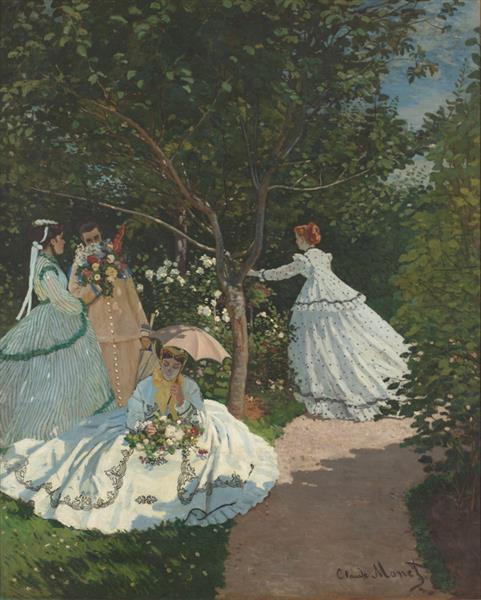
Painted when Monet was 26 and broke. The canvas is 2.5 metres tall — too big to fit through the door of his rented house — so he dug a trench in the garden and lowered it into the ground on a pulley to reach the top. He used the same model, his future wife Camille, for all four women. The painting was rejected by the official Salon of 1867 for being 'unfinished' — the brushwork was too loose, the figures too modern. Years later the French state bought it for 200,000 francs, more than ten times what Monet had been paid for any painting in the 1860s. It hangs in the Musée d'Orsay in Paris.
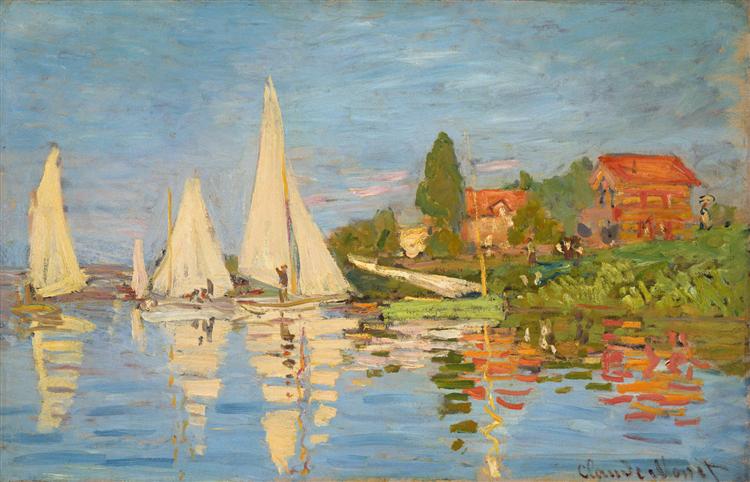
Regattas at Argenteuil 1872
Argenteuil was a small village on the Seine, ten miles north-west of Paris, that became the laboratory of high Impressionism. Monet, Renoir, Manet and Sisley all painted here in the early 1870s. The water in this canvas is a near-pure example of what the movement was trying to do: blocks of pure colour laid side by side — pinks, blues, ochres, whites — with no attempt to imitate the actual reflective surface of water. From a metre away, your eye does the work. Up close, it is almost abstract. It hangs in the Musée d'Orsay.
Saint-Lazare Station 1877
Monet asked the station director of Gare Saint-Lazare, Paris's busiest train terminus, to delay all departures by half an hour while he painted. He set up his easel in the middle of the platform and worked. The director agreed. Monet painted the station twelve times in three months — the steam, the iron rafters, the modern light filtering through smoke. It was an Impressionist statement: the new subject of painting was not Greek gods or Italian saints, it was the railway, the city, the steam. This version is in the Musée d'Orsay; the others are scattered between Chicago, the Fogg, the Pola Museum in Japan, and a few private collections.
Rouen Cathedral 1894
Between 1892 and 1894 Monet painted the west facade of Rouen Cathedral more than thirty times. He rented a room across the square and worked from the second-floor window, switching canvases as the sun crossed the building. He showed twenty of the canvases together at his Paris dealer in May 1895; standing in front of the wall of cathedrals — pink at dawn, white at noon, blue at dusk — was the first time anyone had ever seen a single subject treated as a study of nothing but light. Cézanne said: 'Monet is just an eye, but my god, what an eye.' Today the canvases are scattered across museums; the largest cluster is in the Musée d'Orsay.
Water Lilies 1906
From around 1899 to his death in 1926, Monet painted his water lily pond at Giverny more than 250 times. Some are small; some are 2 metres wide; the late panels are six metres long and curve along the wall like a river. There is no horizon, no shore, no sky — only the surface of the pond and the reflection of the sky in it, with the lilies floating like punctuation. He once said the water lilies were a 'magnificent enchantment' and that he was 'incapable of painting anything else'. The canvases are in MoMA, the National Gallery in London, the Musée d'Orsay, and — most spectacularly — in the two oval rooms of the Musée de l'Orangerie in Paris, where eight enormous panels surround the visitor on every side.