Vincent van Gogh
He painted only for the last ten years of his life — and remade Western painting along the way.
Style and technique
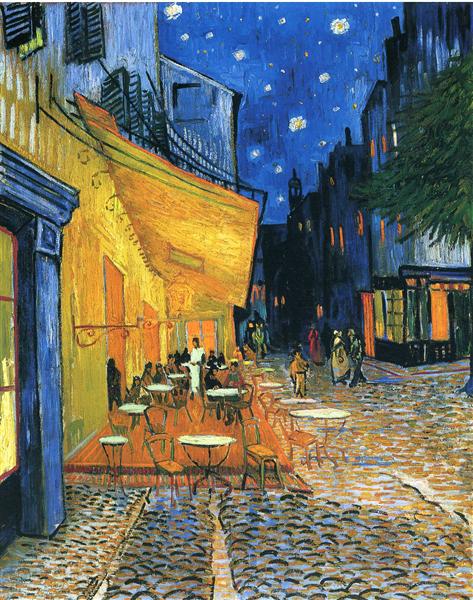
Van Gogh's paintings look like nothing else in the history of art, and you can spot one across a crowded museum room without reading the label. The reason is mostly the brush. Where most painters of the 1880s smoothed their strokes flat, Van Gogh left every single one visible — short, thick, often loaded with so much paint the canvas turns into a relief sculpture you could read with your fingers.
He used colour the way other people used emotion. The yellow of his wheatfields is not the yellow of a real wheatfield. It's brighter, hotter, almost radioactive. The blue of his night skies is not the blue of a real sky. It is the colour of mood, applied with intent. He once wrote to his brother that colour, more than drawing, could 'express something itself'. He spent the last decade of his life proving it.
Four fingerprints make a Van Gogh recognisable on sight.
Visible brushwork. Every stroke shows. There is no smoothing, no glazing. The texture is the painting.
Swirling movement. Skies, fields, cypresses — everything moves. Stars become whirlpools. Wheatfields ripple. Even the walls of his bedroom in Arles seem to lean.
Colour as feeling. He pushes complementary colours next to each other (yellow next to blue, red next to green) so the eye buzzes. His palette is not what nature looks like — it is what nature feels like.
Contour lines. He often outlines objects in dark blue or black, like a stained-glass artist or a Japanese woodcut printer. He collected hundreds of Japanese prints and the influence is everywhere, especially in the late Arles paintings.
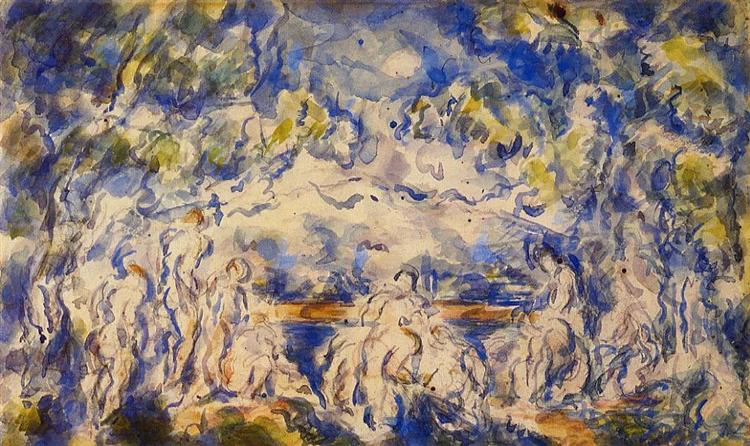
He was not, despite the cliché, an untrained madman. He learned drawing carefully, studied perspective from manuals, and copied Millet, Delacroix and Hokusai for years. But he simplified everything down to its emotional core. Cézanne built form from cubes; Van Gogh built feeling from strokes. The two of them, together, are why painting after 1900 stopped trying to imitate reality and started trying to be something on its own.
Life and legacy
He was born Vincent Willem van Gogh on 30 March 1853 in Zundert, a small village in the southern Netherlands. His father was a Dutch Reformed minister; the family was strict, religious and not particularly artistic. The exact same name — Vincent Willem van Gogh — had been given to a stillborn brother born one year earlier. As a child Van Gogh walked past his own gravestone every Sunday on the way to church.
He failed at almost everything before he tried painting. He worked as an art dealer at Goupil & Cie in The Hague, London and Paris from 1869, and was fired in 1876 for telling customers their taste was bad. He tried to become a Methodist preacher and was rejected. He went to a Belgian coal mining region called the Borinage as an unofficial missionary, gave away his clothes to the miners, slept on a straw floor and was dismissed by the church for 'excessive zeal'. He was 27 years old, broke, and had no profession.
His brother Theo, four years younger and an art dealer in Paris, agreed to support him financially. From that point until Van Gogh's death, Theo sent him an allowance every month and the two wrote each other constantly — more than 800 surviving letters, the greatest written record we have of any artist's working life.
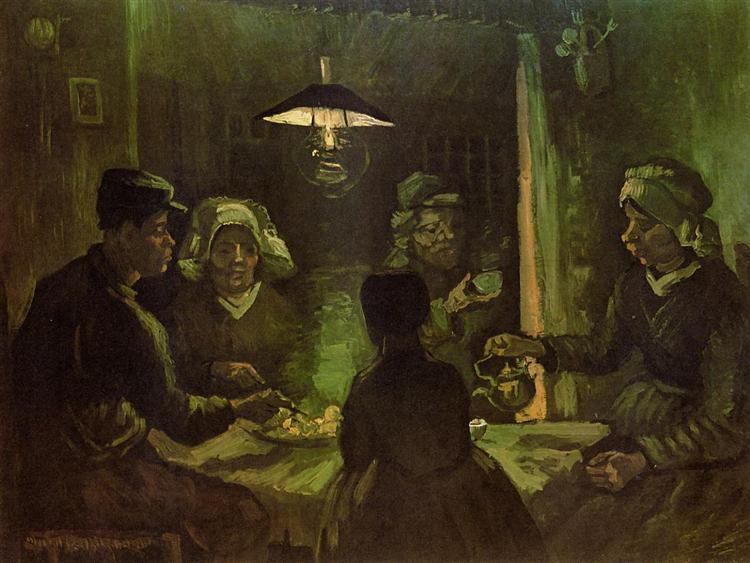
Van Gogh's first paintings, made in the early 1880s in the Netherlands, are dark, earthy, and hard to love. He painted peasants eating boiled potatoes by the light of a single oil lamp, and weavers hunched over looms in muddy interiors. He thought painters should serve the poor. The result is technically clumsy and emotionally fierce — and it includes 'The Potato Eaters' (1885), the work he considered his first real painting.
He moved to Paris in 1886 to live with Theo and discovered, almost overnight, the Impressionists. Monet, Pissarro, Seurat, Toulouse-Lautrec — all painting in the same city he was now in. His palette exploded. Within two years his canvases went from earth tones to electric yellow.
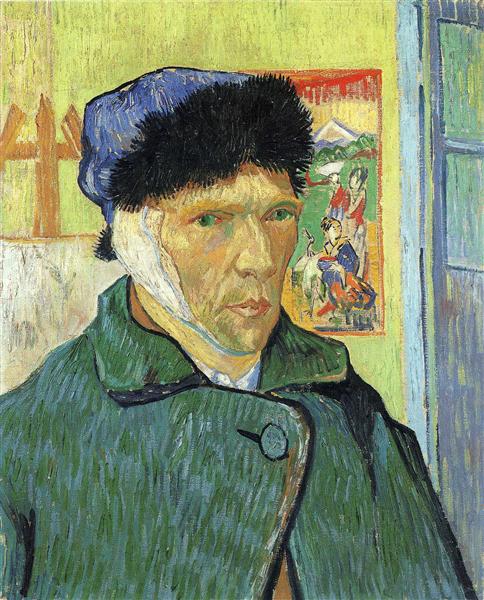
In February 1888 he left Paris for Arles, in Provence, looking for what he called 'the Japan of the South' — bright sun, clear colour, simple peasant life. He rented a small house, painted it yellow, and dreamed of founding an artists' commune there. Paul Gauguin came to live with him in October. They lasted nine weeks. After a violent argument on the night of 23 December 1888, Gauguin walked out and Van Gogh, alone, cut off the lower part of his own left ear with a razor. He wrapped it in newspaper and gave it to a woman at a local brothel. He woke up in a hospital with no memory of the night.
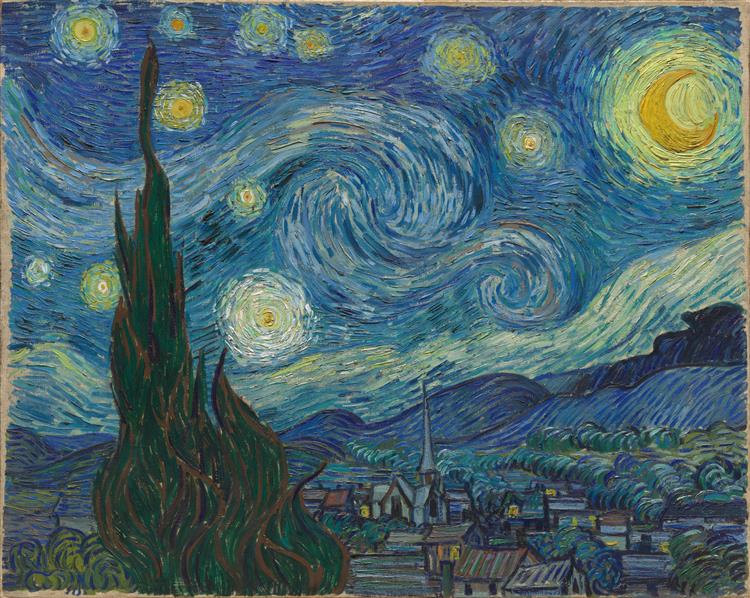
The months after the breakdown produced his most famous paintings. He admitted himself voluntarily to the asylum at Saint-Rémy-de-Provence in May 1889 and stayed for a year. From his barred window he painted 'The Starry Night'. He painted irises, cypresses, olive trees, his own room, his own anguished face. He worked at a frantic rate — sometimes a finished canvas every day.
In May 1890 he moved north to the village of Auvers-sur-Oise, near Paris, under the care of a homeopathic doctor named Paul Gachet. He painted seventy canvases in seventy days. On 27 July 1890 he walked into a wheatfield and shot himself in the chest with a revolver. He did not die at once. He walked back to the inn where he was staying, was put to bed, and lived another two days. His brother Theo arrived from Paris in time. Vincent's last words, in French, were that the sadness would last forever.
He was 37 years old. Theo died six months later, broken by grief. They are buried side by side in the village cemetery at Auvers. By 1891 Van Gogh was already becoming famous. By 1900 he was a giant. He had sold one painting in his life — 'The Red Vineyard' — for 400 francs.
Five famous paintings
The Potato Eaters 1885
Van Gogh's first painting that he considered finished, and a world away from everything he would do later. Five peasants — a real family from the village of Nuenen, where he was living with his parents — sit around a small table eating boiled potatoes by the light of one hanging oil lamp. The colours are earth, smoke, raw umber. The hands are huge and gnarled, the faces almost ugly on purpose. Van Gogh wrote to Theo that he wanted the viewer to feel that these people 'have honestly earned their food' with the same hands that dig the ground. He worked on it for months and considered it the painting against which the rest of his career should be judged. Critics in 1885 called the figures grotesque. Today it hangs in the Van Gogh Museum in Amsterdam as a quiet, dark monument to where everything started.
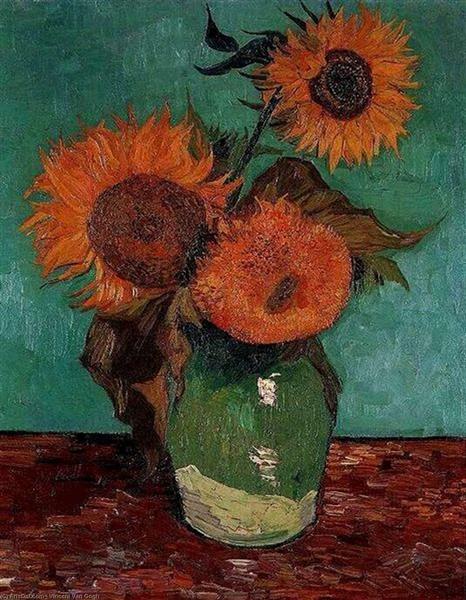
Sunflowers 1888
He painted seven versions of sunflowers in vases during the late summer of 1888 in Arles, intending to decorate the Yellow House before Gauguin arrived. He wanted Gauguin to walk in and see a wall covered in suns. The flowers themselves are at every stage — fresh, full-bloom, drooping, dried, dead — painted in nothing but yellows: chrome yellow, lemon yellow, ochre, gold. The pigment Van Gogh used was a brand-new chrome yellow that has darkened slightly over the last century, so the actual paintings today are a touch browner than he saw them. Even so, walking into a room where one of these hangs is one of the closest experiences in painting to walking into sunlight.
Self-Portrait with Bandaged Ear 1889
Painted in January 1889, a few weeks after he cut off part of his own left ear during the violent breakdown that ended his time with Gauguin. He sits in front of a green door, mouth set, pipe lit, the bandage covering the right side of his head — because he was looking at himself in a mirror, the wound appears on the wrong side. Behind him hangs a Japanese woodblock print, a quiet reminder that even at his lowest he was still studying, still looking. The face is calm, almost defiant. He has decided to keep working. There are two versions of this painting; the more famous one is in the Courtauld Gallery in London.
The Starry Night 1889
Painted from memory in his room at the Saint-Rémy asylum, in early June 1889, looking out of an east-facing barred window before sunrise. The village in the foreground is invented; there was no village from his window. The cypress on the left is real. The huge swirling sky, with eleven stars, a crescent moon and a luminous Venus, is a mixture of what he saw and what he felt — a sky he wrote about in his letters as a place of consolation, the dead travelling among stars 'as we use a train down here'. The painting was barely noticed in his lifetime. It now hangs in the Museum of Modern Art in New York and is, by some distance, the most reproduced painting of the 20th century.
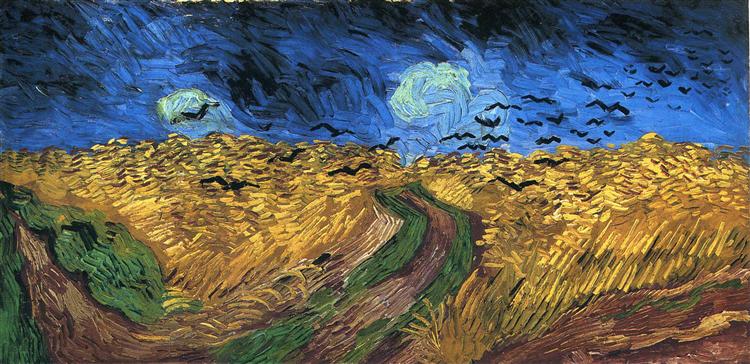
Wheatfield with Crows 1890
One of the last paintings he made, in the wheatfields just outside Auvers-sur-Oise, in the final fortnight of his life. A double-square format — much wider than tall — rare in his work. A path divides into three and disappears into the field. The sky is a deep, troubled blue. Black crows scatter across the foreground. For decades it was assumed to be the painting on his easel when he shot himself; recent research suggests it was made earlier in July 1890. Either way, it is hard to look at without reading premonition into every stroke — a man choosing his palette in the field where, days later, he would walk in with a revolver.