Joaquín Sorolla
He painted Mediterranean sunlight the way it actually is — blinding, warm, and all over everything at once.
Style and technique
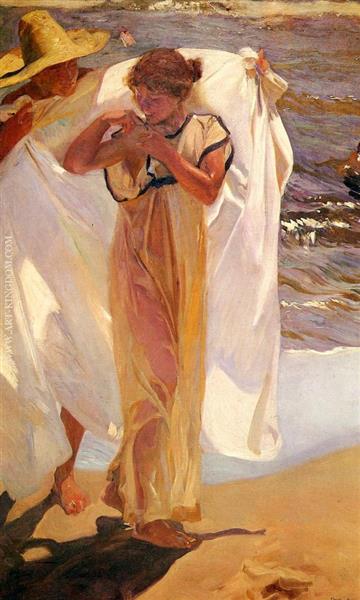
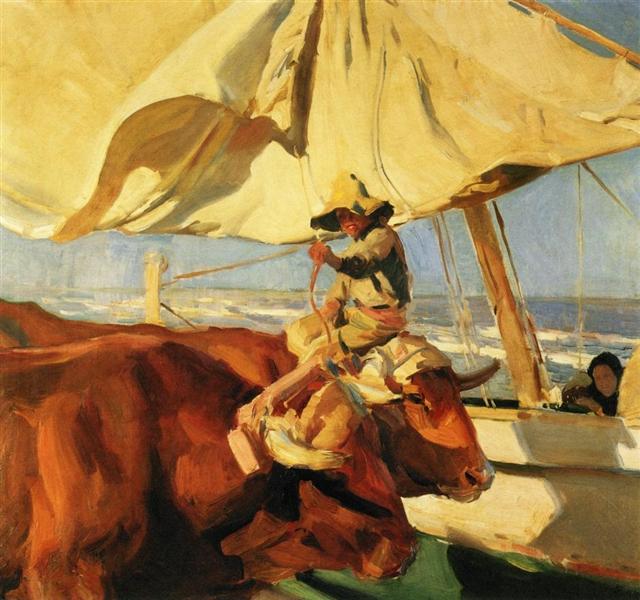
Sorolla's subject is light — specifically the Mediterranean light of the Valencian coast, which is qualitatively different from the soft northern light of Paris or London that defined the French Impressionist palette. Mediterranean summer light is harsh and total; it flattens shadows, whitens surfaces, makes the sea and sand and stone glare with an intensity that requires specific technical responses.
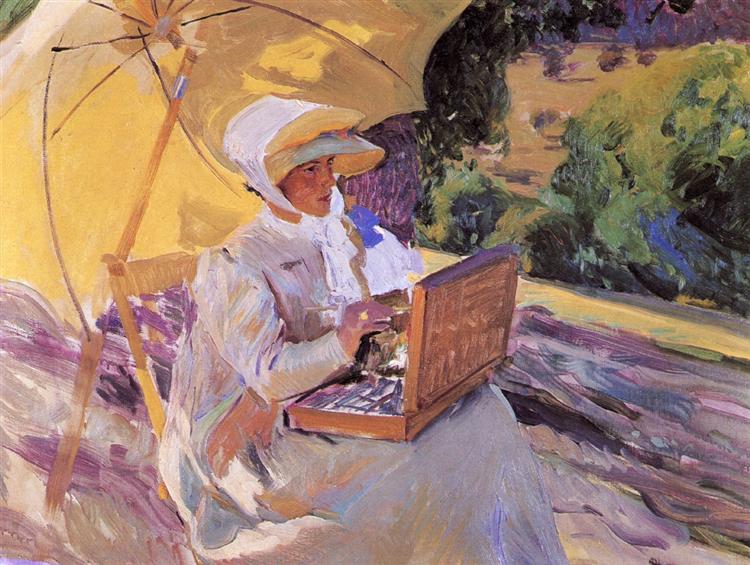
His primary response was a palette of extraordinary brilliance: whites that are not white but the entire visible spectrum, blues that range from near-purple to near-green across a single surface of water, yellows and oranges and pinks that should not coexist and do. He applied paint with great speed and confidence, often outdoors, completing large canvases in a single session to capture the light before it changed.
The beach paintings are his most famous works, and they achieve something technically remarkable: the sensation of standing in Mediterranean sunlight. The sparkle of water, the weight of heat, the way light penetrates even shadow in bright outdoor conditions — all these are rendered in paint that, examined closely, dissolves into rapid, disconnected marks and, viewed at a metre's distance, assembles into convincing space and light.
Four fingerprints: Mediterranean light at full intensity — the whiteness of beach sand in summer, the sparkle of shallow water, rapid, confident brushwork applied in thick strokes that describe form and light simultaneously, figures in outdoor settings — on beaches, in gardens, at the water's edge — absorbed in activities of leisure or work, and the specific light of Valencia and the Spanish coast as the primary subject beneath every other subject.
Life and legacy
Sorolla was born on 27 February 1863 in Valencia, the second child of a tile maker. Both his parents died of cholera in 1865, when he was two, and he and his sister were raised by an aunt and uncle. His uncle was a locksmith who recognised Sorolla's early gift and arranged for him to study drawing at the Escuela de Artesanos.
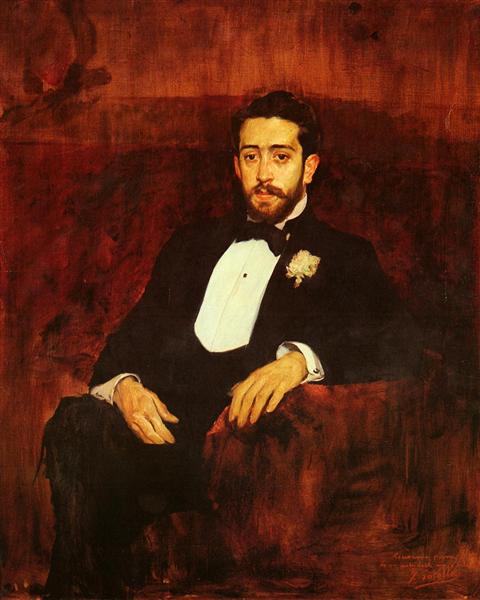
He entered the Escuela de Bellas Artes de San Carlos in Valencia at fifteen and received a conventional academic training in drawing and painting. He made a trip to Madrid in 1881 to study the Spanish masters in the Prado — Velázquez above all — which left permanent marks on his approach to tone and to the single figure in a defined space.
A fellowship from the Diputación Provincial de Valencia in 1885 enabled him to spend four years in Rome, where he worked under the influence of academic history painting but also discovered the work of Fortuny and the international plein air movement. He married Clotilde García del Castillo in 1888 in Rome, and the marriage was the central personal fact of his life; Clotilde appears in his paintings for the next thirty years.
He moved to Paris in 1889 and encountered the French Impressionists, whose influence loosened his handling and shifted his interest toward light and outdoor subjects. He returned to Spain and settled permanently in Madrid in 1890, painting the beach scenes that would define his reputation.
His international reputation was built in the early 1900s through major exhibitions in Paris, London, Berlin, and — most consequentially — New York, where a 1909 exhibition at the Hispanic Society of America attracted enormous attention and popular success. Archer Milton Huntington, the founder of the Hispanic Society, commissioned the 'Visions of Spain' murals — fourteen large panels depicting the regions and traditions of Spain — which Sorolla worked on from 1913 to 1919. The murals, now in the Hispanic Society's library in New York, are the most ambitious work he undertook.
The Museo Sorolla in Madrid — his former house and studio, left to the Spanish state by Clotilde after his death — remains one of the most intimate and complete artist's museums in the world.
Five famous paintings
Children at the Beach 1910
Two small boys play at the edge of the sea, the shallow water washing around their ankles, the sand and water rendered in Sorolla's most dazzling palette of white, turquoise, and pale gold. The boys are absorbed in what they are doing; one bends forward; the other stands and looks toward the water. The light is total — there is almost no shadow, and what shadow there is carries colour rather than darkness. The painting is technically brilliant: the sensation of standing in shallow warm water in bright sunlight is produced entirely through the choice and application of paint, without any illusionistic trickery. It is in the Museo del Prado in Madrid.
Walk on the Shore 1909
Clotilde and their daughter Elena walk along the water's edge, their white dresses catching the afternoon light. The composition is simple and asymmetrical — the two figures at the right of the frame, the beach and distant water to the left — and the handling is Sorolla's most direct: each mark of the brush is a decision about light, the white of the dresses described in dozens of different whites that together produce the sensation of cloth in sunshine. The horizon is high; the beach is seen from slightly above. It was painted on the beach at Valencia and is in the Museo Sorolla.
Sewing the Sail 1896
Women and a child sit on a sail spread on the ground in the shade of a boat, repairing or making it. The composition is flat and horizontal — the white sail fills most of the canvas, the figures arranged across it. The light reflected off the white sail onto the women's faces and clothing is the technical challenge Sorolla set himself: light coming up from below, reflected white, modifying the skin tones and the colours of their clothing. The painting is a departure from his beach scenes in its subject matter — working women rather than leisured bathers — but the same concern with the quality of outdoor Mediterranean light governs every decision. It is in the Museo del Prado.
Sad Inheritance 1899
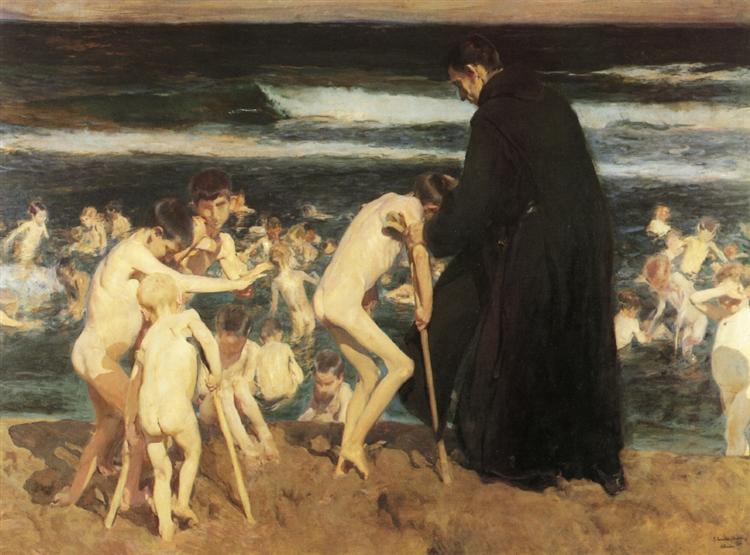
A painting unlike anything else in his output: a group of boys crippled by polio are brought to the sea to bathe by a Salesian friar. The boys' bodies are distorted, their movements laboured; the friar helps them into the water with great care. The light is still Sorolla's light — the Mediterranean midday, the bright sand and sparkling water — but in this context it becomes almost unbearably beautiful against the tragedy of the children's condition. The painting won a medal of honour at the 1900 Paris Exposition and is one of the works that established his international reputation. It is in the Caja de Ahorros del Mediterráneo collection in Valencia.
The Horse's Bath 1909
A horse and its rider are led into the sea to bathe — the horse partially submerged, the rider's white shirt and the horse's pale coat catching the strong afternoon light. The water around the horse is rendered with great technical freedom: horizontal strokes of blue, turquoise, white, and green describe the shallow, disturbed sea with the confidence of a painter who has watched this kind of light on this kind of water for forty years. The composition is dominated by the horse's flanks and the moving water; the rider is barely present. It is in the Museo del Prado in Madrid.