Camille Pissarro
The only Impressionist who mentored everyone — and painted every season for forty years.
Style and technique
Pissarro was the elder statesman of Impressionism — the only painter who showed at all eight Impressionist exhibitions between 1874 and 1886, who was old enough to have studied with Corot and young enough to experiment with Seurat's Pointillism in his fifties. He kept reinventing his approach when most painters his age were consolidating, and this restlessness is the defining characteristic of his career.
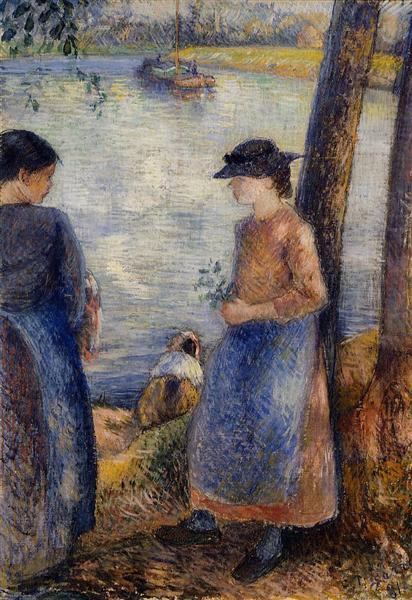
His fundamental subject was the rural village and its surrounding countryside — the orchards, fields, market gardens, and peasant labourers of the Pontoise and Éragny regions north of Paris where he lived for most of his adult life. He painted these subjects across every season and in every kind of light, building up a sustained visual record of agricultural Normandy that is unmatched in French painting for consistency and depth.
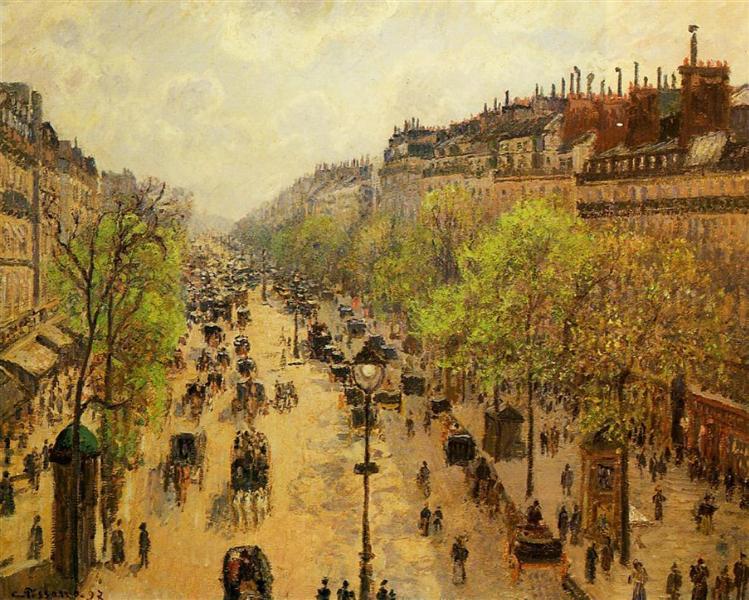
His paint surface is varied but always keyed to observation: loose, loaded brushstrokes in his Impressionist phase; precise, comma-shaped dots during his Pointillist period (1885–1890); and a return to looser, broader handling in his final decade when he painted the Paris boulevards from hotel windows above the traffic, his eye condition making outdoor painting difficult.
Four things identify a Pissarro: the high horizon line that compresses the sky and maximises the landscape, the figure of a peasant or worker integrated into the landscape without drama, a silvery or golden light specific to northern France, and compositions that favour the quiet over the spectacular — a lane, a field, a market square, rather than a storm or a theatrical effect.
He mentored Cézanne in Pontoise from 1872 to 1874 — the crucial years in which Cézanne's mature style began to form. He also mentored Gauguin, who worked alongside him in the late 1870s. Both credited him with teaching them how to look.
Life and legacy
Pissarro was born on 10 July 1830 on the island of Saint Thomas in the Danish West Indies — now the US Virgin Islands. His father was a Jewish merchant from Bordeaux; his mother was a Creole woman from the Caribbean. The family was French-speaking and commercially prosperous.
He was sent to school near Paris at twelve and remained in France for four years before returning to Saint Thomas. In 1852, at twenty-two, he left his father's hardware shop and went to Venezuela with the Danish-French painter Fritz Melbye to paint. Two years in Caracas gave him his real artistic foundation. He arrived in Paris in 1855 and immediately immersed himself in the Salon of that year, which included Courbet's controversial one-man exhibition of Realist painting.
He studied under Corot briefly, attended the Académie Suisse, and began forming friendships with the painters who would become the Impressionists — Monet, Cézanne, Renoir, and Degas among them. He settled in Pontoise in 1866, began a sustained working relationship with the landscape there, and became the mentor figure of the nascent movement.
The Franco-Prussian War of 1870 drove him to London, where he discovered Constable and Turner and sold almost nothing. Returning to Pontoise in 1871, he found that the Prussian troops had been quartered in his house: out of approximately 1,500 paintings he had left in storage, 40 survived. He never fully recovered financially from this loss.
In 1872–1874, Cézanne came to work alongside him in Pontoise. They worked side by side in the fields, and Cézanne later said that Pissarro was 'a kind of God to me'. The relationship was reciprocal — Pissarro's technique became more structured and less loose in these years, partly in response to Cézanne's methodical approach.
In the mid-1880s he underwent a sustained crisis of method and adopted Seurat's Pointillist technique — painting in tiny dots of pure colour — for five years. He eventually abandoned it as too mechanical, though some of the works from this period are extraordinarily refined.
An eye condition that required him to avoid dust and wind drove him to paint from hotel and apartment windows in his final decade. The series of Paris boulevard paintings from 1897–1903 — showing the Avenue de l'Opéra, the Boulevard Montmartre, the Rue Saint-Honoré in different weathers and at different hours — are among the most technically ambitious cityscapes of the era. He died on 13 November 1903 in Paris, aged seventy-three.
Five famous paintings
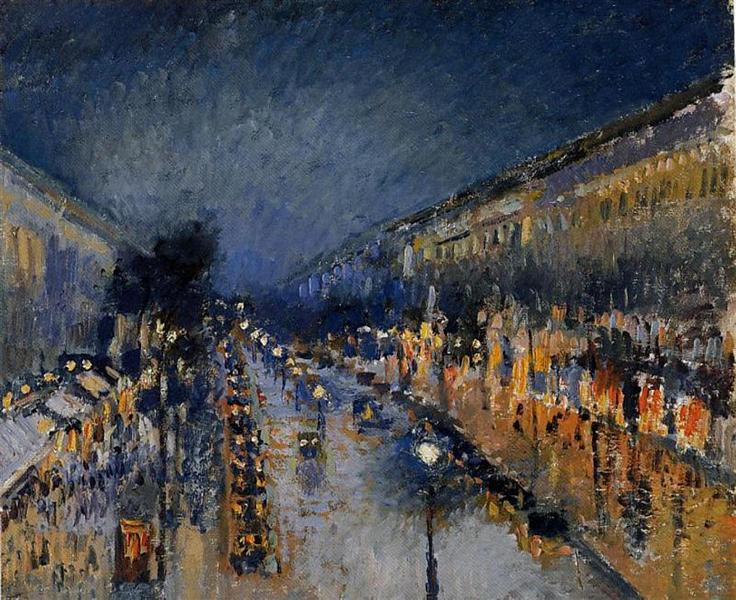
Boulevard Montmartre at Night 1897
Pissarro painted the Boulevard Montmartre in a series of fourteen canvases from his room at the Grand Hôtel de Russie in early 1897, each showing the same view in different weather, light, and time of day. This is the single nocturnal canvas of the series. The gaslights of the boulevard reflect off the wet paving stones in long yellow streaks; the silhouettes of pedestrians and carriages blur into the reflections. The result looks more like Turner's late atmospheric work than the clear daylight Impressionism of Pissarro's earlier career. His eye condition had made outdoor painting impossible; the hotel window became his Monet's Rouen Cathedral. It hangs in the Hermitage Museum in Saint Petersburg.
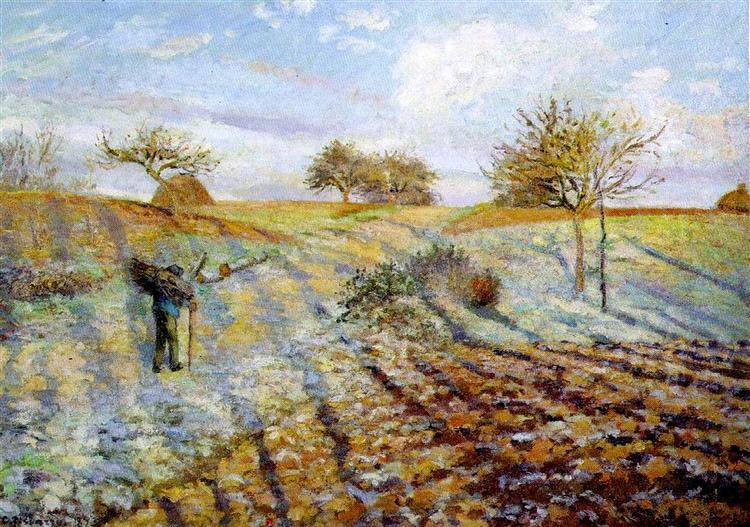
Hoarfrost 1873
One of the key works from the Pontoise period, painted the same year he was working alongside Cézanne. A field of frost-covered soil in early morning: the ground has a pale, almost luminous surface, and a peasant figure works in the middle distance near a low hedgerow. The painting is built from small, varied brushstrokes of broken colour — grey-green, pale blue, ochre, white — that capture the specific quality of winter morning light on frozen earth. It was shown at the first Impressionist exhibition of 1874 and was among the most technically accomplished works in the show. It hangs in the Musée d'Orsay.
Boulevard Montmartre, Spring Morning 1897
A companion to the nocturnal view from the same hotel window, painted in clear morning light with the boulevard waking up: carriages, pedestrians, the lines of plane trees beginning to leaf. The composition is identical to the night painting — same viewpoint, same buildings, same diagonal of the road receding — but the quality of light is completely different: cool blue-white morning air rather than gaslit yellow. Pissarro's method of making systematic series from the same viewpoint was directly comparable to Monet's cathedral and haystack series, though his Paris series was achieved under much harder personal circumstances.
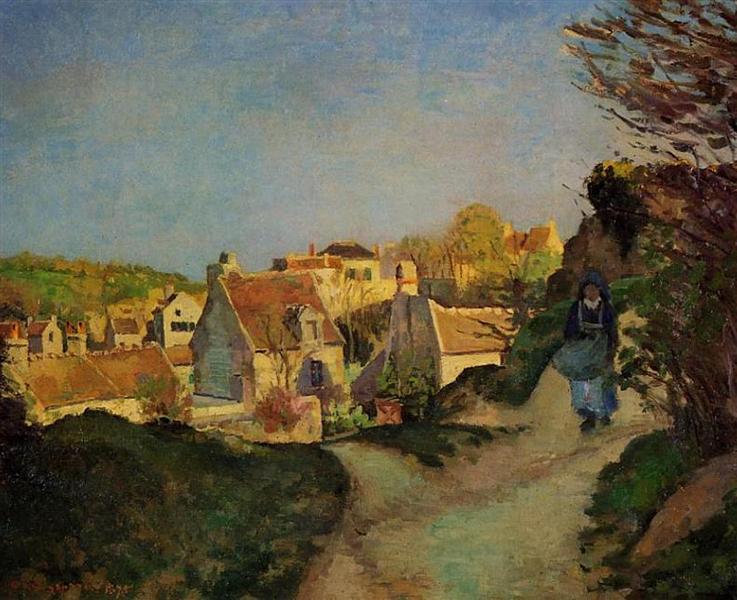
The Garden at Pontoise 1877
A kitchen garden in summer, the beds ordered in rows, figures working in the middle distance. Pontoise appears in many of Pissarro's paintings of the 1870s and this work shows the village as an organised, productive agricultural space rather than a wild or picturesque landscape. The paint surface is densely worked: individual strokes of ochre, green, pale blue, and white build up the texture of the foliage and earth. The scale is modest — a scene of everyday agricultural activity, painted with the care usually reserved for grand subjects. It represents the quiet centre of his sustained project of observing one specific patch of northern France.
Kneeling Peasant Woman 1882
A single figure — a woman in a white headscarf and dark skirt — kneels in a field doing some form of agricultural work. The landscape behind her is a soft green, the sky a pale blue. Pissarro's treatment of the peasant worker is warmer and more intimate than Millet's formal monumentality: this woman is not a symbol but a specific person in a specific posture on a specific morning. The painting represents his Pontoise period at its most direct — the figure integrated entirely into the landscape, the colour broken into small strokes, the whole composition built from a sustained observation rather than a compositional idea.