Peter Paul Rubens
The diplomat who painted empires and the flesh they were built on.
Style and technique
Rubens painted energy in bodies. That is the central fact of his style: the human figure in his hands becomes a vehicle for force, desire, turbulence, and muscular momentum. His nudes are famously full-figured — the phrase 'Rubenesque' has entered common language — but the real subject is not softness but movement. Those full bodies twist, lunge, strain, and tumble in ways that no real body could sustain for more than a second. Rubens catches them at the peak of their action and freezes them in paint.
He spent eight years in Italy between 1600 and 1608 and absorbed everything that mattered: Titian's colour, Michelangelo's anatomy, Caravaggio's dramatic lighting, and the whole tradition of classical sculpture that he studied directly in Rome, Mantua, and Genoa. He returned to Antwerp in 1608 as a different painter than he had left — technically the most accomplished artist north of the Alps, with a synthesis nobody else had achieved.
Four things identify a Rubens from across a gallery.
Colour as warmth. His palette runs to warm oranges, deep reds, gold, and the particular amber of Flemish oak panelling. Even his skies tend towards a warm cream-blue that amplifies the heat in his figures.
The diagonal composition. His large narrative paintings almost always organise themselves around a great diagonal sweep — a body falling, a horse rearing, a battle tide turning — that gives the static canvas a sense of rushing movement.
Flesh as the primary subject. Whether painting mythological figures, Christian martyrs, or hunting scenes, Rubens devotes more careful attention to skin than to any other surface. He built it in transparent glazes over a warm pinkish ground, and it catches light differently in different passages — the forehead, the shoulder, the inner forearm.
Classical confidence. His figures are anatomically complex, always posed in ways that reference ancient sculpture, and yet they never feel academic. They feel like they could stand up and walk through the wall.
Life and legacy
Rubens was born on 28 June 1577 in Siegen, a small town in what is now western Germany, to a Flemish father who had fled Antwerp during the religious upheavals of the Spanish Netherlands. His father died in 1587 and the family returned to Antwerp, where Rubens received a humanist education and learned Latin, which he eventually spoke and wrote with scholarly ease.
He entered the Antwerp guild of painters in 1598 and left for Italy in 1600, aged twenty-three. He spent eight years there, primarily in the service of Vincenzo I Gonzaga, Duke of Mantua. The Italian years were the making of him: he copied Titian in the ducal collection, studied Michelangelo's Sistine ceiling, and watched Caravaggio's scandalous new work divide Rome. He also began his parallel career as a diplomatic envoy, carrying letters and packages between Mantua and the court of King Philip III in Madrid. He had discovered that painting and politics were not incompatible.
His mother's death in 1608 brought him back to Antwerp. He had intended to return to Italy but instead settled permanently, married Isabella Brant — a lawyer's daughter of seventeen, he was thirty-two — and accepted a court appointment as painter to the Archdukes Albert and Isabella, who governed the Spanish Netherlands from Brussels. The stipend came with a house and a condition: he had to live in Antwerp.
The next two decades were an extraordinary double life. In his Antwerp studio he ran the most productive painting workshop in Europe — altarpieces for churches across Flanders, mythological cycles for noble patrons, the enormous Marie de' Medici cycle of twenty-four canvases now in the Louvre, painted for the Luxembourg Palace in Paris between 1622 and 1625. At the same time he was sent on formal diplomatic missions to England, Spain, and the Dutch Republic, negotiating peace treaties between the great powers. Charles I of England knighted him in 1630.
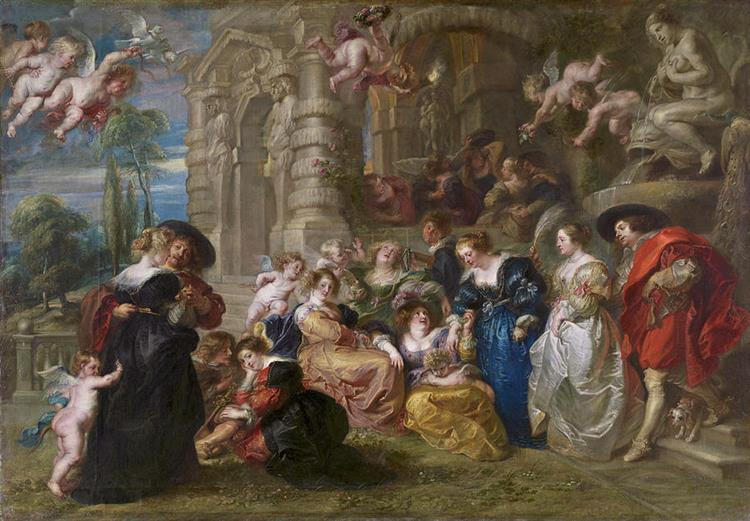
Helena appears in dozens of paintings from the 1630s — sometimes as Venus, sometimes as herself. The late domestic works have a warmth and relaxed intimacy that the great public commissions lack. 'The Garden of Love' (1633) shows Rubens himself in the left foreground, ushering a reluctant Helena into the embrace of a fountain courtyard full of lovers.
He died on 30 May 1640 in Antwerp, aged sixty-two, of a gout condition that had progressively affected his hands. His two sons by Helena were born after his death. He left a fortune, a magnificent house in Antwerp, a collection of ancient marbles and coins, and paintings that were immediately dispersed across the courts of Europe.
Five famous paintings
Descent from the Cross 1614
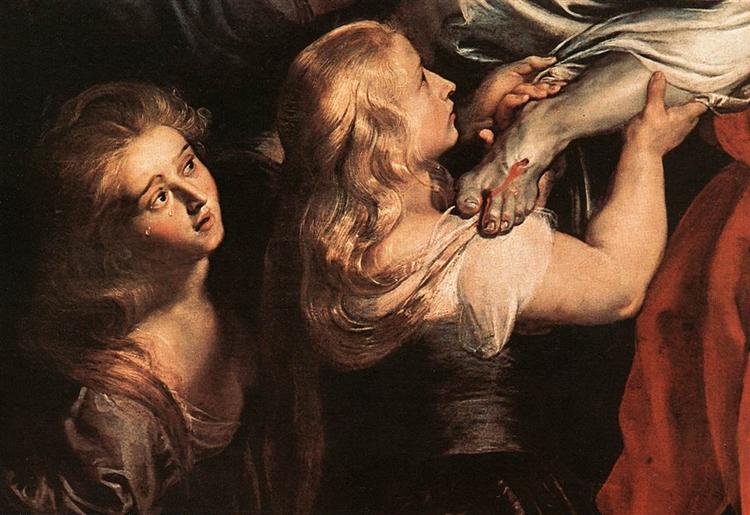
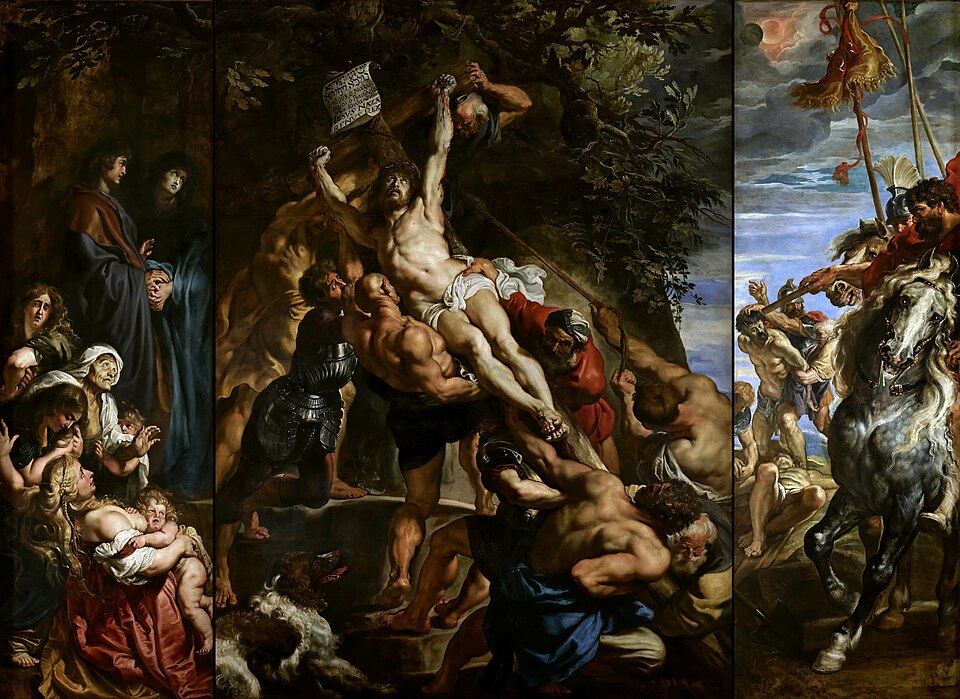
The central panel of a triptych altarpiece in the Cathedral of Our Lady in Antwerp, where it has hung since 1614 and where Rubens himself was later buried. Christ's white body is being lowered from the cross by a group of figures, and the composition is organised around the long diagonal of that body — limp, fully dead, its weight entirely real. Rubens spent years studying the Antique and Michelangelo to paint a body like this: fully human, fully heavy, without any suggestion of divine lightness. The man at the top grips the shroud in his teeth to free both hands for the lowering. It is one of the great Baroque altarpieces.
Samson and Delilah 1610
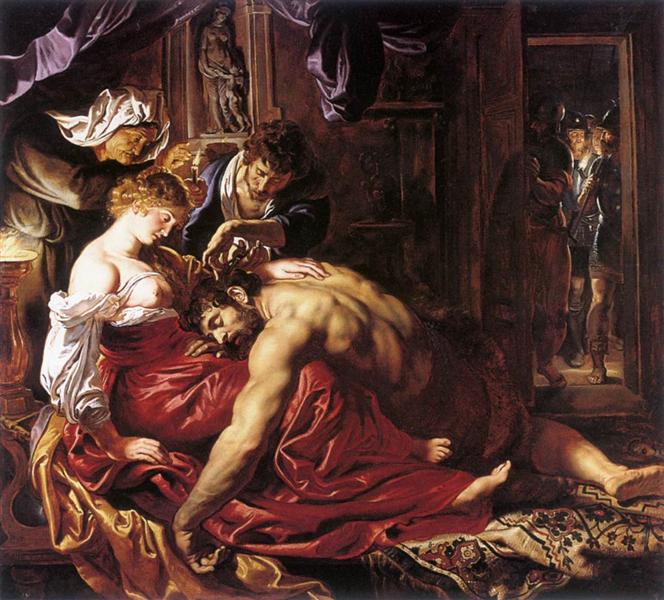
Painted shortly after Rubens's return from Italy, this canvas shows Delilah cradling the sleeping Samson's head in her lap while a soldier cuts his hair. The composition is extraordinarily compressed: Samson fills almost half the canvas, his great back towards us, the muscles still visible but entirely relaxed in sleep. An old procuress holds a candle; a woman in a doorway watches. The scene takes place in low warm light, the influence of Caravaggio still fresh. It hangs in the National Gallery in London, where it was acquired in 1980 for a price then considered extravagant: £2.5 million.
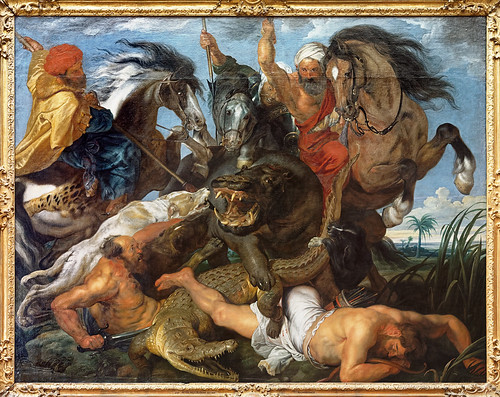
The Hippopotamus Hunt 1616
One of four large hunting scenes commissioned by Maximilian I, Elector of Bavaria, for his hunting lodge at Schleissheim. A hippopotamus and a crocodile are attacked simultaneously by a tangle of riders, horses, dogs, and spearmen, all of them locked together in a violent spiral of bodies. Rubens almost certainly never saw a hippopotamus — he based the animal on a wooden model and descriptions — but the painting has a raw kinetic energy that no amount of taxidermy study could produce. The horses are magnificent: plunging, screaming, absolutely in the middle of the action. It hangs in the Alte Pinakothek in Munich.
The Straw Hat 1625
A portrait of a young woman — possibly Susanna Lunden, sister of Helena Fourment, whom Rubens would marry five years later — wearing a broad-brimmed hat with ostrich feathers against a blue sky. The painting is famous for a technical puzzle: the hat is made of felt, not straw, but Rubens rendered its shadow on the face with an almost scientific accuracy that inspired generations of portrait painters, including Joshua Reynolds, who wrote about it admiringly after seeing it in Antwerp. Velázquez almost certainly saw it too. It hangs in the National Gallery in London.
The Garden of Love 1633
A large canvas of unusual intimacy for Rubens, showing an outdoor courtyard full of elegantly dressed couples. Rubens himself appears at the far left, ushering a hesitant woman — Helena Fourment, his young second wife — towards the group. Putti swarm in the air above; a stone fountain with a Venus figure dominates the right background. The painting has no mythological subject and no historical narrative. It is simply a celebration of courtship, dressed up in the language of the fête galante genre that would later inspire Watteau. It hangs in the Prado in Madrid.