The hidden science behind Munch's The Scream
One of the most reproduced images in art history may not be pure nightmare — it might be a weather report. Plus: four versions, two heists, and a $119.9 million auction.
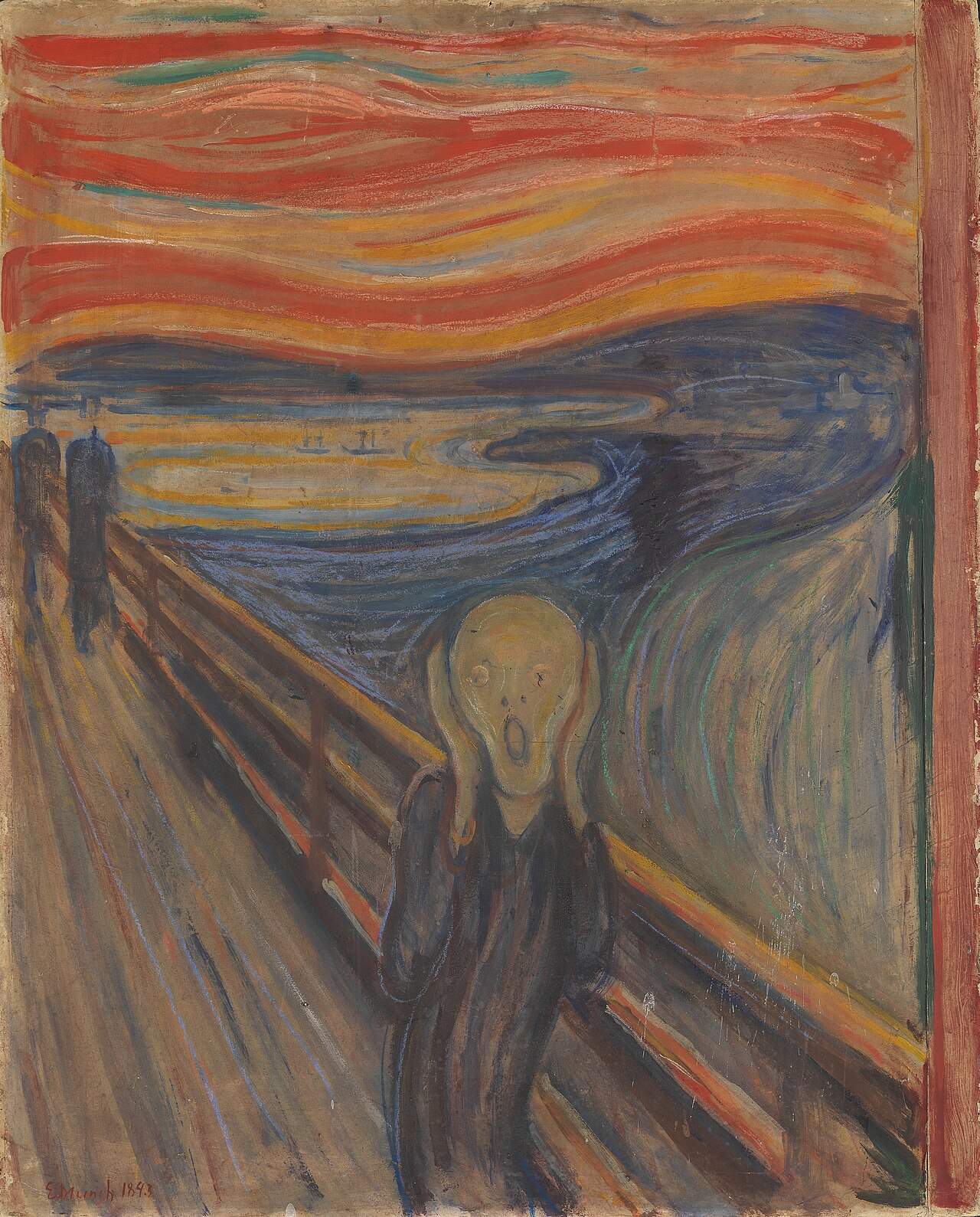
Few images need no introduction. The bald, hollow-eyed figure clutching its face against a churning blood-red sky has been reproduced on emoji, Halloween masks and a thousand dorm-room posters. But look past the screaming figure for a moment. The real mystery of this painting might be hanging in the sky above it.
Not one painting — four
Edvard Munch didn't paint The Scream once. He made four versions between 1893 and 1910: two in tempera, two in pastel, spread across Norway's National Gallery, his own Munch Museum, and a private collection. Each is slightly different — a different sky, a different tilt to the figure's head — the same vision, reworked for almost two decades.
"…I sensed an infinite scream passing through nature." — Munch's diary, 1892
What actually happened that evening
Munch described the moment years later: walking along a road above the Oslo fjord at sunset with two friends, the sky suddenly flaring red. He stopped, trembling, while his friends walked on, oblivious. The painting freezes exactly that gap — one person overwhelmed, everyone else simply continuing their evening.
A widely cited scientific theory holds that the blood-red sky wasn't invented — it may be a memory of a real atmospheric event. The 1883 eruption of Krakatoa threw so much ash into the atmosphere that observers across Europe, including Norway, reported vivid red twilights for months afterward. Munch's walk falls right inside that window.
Could you spot a Munch?
Test your eye against 1,200+ paintings from 80+ masters.
Play the quiz →Stolen. Twice.
The painting's fame has made it a target. In 1994, thieves used a ladder to break into Oslo's National Gallery on the opening morning of the Winter Olympics and walked out with the original tempera version in under a minute, leaving a taunting note behind. It was recovered undamaged three months later. A decade on, in 2004, armed robbers stole a different version — along with Munch's Madonna — from the Munch Museum in broad daylight. That one took two years to recover, and came back water-damaged.
So — nightmare, or weather report?
Probably both. Munch didn't need Krakatoa to feel anguish; his diaries returned for years to the dread underlying ordinary life. But knowing a real volcanic sunset may sit underneath the painted one doesn't shrink the picture — it does the opposite. The sky was real. The scream was his.
More by Munch