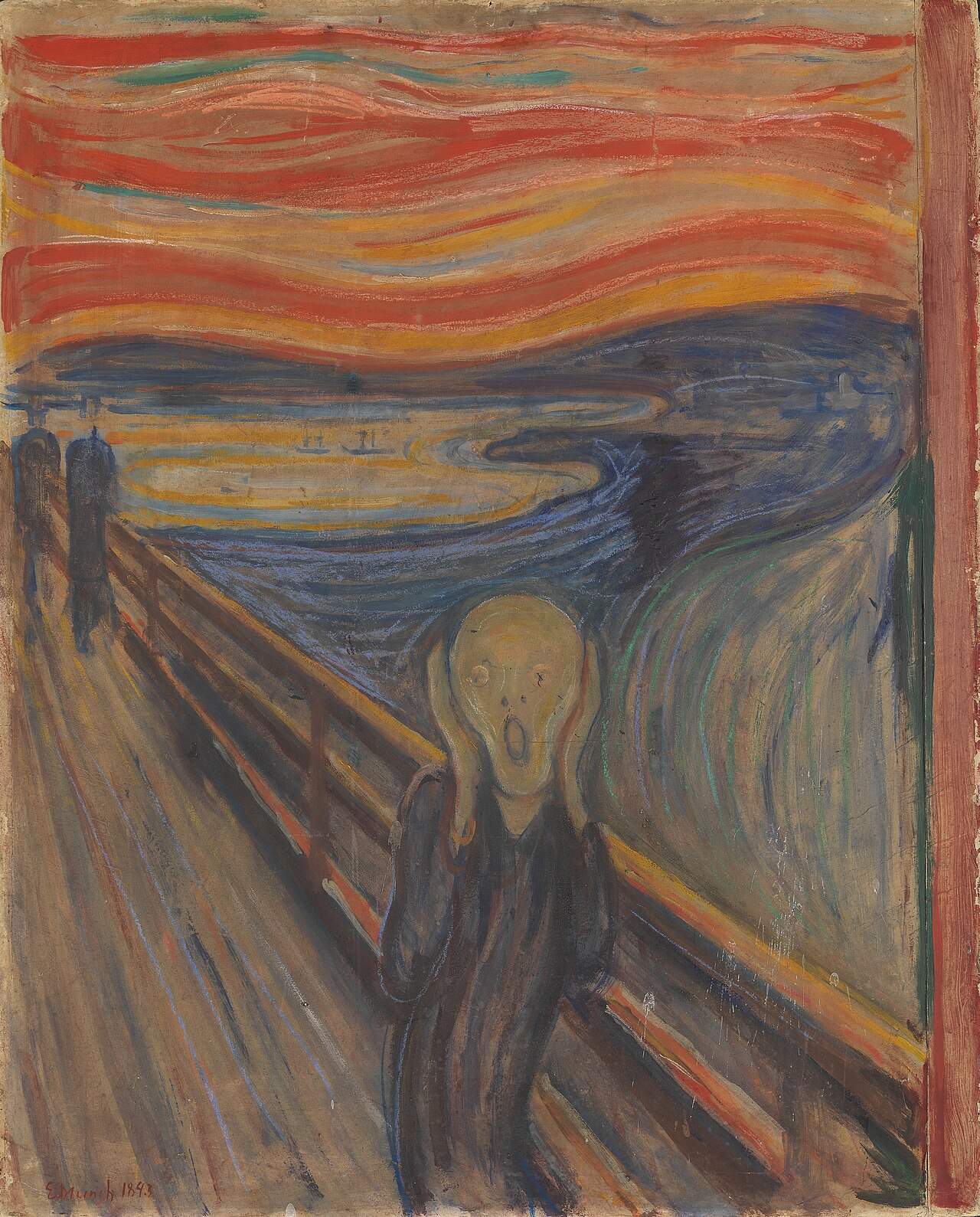
Edvard Munch
He painted anxiety, jealousy and grief decades before anyone had words for it.
Style and technique
Munch did not paint things. He painted states of mind. Where the Impressionists had spent the 1870s and 80s perfecting how light falls on a riverbank at four o'clock, Munch — twenty years younger and on the cold side of Europe — was painting what it feels like to lie in bed listening to your sister die of tuberculosis. The subject of a Munch is almost always an emotion, given a body and a face and a place to stand.
He pushed the rules of Impressionism in a violent direction. Colours stopped describing reality and started describing feeling: green skies, red faces, blue floors. Outlines came back, hard and dark, the way they appear in nightmares and stained glass. Figures became silhouettes; landscapes became symbolic; the empty space around a figure became as full of dread as the figure itself.
Four fingerprints make a Munch unmistakable.
Wavy, contagious lines. Once he had broken with naturalism around 1890, his lines became serpentine, snake-like, ripple outwards through skies, water and walls. The whole canvas vibrates with the same anxiety as the central figure.
Strange, unnatural colour. Faces that go green, suns that go blood red, water that turns lilac. He uses colour as a chord of feeling, not a description.
Silhouetted figures with simplified faces. Often without features. Mouths open or closed in extreme expressions. He was studying photography, theatre and the new psychology, and the simplification is deliberate.
Empty foreground space. A man at the centre of the canvas, an empty wooden floor in front of him. A long road in front of three walking figures. The space pulls at you. You are forced into the picture.
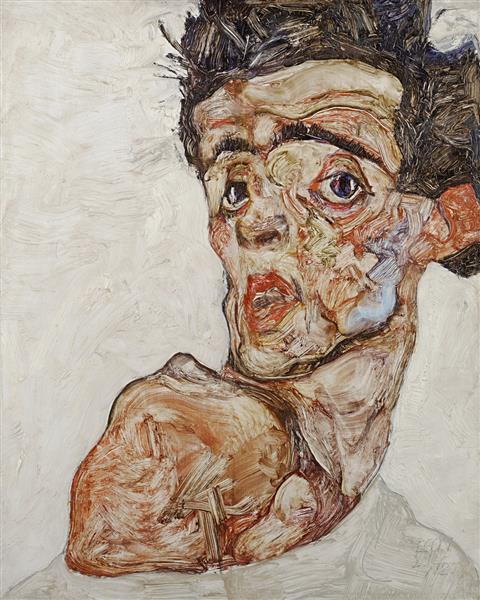
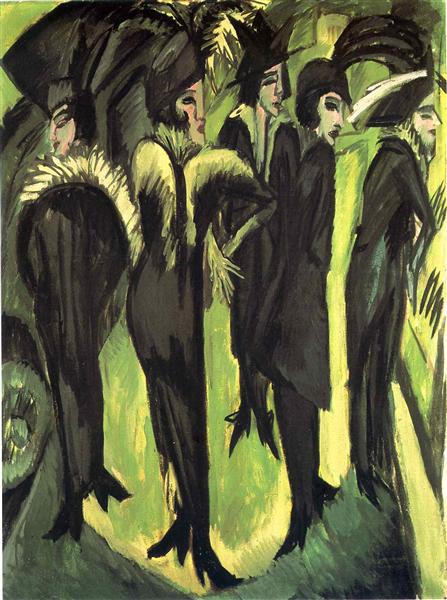
Munch is the bridge between Symbolism (his 1880s mentor circle in Berlin) and German Expressionism (the artists, like Kirchner and Schiele, who took his lessons twenty years later). He was not exactly the founder of Expressionism, but the movement is unthinkable without him.
Life and legacy
Edvard Munch was born on 12 December 1863 in Løten, a farming district in eastern Norway. His father, Christian, was a military doctor with deep, depressive Christianity; his mother, Laura, was 21 years younger than her husband and already ill with tuberculosis when Edvard was born.
The family moved to Oslo (then called Christiania) when Edvard was a year old. His mother died of tuberculosis when he was five. His older sister Sophie, the closest figure in his early life, died of the same disease when he was 14. He himself was constantly ill — bronchitis, rheumatic fever, recurring chest pain — and his father convinced him from boyhood that his bad health was a punishment from God. Death, sickness and guilt were the architecture of his childhood.
He studied engineering for a year and gave it up. In 1881 he enrolled in the Royal School of Drawing in Oslo, and within a year was drawing better than his teachers. He was not a poor boy, exactly, but the family lived on his father's small army pension and on small loans from a wealthy aunt, Karen Bjølstad, who would move into the house after Edvard's mother died and effectively raise him.
He painted his sister Sophie on her deathbed (the first version of 'The Sick Child', 1885–86). The picture was savaged by Norwegian critics — too rough, too unfinished, too sad — and Munch took the wounding personally. He went back to it and repainted it six times across his life. For decades he believed that 'The Sick Child' was the painting around which his entire career turned.
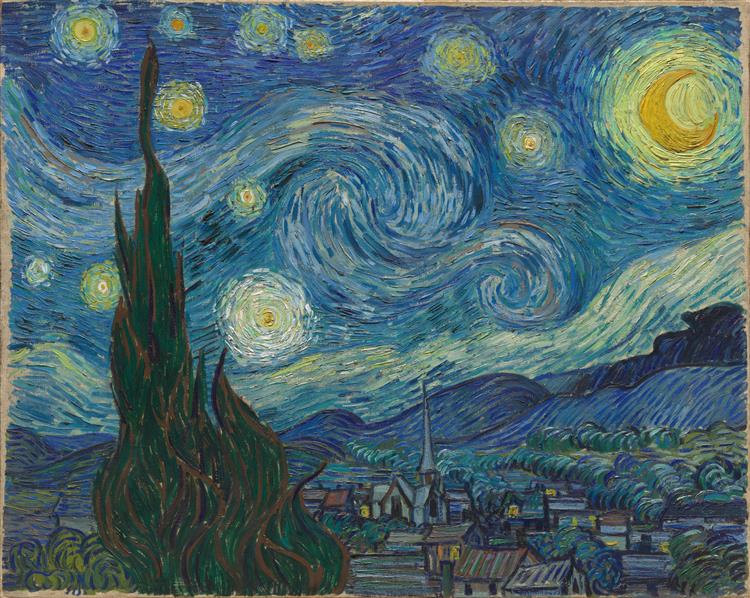
He travelled. In Paris in 1889 he absorbed the Impressionists and, more importantly, Van Gogh and Gauguin. In Berlin in 1892 he was given a one-man show that the conservative Verein Berliner Künstler closed after eight days, calling it scandalous; the resulting walkout split the German art world and led directly to the founding of the Berlin Secession. He never expected to be a controversy; he became one.
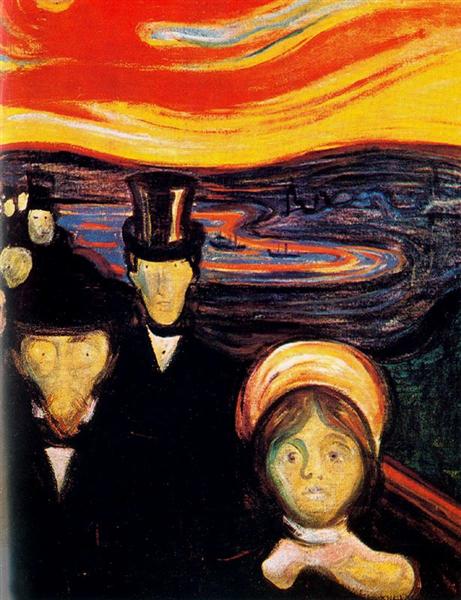
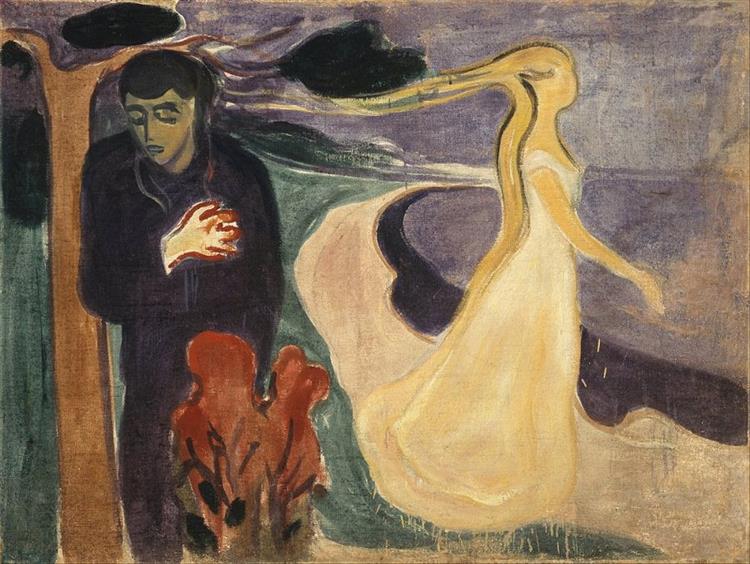
The great cycle of his middle career was the so-called 'Frieze of Life' — a planned series of paintings about love, anxiety and death that he worked on from roughly 1893 to 1902. 'The Scream' (1893) is the most famous part of it. 'Madonna' (1895), 'Vampire' (1895), 'Anxiety' (1894), 'Ashes' (1894), 'Death in the Sickroom' (1893), and 'Separation' (1896) all belong to the same project. He kept rearranging them, repainting them, and transferring the same compositions into prints — Munch made some of the greatest woodcuts and lithographs ever printed, in editions still considered the modern revival of European printmaking.
In the 1890s he had a series of intense relationships with women, all of which he described in his diaries as catastrophic. The most violent was with a wealthy Norwegian woman named Tulla Larsen. The relationship ended in 1902 with a quarrel and a gunshot — a small revolver went off, accidentally according to some accounts and deliberately according to others, and Munch was left with two fingers of his left hand permanently damaged.
In 1908, after years of heavy drinking and increasingly severe panic attacks, he checked himself into a clinic in Copenhagen for eight months. The treatment, by the standards of the time, was effective: cold baths, sedatives, electric shocks. He came out at 45 and the second half of his life began. He moved back to Norway, lived alone in the country, drank less, and painted in a brighter, more open palette: 'The Sun' for Oslo University in 1916, dozens of luminous Norwegian landscapes, increasingly thinned-out portraits.
In the 1930s, the Nazis declared his work 'degenerate' and removed 82 of his pictures from German public collections. He was on the Nazis' watchlist; he wrote a will in 1940, after the German invasion of Norway, leaving his entire surviving collection — over 1,000 paintings, 4,500 drawings and 18,000 prints — to the city of Oslo.
He died of pneumonia in his house at Ekely, outside Oslo, on 23 January 1944, aged 80. His funeral was officiated by the German occupation authorities, which embarrassed his family for decades.
The city of Oslo opened the Munch Museum in 1963. A new, much larger Munch Museum opened in 2021 on the Oslo waterfront. It now holds almost his entire surviving output, including all four versions of 'The Scream' that he made between 1893 and 1910 — two of which were stolen from museums (in 1994 and 2004) and recovered.
Five famous paintings
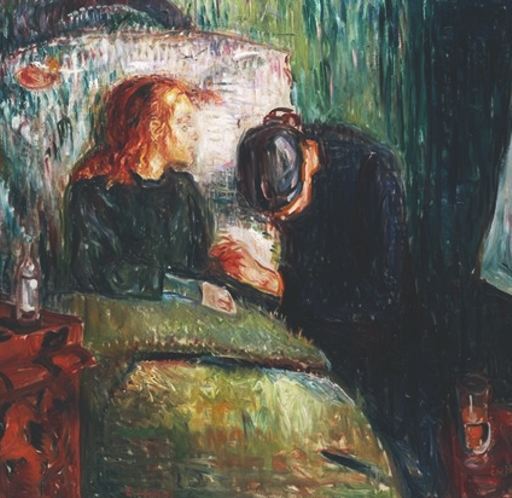
The Sick Child 1886
Munch's older sister Sophie died of tuberculosis at fifteen, when Edvard was fourteen. Six years later he began the painting that became, in his words, 'the picture I wrestled with most'. A pale red-haired girl rests her head on a pillow in profile; her aunt sits beside her, head bowed, holding her hand. The brushwork is deliberately rough — almost scraped — as if Munch had attacked the canvas with a knife. Norwegian critics in 1886 called it unfinished. He went on to paint six versions of the same scene over the next forty years, each slightly different. The first, original version is in the Norwegian National Museum in Oslo; later versions are in Tate Modern, the Munch Museum and Gothenburg.
Death in the Sickroom 1893
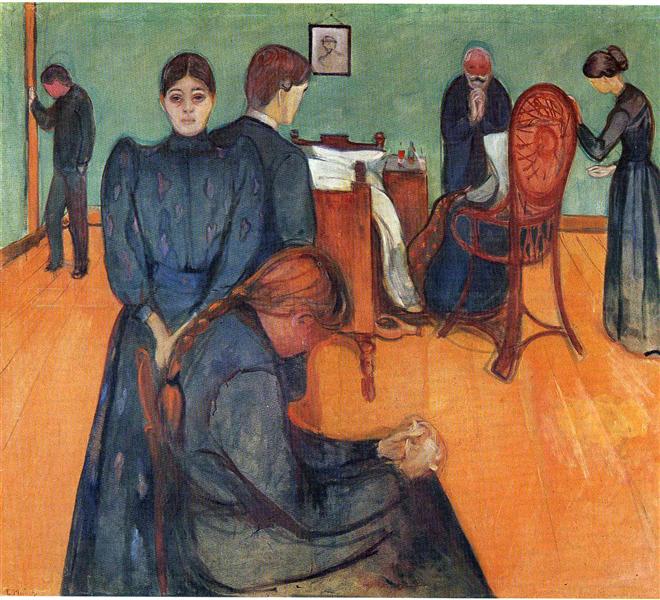
Painted as part of the 'Frieze of Life' cycle, this is Munch's most autobiographical work. Six members of his family stand and sit in a small room — his father, his aunt Karen, his three sisters, his brother — with the dying figure (almost certainly his sister Sophie) sitting in a high-backed chair on the right, her face mostly turned away. Each figure is isolated in their grief; nobody touches anyone else. The wooden floor takes up almost a third of the canvas. There is no window, no clock, no narrative — only the silence of a room where someone is dying. It is in the Munch Museum in Oslo.
Anxiety 1894
A direct echo of 'The Scream', painted a year later, on the same fjord road outside Oslo. A group of figures walks towards the viewer along a wooden boardwalk, the sky behind them streaked with the same red-orange waves Munch had painted in 'The Scream'. Their faces are pale, expressionless, almost identical — a queue of dread. There is a top-hatted man at the front whose dark eyes are simply two empty holes. The painting belongs to the same emotional landscape as 'The Scream' but generalises the horror: it is no longer one person's panic on a bridge; it is a city's. It hangs in the Munch Museum.
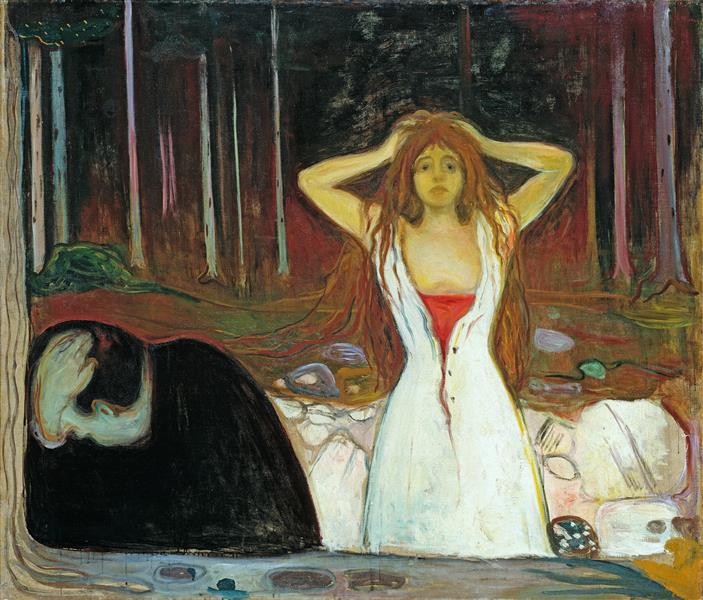
Ashes 1894
A man and a woman in a clearing, after — what? An argument, a sexual encounter, a love affair ending. The man, on the left, holds his head in his hands. The woman, in the centre, stares straight at the viewer with her white shift open, her dark hair loose, her hands raised to her temples. Behind them a fallen tree-trunk smoulders, throwing a thin column of grey smoke into the sky. The colour palette is autumnal, almost black-red. The painting belongs to the 'Frieze of Life' and is one of Munch's finest treatments of his recurring theme: the catastrophe of intimacy. It is in the Norwegian National Museum.
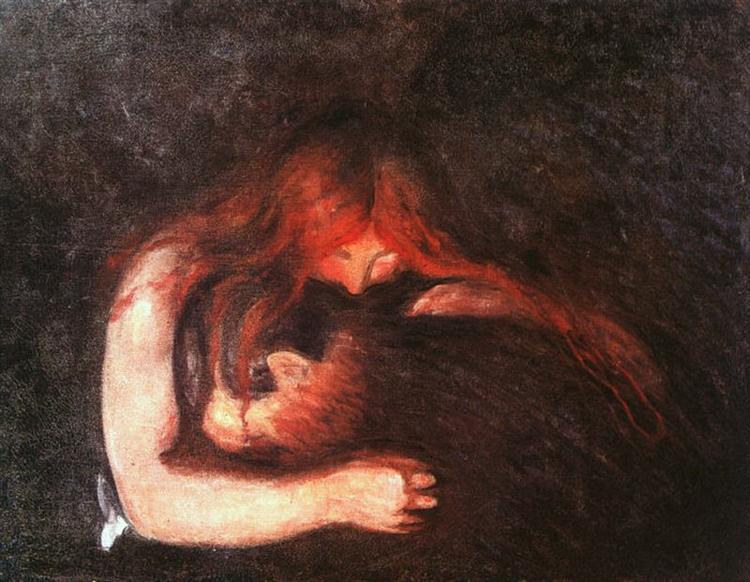
Vampire 1895
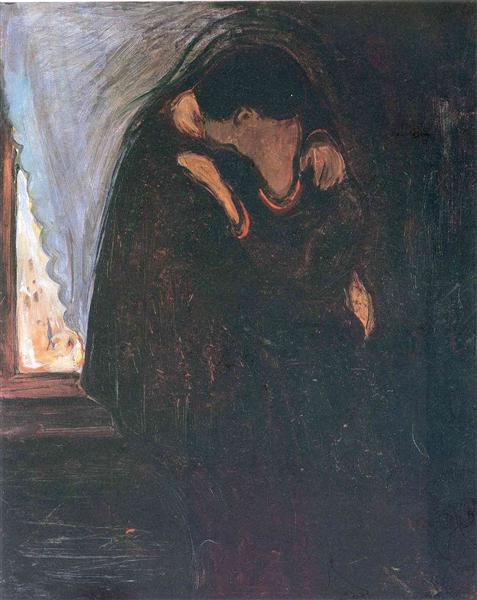
Originally titled 'Love and Pain', and later renamed by a critic. A woman, with long red hair, leans down over a man whose face is buried in the curve of her neck. Her hair falls around them like a curtain. They could be embracing, or she could be biting his neck — Munch was deliberately ambiguous, and the title slipped from one reading to the other. The painting was painted in at least six oil versions and many lithographs. The Nazis included it in the 1937 'Degenerate Art' exhibition; one version they confiscated has never been recovered. The most famous version is in the Munch Museum, Oslo.