Francisco de Goya
He started as the king's court painter and ended painting his walls with monsters.
Style and technique
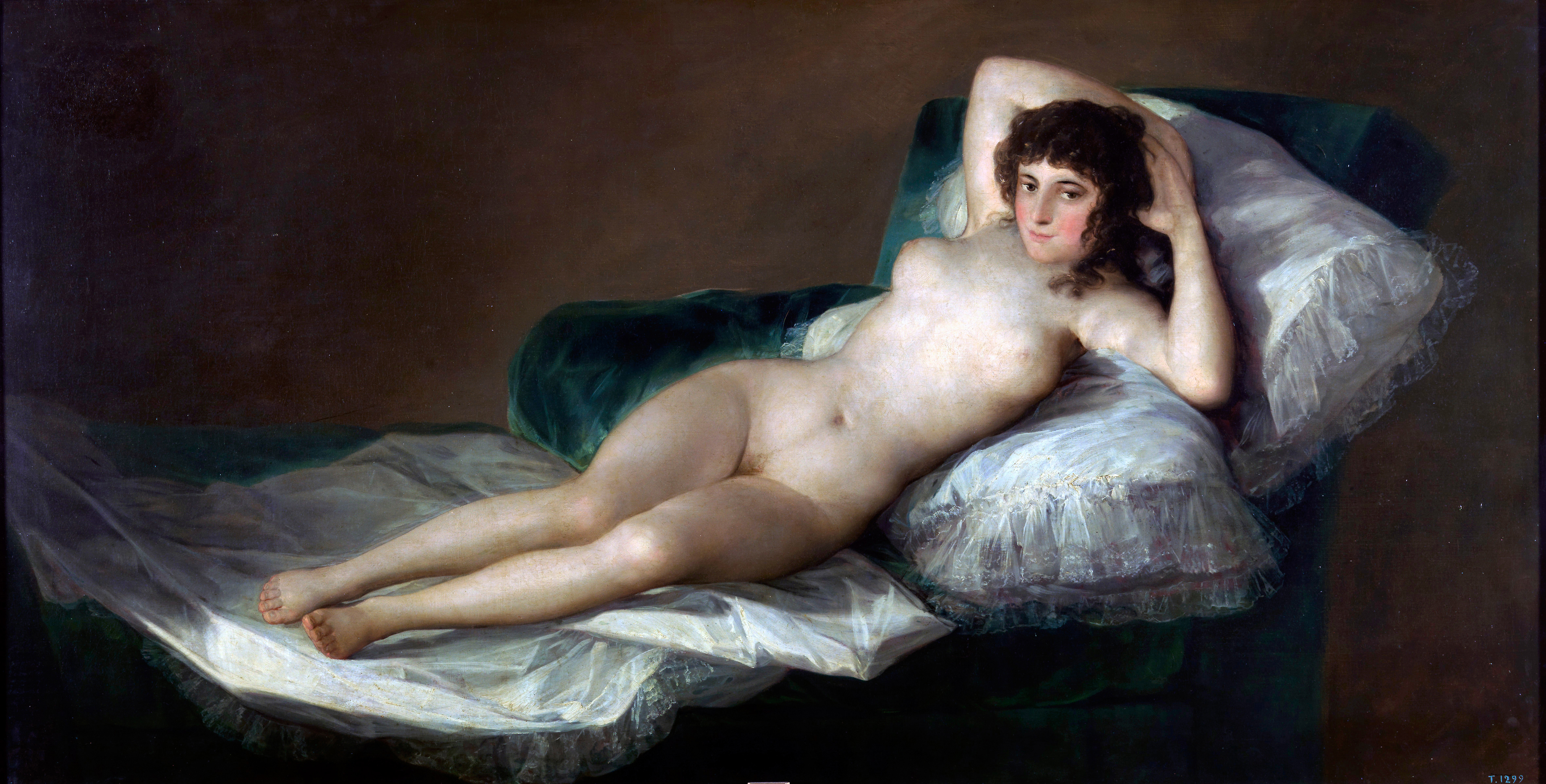
Goya's career spans four entirely different modes of painting, and they have almost nothing in common except the hand that made them. The early tapestry cartoons are festive, warm, light as a Boucher — their subject is the leisure of fashionable Madrid. The royal portraits of the 1780s and 1790s are precise, penetrating, unsparing of their subjects in a way that makes them unlike any court portraiture before or since. The war paintings of 1808–1814 are among the most brutal images of violence in the history of art. And the Black Paintings of his final years, applied directly to the plaster walls of his own house, are something for which no precedent exists.
The rupture came in 1792, when Goya fell catastrophically ill — probably from a viral infection — and lost his hearing entirely at the age of forty-six. He recovered but was deaf for the remaining thirty-six years of his life. Something changed in his art immediately. The illness was the border between two careers.
His portrait style after 1800 is famous for its lack of flattery. The royal family of Charles IV, in the great group portrait of 1800–1801, look exactly like what they were: a collection of overdressed, mildly stupid provincial grandees who happened to be born into absolute power. Every face is specific; none is idealised. This is extraordinary in a court portrait. Nobody apparently objected.
His technique evolved towards looseness and speed as he aged. The early work is careful, even a little stiff. By 1800 the brushwork is fluent and confident. In the Black Paintings it becomes almost reckless: the paint is applied with palette knife and cloth as well as brush, the surfaces are rough and urgent, the colours are restricted to black, grey, white, ochre, and a deep dirty brown.
Life and legacy
Goya was born on 30 March 1746 in Fuendetodos, a tiny village in Aragon. His father was a master gilder; the family was modestly artisan. He trained in Zaragoza under José Luzán and made two failed attempts to win the prize of the Real Academia de Bellas Artes in Madrid before traveling to Italy in 1770 at his own expense.
He returned to Zaragoza in 1771 and began receiving commissions for church frescoes. In 1773 he married Josefa Bayeu, sister of the court painter Francisco Bayeu, which gave him useful connections. He moved to Madrid and in 1776 began producing tapestry cartoons for the Royal Tapestry Factory — designs that would be woven into the tapestries decorating the royal palaces.
These cartoons — cheerful scenes of kite-flying, parasols, bullfights, and picnics on the riverbank — were successful and led directly to royal patronage. In 1786 he was appointed court painter to Charles III; in 1789, to Charles IV. By 1799 he was First Painter to the King, the highest position in the Spanish art establishment.
The illness of 1792 destroyed his hearing but produced the series of small cabinet paintings he sent to the Academy in 1794, describing them as works done 'to make observations for which commissioned painting gives no opportunity, and in which fantasy and invention have no limit.' These paintings — a fire, a carnival, a lunatic asylum, an attack by bandits — are the first warning of where he was heading.
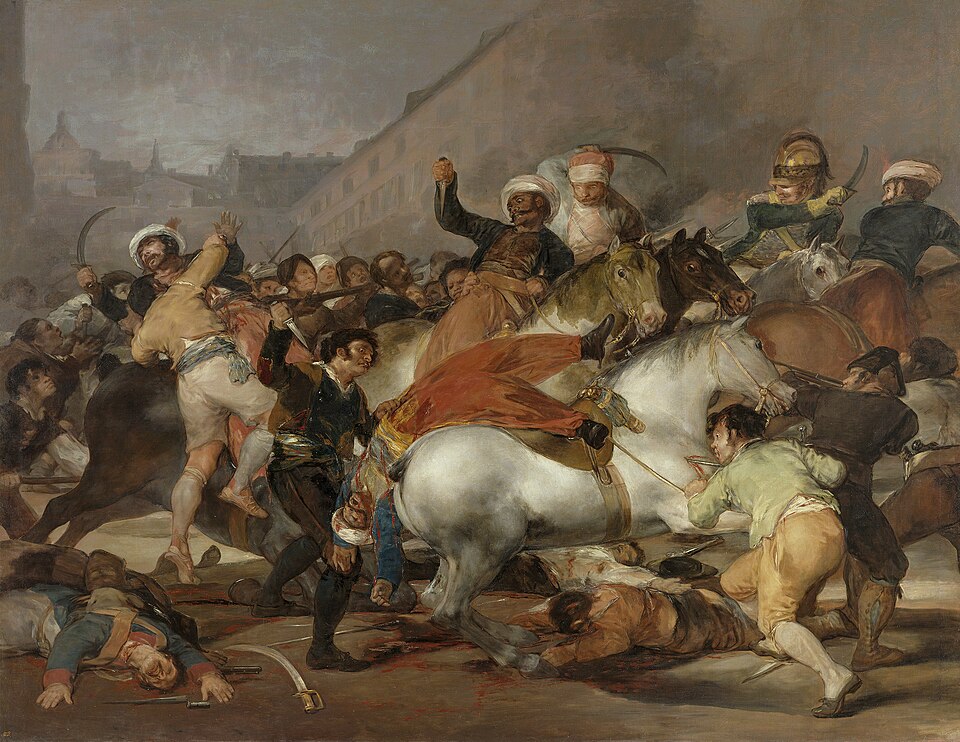
The French invasion of 1808 and the subsequent Peninsular War gave him the raw material of his middle period. He was in Madrid during the occupation and witnessed the events of the 2nd and 3rd of May 1808 — the popular uprising against French troops and its bloody suppression. He painted these events six years later, in 1814, in two enormous canvases that remain the most powerful anti-war paintings in the history of art.
In 1819 he bought a country house — the Quinta del Sordo, 'House of the Deaf Man' — outside Madrid. He lived there in semi-retirement and, in a period probably between 1820 and 1823, painted fourteen extraordinary murals directly onto the plaster walls of the two main rooms. The Black Paintings — Saturn devouring his son, a giant, two old men eating soup, a witches' sabbath, a dog's head barely visible above a hill — were never intended for public view. They were his private world.
In 1824, threatened by political persecution under the restored absolute monarchy, he went to Bordeaux under the pretext of seeking medical treatment and never returned to Spain. He died in Bordeaux on 16 April 1828, aged eighty-two. The Black Paintings were transferred from plaster to canvas in the 1870s and are now in the Prado.
Five famous paintings
The Second of May 1808 1814
The companion piece to 'The Third of May', painted in 1814 from memory and witnesses' accounts of an event Goya may have observed directly. The confrontation in the Puerta del Sol in Madrid: Spanish civilians attack French Mamluk cavalry with knives, axes, and bare hands. The composition is a tangle of bodies and horses, all diagonal energy, the violence absolutely specific — a knife going in, a horse rearing, a man being pulled down. There is no hero and no villain, just the savage reciprocity of bodies in contact. It hangs in the Prado alongside its companion piece.
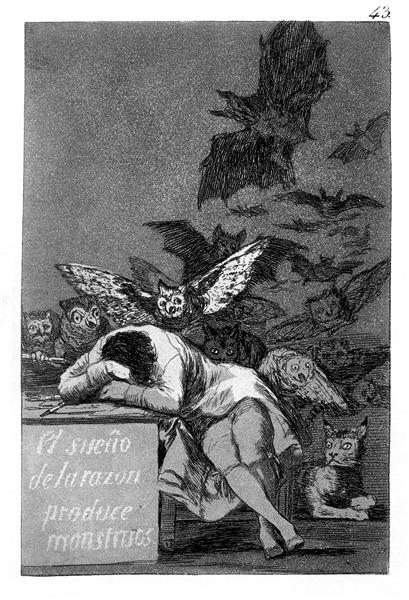
The Sleep of Reason Produces Monsters 1799
The most famous image from his print series 'Los Caprichos', published in 1799. A figure — the artist himself — slumps asleep at a desk; behind and above him, out of the darkness, rise owls, bats, and a wild cat that stares directly at the viewer. The caption reads: 'El sueño de la razón produce monstruos'. This is often translated as 'the sleep of reason' — reason's dormancy releasing the monsters within — but 'sueño' in Spanish also means dream, so it reads equally as 'the dream of reason produces monsters'. Goya may have intended both. The print became one of the defining images of the Enlightenment's complicated relationship with its own shadows.
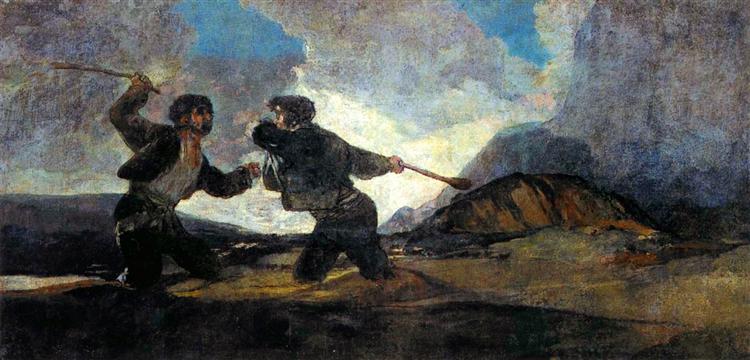
Duel with Cudgels 1823
One of the Black Paintings, applied directly to the plaster walls of the Quinta del Sordo. Two men — up to their knees in sand or bog — beat each other with wooden clubs. Neither can run away; neither can win; both are sinking. The scene has no narrative context and no readable explanation: it is pure image, pure violence, pure futility. The paint surface is rough and rapid — brushed, smeared, scraped. The two figures are barely differentiated except by the light catching their faces. It is probably the most concentrated image of irrational human conflict ever painted. It hangs in the Prado.
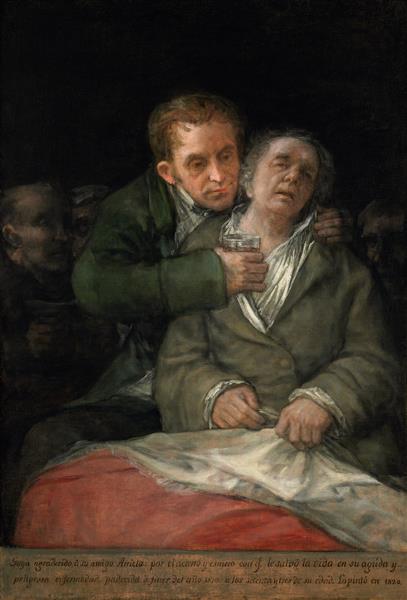
Self-Portrait with Dr. Arrieta 1820
Goya painted this as a gift to his doctor after surviving a serious illness in 1819 — the same illness that may have brought him to the Quinta del Sordo. He shows himself propped up in bed, his face the yellowy-grey of a man near death, while his doctor supports him from behind and holds a glass of medicine to his lips. In the dark background, partly visible, are the faces of figures who may be witnesses or may be hallucinations. The inscription on the canvas records his gratitude. It is the most personally vulnerable image Goya made of himself, and the one that most directly confronts mortality.
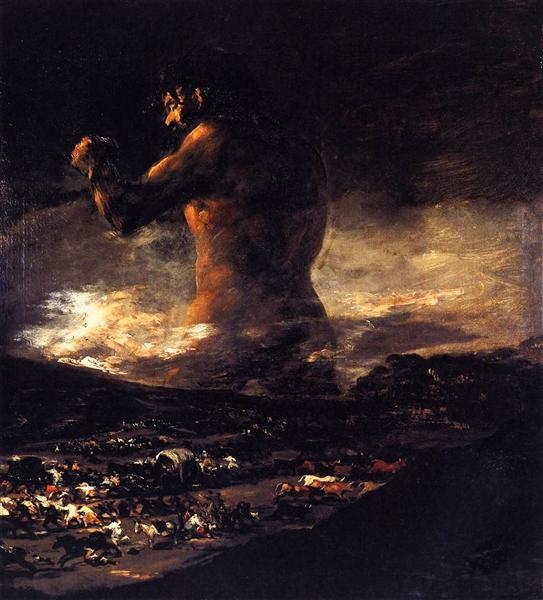
The Colossus 1812
An enormous naked giant sits or rises above a mountain landscape; below him, tiny figures — people, horses, cattle — scatter in panic across a wide plain. The giant is seen from behind (another Rückenfigur, though Goya was probably not thinking of Friedrich), his head bowed slightly, his fists clenched. He is both threat and indifference: he may not even be aware of the panic he is causing. The painting has been attributed and de-attributed to Goya several times by technical analysis; the current scholarly consensus favours Goya himself, possibly painted during the Napoleonic wars as an image of terror on a civilisational scale. It hangs in the Prado.