Francisco de Zurbarán
He painted monks in white wool so real you can feel the cold stone of the cloister.
Style and technique
Zurbarán painted cloth with an intensity that is almost architectural. His Franciscan and Dominican monks wear habits of white, grey, and black wool, and he renders the folds of this cloth — the precise way heavy fabric hangs, catches light, bunches at the waist, drags on stone floors — with a three-dimensional precision that makes the figures look carved rather than painted.
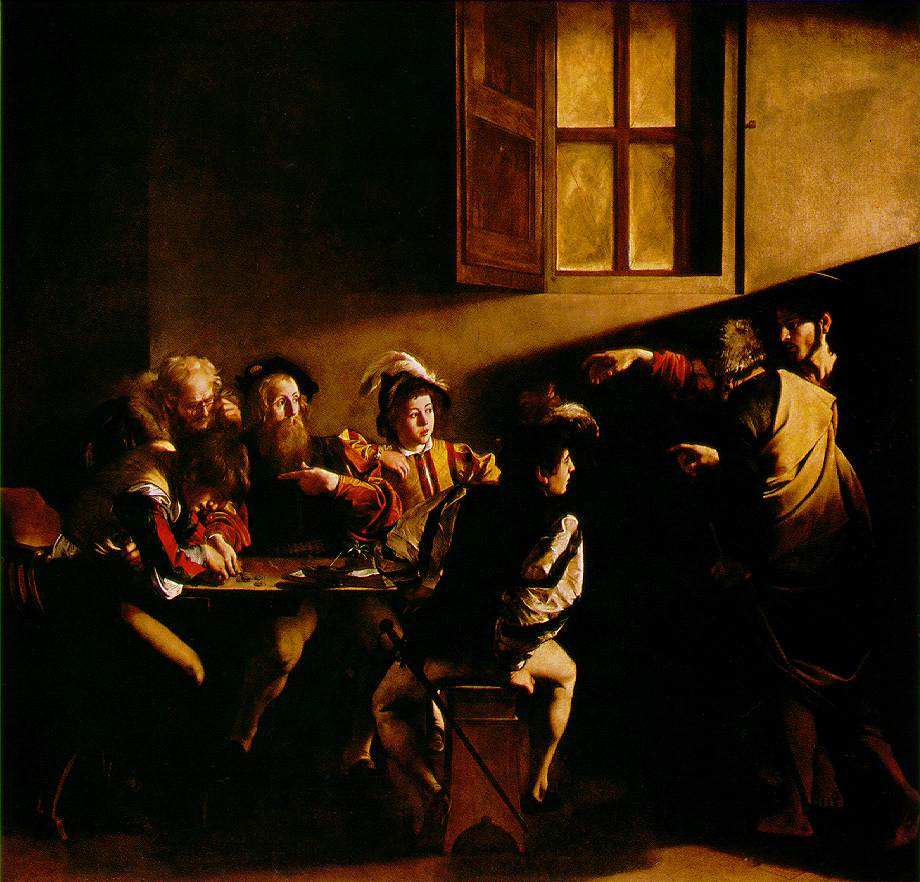
He absorbed Caravaggio's tenebrism early and used it with more disciplined restraint than almost anyone else. The light in his paintings is always specific — a window, a candle, the sky glimpsed through a cell door — and it creates hard-edged shadows with a geometry that makes the composition feel like an architectural drawing. There is no atmospheric middle ground; his figures emerge from absolute darkness into absolute light.
His still lifes are among the most extraordinary in Western painting. 'Still Life with Lemons, Oranges and a Rose' (1633) — a small canvas, 62 by 109 centimetres — shows three groups of objects on a dark table: a plate of lemons, a basket of oranges with flowers, and a cup with a rose and water. Nothing decorative, nothing superfluous. Each object sits in its own pool of light against the darkness, as carefully positioned as a saint in an altarpiece. The painting is in the Norton Simon Museum in Pasadena.
Four things identify his work: the hard-edged shadow against absolute black, the white or pale grey fabric rendered with sculptural precision, a colour palette of extreme austerity — brown, grey, black, white, with touches of orange and red for accents — and a stillness that is specifically the stillness of prayer and contemplation rather than the theatrical freeze of Caravaggio.
Life and legacy
Zurbarán was born on 7 November 1598 in Fuente de Cantos, an Extremaduran village in southwestern Spain, the son of a small merchant. He was apprenticed at fourteen to a maker of polychrome figures in Seville — the wooden religious sculptures used in church interiors — and this early training gave him a precise understanding of how three-dimensional form catches and deflects light.
He moved to the small town of Llerena in 1617, married, and established a workshop producing religious paintings for local churches. His reputation grew quickly, and by 1628 he was receiving major commissions in Seville itself — the great monastery altarpiece cycle for the Convent of San Pablo was his breakthrough, immediately establishing him as the most sought-after painter in southern Spain.
Seville in the 1620s and 1630s was a city of convents and monasteries, wealthy from the American trade and deeply invested in the devotional culture of the Counter-Reformation. The religious houses needed painted decorations — altarpieces, cycles of the lives of their founding saints, images of monastic virtue — and Zurbarán supplied them in enormous quantity. His workshop was the largest in Seville and exported canvases to the New World: Peru and Mexico received large shipments of his work.
Velázquez, who was born the same year and had trained in the same Seville milieu, invited him to Madrid in 1634 to contribute to the decorative programme of the Buen Retiro palace. Zurbarán painted ten large-scale history canvases for the Hall of Realms — his only sustained foray into secular subject matter.
Zurbarán moved to Madrid in 1658, aged sixty, in financial difficulty. He spent his last years there painting small devotional works for private sale. He died on 27 August 1664 in Madrid, apparently in poverty. His exact burial place is unknown. Rediscovery of his work came in the early nineteenth century, when a French general seized dozens of his canvases from Spanish convents during the Napoleonic occupation and brought them to Paris, where they were exhibited in 1838 to enormous critical admiration.
Five famous paintings
Agnus Dei 1635
A lamb, its four legs bound together, lies on a dark stone surface. Nothing else. No landscape, no human figure, no attribute. Just the lamb against absolute darkness, lit from the left by a single light source that picks out the wool in precise detail — the individual fibres, the curve of the back, the texture of the ears. The painting is simultaneously a devotional image of Christ as the sacrificial lamb and a still life of exceptional formal intensity. There are at least six surviving versions in various dimensions; the most famous is in the Prado in Madrid. The image is so reduced and so precise that it approaches the condition of a mystical object.
Still Life with Lemons, Oranges and a Rose 1633
Three groups of objects on a dark table: a plate of lemons with two leaves, a basket of oranges with blossoms and leaves, and a ceramic cup holding a rose and a glass of water. The arrangement is three-part, symmetrical, and entirely without narrative: this is the most formally abstract still life in Spanish Baroque painting. Each object sits in its own light; each surface is different — the waxy peel of the lemons, the rougher texture of the oranges, the translucency of the water in the glass. The religious reading is available but not insisted upon. The painting is in the Norton Simon Museum in Pasadena, California.
Saint Francis 1635
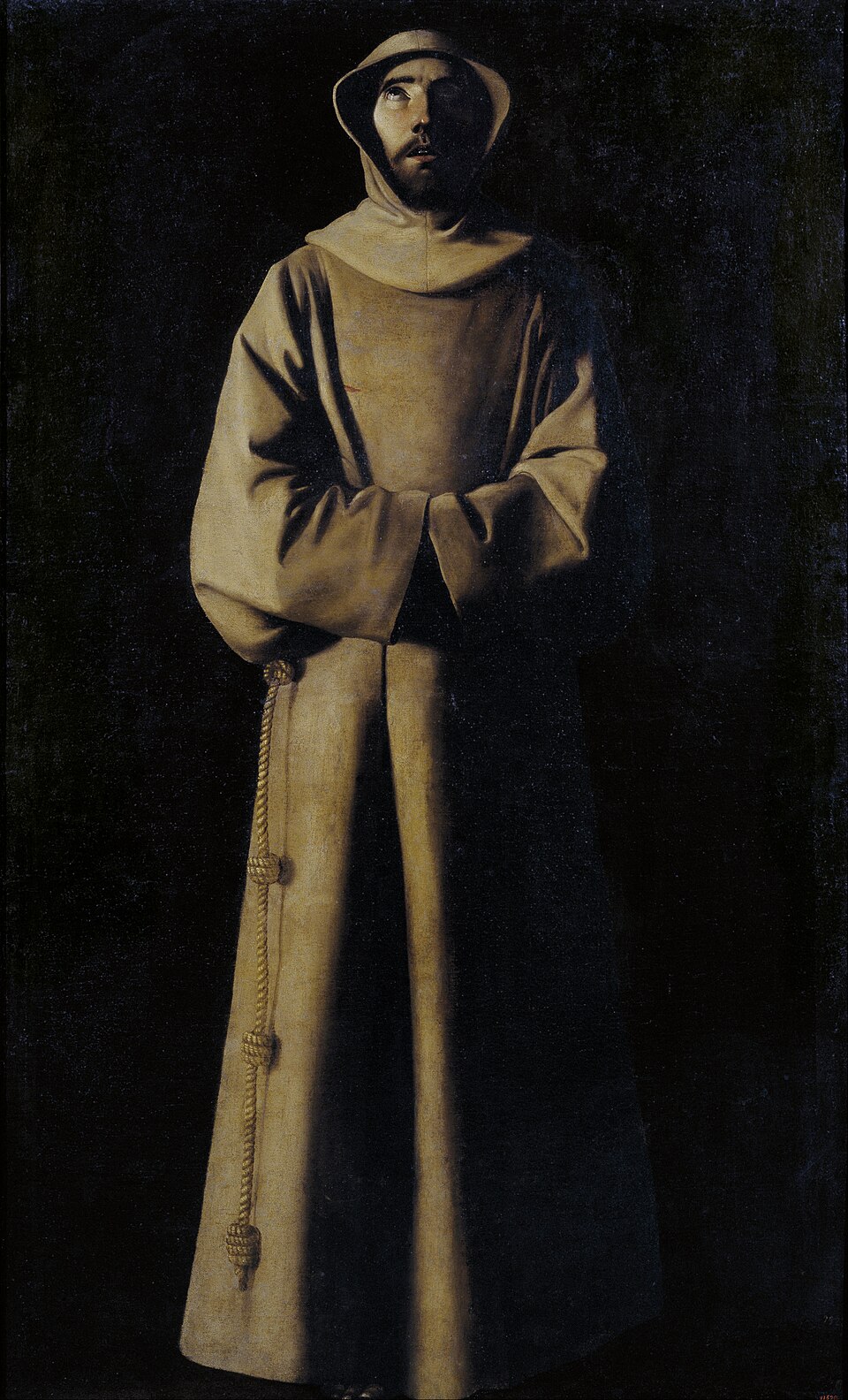
A standing Franciscan monk — Saint Francis — in a brown habit, his face obscured by the deep shadow of his hood, holding a skull in both hands and looking down at it. The figure is front-lit, emerging from complete darkness. The skull reflects the light; the hands are rendered in extraordinary detail. This is one of Zurbarán's most stripped-down compositions: no landscape, no attributes, no narrative, just the figure and the skull. The meditation on death — the memento mori tradition — is absorbed entirely into a study of how a habit hangs on a body. The painting is in the National Gallery in London.
The Immaculate Conception 1630
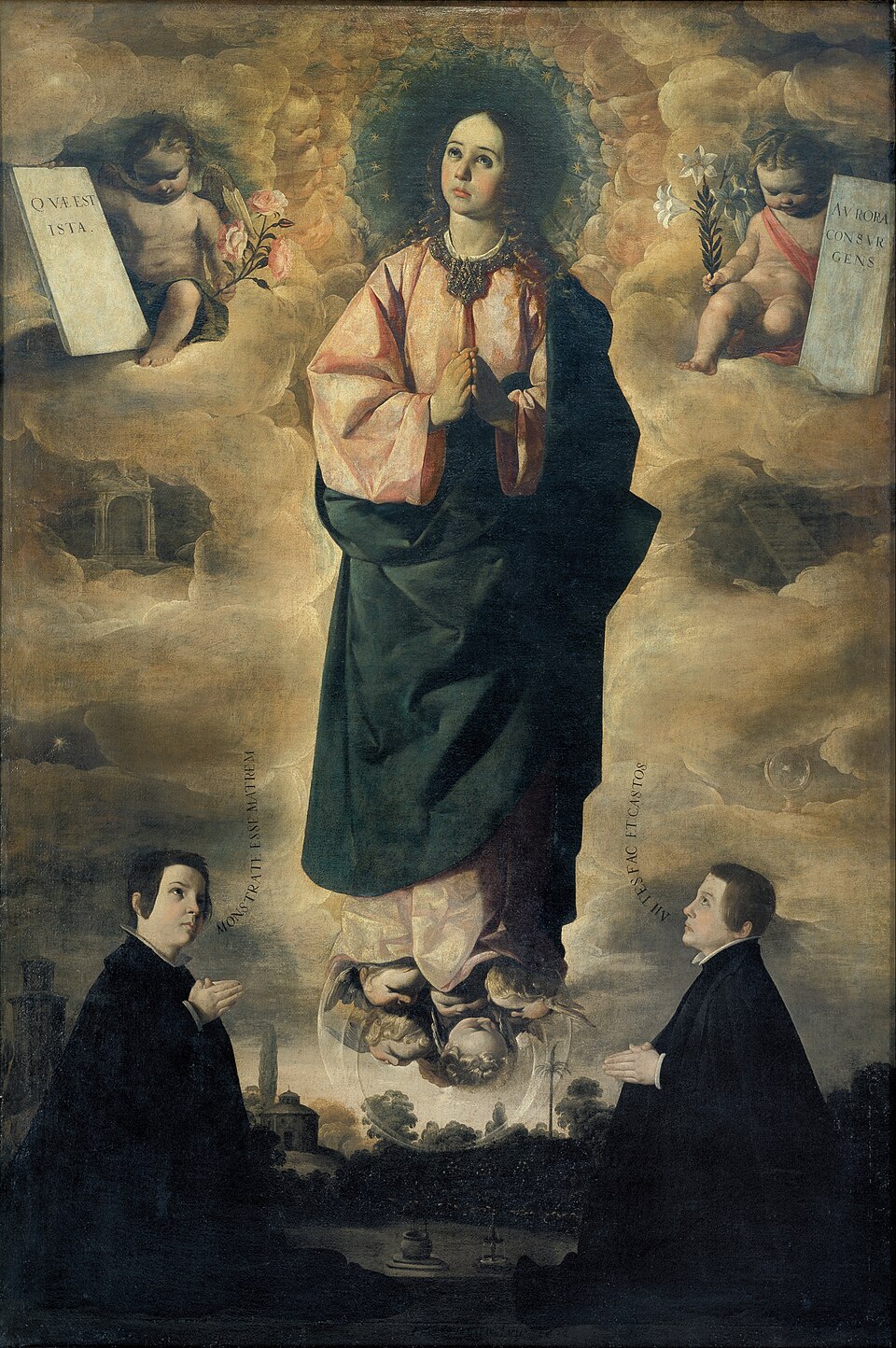
A standard devotional subject — the Virgin standing on a crescent moon surrounded by angels — treated with Zurbarán's characteristic austerity. The angels carry the attributes of the Virgin from the Song of Songs (a mirror, a crown, a palm). The Virgin herself is rendered in white and blue with a precision that shows his full mastery of fabric: the white robe catches the light differently on each fold. The Immaculate Conception was a theologically contested doctrine in seventeenth-century Spain; Seville was one of its most ardent defenders. This painting was produced for the Seville market at the peak of the controversy.