Gustave Caillebotte
The Impressionists' wealthy patron who painted Paris with an engineer's precision and a photographer's eye.
Style and technique
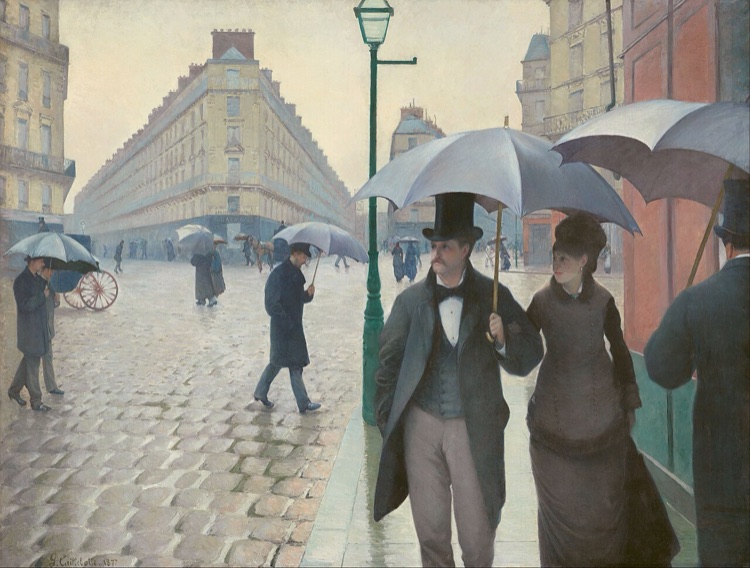
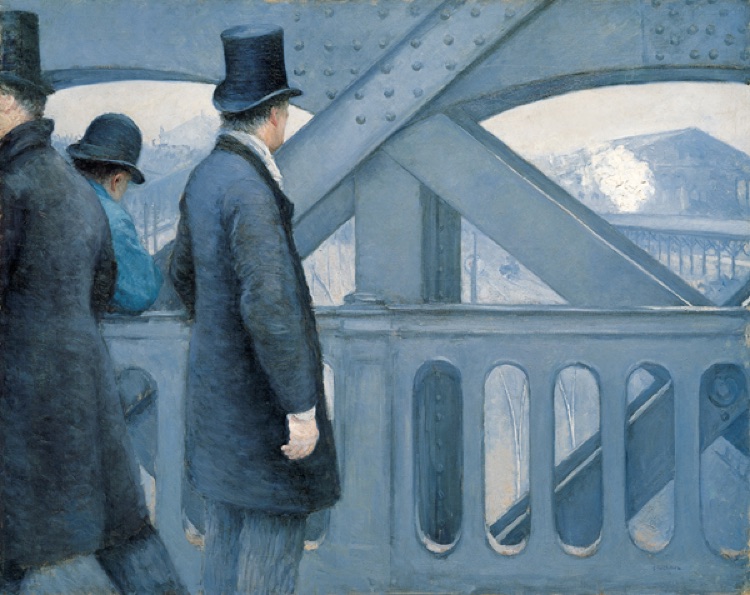
Caillebotte occupies a curious position within Impressionism: he exhibited alongside Monet, Renoir, and Degas, funded many of their canvases, and yet painted in a manner cooler, more exacting, and more indebted to draftsmanship than the shimmering, broken brushwork usually associated with the movement. Trained partly in the academic tradition and fascinated by the era's new science of photography and its plunging perspectives, he built his pictures like an engineer: streets, bridges, and floors are ruled into place with near-mathematical precision, vanishing points pulling the eye deep into space along cobblestones, iron trusses, or floorboards. Where his colleagues dissolved form into atmosphere, Caillebotte kept edges crisp and tonal contrasts controlled, favoring greys, blacks, and muted blues that lend his Paris a damp, overcast gravity rather than sunlit sparkle.
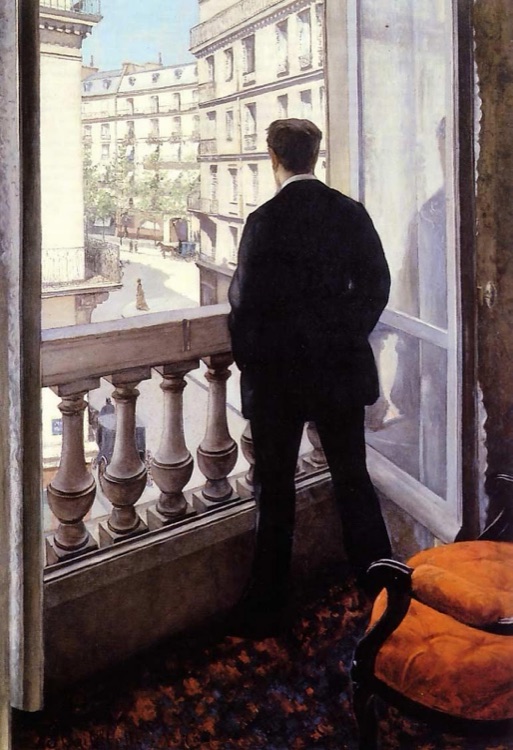
Borrowing devices from photography and Japanese woodblock prints, he cropped bodies at the canvas edge, tilted vantage points steeply downward from balconies, and let empty foreground space press uncomfortably close to the viewer, producing compositions that feel snapped rather than composed.
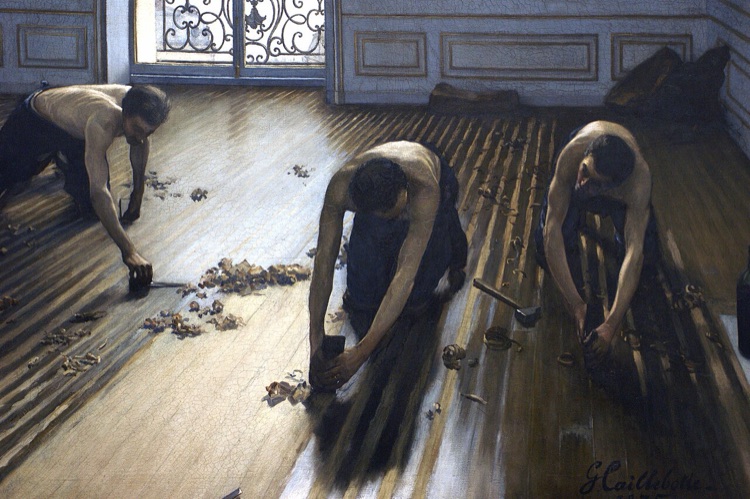
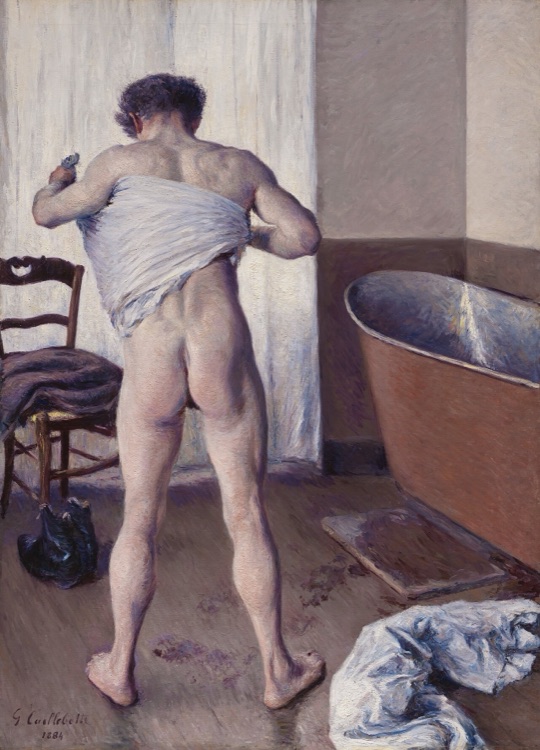
The Floor Scrapers shows shirtless workers stripping a parquet floor with an anatomical frankness that scandalized the official Salon, which rejected the picture in 1875 as needlessly vulgar. Caillebotte's nudes and workers are rendered with the same dispassionate clarity he gave to rain-slicked streets or snow-covered rooftops, refusing both academic idealization and impressionistic haze. The result is a distinctive hybrid: an Impressionist commitment to contemporary, everyday subject matter fused with a realist's structural rigor and a photographer's sense of cropped, accidental framing, making him one of the movement's most quietly radical and visually modern painters.
Life and legacy
Gustave Caillebotte was born in Paris on August 19, 1848, into a family that had grown rich supplying textiles to the French army; his father's fortune, later augmented by property investments, left Gustave and his brothers financially independent for life. After training as an engineer and earning a law degree, he served briefly in the Franco-Prussian War before turning decisively to painting, entering the studio of academic artist Léon Bonnat and, in 1873, gaining admission to the École des Beaux-Arts. His technical background never fully left his art: an engineer's fascination with structure, perspective, and geometry runs through even his most casual Parisian scenes.
Caillebotte's submission to the official Salon, The Floor Scrapers, was rejected in 1875 for its frank depiction of laboring men, pushing him toward the independent Impressionist group, whose second exhibition he joined in 1876.
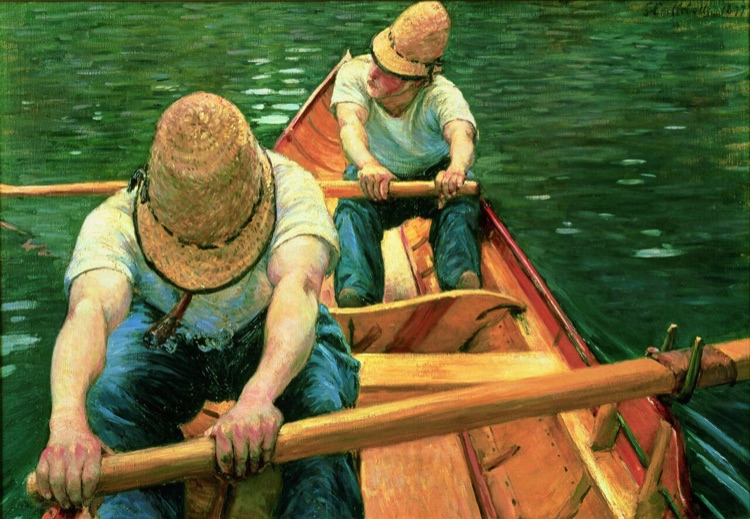
Independently wealthy, he bought canvases directly from Monet, Renoir, Pissarro, Sisley, and Degas when they were broke and unsalable, paid studio rent, and helped organize and finance the group's exhibitions between 1876 and 1882. His Paris apartment doubled as an informal gallery for the paintings he acquired from his friends, and his own domestic life supplied many of his subjects: brothers reading, laborers refinishing his floors, views from his balcony over Boulevard Haussmann. An avid yachtsman and gardener, he later settled at Petit-Gennevilliers along the Seine, where boating and horticulture increasingly absorbed him alongside painting.
His will bequeathed his personal collection of roughly seventy Impressionist paintings to the French state, on condition they eventually enter the Musée du Luxembourg and later the Louvre. The gift provoked a bitter public controversy: officials and academic critics balked at hanging works by Monet, Renoir, Cézanne, and Manet in a national museum, and only part of the bequest was accepted after prolonged negotiation with his executor, Renoir. Caillebotte's own paintings, meanwhile, remained largely in private family hands and out of public view for decades, so that the man who had done so much to secure Impressionism's future was himself nearly forgotten as a painter. Only from the 1950s onward, as scholars rediscovered canvases like Paris Street; Rainy Day, did Caillebotte re-emerge as one of the movement's most original and technically daring artists in his own right.
Five famous paintings
Paris Street; Rainy Day 1877
Nearly seven feet wide, this monumental canvas captures the intersection of Rue de Turin and Rue de Moscou near the Gare Saint-Lazare. A well-dressed couple sharing an umbrella advances into the foreground while a lone man is cropped abruptly at the picture's right edge, as though caught by a passing camera rather than composed by an artist. Cobblestones and facades are ruled into sharp one-point perspective, and the damp grey palette conveys a distinctly modern, faintly melancholic Parisian mood. Shown at the 1877 Impressionist exhibition, it now hangs in the Art Institute of Chicago.
The Floor Scrapers 1875
In his own apartment on Rue de Miromesnil, three shirtless workers kneel to strip a parquet floor, their backs and arms rendered with an anatomical precision more often reserved for academic nudes than scenes of manual labor. Raking light catches curls of wood shaving and the sheen of sweat on skin, while the floorboards recede in the same rigorous perspective Caillebotte later applied to Parisian streets. The Salon rejected the painting in 1875, unsettled by its frank treatment of working-class bodies; shown instead at the second Impressionist exhibition in 1876, it remains one of the era's boldest depictions of ordinary labor.
Le Pont de l'Europe 1876
On the iron bridge spanning the rail yards behind Gare Saint-Lazare, a fashionably dressed couple strolls past a workman leaning on the railing, his gaze fixed on the tracks below, while Caillebotte's own dog trots into the foreground. The bridge's steel latticework is drawn with an engineer's exactitude, its diagonals driving the eye into a steep, vertiginous perspective that mirrors the disorienting scale of industrial Paris. By setting bourgeois leisure and working-class labor within the same shadow, Caillebotte quietly registers the social contrasts produced by Haussmann's modernization of the city.
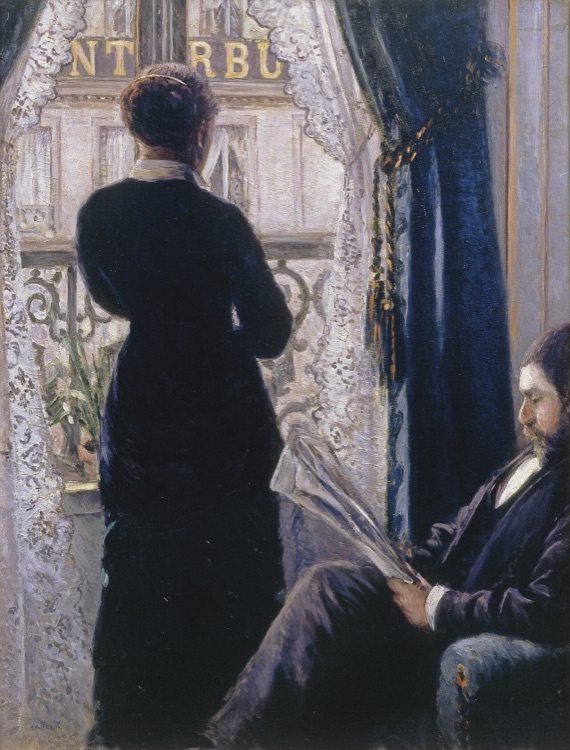
Interior, Woman at the Window 1880
In a dim, richly furnished Parisian apartment, a man sits absorbed in a newspaper while, behind him, a woman stands silhouetted at a window, gazing out at the bright street. The two figures share the room but not a glance, separated by empty space and deep shadow. The painting's quiet emotional distance — the man engrossed in reading while the woman turns away toward the light — gives ordinary domestic space an undercurrent of isolation rarely explored so directly by Caillebotte's Impressionist peers. Contrasting the room's heavy shadow with the glare of the window beyond, he uses light itself to dramatize the couple's psychological separation, turning a mundane bourgeois interior into a study of quiet, unspoken estrangement.
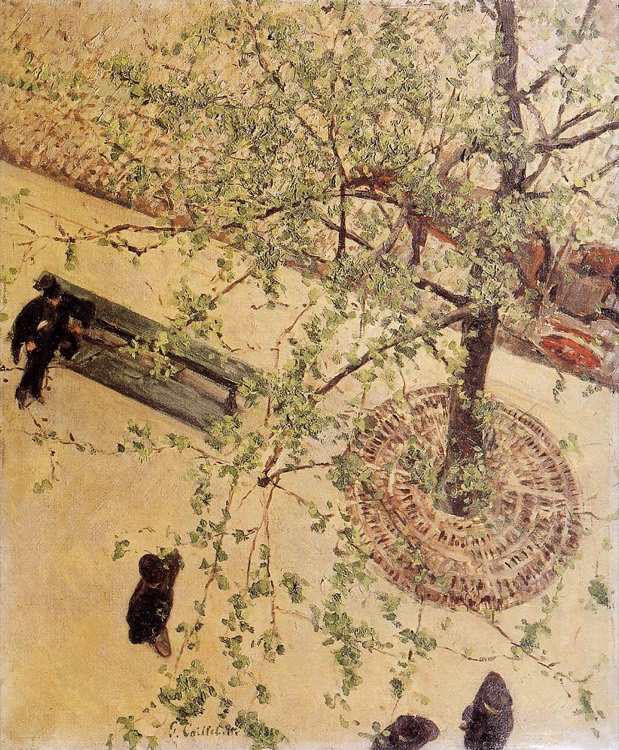
Boulevard Seen from Above 1880
Looking almost straight down from a high window or balcony, this view compresses a Parisian boulevard into a steep, plunging perspective. Carriages and tiny pedestrians cast long shadows across the pavement far below, while the tops of trees interrupt the sightline with patches of foliage. The dizzying bird's-eye vantage owes as much to contemporary photography and Japanese woodblock prints as to traditional landscape painting, flattening the boulevard into a nearly abstract pattern of light and shadow. Caillebotte returned repeatedly to such vertiginous viewpoints from his own apartment windows, treating the ordinary modern street as a subject for radical, camera-like experiments in perspective that few of his Impressionist contemporaries attempted.