Jean-Auguste-Dominique Ingres
The man who made the line into a religion — and the female body its cathedral.
Style and technique
Ingres believed in the absolute primacy of drawing. Line, in his practice, was not a preliminary step towards colour but the complete artistic act. He had been David's student and absorbed the Neoclassical emphasis on clarity, sculptural form, and the example of antiquity — but he carried it somewhere his teacher never went, into a zone of almost obsessive formal perfection.
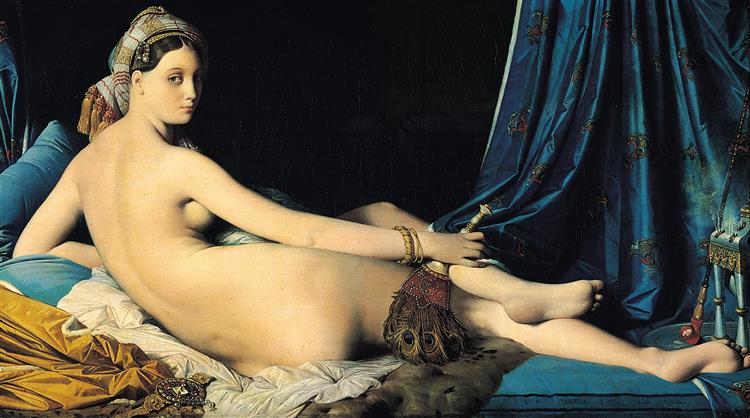
His figures are anatomically impossible. The 'Grande Odalisque' of 1814 has a spine several vertebrae too long; her body is elongated far beyond any anatomical measurement. This was pointed out immediately by critics when it was shown. Ingres did not care. The elongation was intentional — it produced a more beautiful contour, and the contour was what mattered. Beauty and anatomical accuracy were not the same thing, and when forced to choose, he chose beauty.
His surfaces are extraordinarily smooth. He spent enormous effort eliminating visible brushwork: his finished canvases look more like enamel or polished marble than painted canvas. This surface quality was simultaneously his most admired and most debated achievement. Delacroix, his great rival, found it cold and mechanical; Turner praised it; Ingres himself considered it the only appropriate finish for a serious painting.
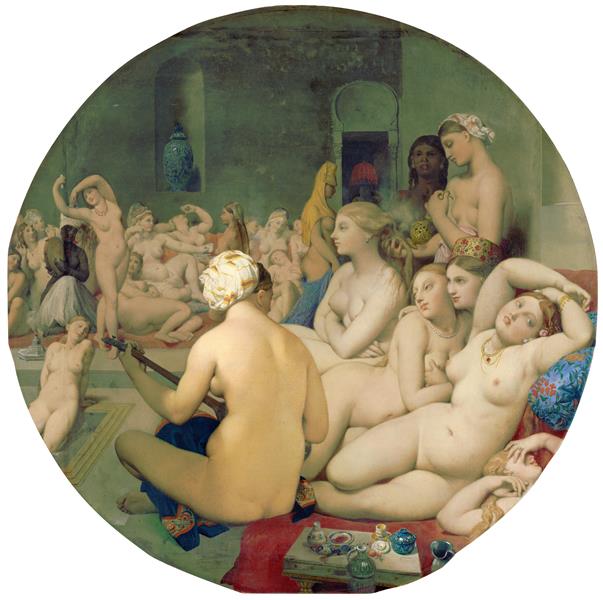
The nude female back was his greatest subject. In painting after painting — the 'Valpinçon Bather' (1808), the 'Grande Odalisque' (1814), the 'Turkish Bath' (1862) — he approached the same form from different angles, with different degrees of intimacy. The line where the spine meets the small of the back, the curve from shoulder to waist — these were territories he mapped with the precision of a surveyor.
His portraits, by contrast, are among the most psychologically alert of the nineteenth century. In them he briefly abandoned his commitment to pure form and engaged with the specific: the face of Monsieur Bertin (1832), the newspaper proprietor, has a weight and particularity that are almost uncomfortable.
Life and legacy
Ingres was born on 29 August 1780 in Montauban, a provincial city in southwestern France. His father was a painter and sculptor of modest means; he ensured his son had good early training, and Ingres arrived in Paris at eleven to study at the Royal Academy of Painting. By seventeen he was working in the studio of Jacques-Louis David himself.
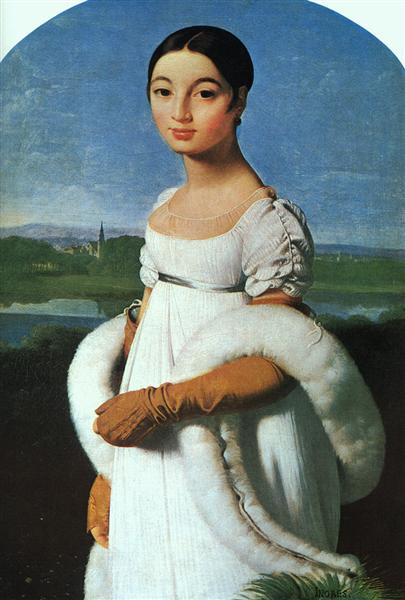
He won the Prix de Rome in 1801 but the French government, preoccupied with Napoleonic wars, could not fund his scholarship immediately. He spent five years in Paris, during which he painted the remarkable series of portraits — the Rivière family, the Bonaparte household — that show him already in full command of his mature style. He finally arrived in Rome in 1806.
He stayed in Italy for eighteen years. Rome was followed by Florence, where he was director of the French Academy from 1834 to 1841. He absorbed Raphael above all others — he carried a print of the 'Madonna of the Chair' in his pocket for decades and is said to have wept in front of it. He also loved Titian, Greek vases, Poussin, and the portrait drawings of Holbein, which he studied with great care.
His reception in Paris was initially uncertain. The 'Grande Odalisque', shown at the 1819 Salon, was attacked for its anatomical distortions and its cold surface. But he gradually won over the critics and by the 1820s was being positioned as the defender of the classical tradition against the Romantic innovations of Eugène Delacroix.
The rivalry with Delacroix was real and definitive. It organised French art criticism for a generation: Ingres stood for line, drawing, classical order; Delacroix stood for colour, movement, and Romantic passion. The two men barely spoke. Ingres reportedly called Delacroix 'the apostle of ugliness'. Delacroix admired him privately while disagreeing with almost everything he represented.
He died on 14 January 1867 in Paris, aged eighty-six, having outlived almost everyone he had competed with. He left his drawings — thousands of them, the finest collection of nineteenth-century French draughtsmanship that exists — to the museum of Montauban, his birthplace, where they still are.
Five famous paintings
La Grande Odalisque 1814
A reclining nude, seen from behind, turns to look over her shoulder at the viewer. Her spine is visibly too long — at least three vertebrae more than any human anatomy permits. Critics at the 1819 Salon attacked this immediately. Ingres had not miscounted; he had deliberately elongated the figure because the longer curve was more beautiful. Behind her, dark draperies and a peacock fan create a flat, almost decorative background. The surface of the canvas is completely smooth: no brushstroke is visible. The painting is in the Louvre; it has been there since 1899 and is one of the most studied and reproduced female nudes in Western art.
The Turkish Bath 1862
Ingres completed this extraordinary canvas at the age of eighty-two. It was originally rectangular; he cut it into a tondo in 1862 and reworked it extensively. Inside the circular format, more than twenty nude women bathe, dry themselves, converse, and make music in an imaginary Turkish hammam. The foreground figure plays a lute with her back to the viewer — the same back Ingres had been painting since the 'Valpinçon Bather' of 1808, fifty years earlier. The painting is a summary and a valediction: a lifetime's obsession with the female form condensed into a single canvas. It hangs in the Louvre.
The Apotheosis of Homer 1827
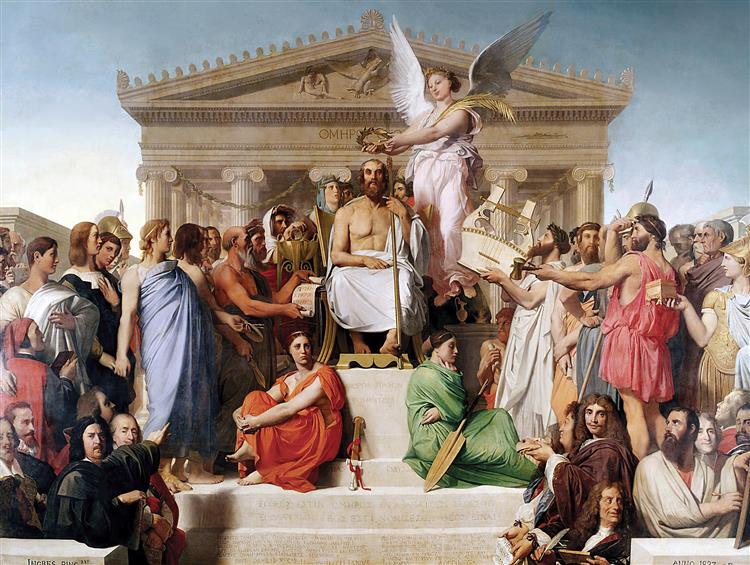
A vast Neoclassical allegory commissioned as a ceiling painting for the Louvre. Homer, in the centre, is crowned with a laurel wreath by the figure of Victory; below him, arrayed on the steps of a Greek temple, sit forty-six figures from antiquity and from modern history who are identified as Homer's spiritual descendants. Dante, Raphael, Poussin, Shakespeare, and Molière are among them. The painting is an argument about cultural tradition and about what Ingres believed the great chain of high art consisted of. The original is in the Louvre; a reduced version is in the National Gallery in London.
The Vow of Louis XIII 1824
Painted for the Cathedral of Montauban, Ingres's birthplace, this large altarpiece shows Louis XIII dedicating France to the Virgin Mary. The composition is a deliberate quotation of Raphael's Sistine Madonna — the Virgin with the Christ child appears in a cloud of angels above, while Louis kneels in armour below. The painting was a critical success at the Salon of 1824 and established Ingres as the leading defender of the classical tradition at a moment when Delacroix's Massacres at Chios was attacking that tradition from the same Salon. The painting is still in Montauban Cathedral.
Oedipus and the Sphinx 1808
A very early work, painted in Rome when Ingres was twenty-eight. Oedipus leans against a rocky outcrop, his body a study in Neoclassical male anatomy, and gestures confidently at the Sphinx. A human foot — the remnant of a previous challenger — protrudes from a crevice below. The Sphinx is rendered almost naturalistically, a lion's body with a woman's head, regarding Oedipus with calm curiosity. The painting uses the same formal vocabulary as David — the sculptural figure against a dark background, the precise and legible pose — but the psychological temperature is already colder, more detached. It hangs in the Louvre.