Jean-Antoine Watteau
He invented a world of pleasure so melancholy it made you ache for it.
Style and technique
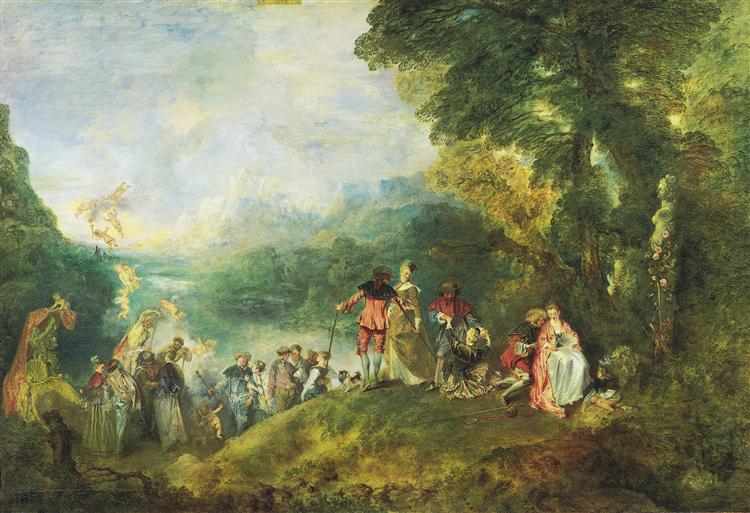
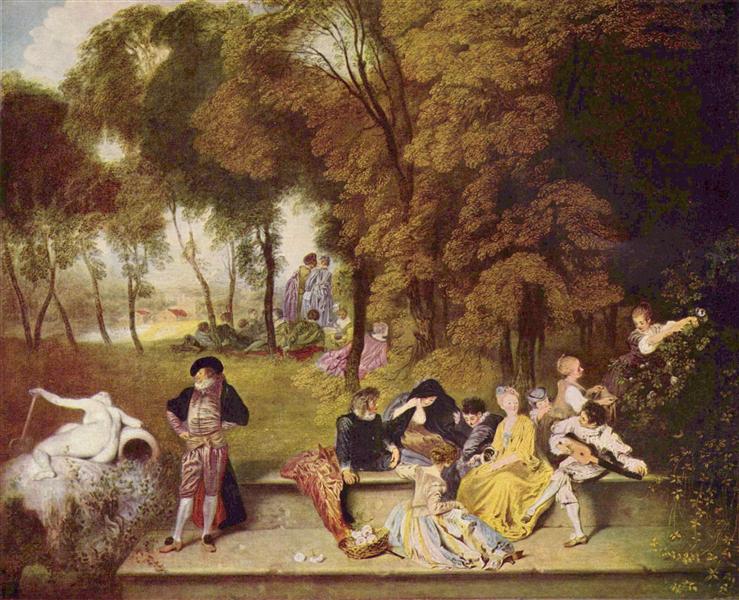
Watteau invented a genre. No one before him had painted what he painted: groups of elegantly dressed figures in parkland settings, drifting in conversation, listening to lute music, flirting, departing for mysterious destinations. The French Academy, when it finally admitted him as a full member in 1717, had to coin a new category for his diploma painting — fête galante, an 'outdoor festivity' — because nothing in the existing taxonomy could contain it.
The atmosphere is everything. The figures float in a warm, slightly hazy light that is not quite morning and not quite afternoon. The park behind them is full of soft sculptured trees and a sky that is never quite cloudless. There is music implied in every canvas — the lute appears constantly — but nobody is playing loudly. The conversations are inaudible.
His drawing was extraordinary — probably the best of any French artist of his century. He carried a sketchbook everywhere and filled it with figures from life: comedians, soldiers, people in streets. He then assembled these drawings into compositions, cutting them out mentally and arranging them in new groupings. A figure drawn in one context reappears in another painting with different company. This compositional recycling gives his work a consistency of touch across very different subjects.
The silk in his paintings is specifically Watteau's own achievement. He was born near the textile-manufacturing region of Flanders and understood woven fabric with an almost technical precision. The pale blue, rose, silver, and lemon silks that his figures wear catch light differently on every fold, and he painted each fold individually with a loaded, confident brushstroke that no imitator quite managed to replicate.
His palette is the palest and most silvery in the French tradition — pink, pearl, pale gold, soft green. He took these colours directly from Rubens, whose vast canvases he had spent years copying in Pierre Crozat's collection in Paris.
Life and legacy
Watteau was born on 10 October 1684 in Valenciennes, a Flemish town that had been French for only eight years when he arrived. His father was a tiler; there was no money for an extended artistic education. He trained locally under the painter Jacques-Albert Gérin and arrived in Paris around 1702, broke, aged about eighteen.
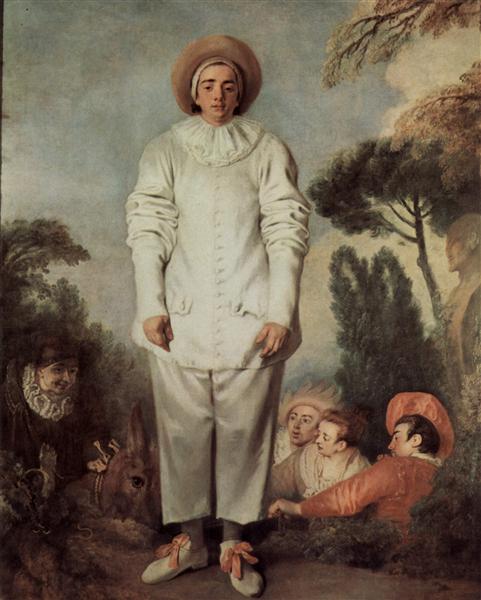
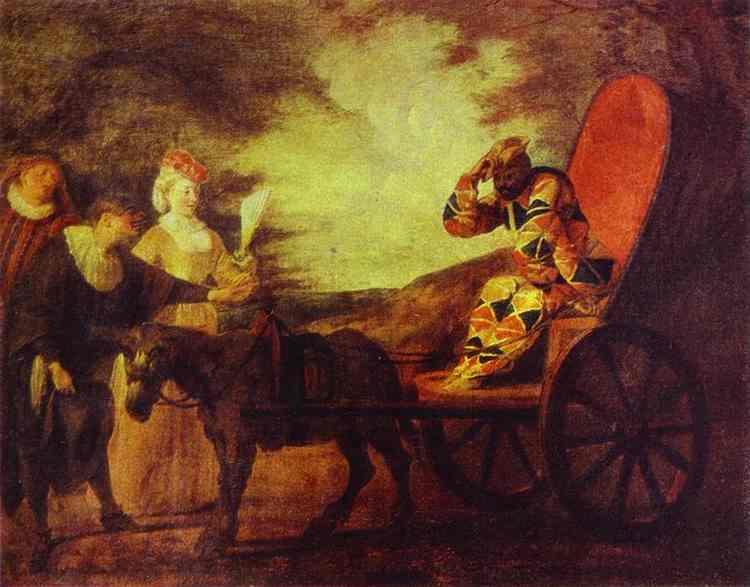
Paris in 1702 was a city of theatre. The Comédie-Française and the Italian comedy troupes performed constantly, and their costumes — Pierrot's white smock, Harlequin's diamond-patched suit, Mezzetin's striped jacket — became the visual vocabulary of Watteau's entire career. He got work almost immediately painting theatrical scenery and then found his way into the studio of Claude Gillot, a painter who specialised in theatrical subjects. From Gillot he went to Claude Audran, the keeper of the Luxembourg Palace, which contained the enormous Marie de' Medici cycle by Rubens that Watteau spent years studying.
The Rubens series changed everything. Watteau saw in those large canvases the model for outdoor painting in warm, diffused light, with freely grouped figures, rich colour, and a sense of festive ease. He spent years absorbing this lesson and made it entirely his own.
He was accepted as an associate of the Royal Academy in 1709 and submitted his diploma painting — the 'Pilgrimage to the Island of Cythera' — only in 1717, having been repeatedly reminded by the Academy that he owed them a presentation piece. They admitted him immediately and created the new category for it.
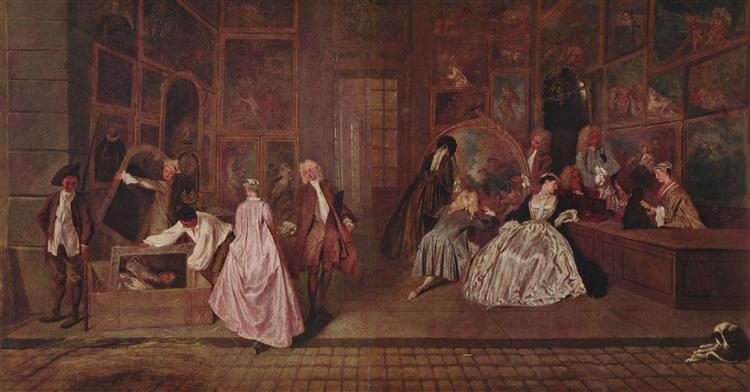
In 1719 he traveled to London to consult a noted physician, Dr. Richard Mead, about his lungs. England suited him poorly and he returned to Paris in 1720, visibly deteriorating. His last great work, 'Gersaint's Shopsign' — a large canvas painted in the autumn of 1720 for his friend Edme-François Gersaint's art dealership — was completed in about eight days, working morning to evening while he could still stand. It is the most openly urban and observational painting he ever made: customers examine paintings in a shop while a crate is packed on the floor.
He died on 18 July 1721 at Nogent-sur-Marne, aged thirty-six. His death was witnessed by his friend and patron Jean de Jullienne, who later organised the engraving of his entire output — a project that ran to four folio volumes and preserved several works now otherwise lost. His direct influence passed to Boucher and Fragonard, but his deeper legacy — the idea of a painting as an atmosphere rather than a narrative — runs through Corot, the Impressionists, and on into the twentieth century.
Five famous paintings
Pilgrimage to the Island of Cythera 1717
Watteau's diploma painting, submitted to the Royal Academy in 1717 and received with enough confusion that they had to invent the term 'fête galante' to describe it. Cythera was the island sacred to Venus in antiquity; Watteau shows a group of couples in a parkland setting, apparently preparing to embark for — or possibly just departing from — the island of love. The direction of travel is deliberately ambiguous: are the lovers arriving or leaving? The landscape is warm and slightly hazy, the light golden-afternoon. Putti circle the gold-and-rose column topped by a Venus figure at the right. The painting is in the Louvre; a second version, slightly different, is in the Charlottenburg Palace in Berlin.
Pierrot (Gilles) 1719
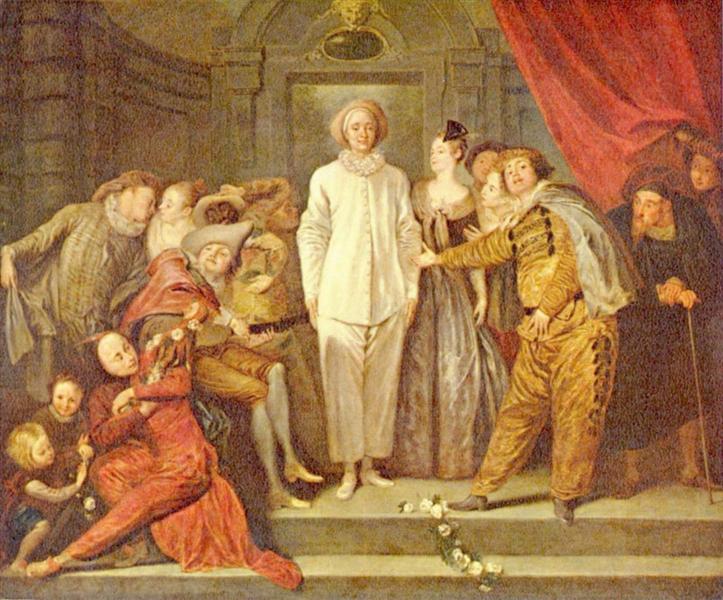
The most enigmatic of Watteau's paintings and the one most discussed by later critics. A large figure in the white silk costume of the commedia dell'arte character Pierrot stands frontally in the centre of the canvas, his arms hanging loosely at his sides, his face wearing an expression of almost total blankness. Behind and below him, on a slope, four smaller figures from the Italian comedy — a doctor, an actor in a black mask, a woman, a man on a donkey — cluster in lively conversation, seemingly ignoring him. Pierrot is at once the central figure of the painting and completely marginalised. The canvas is large — 184 by 150 centimetres — and hangs in the Louvre.
Gersaint's Shopsign 1721
Watteau's last major work, painted in eight days in the autumn of 1720 for his friend Gersaint's art dealership on the Pont Notre-Dame in Paris. It is a large horizontal canvas — 166 by 306 centimetres in total — showing the interior of the shop: customers examining paintings on the wall, a female figure kneeling to look at a painting being shown to her, and a packing crate on the floor into which a portrait of Louis XIV is being placed. The king, dead since 1715, is being packed away — the old order filed under miscellaneous. Watteau died seven months after painting it. It hangs in the Charlottenburg Palace in Berlin.
Italian Comedians 1720
A late work, probably one of the last canvases he completed before his health finally prevented sustained work. A cast of figures in theatrical costume — Pierrot, Harlequin, Mezzetin, a doctor, a scaramouche — stand on a stage taking their bow before a theatre curtain. The composition is more frontal and more theatrical than his fête galante paintings, closer to a cast portrait than a scene. The light falls from above, slightly theatrical. The figures look out at the viewer with varying degrees of invitation and resignation. It is one of the most concentrated summaries of his obsession with theatre as a condition rather than a subject.