Jacques-Louis David
He gave the Revolution its face, then gave Napoleon his myth.
Style and technique
David painted civic virtue as a visual argument. His great paintings of the 1780s — the Oath of the Horatii, Brutus, the Death of Socrates — arrive at the Salon like manifestos. They show men of ancient Rome at the moment of supreme moral choice: ready to die for a principle, choosing duty over family, meeting death with philosophical calm. French society, watching the ancien régime crumble in slow motion, understood the argument immediately.
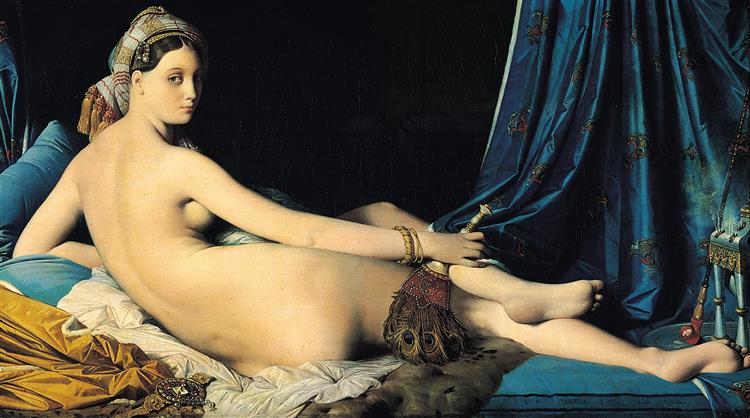
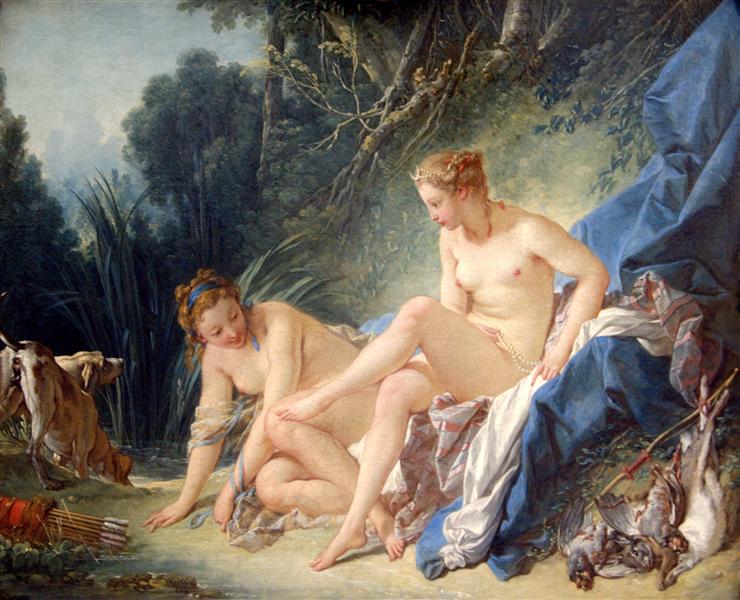
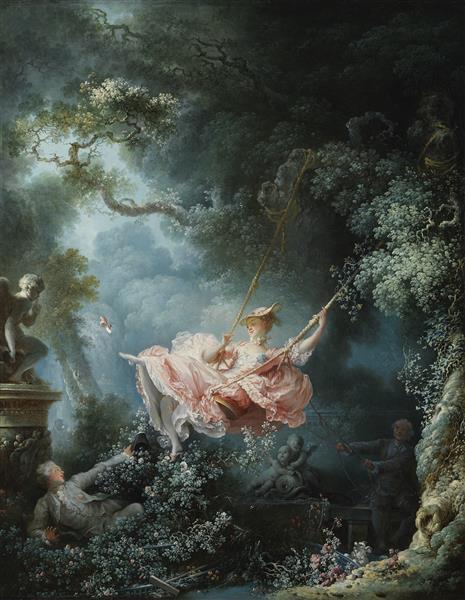
His style was forged in Rome, where he spent five years studying classical sculpture and ancient bas-reliefs. He returned with a conviction that the Rococo frivolity of Boucher and Fragonard was not merely aesthetically wrong but morally corrupt — the visual expression of an aristocratic system that deserved to collapse. Neoclassical clarity was his weapon: hard outlines, cool local colour, figures posed in profile like figures on a frieze, architectural settings of severe geometrical precision.
The compositions are calculated to produce a specific moral sensation. In the 'Oath of the Horatii' (1784), three brothers extend their arms towards three swords held by their father. The architectural arcade behind them is perfectly aligned with their outstretched arms. On the right, the women collapse in grief. The left side of the painting is all angles and tension; the right is all curves and resignation. The canvas is making an argument about what men and women respectively do.
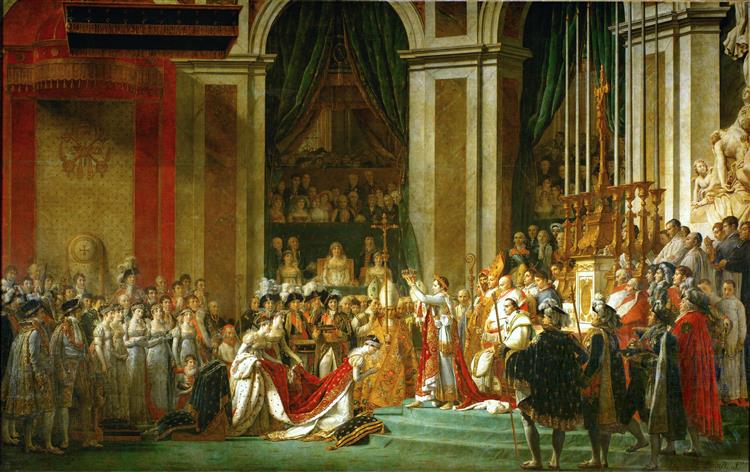
After 1799, his style bent to Napoleon's requirements. The heroic republican subjects gave way to enormous imperial pageants: 'The Coronation of Napoleon' (1807), a painting nearly ten metres wide, showing 200 identifiable individuals at the ceremony in Notre-Dame. The technique is the same — precise, cold, masterfully organised — but the moral register has reversed. This is not civic virtue but dynastic spectacle.
Life and legacy
David was born on 30 August 1748 in Paris, into a modestly prosperous merchant family. His father was killed in a duel when he was nine; he was raised by his two uncles, both architects with high cultural ambitions for their nephew. He trained under the painter François Boucher — a distant relation — and then, after failing the Prix de Rome three times, finally won it in 1774 on his fourth attempt.
The five years in Rome (1775–1780) were transformative. He arrived a competent but unremarkable painter in the late Baroque tradition and returned a convinced theorist and technical revolutionary. He had studied the ancient sculptures in the Vatican and the Capitol, had made careful copies of Raphael frescoes, and had absorbed the theoretical ideas of the German scholar Johann Joachim Winckelmann, who argued that Greek art embodied the perfect union of beauty and moral seriousness.
Back in Paris, he rose with terrifying speed. 'The Oath of the Horatii' was exhibited at the Salon of 1785 and produced the most discussed critical reaction of the decade. It was read immediately as a political statement, though David was not yet an overtly political man — the painting's theme of patriotic sacrifice had a different resonance in France of 1785 than it would have in 1793. He followed it with Socrates Drinking the Hemlock (1787) and 'Brutus Receiving the Bodies of his Sons' (1789), shown at the Salon that opened three weeks after the storming of the Bastille.
The Revolution made him. He became an active participant — voted for the execution of Louis XVI, organised the great revolutionary festivals as the visual equivalent of state pageantry, sat on the Committee of General Security during the Terror. He was the intimate friend of Robespierre, and when Robespierre fell in Thermidor 1794, David was arrested and imprisoned briefly. He narrowly escaped the guillotine.
He threw himself into Napoleon. From 1804 onwards he was the Emperor's official painter, producing the cycle of Napoleonic propaganda that included the enormous 'Coronation' and 'Distribution of the Eagle Standards'. Napoleon said David was the only painter who had understood him.
He died on 29 December 1825 in Brussels, aged seventy-seven, after being struck by a carriage. Louis XVIII had refused his request to return to France. His students — Ingres, Girodet, Gérard — were the dominant painters of the next generation.
Five famous paintings
The Oath of the Horatii 1784
David's political and aesthetic manifesto, painted in Rome and exhibited at the Paris Salon of 1785 where it caused a sensation. Three Roman brothers extend their right arms towards three swords held by their father, swearing to fight — and die if necessary — for Rome against Alba Longa. On the right, the women of the family collapse in anguish. The composition is organised with geometric severity: three arched columns, three groups of figures, the outstretched arms as the central diagonal. Nothing is ambiguous, soft, or accidental. France in 1785 understood this as a painting about what men owed their state. The French Republic acquired it in 1793; it hangs in the Louvre.
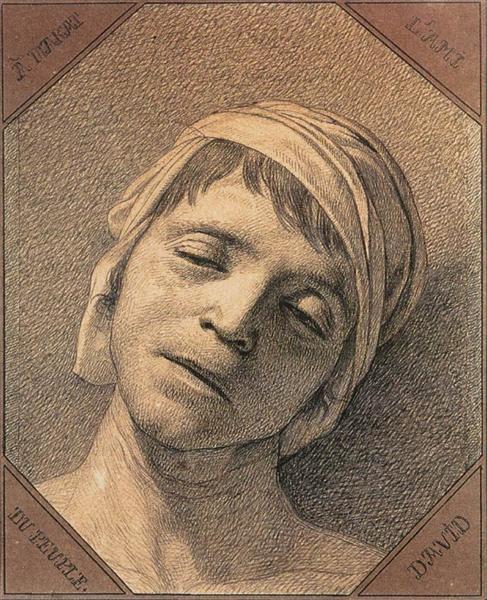
The Death of Marat 1793
Jean-Paul Marat, journalist and revolutionary, was stabbed to death in his medicinal bath by Charlotte Corday on 13 July 1793. David was sent to view the body the next day and painted this canvas within months. Marat lies back in the bath, his writing board across the edge, his hand still holding the pen he was using when she struck him. The wound in his chest is small and precise; his face is calm. The painting is stripped of almost all context — no floor, no room, no other figures, just Marat against a dark background. It was the most effective propaganda painting of the revolutionary era and the most artistically honest, because David was actually grieving.
Napoleon Crossing the Alps 1801
Napoleon commissioned five versions of this painting, all variations on the same composition: the First Consul on a rearing horse, his cloak streaming back in a high Alpine wind, his hand pointing forward. The reality of the crossing — Napoleon rode a mule — was irrelevant. David was making an image, and he made it as efficiently as possible: the horse is almost heraldic, the pose is a quotation of Titian's equestrian portraits, the sky is stormy and heroic. The stones in the foreground bear the carved names of Hannibal and Charlemagne, conquerors who crossed the same mountains. David is announcing the third name. Four of the five versions survive; the most famous hangs at Malmaison.
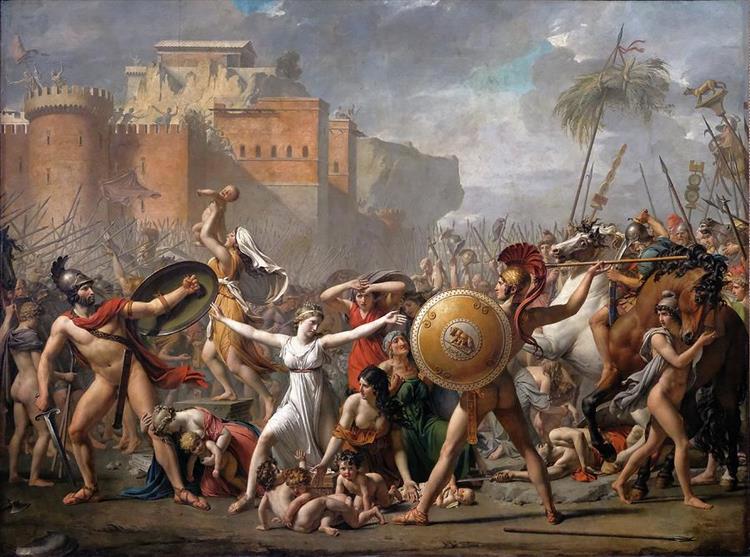
Intervention of the Sabine Women 1799
Painted during David's imprisonment after Thermidor and finished in 1799. The subject is from Roman legend: the Sabine women, seized by Romans as wives, now throw themselves between their Roman husbands and their Sabine fathers and brothers to stop the war. David explicitly intended this as a painting about reconciliation after the Terror — he had watched his Robespierrist friends go to the guillotine and his royalist friends go to the scaffold. The composition is enormous — 385 by 522 centimetres — and theatrical, with figures frozen mid-battle in sculptural poses that recall the Elgin Marbles. It hangs in the Louvre.
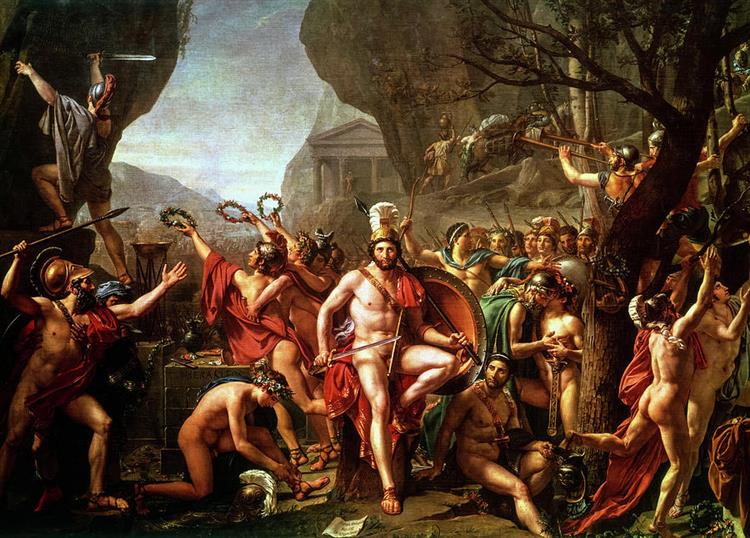
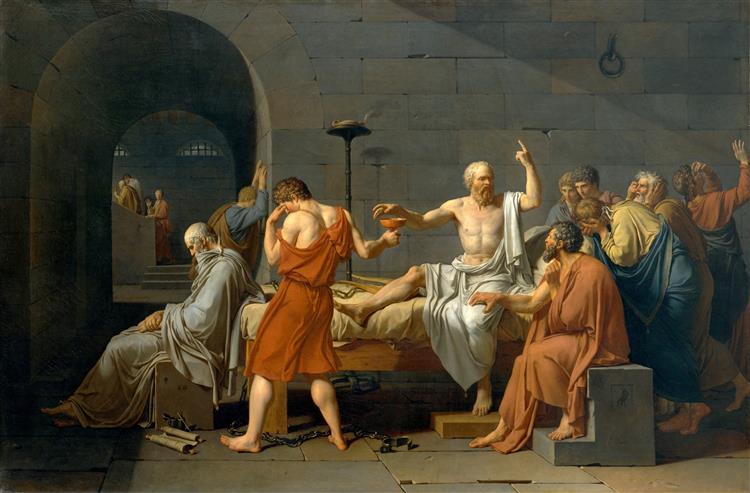
The Death of Socrates 1787
Socrates, condemned to death for impiety, raises his arm to receive the cup of hemlock while with his other hand he indicates the sky — philosophy, truth, the world of ideas. His disciples weep around him; one figure, possibly Plato, sits at the foot of the bed with his back to the scene. The composition is a moral exercise: here is a man choosing death over the betrayal of his principles. David painted it in 1787, two years before the Revolution, but the argument it makes — that the good man dies rather than compromises — would be reread in a very different light after 1789. It hangs in the Metropolitan Museum of Art in New York.