Jean-François Millet
He gave the peasant back their dignity, and the world called it radical.
Style and technique
Millet painted agricultural labour — ploughing, sowing, gleaning, haymaking — with the formal weight that earlier centuries had given to battles and coronations. He was not making political arguments; he was painting what he knew. He grew up in a Norman farming village, worked alongside field labourers, and understood the specific quality of fatigue in a body bent over a furrow. This knowledge made him dangerous to those who preferred their peasants invisible.
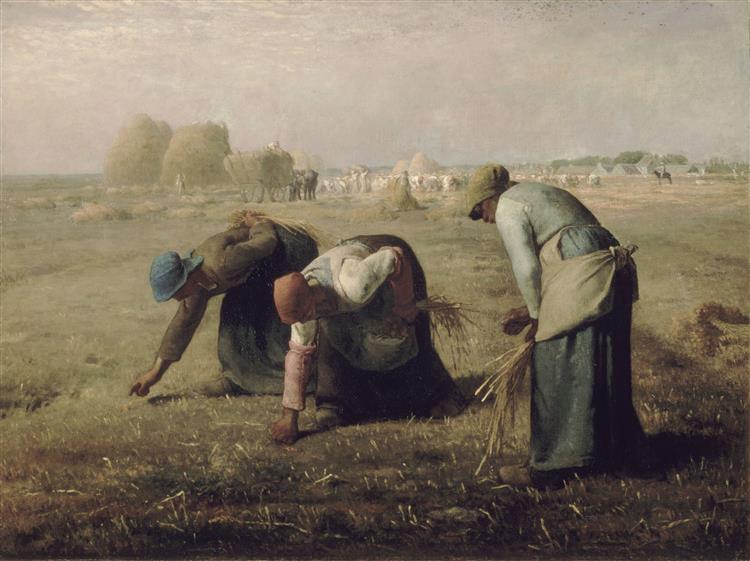
The Gleaners (1857) caused sustained unease among French conservatives not because of anything propagandistic in its treatment, but because of its scale and its formal seriousness. Three women in worn clothes picking up leftover grain after the main harvest was a painting that could not be ignored or found trivial — Millet had given it the compositional weight of a frieze, and that weight was a statement.
His colour was earthy and warm — raw umber, ochre, warm green, the particular blue of peasant cotton. He had little interest in the bright, saturated colour of the Impressionists who were forming around him in his final years. He wanted the colour of a field at dawn, which is not flashy but very specific.
Light in his paintings tends towards the oblique: early morning or late afternoon, the long low light of northern France that stretches shadows and dramatises the silhouette of a figure against a pale sky. He often silhouetted his figures against the horizon so that the shape of the body — bent, reaching, walking — carried the entire meaning.
Four markers: the silhouetted figure against a luminous sky, the agricultural implement as the visual centre (scythe, pitchfork, gleaning basket), a warm, low-light palette that unifies earth and figure, and an almost complete absence of landscape detail — his backgrounds are suggested with very few marks.
Life and legacy
Millet was born on 4 October 1814 in Gruchy, a hamlet in the Cherbourg peninsula of Normandy, the eldest son of a farming family. He grew up working in the fields and only began serious study of painting in his teens, first in Cherbourg and then in Paris, where he entered the studio of Paul Delaroche in 1837.
Paris was not easy. He was poor, unsophisticated, and found the city bewildering. He worked for years painting portraits in Cherbourg and early genre paintings — some of them erotic or Rococo in character — that he later tried to suppress. His early career bears almost no resemblance to the monumental peasant painter he would become.
The cholera epidemic of 1849 drove him from Paris. He settled permanently in Barbizon, a village at the edge of the Forest of Fontainebleau, fifty kilometres south of Paris, that was already established as a colony for painters escaping the city. His neighbour was Théodore Rousseau, the landscape painter; Charles-François Daubigny was nearby. Millet stayed in Barbizon for the rest of his life.
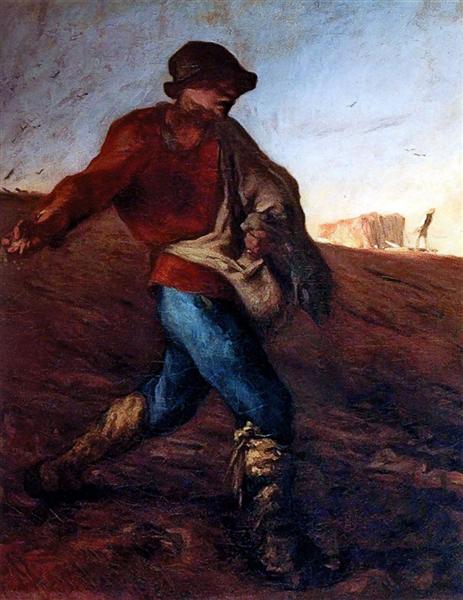
From Barbizon he could observe the agricultural labour of the Brie plain — the great flat farmland stretching south from the forest — and he began painting what he saw. 'The Sower' appeared at the Salon of 1850 and established the subject that would define his career. The Salon of 1857 showed 'The Gleaners', which generated a sustained critical and political argument: was Millet painting these women with compassion or with socialist sympathy? He always maintained he was painting with neither — just accuracy.
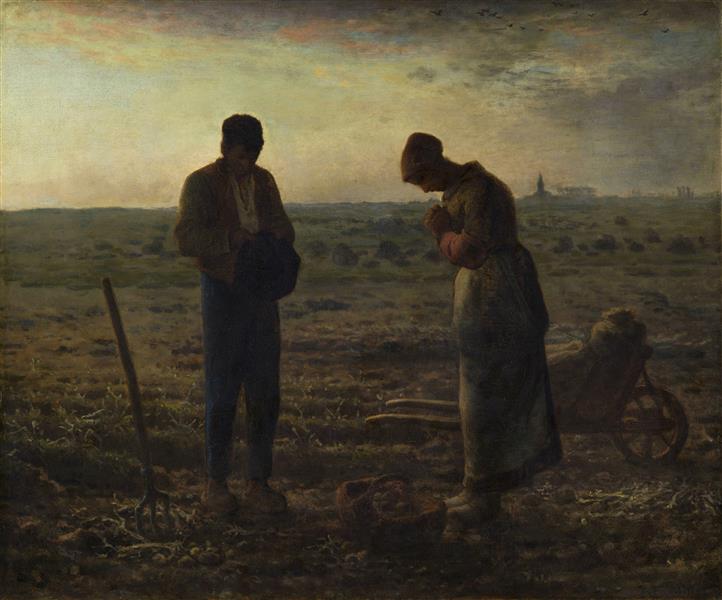
'The Angelus' was painted between 1857 and 1859 and became the most reproduced painting of the nineteenth century. It shows two peasants pausing in a potato field at the sound of the church bell sounding the Angelus prayer — the man stands with his hat in his hands, the woman bows her head. It was bought by the American Art Association in 1889 for 553,000 francs — then a world record for a painting — after a bidding war between French and American buyers. The French government eventually acquired it for the Louvre.
He died on 20 January 1875 in Barbizon, aged sixty. His direct legacy is peculiar: his peasant subjects and silhouetted figures influenced Van Gogh most decisively, and through Van Gogh the whole of early twentieth-century Expressionism carries something of Millet's formal gravity.
Five famous paintings
The Gleaners 1857
Three women — old, bent, wearing cotton headscarves and worn aprons — stoop across a harvested field picking up the leftover grain that the harvesters have left behind. In the background, barely visible through the summer haze, the main harvest piles up in golden stacks behind a mounted overseer. The foreground women are doing the ancient, permitted work of the very poor: gathering what others have left. Millet gives them the scale and the formal seriousness of monumental sculpture. The figures are almost silhouetted against the pale harvest sky. The painting caused extended political alarm in 1857 and has never quite lost its moral charge. It hangs in the Musée d'Orsay.
The Angelus 1859
Two peasants stand in a potato field at dusk, the man with his hat in his hands, the woman's head bowed, both pausing at the sound of the distant church bell ringing the Angelus prayer. A basket of potatoes and a wheelbarrow lie between them. The light is the specific failing light of a northern French late afternoon — warm, directional, catching the surface of the soil and the curve of the woman's bent back. The painting became the most reproduced image of the nineteenth century and was eventually sold in 1889 for 553,000 francs, then a world record. It hangs in the Musée d'Orsay.
The Sower 1850
A single peasant figure strides across a field at the moment of sowing, his arm raised to scatter grain. The light is the dramatic low light of either dawn or dusk — the figure is silhouetted against a luminous sky. Millet reduces the scene to its essential elements: man, motion, sky, earth. No detail is unnecessary. The figure's stride has an almost heroic authority that comes entirely from its formal simplicity. Van Gogh copied this painting multiple times, first in drawings and then in oils, and his version is in the Van Gogh Museum. Millet's original is in the Museum of Fine Arts in Boston.
The Man with the Hoe 1862
A single labourer leans on his hoe in a cleared field, his head hanging, his body expressing complete exhaustion. The earth has been broken; he has broken it. Behind him, a pale horizon. The painting is almost deliberately uncomfortable: there is nothing consoling or ennobling in this image, none of the heroic stride of 'The Sower'. This is what agricultural work looks like after hours of it. Edwin Markham's 1899 poem 'The Man with the Hoe', written in response to this painting, made it a symbol of working-class protest in America. The original is in the J. Paul Getty Museum in Los Angeles.
Shepherdess with her Flock 1864
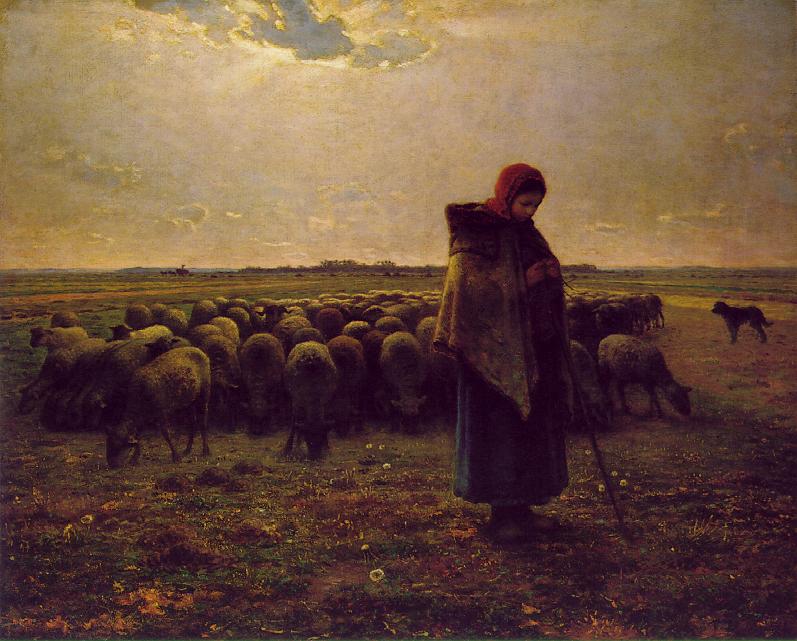
A young shepherdess stands in a landscape at dusk, a thin shadow against the pale evening sky, watching her flock of sheep in the middle distance. She knits as she watches — the particular simultaneity of idle hands and attentive eyes that is specific to pastoral labour. The sheep are rendered as a soft, grey-brown mass; she is a dark vertical against a warm horizon. Millet painted dozens of versions of this subject over his career; this one in the Musée d'Orsay is among the most fully realised, with a luminosity in the evening sky that approaches the Impressionist atmospheric painting being developed by his contemporaries.