Johannes Vermeer
Roughly 35 paintings in 21 years — and almost no documents about who he was.
Style and technique
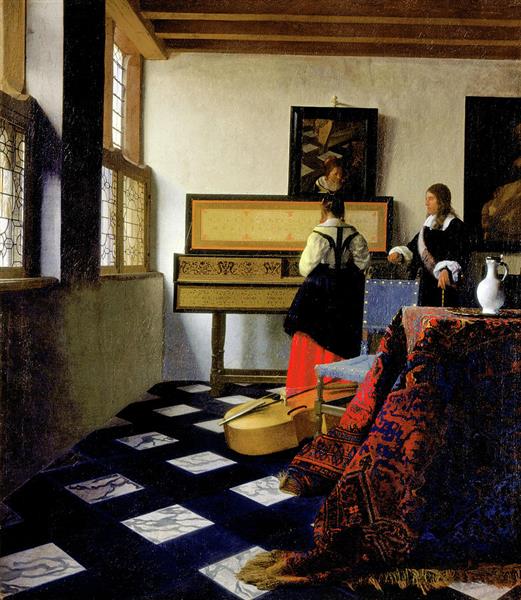
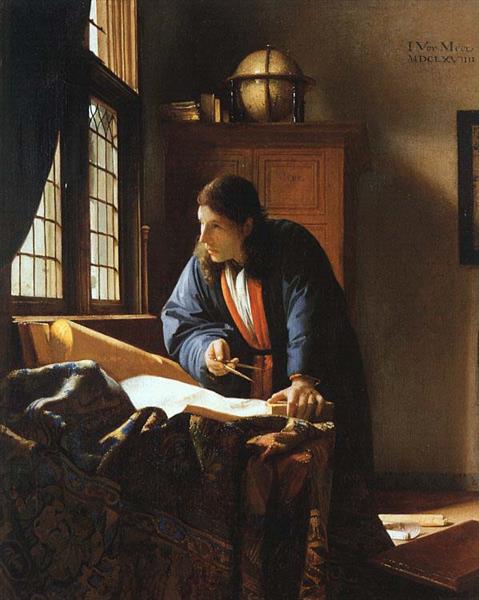
Vermeer painted silence. There are at most 35 surviving paintings by him; almost all of them depict a woman alone in a room, doing something quiet — pouring milk, weighing pearls, reading a letter, tuning a lute, looking up at the viewer. The window is always on the left. The light always falls in the same pearly, oblique way. There is rarely a sound to imagine — no horse, no crowd, no thunder, no battle.
He pulls this off with a technique that is almost photographic. He had clearly studied light the way other painters studied anatomy. Specks of brightness on the rim of a pewter jug, the violet shadow inside a cup, the way the linen of a wall hangings absorbs blue at one edge and yellow at the other — all of it is recorded with a precision that no one else in 1660 was attempting.
Four fingerprints make a Vermeer recognisable on sight.
Light from the left. Always. A window, frequently with leaded panes, on the left wall of the room, casting a soft north-facing light across the figure.
Pure ultramarine. Vermeer used ground lapis lazuli — a pigment in 1660 more expensive than gold — for his blues. He used it not just in obvious places but underneath other colours, to give shadows depth. He bankrupted his family partly because of how much he spent on pigment.
Camera-like blur. Highlights on metal jugs, on bread, on tapestry, look very specifically like out-of-focus highlights through a lens. Most scholars now agree he used a camera obscura as a compositional aid — not to trace, but to see.
Domestic interiors. Almost the entire surviving body of work is set in two or three rooms in his own house: tiled floor, leaded window, white wall, table, chair, woman.
Vermeer was forgotten for 200 years after his death. Almost no contemporary critic mentioned him. He was rediscovered in 1866 by a French journalist named Théophile Thoré-Bürger, who wrote a long essay on a 'sphinx of Delft'. Within a generation, he had moved from total obscurity to the centre of the Dutch canon. Today his paintings are among the most expensive and tightly-guarded objects in any museum in the world.
Life and legacy
Johannes Vermeer was baptised in the Reformed Church in Delft, Holland, on 31 October 1632. The exact date of his birth is unknown — Dutch protestant families baptised within a few days of birth, so he was probably born in late October. He was the son of a silk weaver who also kept an inn called Mechelen on the central market square of Delft, and who dealt in paintings on the side. His father registered with the Saint Luke's guild of painters, mostly to legalise the trading of art, and Vermeer would inherit both the inn and the trade.
We know almost nothing about his apprenticeship. There are no surviving teacher's records, no early drawings, no signed correspondence. He may have studied with the painter Carel Fabritius, also of Delft, who was killed in the catastrophic explosion of the city's gunpowder magazine in October 1654. Fabritius's death — at 32 — is one of the great might-have-beens of Dutch painting; only about a dozen of his works survive, and they are all astonishing. Vermeer was 21 when it happened.
In April 1653 he married Catharina Bolnes, the daughter of a wealthy Catholic family. The marriage required Vermeer to convert to Catholicism — controversial in Calvinist Holland and probably the reason that no record of his daily life survives in the local protestant archives. His mother-in-law, Maria Thins, was a difficult, divorced, very rich Catholic woman who lived with Catharina and Johannes in a large house on the Oude Langendijk in Delft. Maria, by all accounts, ran the household. Vermeer painted in an attic studio at the top of the building.
The Vermeers had 15 children in 21 years of marriage, of whom 11 survived to adulthood. The household was permanently overcrowded, financially shaky, and Catholic in a Protestant city.
He was, by Delft standards, respected. He was elected head of the Saint Luke's guild twice (in 1662 and 1670), a position usually given to senior painters. He worked as an art dealer, mostly trading other Dutch paintings to keep the household solvent. The few paintings he made himself were sold to a single patron, Pieter van Ruijven, a wealthy Delft merchant who eventually owned about half of Vermeer's known output. This is one of the reasons we now know so few Vermeers — most of them stayed in one house for a generation.
1672 was the disaster year — the *rampjaar*, 'disaster year' in Dutch — when France invaded the Netherlands. The Dutch art market collapsed. Vermeer could not sell his own paintings or anyone else's. The household sank into debt. Maria Thins's investments stopped paying. Vermeer began to take out loans against his house.
He died on 15 December 1675, aged 43. Catharina, his widow, told the bankruptcy court that he had 'in a day or a day and a half' fallen ill and died — almost certainly of a stroke or a heart attack triggered by financial despair. She declared bankruptcy, surrendered most of his paintings to creditors, and kept only two: 'The Art of Painting' and a portrait of her own mother. Both were eventually sold to pay debts.
For two centuries he was a footnote. Then in 1866 a French art critic and revolutionary, Théophile Thoré-Bürger, published a series of long articles in the Gazette des Beaux-Arts arguing that an unknown Dutch painter named Vermeer was one of the great masters of the 17th century. He attributed about seventy paintings to Vermeer; modern scholarship has narrowed that number to around 35, and that figure is contested by perhaps three or four works.
The Mauritshuis in The Hague holds three Vermeers, including 'Girl with a Pearl Earring' and 'View of Delft'. The Rijksmuseum in Amsterdam holds four, including 'The Milkmaid' and 'Woman Reading a Letter'. The rest are scattered across roughly 30 collections, from the National Gallery in Washington to a private island in Tokyo. The 2023 Vermeer exhibition at the Rijksmuseum brought together 28 of them under one roof — the largest gathering since the painter's lifetime, and possibly ever.
Five famous paintings
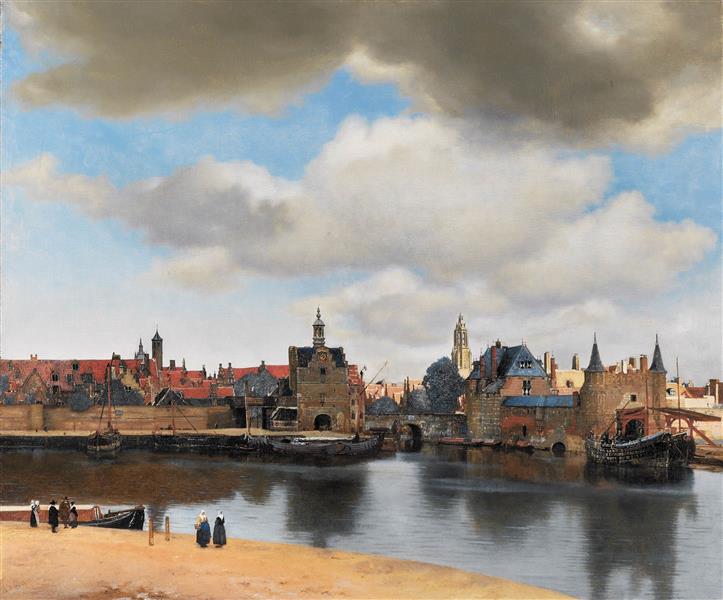
View of Delft 1661
Vermeer painted his own city, from the southern bank of the river Schie, on a cool overcast morning around 1661. The clouds are massed but breaking; one beam of sunlight catches the red roofs of the New Church on the right. Almost nothing happens in the painting — five tiny figures stand on a quay in the foreground; a few boats are moored; smoke rises from one chimney — and yet it is one of the most loved cityscapes ever painted. Marcel Proust spent the last years of his life thinking about this painting. He wrote it into 'In Search of Lost Time' as the painting in front of which a character collapses with a heart attack, having seen 'a small patch of yellow wall' so beautiful he realises he should have written differently. The painting hangs in the Mauritshuis in The Hague.
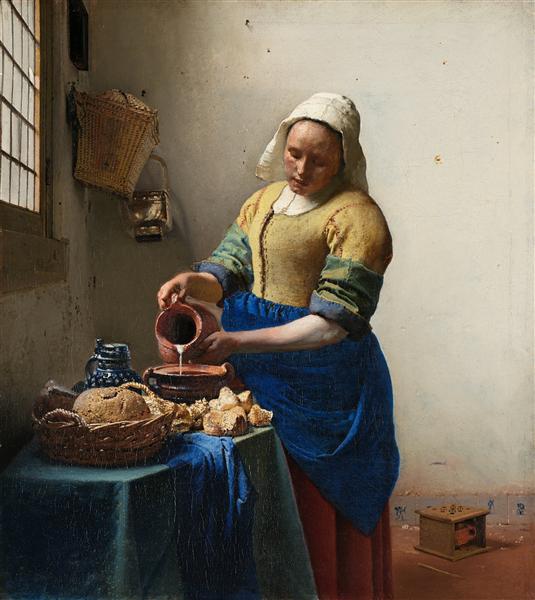
The Milkmaid 1660
A maid stands at a wooden table, pouring a thin stream of milk from a brown jug into an earthenware bowl. The window — leaded panes, a small chip in the upper right corner that he painted in detail — sends pearly daylight across her bare arms and her white linen cap. The bread on the table is broken, with crumbs you can almost count. The wall behind her is empty. Vermeer used real lapis lazuli for the apron — the most expensive pigment available in 1660, used here for an apron, on a kitchen maid, with no irony. The painting is roughly 45 cm × 41 cm and hangs in the Rijksmuseum in Amsterdam, in a room of its own.
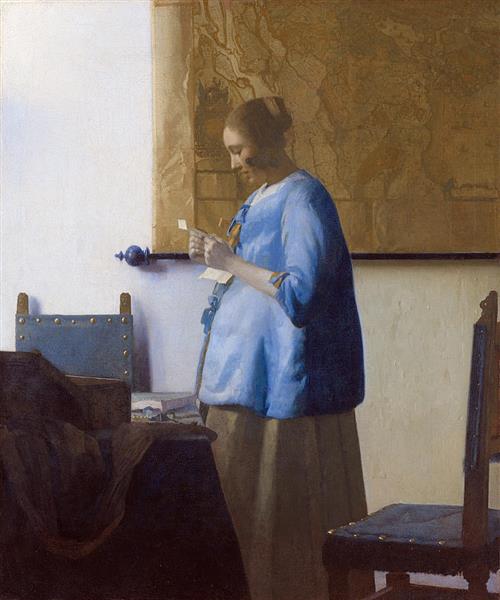
Woman Reading a Letter 1663
A young woman, possibly pregnant, stands in profile by a table reading a letter. The room is again Vermeer's own house: a chair on the right, a map of Holland behind her, the leaded window casting its left-hand light. The painting is one of the great quiet domestic scenes in Western painting — utterly undramatic, utterly absorbing. Recent restoration of a closely related painting in Dresden — also a 'Woman Reading a Letter' — revealed that Vermeer originally painted a Cupid figure on the wall behind her, and then painted over it. He often did this: the painting we see is rarely the painting he started. This particular version is in the Rijksmuseum, Amsterdam.
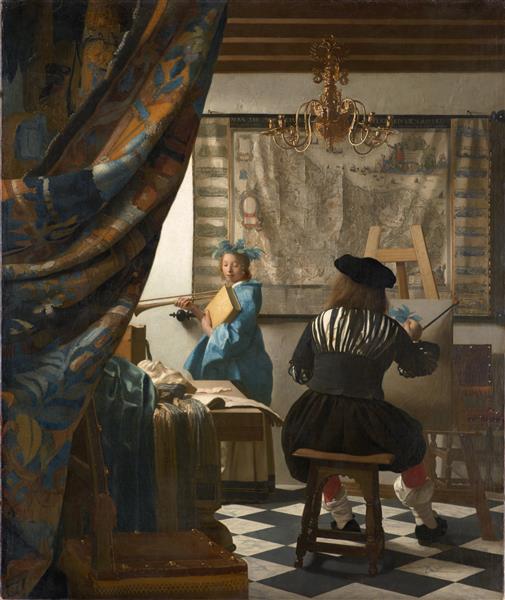
The Art of Painting 1668
Vermeer's largest and most ambitious painting, and one of only two he kept in his own house at his death. A painter — seen from behind, in stockings and a slashed doublet — sits at his easel painting a young woman dressed as Clio, the muse of history, holding a trumpet and a book. A heavy curtain pulls back on the left to let the viewer in. A map of the seventeen Dutch provinces hangs on the wall. Vermeer is reflecting on what painting itself is for: it makes the muse of history visible. The painting was Maria Thins's most prized possession; she held on to it through her son-in-law's bankruptcy. It is now in the Kunsthistorisches Museum in Vienna, Hitler's favourite painting and one of the most heavily insured works in the world.
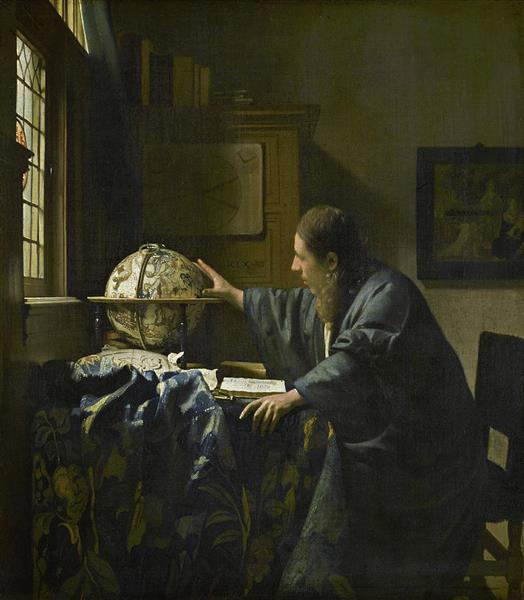
The Astronomer 1668
An astronomer — usually identified as Vermeer's friend and Delft contemporary, the microscopist Antonie van Leeuwenhoek, though the resemblance is debated — leans towards a celestial globe, his right hand resting on it, deep in concentration. A book is open beside him, the window on the left throws light across his blue robe. The painting is the companion piece to 'The Geographer', also in our collection: same model, same room, same light, two scenes of a man pursuing knowledge. 'The Astronomer' was looted by the Nazis in 1940 from a Rothschild collection in Paris; recovered after the war, it is now in the Louvre.