Edward Hopper
He painted the loneliness of America with the geometry of an architect.
Style and technique
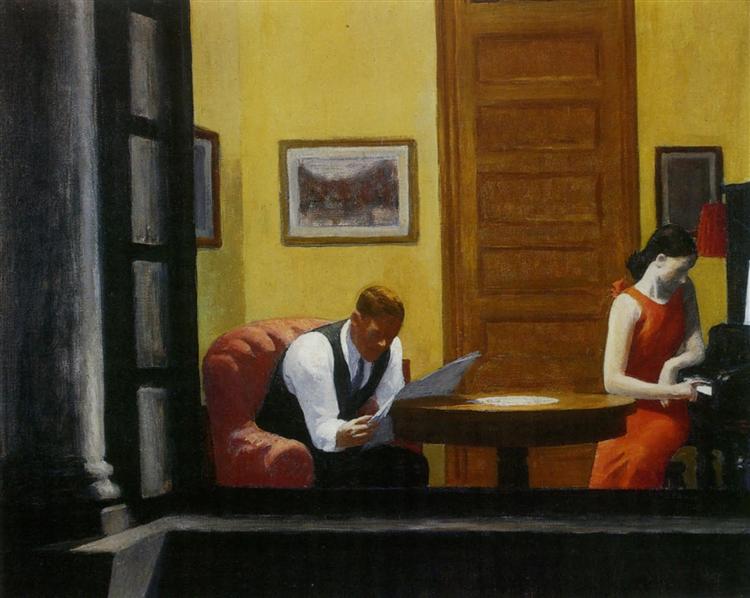
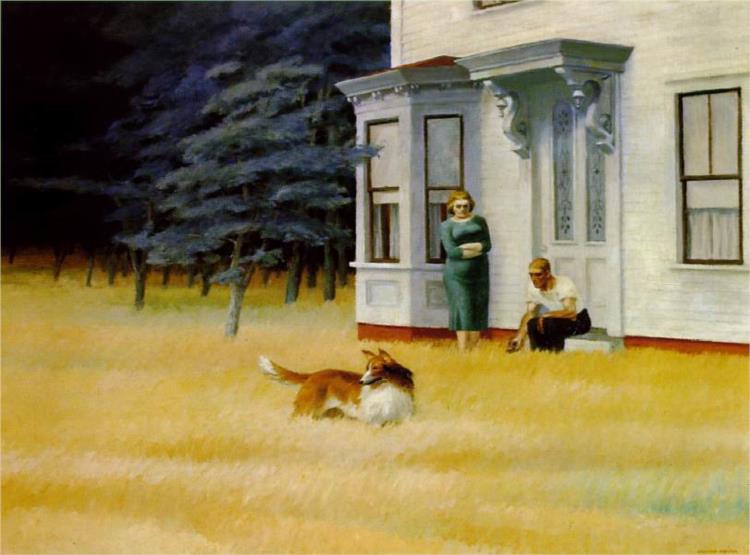
Hopper paints silence at noon. Or silence at three in the morning, in a diner, with one couple at the bar and a man drinking coffee alone. The defining feeling of his work is a strong, oblique sunlight falling across an empty room, and one or two figures inside that light who are not speaking to each other.
He was a Realist working through the decades that produced Cubism, Surrealism and Abstract Expressionism, and he ignored all three. He had been to Paris three times before 1910 and had seen everything Picasso was painting; he came back to America and decided the only thing worth doing was painting rooms with windows in them.
Four fingerprints make a Hopper unmistakable.
Geometric blocks of light. Sunlight falls in clean rectangles across walls, floors and faces. The light is always specific to a time of day — morning, late afternoon, after midnight — and it does almost as much narrative work as the figures.
Solitude as a subject. Even when there are two people in the painting, they don't look at each other. Couples in restaurants stare past one another. A woman reads alone in a hotel bed; a man eats alone in a diner. The empty space around the figures is not a compositional accident; it is the meaning.
American architecture as a character. Victorian houses, gas stations, cinema interiors, rooftops, fire escapes, motel rooms. He treats the buildings of inter-war America with the same patience an Italian Renaissance painter gave to columns and arches.
Tight, almost rigid composition. He spent weeks on each painting, working through dozens of preparatory drawings. The buildings line up at exact angles. Figures sit dead-centre in their windows. Nothing moves.
His wife Jo (Josephine Nivison) was his only female model for forty-three years. He painted her hundreds of times, and she kept a detailed diary of every painting he made. The diary is now the single most important source for dating and understanding his work.
Life and legacy
Edward Hopper was born in Nyack, New York, on 22 July 1882, the son of a small dry-goods merchant. The family was Baptist, prosperous enough, and uncomfortable in a quiet way — Hopper's father had failed in business, and Edward grew up thin, awkwardly tall (he reached 1.93m), and almost incurably shy.
He took the boat down the Hudson to Manhattan in 1899 and enrolled at a commercial illustration school. From there he moved to the New York School of Art, where he studied under the painter Robert Henri for six years. Henri taught him to paint the city as it was — saloons, tenements, working people — and to look hard at Manet and Edgar Degas. The lessons stuck.
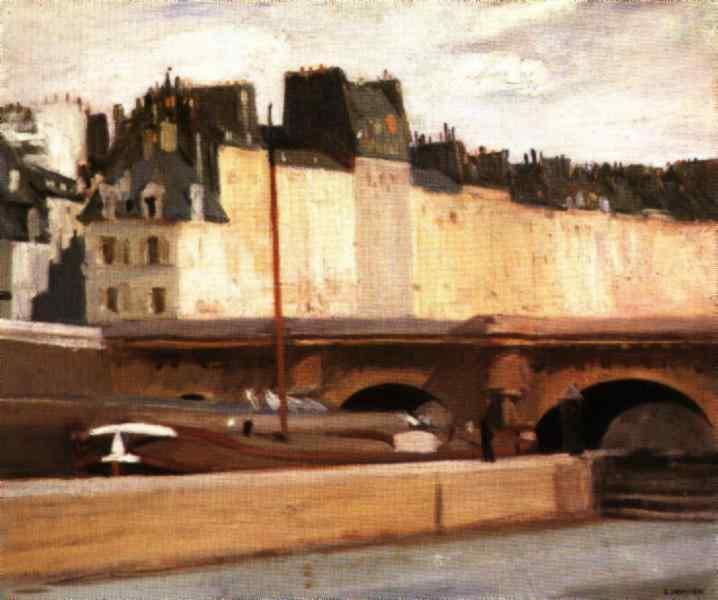
Between 1906 and 1910 Hopper took three trips to Paris, paid for partly by his parents and partly by commercial illustration work. He saw the early Cubists, the late Impressionists, the salons. He came back to New York and decided, almost stubbornly, that none of it was for him. He would paint American rooms in American light. Nothing else.
He finally exhibited a single painting at the 1913 Armory Show — the famous exhibition that introduced European modernism to the United States — and sold it for $250. He sold no other oil painting for the next ten years. He paid the bills by drawing covers for trade magazines aimed at hotel chefs and shipping clerks. He hated the work and was too good at it to refuse.
In 1920, aged 38, his first one-man show at the Whitney Studio Club sold one watercolour. In 1923 he met Josephine 'Jo' Nivison, a former classmate from the Henri school, on a sketching trip to Gloucester, Massachusetts. She was 41, painted in watercolour, and was already in his old circle. They married the next year. He was 42; she was 43. Children were no longer possible. They moved into a fourth-floor walk-up at 3 Washington Square North in Manhattan, and lived there for the next 54 years.
The marriage was a strange compact: Hopper was famously taciturn, sometimes outright cold; Jo was talkative, voluble, and gradually subordinated her own painting career to manage his. From 1924 onwards she was his only female model. Every female figure in every Hopper — the woman at the lunch counter, the redhead in 'Nighthawks', the nude in 'Eleven A.M.', the bored hotel guest in 'Western Motel' — is Jo, posed in his studio in different wigs.
From 1924 onwards his career suddenly moved. The Brooklyn Museum bought a watercolour. Galleries took him on. He gave up illustration and never went back. His subject matter remained almost monomaniacally constant: empty streets at night, lighthouses, motels, gas stations, women looking out of windows.
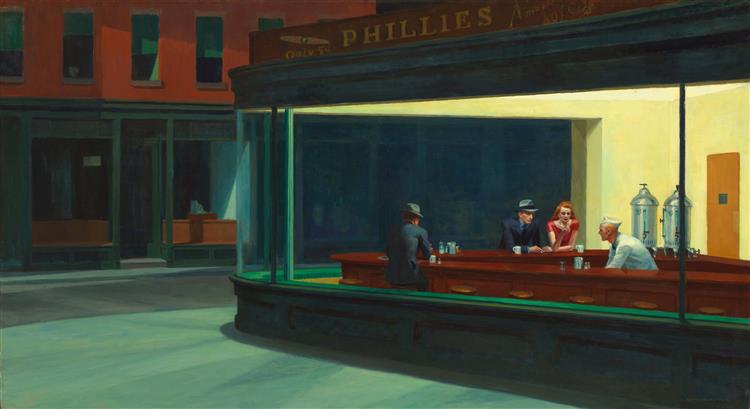
'Nighthawks' was painted in early 1942, in the weeks immediately after the attack on Pearl Harbor. Jo posed for the redhead. The diner is invented but loosely based on a corner restaurant on Greenwich Avenue in the Village. The Art Institute of Chicago bought it that May for $3,000.
The rest of his life is unusually quiet. Summers in Truro, Cape Cod, in a small house Hopper had built himself in 1934. Winters in Washington Square. A handful of paintings each year — three, four, sometimes only one. By the late 1950s he was the most famous living American Realist, but he was bypassed by the rise of Abstract Expressionism and almost forgotten in the critical conversation. He kept painting.
He died on 15 May 1967, aged 84, in his Washington Square studio. Jo died ten months later. She left almost the entire surviving estate — about 3,000 works — to the Whitney Museum of American Art, which now holds the largest collection of his work in the world. Many of the paintings she had made herself were lost in the years after her death, dismissed by curators as 'minor'. A new wave of scholarship is gradually recovering them.
Five famous paintings
Automat 1927
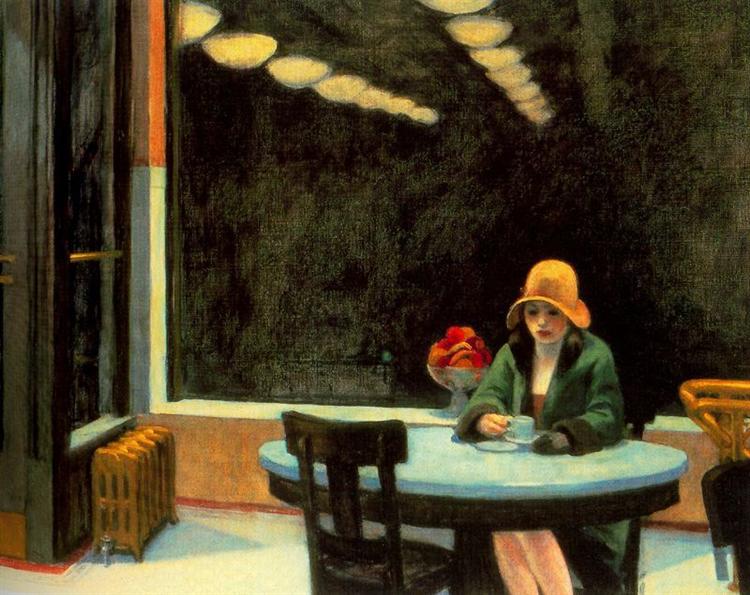
An early Hopper, painted in the second year of his marriage. A young woman in a green coat and yellow cloche hat sits alone at a small round table in an automat — a self-service cafeteria where you put nickels in a slot to open a small glass door and take out a sandwich. She has taken off one glove. She holds a cup of coffee in both hands. Her face is averted. Behind her, the windows of the automat are completely black, and the reflected ceiling lights stretch off into the distance like two diminishing strings of pearls. There is no other person in the room. Hopper has placed her in a perfect rectangle of warm yellow light against a pure black void. The painting hangs in the Des Moines Art Center.
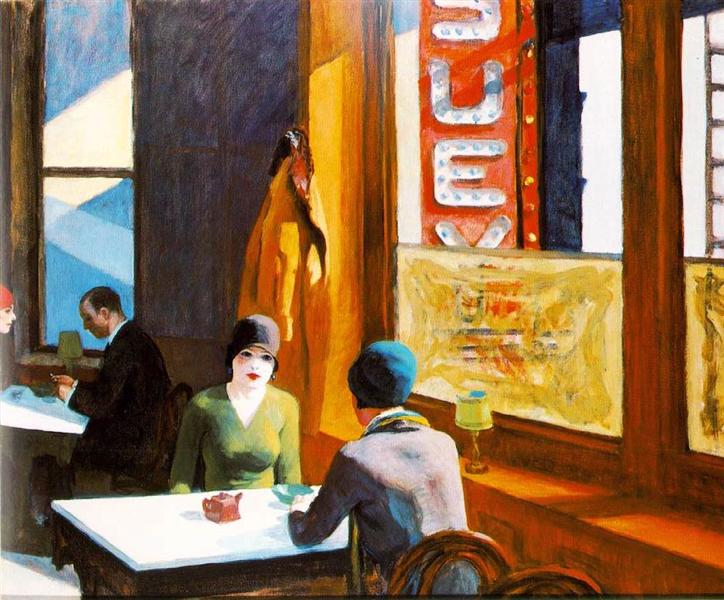
Chop Suey 1929
Two women sit at a small table in a Chinese restaurant in Manhattan. The one closest to us — Jo, recognisable by the cheekbones — looks across at her companion, who looks back at her. They are the only thing in a Hopper that looks even faintly like a conversation. Outside the window, a hot patch of afternoon sunlight throws a heavy yellow rectangle across the wall above their heads. A red Chinese letter on the painted glass — half visible, the bottom of the character cut off — reads SUEY. The painting was bought by a private collector in 1929 and stayed in the same family for 89 years before selling at auction in 2018 for $91.9 million, a record for a pre-war American painting.
Gas 1940
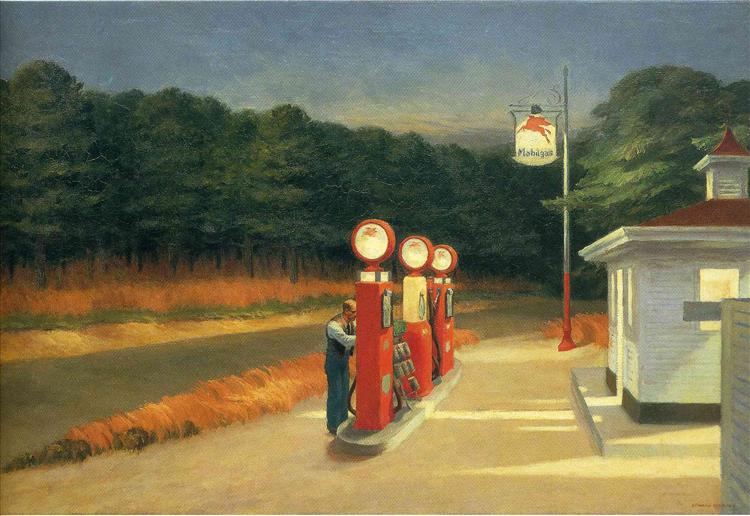
A petrol station at the edge of a forest, at sunset. Three Mobilgas pumps, painted with the trademark red flying horse, stand in front of a small white building. A single attendant in a tie and waistcoat stands beside one of the pumps, his back to us, doing something with the nozzle. There is no car. The road runs into the dark trees and disappears. The painting is about the moment when the day's traffic has ended and the man at the pump is alone with the woods. Hopper had taken several driving trips around New England in the late 1930s; this is the kind of station they used. It is in the Museum of Modern Art.
Nighthawks 1942
A late-night diner on a corner in lower Manhattan. Three customers — a man and a woman seated together, a man in a fedora drinking coffee alone — sit at the curved counter. A counterman in a white uniform leans down to retrieve something. There is no door. There is no exit from the diner. There is no other person on the empty street outside. The redhead is Jo. The painting was made in the early winter of 1942, eleven weeks after Pearl Harbor. Hopper said later that he had been thinking, simply, of 'a restaurant on Greenwich Avenue where two streets meet'. It is in the Art Institute of Chicago, where it has been since the year it was painted.
Morning Sun 1952
Late-period Hopper, painted when he was 70 and Jo was 71. A single woman — Jo, in a pink slip — sits on a narrow hospital-style bed in an otherwise empty bedroom, her arms wrapped around her knees, looking out of the window. The window itself is large, low, and full of intense direct morning sunlight which falls across her bare arms and the sheet at the foot of the bed. There is no other furniture. The wall is empty. The view from the window is just a corner of a brick building. The painting is the closest he ever came to making a portrait of his marriage: forty years in the same apartment, looking at the same view, in the same light. It is in the Columbus Museum of Art, Ohio.