Théodore Géricault
He turned a real shipwreck scandal into painting's most devastating indictment of power and privilege.
Style and technique
Géricault's art fuses the structural discipline of Neoclassicism with the emotional violence and painterly drama of the Baroque, making him a pivotal hinge between Jacques-Louis David's generation and the full flowering of French Romanticism. Trained under the Neoclassicist Pierre-Narcisse Guérin, he rebelled against academic decorum, gravitating instead toward Rubens, Rembrandt, and Michelangelo, whose churning compositions and dramatic chiaroscuro he absorbed on a formative trip to Italy. Light in his paintings rarely falls evenly: it rakes across straining muscles, isolates a single anguished face within a crowd, or picks out a corpse's grey flesh against darkness, heightening tension rather than clarifying form.
What set Géricault apart from his contemporaries was his refusal to reserve grand-manner painting for myth, religion, or ancient history. He applied history painting's full scale and moral seriousness to a contemporary news story in The Raft of the Medusa, and later to unglamorous modern subjects like horse racing and criminal insanity, implicitly arguing that ordinary and marginal lives deserved the same pictorial gravity once reserved for kings and gods. This unflinching realism extended to the body itself: he sketched cadavers, amputated limbs, and the dying to get anatomy and the exact color of decaying flesh right, refusing to soften mortality for the viewer's comfort.
His portraiture, especially the late series painted for a Parisian psychiatrist, shows a comparable psychological intensity, trading idealized likeness for close, almost diagnostic observation of real faces marked by suffering and obsession. Meanwhile his lifelong passion for horses, sharpened by his own considerable skill as a rider, gave his paintings their signature coiled, dangerous energy, animal and human anatomy rendered with equal, hard-won expertise.
Life and legacy
Jean-Louis André Théodore Géricault was born in Rouen in 1791 to a wealthy family whose fortune, built partly on the tobacco trade, freed him from ever needing to sell paintings for a living. Raised largely in Paris, he showed an early passion for horses and drawing rather than academic discipline, training first under the fashionable equestrian painter Carle Vernet and then under the stricter Neoclassicist Pierre-Narcisse Guérin, though he chafed against both men's polish and convention. A journey to Italy in 1816-17 exposed him to Michelangelo and the Roman Baroque, deepening his taste for dramatic scale and muscular, straining bodies over cool classical restraint.
Géricault's defining work, The Raft of the Medusa, grew directly out of one of the great political scandals of the Bourbon Restoration. In 1816, the French naval frigate Méduse ran aground off the coast of West Africa; its captain, a returned royalist émigré appointed through court patronage rather than competence, commandeered the lifeboats for officers and cut loose a makeshift raft carrying more than 150 soldiers and passengers.
Géricault pursued the subject with near-obsessive rigor: he interviewed survivors, had a carpenter build a scale model of the raft in his studio, and visited the Beaujon hospital and morgue to sketch corpses and severed heads and limbs, studying the exact discoloration of dying flesh. The finished canvas, over sixteen feet wide, read less as a rescue scene than as an accusation, and its unveiling at the 1819 Salon detonated as a direct assault on a negligent, incompetent monarchy, even as officials tried to defuse its politics by quietly awarding it a medal.
In his final years, Géricault turned his unsparing eye inward, toward madness itself. Working with the pioneering psychiatrist Dr. Étienne-Jean Georget at the Salpêtrière and Bicêtre asylums, he produced a series of portraits of patients, each diagnosed with a single obsessive monomania, painted not as grotesques but as individuals worthy of serious study, part of Georget's broader effort to argue that mental illness was a medical condition rather than moral failing or criminal taint.
He never lived to see his reputation fully secured. An expert but reckless horseman, he suffered severe internal injuries from repeated riding falls, aggravating damage to his spine that left him bedridden and in agony for months.
Within a decade, however, the younger Eugène Delacroix, who had posed as one of the dying figures on the raft, openly credited him as Romanticism's founding genius, and Géricault's premature death only cemented his legend as the movement's brilliant, doomed forerunner.
Five famous paintings
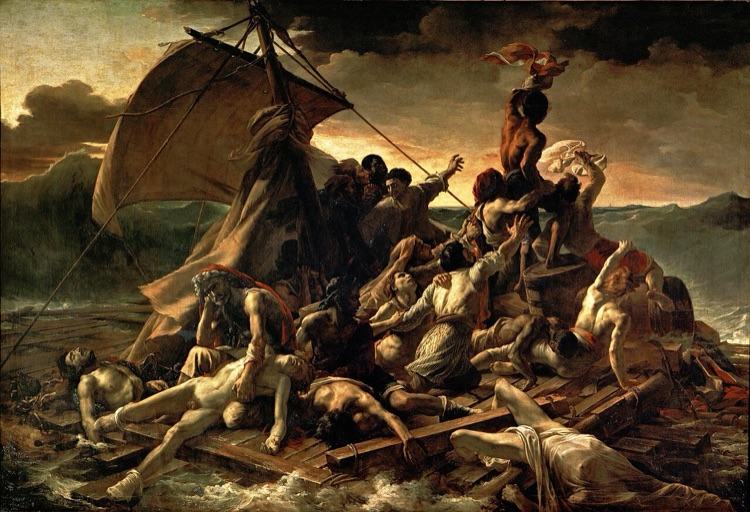
The Raft of the Medusa 1818-1819
Géricault's monumental masterpiece reimagines the horrifying aftermath of the 1816 wreck of the French frigate Méduse, whose incompetent captain, appointed through court patronage, abandoned over 150 people to a makeshift raft. After thirteen days of starvation and cannibalism, only fifteen survived. Géricault interviewed survivors, built a scale model of the raft, and studied corpses and severed limbs from the Paris morgue to render flesh with clinical accuracy. The pyramidal composition surges toward a distant rescue ship, fusing Baroque drama with political outrage — an indictment of a negligent monarchy that scandalized the 1819 Salon.
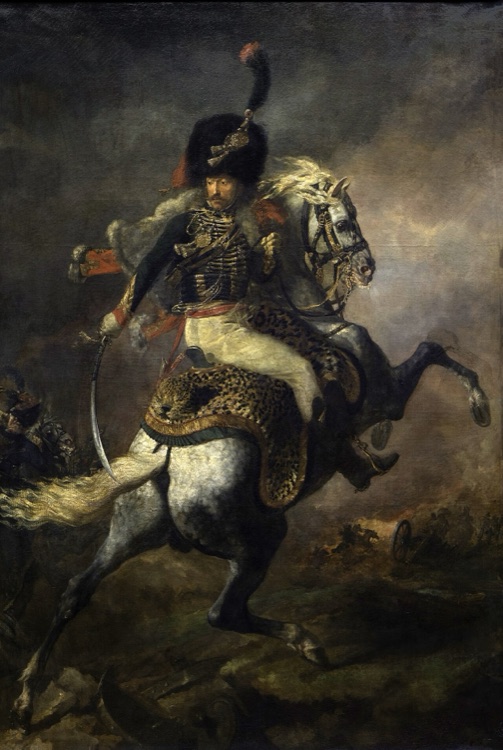
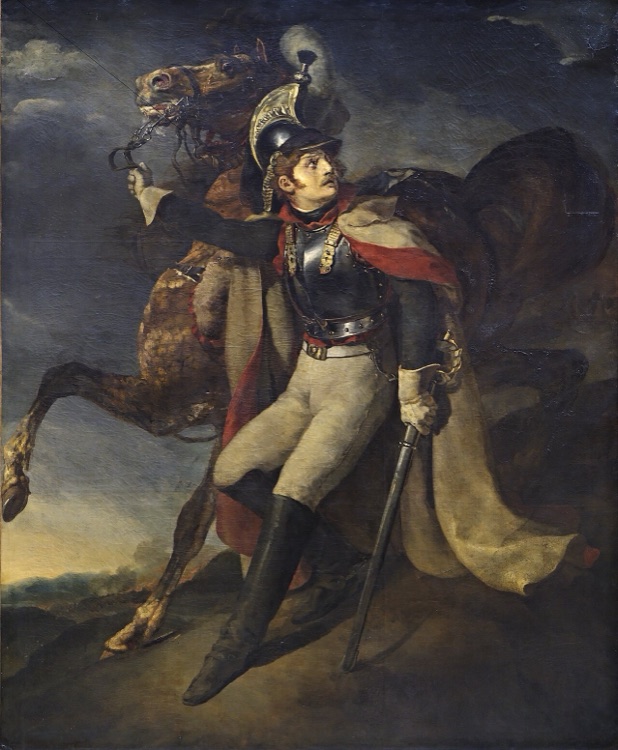
The Charging Chasseur 1812
Painted when Géricault was just twenty-one, this electrifying canvas — also known as Mounted Officer of the Imperial Guard — announced a radical new voice at his first Salon. A cavalry officer twists in his saddle atop a rearing horse, sabre raised, smoke and cannon fire churning behind him. Rather than Neoclassicism's cool clarity, Géricault reached for Rubens and the Baroque: raking light, torqued anatomy, a sense of imminent catastrophe. Drawing on his own skill as a horseman, he captured equine muscle with rare precision, fusing horse and rider into one convulsive unit of energy — a premonition, in hindsight, of Napoleon's coming collapse.
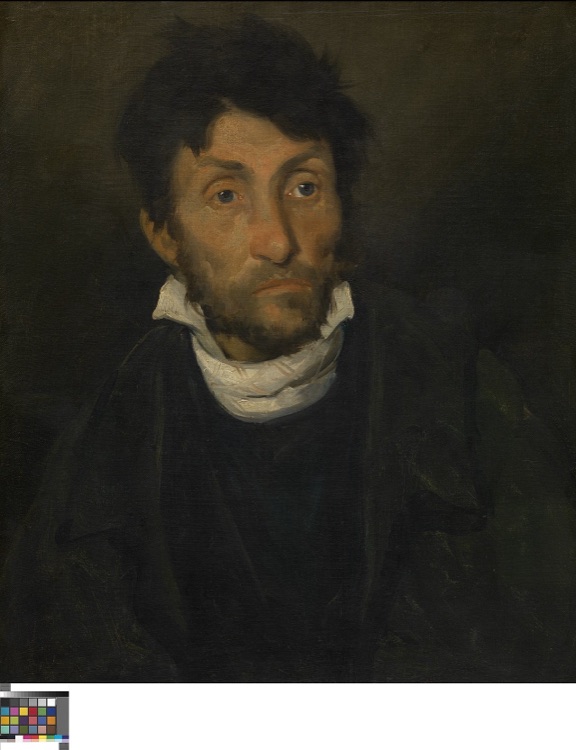
Portrait of a Kleptomaniac c. 1822
Commissioned by the psychiatrist Dr. Étienne-Jean Georget, this portrait belongs to a series of ten, of which five survive, each depicting an asylum patient gripped by a single isolated mania — theft, envy, gambling, command, kidnapping. Painted with the same precision Géricault brought to the Medusa's corpses, the sitter's reddened eyes, slack mouth, and rumpled collar convey not caricature but exhausted humanity. There is no theatrical madness here, only a tired, watchful man caught in quiet suspicion. Made in Géricault's final years, the series anticipates modern psychiatric portraiture and his clinical fascination with the mind's fractures.
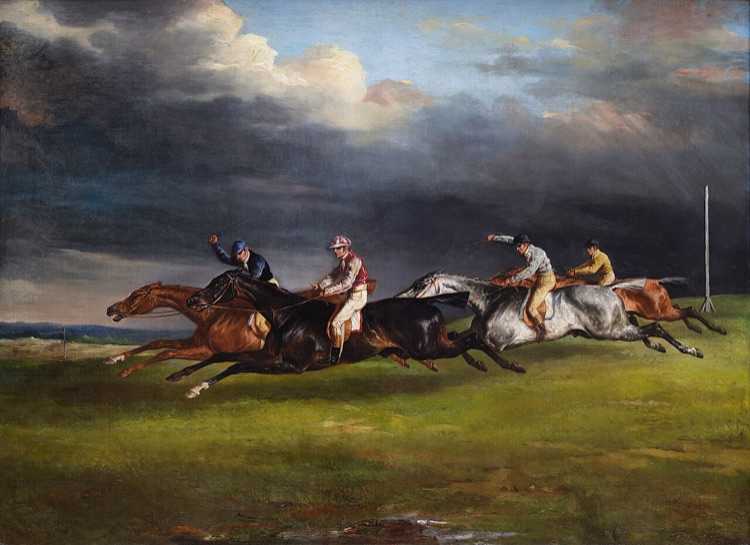
The Epsom Derby 1821
Painted during Géricault's stay in England, this sparkling depiction of a horse race at Epsom Downs captures four racehorses stretched into full gallop, legs extended fore and aft in the era's conventional "flying gallop" pose, later disproven by photography yet visually thrilling all the same. Low storm clouds and glinting wet turf lend the scene a theatrical, feverish energy, while the jockeys' brilliant silks punctuate its sweeping horizontal composition. An accomplished rider himself, Géricault brought genuine equestrian knowledge to the subject, treating a modern sporting spectacle with the ambition he once reserved for history painting.
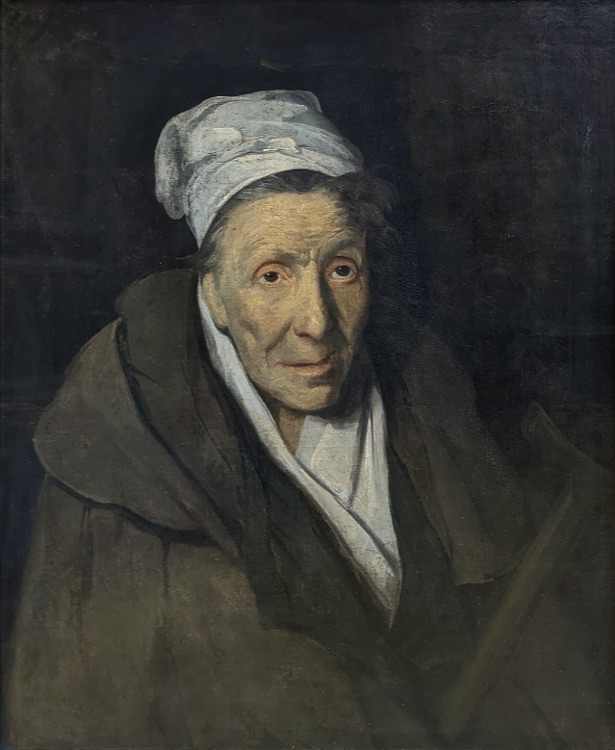
A Woman Addicted to Gambling c. 1822
Another of the Salpêtrière "monomaniac" portraits made for Dr. Georget, this canvas confronts a woman whose sunken, hooded eyes and pursed mouth suggest years of compulsive ruin. Rendered in the same somber palette as its companion portraits, the painting refuses both pity and mockery, granting its subject an unsettling dignity instead. Géricault's brushwork is loose yet exact, built from close observation — evidence of real time spent with patients, not generic "mad" stereotypes inherited from earlier art. Painted shortly before his death, it is among the first sustained attempts to depict mental illness as individual experience rather than moral failing.