How to recognise a Klimt in five seconds
Gold that isn't paint, two different patterns for two different people, and skin as the only thing in the picture allowed to be round.
Klimt is the painter people recognise without knowing they do — the gold, the embrace, the poster above a thousand sofas. Underneath the decoration there is a method, and it is consistent enough that three tells will catch him on almost any canvas from his golden decade.
The three tells
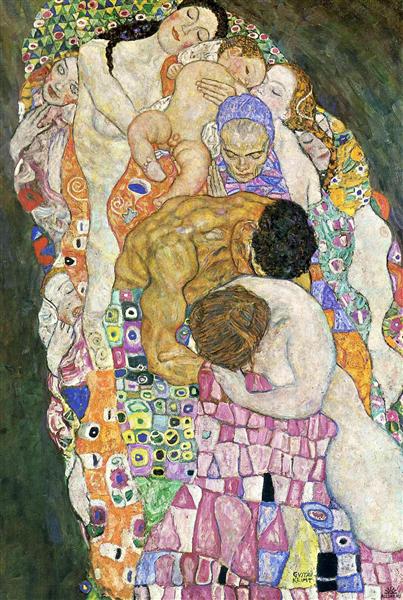
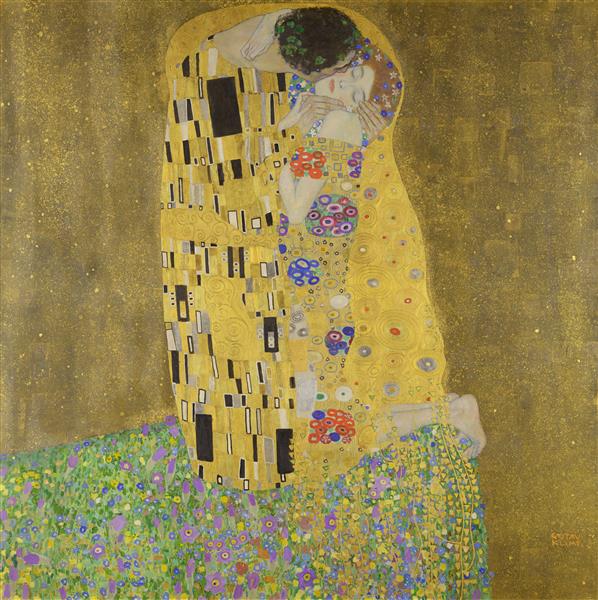
First, the ground is flat. No horizon, no room, no cast shadow — just a field of gold that the figures sit on rather than in. Second, pattern does the characterising: in The Kiss the man is wrapped in hard black-and-white rectangles while the woman is covered in circles, ovals and flowers, so you can tell who is who without seeing a face. Third, modelling is rationed. Faces, hands, feet, a shoulder — those are painted as ordinary three-dimensional flesh. Everything else stays as flat as wallpaper. A modelled head on a flat gold body is the Klimt signature.
He wasn't gilding the picture. He was refusing to pretend the surface was a window.
Why it works
Western painting since the Renaissance had treated a canvas as a window: depth, perspective, a believable room behind the frame. Klimt's gold does the opposite — it insists the picture is a flat, decorated object, the way a Byzantine mosaic or a medieval icon does. His father was a gold engraver, so the material was family trade before it was style, and the mosaics he saw in Ravenna gave him the licence. Keeping the faces and hands modelled is what makes it bite: real people, pressed into ornament.
In 1897 Klimt walked out on Vienna's artistic establishment and founded the Secession, whose motto is still carved above its door: To every age its art, to art its freedom. He was its first president. A century later his portrait of Adele Bloch-Bauer became, briefly, the most expensive painting ever sold.
Ready to test your eye?
Try spotting a Klimt against 1,389 paintings by 118 painters.
Play the quiz →One trap: Vienna 1900
Egon Schiele was Klimt's protégé, and the two hang together in every Vienna 1900 exhibition — which is exactly why people confuse them. The split is easy once you know it: Klimt decorates, Schiele strips. Klimt gives you gold, pattern and closed-eyed calm; Schiele gives you a raw contour line, twisted limbs, sour greens and bare canvas left showing. If the surface is lavish, it's Klimt. If it's uncomfortable, it's Schiele.
More by Klimt