Egon Schiele
He drew the body from the inside out — all nerve endings and no skin.
Style and technique
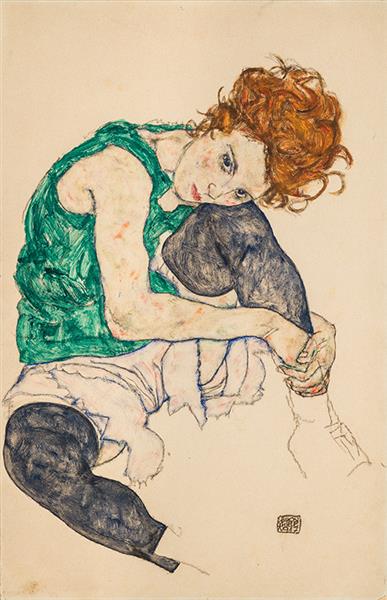
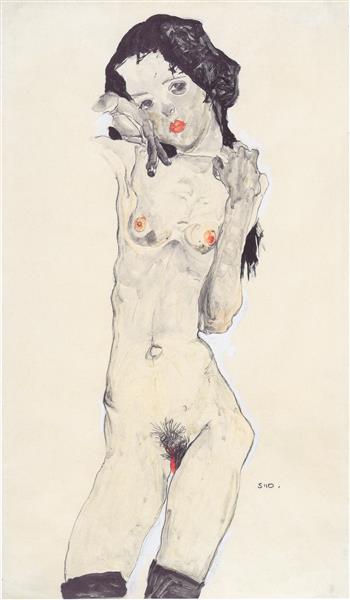
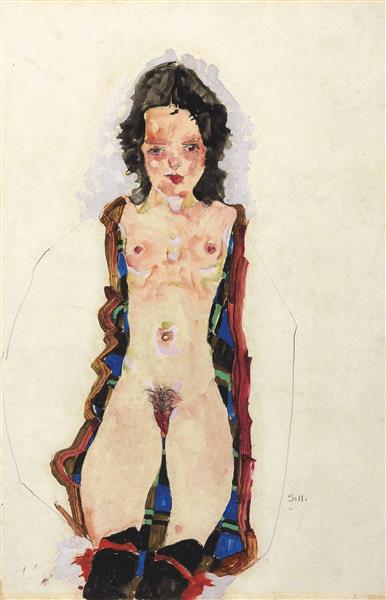
Schiele's line is the most distinctive of the early twentieth century. It is thin, urgent, slightly trembling — the line of a hand that is pressing harder than it needs to, that cannot quite contain the energy moving through it. He draws the edge of a hand, the angle of a forearm, the fold of a bony knee with a precision that is also somehow excessive, as if the line itself were in pain.
He was the most gifted draughtsman of the Viennese Expressionist circle and perhaps of his generation anywhere. He could draw a figure in a few minutes with a completeness of information that other painters would need hours to achieve. The drawings — thousands of them, in pencil, crayon, and watercolour — are in some ways more revealing than the paintings, because the speed of their execution makes the quality of his observation unavoidable.
His subjects were the body in extremis: contorted poses, splayed limbs, an arm raised at an impossible angle, a spine bent as if broken, a pair of legs at a ninety-degree angle to a torso. The poses are not graceful but they are always formally interesting, because Schiele understood that a body bent under psychological pressure has its own specific geometry, and that geometry is more revealing than any careful Neoclassical arrangement.
The colour in his mature work runs from the warm, flesh-tinted grounds influenced by Klimt to colder, more acidic combinations of ochre, white, blue-black, and the specific orange-red he used repeatedly for emaciated bodies. The orange-red is Schiele's colour. It is the colour of a body burning from the inside, and it appears in painting after painting as the dominant accent.
Four fingerprints: the urgent, slightly trembling outline, the pose that communicates psychological state directly, the body isolated against a blank or minimal ground without spatial context, and self-portraiture as a sustained and almost aggressive form of self-examination.
Life and legacy
Schiele was born on 12 June 1890 in Tulln an der Donau, a small town west of Vienna. His father was a railway stationmaster who died of syphilis when Egon was fifteen — a death that left the family in financial difficulty and permanently marked his understanding of the body as a site of suffering and mortality.
He entered the Vienna Academy of Fine Arts in 1906, the same year that Adolf Hitler applied and was rejected. Schiele was taken on immediately — he was visibly exceptional even at sixteen — but found the academic training suffocating. He left in 1909 and formed a small group of rebellious students called the 'Neukunstgruppe' (New Art Group). The same year, he met Gustav Klimt.
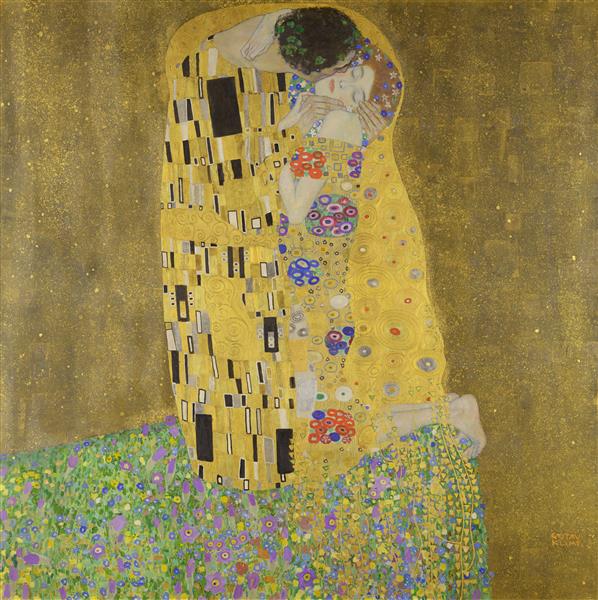
Klimt was forty-six and already the dominant figure of Viennese modernism; Schiele was nineteen. Klimt immediately recognised the young man's talent and provided him with models, commissions to connect him to patrons, and a direct encounter with the decorative richness of Art Nouveau that Schiele would absorb and then move beyond. The influence of Klimt is visible in Schiele's use of ornamental elements and his early interest in the female nude, but Schiele stripped away the decoration and replaced it with exposure: where Klimt's nudes are adorned and contained, Schiele's are angular and raw.
In 1912 he was arrested in the village of Neulengbach, where he had moved from Vienna, on charges of seducing a minor and producing obscene material. The charges were largely fabricated by conservative neighbours. One charge was dismissed; he was convicted of displaying 'pornographic' images in a place accessible to children (his studio) and sentenced to three days in prison. The twenty-four days he spent in pre-trial detention, during which he made a series of extraordinary drawings of the cell and his own hands, became one of the central episodes of his biography.
He was conscripted in 1915 and spent much of the war in relatively comfortable military duties that allowed him to continue painting. His career was finally on the verge of major success in early 1918 — the Vienna Secession exhibition that year devoted an entire room to his work and sold everything.
Edith died of Spanish influenza on 28 October 1918, six months pregnant. Schiele died three days later, on 31 October, also of influenza, aged twenty-eight.
Five famous paintings
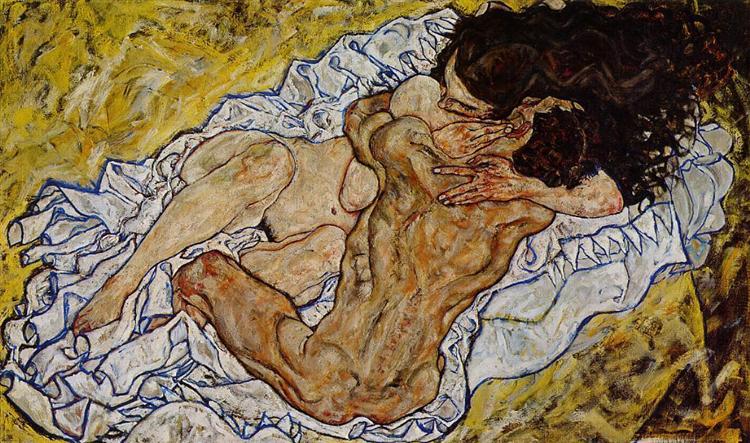
The Embrace 1917
Two figures — a man and a woman — lie together on white sheets in a position of mutual holding that is tender rather than erotic. The man's arms wrap around the woman; she presses into him. The drawing of the entwined limbs is Schiele's most formally complex — arms, legs, and torsos overlap in a pattern that requires sustained looking to disentangle. The white sheets against the warm ground give the painting an unusual airiness compared to the isolated-figure drawings of his earlier period. Schiele was twenty-seven when he painted this; Edith was probably the model. It is in the Österreichische Galerie Belvedere in Vienna.
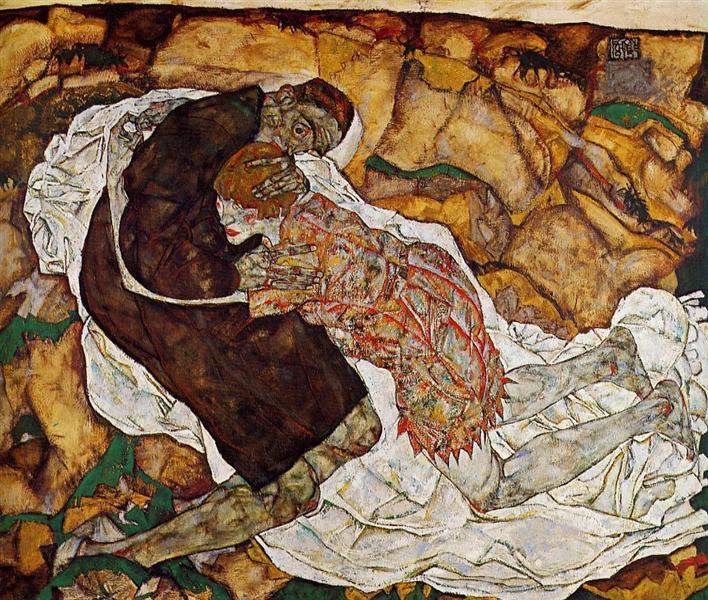
Death and the Maiden 1915
A painting that is simultaneously a self-portrait, a portrait of Wally Neuzil, and a meditation on the end of their relationship. Schiele had just married Edith Harms; this painting was his farewell. A skeletal male figure — Death, and unmistakably Schiele himself — holds a young woman who clings to him with both arms. She presses her face into his neck; he looks away from her, his eyes already distant. The sheets they lie on are grey and crumpled. The pose is tender and final. The painting is in the Österreichische Galerie Belvedere.
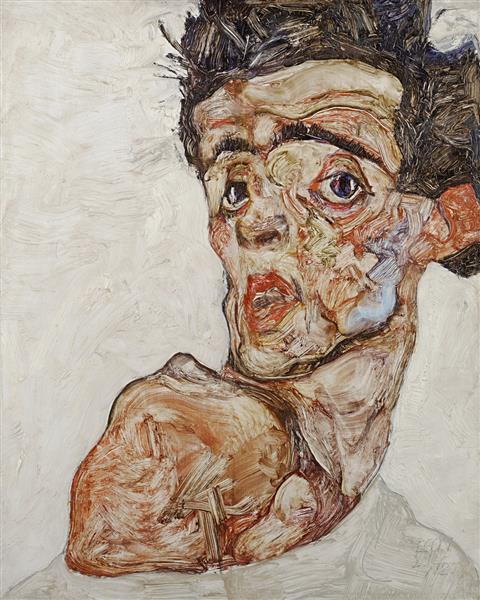
Self-Portrait with Bare Shoulder 1912
Schiele's self-portraits at twenty-two have an almost unbearable directness. He shows himself from the chest up, his head turned slightly, one shoulder bare, his expression a mixture of intensity and deliberate provocation. The drawing of the neck and shoulder shows his full technical mastery: the line describing the collarbone, the shadow under the chin, the specific angularity of his own face, which he knew as well as a surgeon knows an anatomy. The pale flesh against the warm ochre ground is characteristic of his mature palette. There is no sentimentality, no vanity — just intense self-examination.
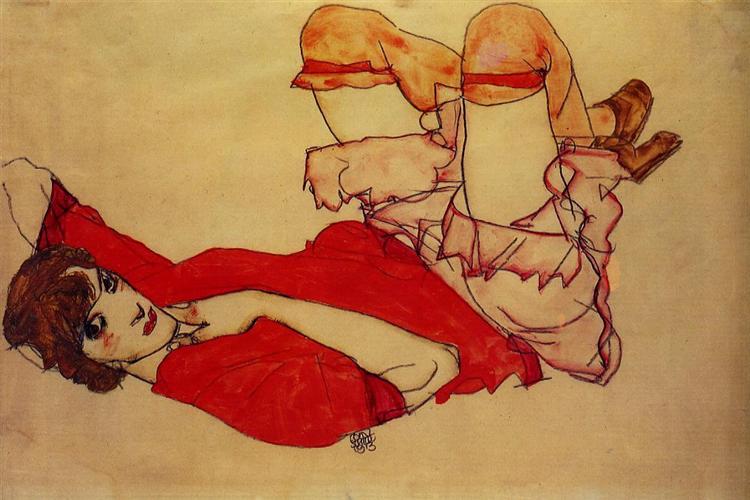
Portrait of Wally 1912
Wally Neuzil was seventeen when she became Schiele's companion and model in 1911; this portrait was made a year later. She looks directly at the viewer, her large dark eyes slightly downcast, her expression composed and self-possessed. The portrait is uncharacteristically gentle — none of the contorted intensity of his self-portraits or figure drawings. The simple direct confrontation of a young woman who knows she is being looked at and is neither frightened nor performing. After their separation in 1915, Wally enlisted as a Red Cross nurse and died of scarlet fever in 1917.
Dead City 1912
A townscape — possibly the Czech town of Krumau, where Schiele spent several summers — seen from an elevated angle. The buildings are compressed together, their rooftops overlapping, windows blank, no human figures visible in the streets below. It is specifically Schiele's view: a city rendered as a collection of angular geometric forms, lifeless and slightly menacing. He returned to this motif many times — the dead or sleeping city as an analogue for a kind of psychological numbness. The buildings look like a body from above, inert, the cells visible but the animating force gone.