Gustav Klimt
He covered women in real gold and turned a Vienna salon scandal into the visual language of a century.
Style and technique
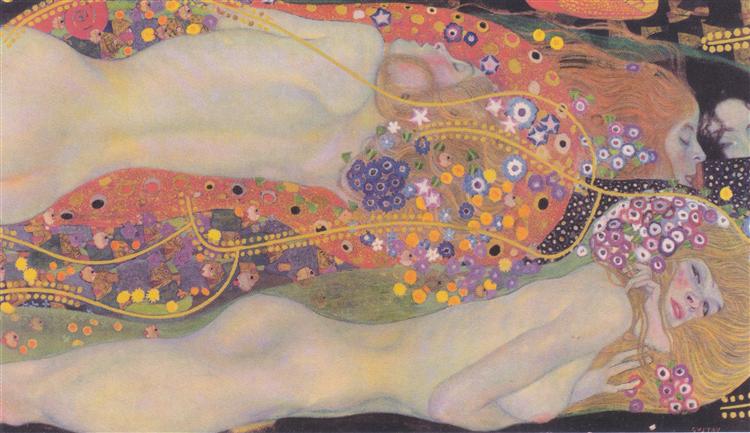
Klimt painted only two things, over and over: women and patterns. The women are sometimes nude, sometimes draped, sometimes only a face floating inside a sea of decoration. The patterns are mosaics, spirals, eyes, triangles, golden squares, swirling Byzantine ornaments — applied with the patience of a goldsmith. He literally stuck gold leaf onto the surface of his canvases, layered it, polished it, and then painted faces and hands inside the gold like jewels in a crown.
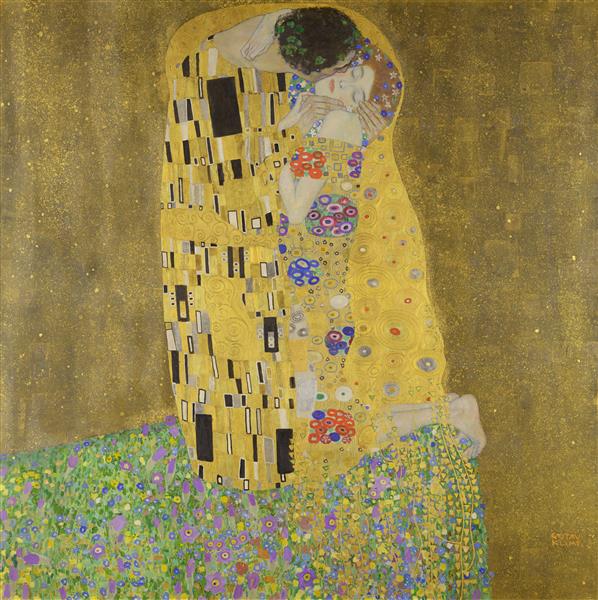
This was his answer to the academic painting his Viennese teachers had drilled into him for nine years. He could draw a perfectly modelled marble torso when he wanted to — and almost nobody who looks at 'The Kiss' realises that the two faces inside the gold are painted with bone-deep classical realism. Klimt's trick is to put two completely different visual languages on the same canvas: hyper-realistic flesh, where it matters; pure decoration, everywhere else.
Four fingerprints make a Klimt unmistakable.
Real gold leaf. The famous 'Golden Period' canvases (roughly 1899–1910) use actual sheets of gold and silver leaf applied directly to the surface, a technique he learned from his father, a gold engraver. They glow in low museum light and look almost dim in flash photography.
Decorative pattern. Squares, spirals, eyes, eggs, scales, eddies. He pulls from Byzantine mosaics (he visited Ravenna in 1903), Japanese textiles, Egyptian ornament, Vienna's own Wiener Werkstätte craftsmen.
Erotic women. His central subject. Always sensual, often pregnant, often half-asleep, always looking either rapturously inward or directly at the viewer with no shame at all.
Square format. Many of his most famous canvases are perfect squares — unusual in 1900. The square removes the conventional 'narrative' framing and turns the painting into a single decorative object, almost like a tile.
Klimt was not technically a member of any 'movement', though he is usually filed under Symbolism or Vienna Art Nouveau (Jugendstil). He founded the Vienna Secession in 1897 — a group of artists who broke away from the conservative Künstlerhaus to build their own exhibition pavilion. Their motto, carved over its door, can still be read in Vienna: *'Der Zeit ihre Kunst, der Kunst ihre Freiheit'* — 'To the age its art; to art its freedom.'
Life and legacy
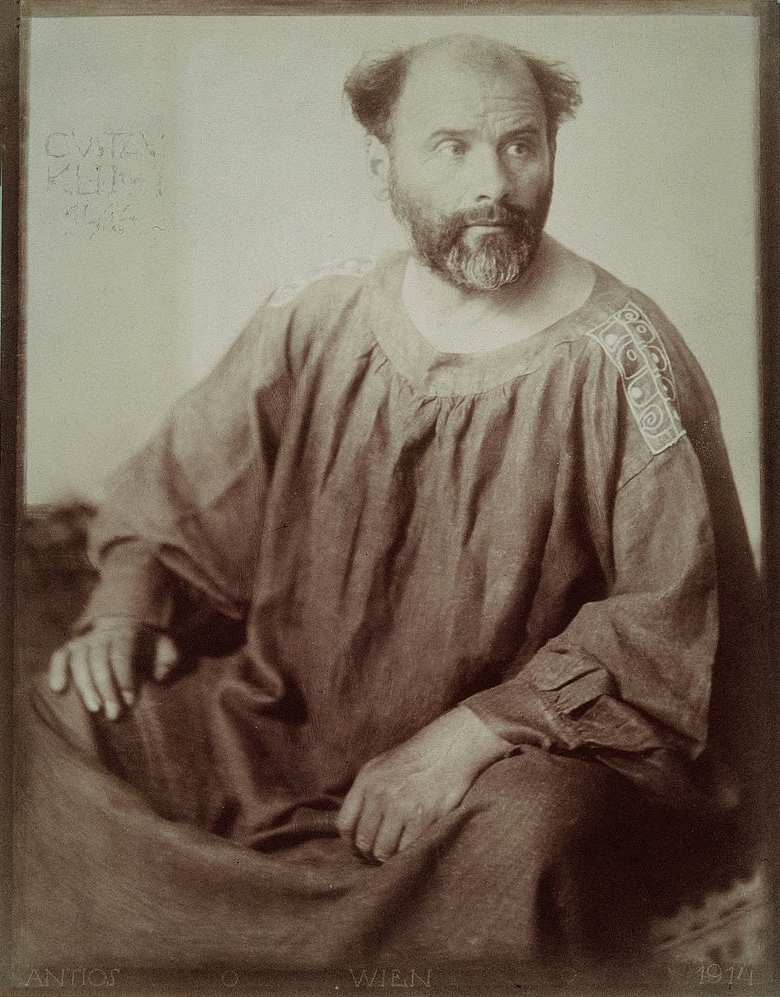
Gustav Klimt was born on 14 July 1862 in Baumgarten, then a village just outside Vienna and now a part of the city. He was the second of seven children. His father, Ernst Klimt, was a gold engraver from Bohemia. His mother, Anna, an aspiring opera singer. The household was poor — Ernst's profession was being slowly destroyed by industrial machinery — and Gustav, his two younger brothers Ernst and Georg, and his four sisters grew up in cramped apartments on the working-class edge of the empire's capital.
At 14, on a state scholarship, he was admitted to the Vienna School of Applied Arts (Kunstgewerbeschule). He studied there for seven years and emerged at 21 with two of his classmates — his brother Ernst and a friend named Franz Matsch — as a partnership of decorative painters. The three of them won the great public commissions of the 1880s and early 1890s in Vienna: ceilings for the Burgtheater, staircases for the Kunsthistorisches Museum, allegories for the new Imperial palaces. They worked from photographs, in academic styles, and were paid by the Habsburg state. Klimt was a respectable, well-dressed, recently-decorated artisan painter.
Then, in the late 1890s, his life shifted in three almost simultaneous directions.
First, his brother Ernst died unexpectedly in 1892 at the age of 28. The grief broke something. Gustav stopped wanting to paint allegories of imperial science.
Second, in 1894, the University of Vienna commissioned him to paint three large ceiling allegories — 'Philosophy', 'Medicine' and 'Jurisprudence' — for the new Great Hall. He worked on them slowly. When he finally exhibited 'Philosophy' in 1900, the Viennese establishment was scandalised. Klimt had filled the canvas with naked, drifting bodies, an enormous stylised female head, and a void of stars. Eighty-seven professors signed a petition asking for the commission to be cancelled. Klimt withdrew, paid back his fee, and reclaimed the canvases. (All three were destroyed in 1945, when retreating SS troops set fire to the castle where they had been stored. Only black-and-white photographs survive.)
Third, in 1897, he and a group of younger artists left the official artists' association in protest and founded the Vienna Secession. They built their own exhibition pavilion in the centre of Vienna — gold-leafed dome, motto carved over the door — and held seventeen exhibitions in the next eight years that brought Monet, Munch, Rodin and Whistler to the city for the first time.
His 'Golden Period' began around 1899 and ran until about 1910 — the canvases for which he is now most famous. He painted 'Judith I' (1901), 'Portrait of Adele Bloch-Bauer I' (1907, the so-called 'Woman in Gold'), 'The Kiss' (1908), and 'Hope II' (1908). He travelled to Ravenna in 1903 to study Byzantine mosaics. He travelled to Venice and Paris and Brussels. He worked obsessively, drawing constantly — almost 3,000 drawings survive, many of them frankly erotic, of the same handful of models who came every day to his garden studio at the edge of Vienna.
He never married. He lived with his mother and unmarried sisters his entire life. His most stable relationship was with the dress designer Emilie Flöge, whom he met when she was 17 and he was 28. They were companions for 27 years. Whether they were lovers is still debated. He fathered at least 14 children with various models, all of whom he supported financially through their mothers. He left a will that included Emilie as a major beneficiary.
In the last decade of his life he moved away from gold, into a warmer, looser, more colour-saturated style — the late portraits, 'The Tree of Life' decorations for the Stoclet Palace in Brussels, 'Death and Life' (1916). The First World War broke the Vienna art market. The empire he had been painting for fifty years began to disappear.
In January 1918 he suffered a stroke while at his studio. Pneumonia followed during the Spanish flu epidemic. He died on 6 February 1918, aged 55. His last words, according to his protégé Egon Schiele, who would die of the same flu nine months later, were: *'Bring me Emilie.'* She arrived too late.
The largest single collection of his paintings is at the Belvedere Museum in Vienna, where 'The Kiss' has hung in the same room since 1908.
Five famous paintings
Judith I 1901
The first major painting of Klimt's Golden Period. Judith — the biblical heroine who beheads the enemy general Holofernes — is shown in a state of erotic ecstasy: half-smile, half-closed eyes, breast bared above a shimmering gold collar, holding the severed head of Holofernes in her right hand at the bottom of the canvas. Most viewers don't notice the head at first; Klimt deliberately tucks it almost out of sight, half-cut by the frame. The painting was scandalous in Vienna in 1901 — Judith was supposed to be a virtuous heroine, not a Decadent enchantress. Today it hangs in the Belvedere as one of the most reproduced Klimts in the world.
The Tree of Life 1909
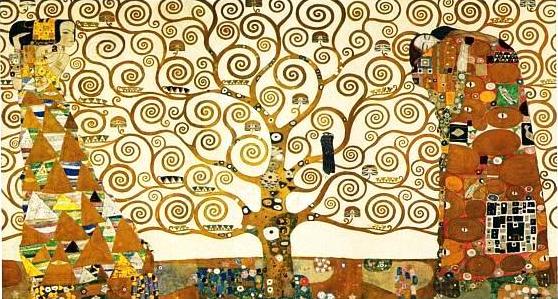
Strictly speaking this is a single panel of an enormous mosaic frieze designed for the Stoclet Palace in Brussels, a private mansion built between 1905 and 1911 for the Belgian banker Adolphe Stoclet. Klimt painted the cartoons for the dining-room frieze at full size in his Vienna studio. They depict a stylised tree with spiralling golden branches, a standing female figure on the left ('Expectation') and an embracing couple on the right ('Fulfilment'). Real mosaicists then translated the cartoons into glass, gold, enamel and semiprecious stones for the actual dining room. The original cartoons are at the Museum of Applied Arts in Vienna; the Stoclet Palace itself is closed to the public.
The Kiss 1908
The most famous Klimt and one of the most reproduced paintings in the world. A man and a woman kneel on a small flowery patch of grass at the edge of a golden abyss. The man, his back to us, leans forward to kiss the woman's cheek. Their bodies are wrapped together in an enormous golden cloak — his pattern made of black-and-white rectangles, hers of bright concentric circles. Only their faces, hands and her bare feet emerge from the gold. The square format (180 cm × 180 cm), the real gold leaf and the deliberate medieval-icon framing turn the kiss into something more than a romantic moment — it is closer to a religious image. The painting has been at the Belvedere in Vienna since 1908, the year he finished it; the Austrian state bought it directly from his easel.
Portrait of Adele Bloch-Bauer II 1912
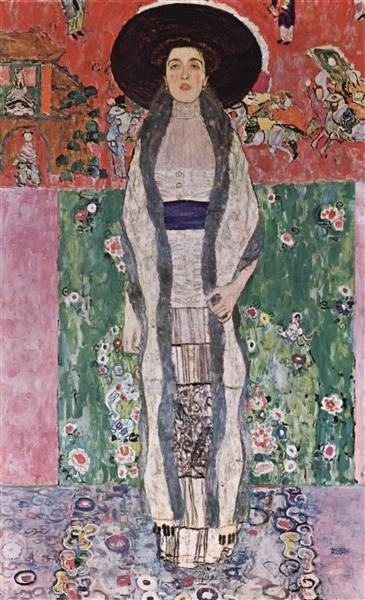
Adele Bloch-Bauer was a Viennese socialite, the wife of a Jewish sugar magnate, and the only person Klimt ever painted twice in full-length oil. The first portrait (1907), in solid gold, became known as the 'Woman in Gold' and was looted by the Nazis in 1938; her niece Maria Altmann fought a seven-year legal battle and recovered it in 2006. The second portrait, painted in 1912 when Klimt was moving away from gold, shows Adele standing against a flowery green-blue background with a tall black hat, in a more painterly, less hieratic style. Maria Altmann sold it at auction in 2006 to the financier Ronald Lauder for $87.9 million; today it is at the Neue Galerie in New York, alongside its golden sister.
Death and Life 1916
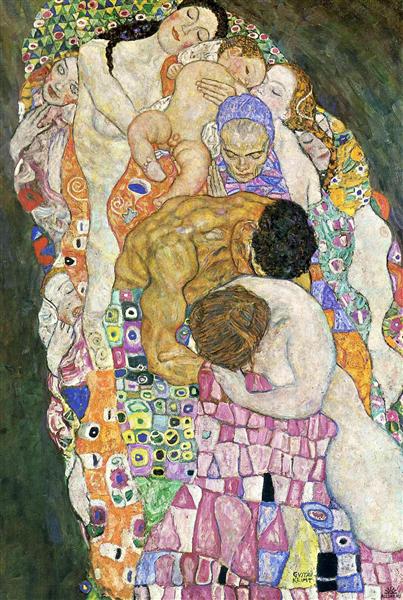
Painted in two versions — first in 1908, then heavily reworked in 1915–16 with a different background. On the right, a tangle of bodies: women, children, a man, an old grandmother, locked together in tones of warm flesh and decorative pattern, eyes closed in sleep or rapture. On the left, separated by a stark dark void, stands Death — a grinning skull in a patterned blue robe, holding a cudgel, watching the sleeping group. Klimt won the gold medal at the 1911 Esposizione Internazionale in Rome with the first version of this painting, and reworked it five years later, in the middle of the Great War, into something even bleaker. It hangs today in the Leopold Museum in Vienna.