
Japonisme / Ukiyo-e
Japan's woodblock prints arrived in the West and broke every rule painters thought was sacred.
In the 1850s and 1860s, Japanese woodblock prints began flooding European markets — first as cheap wrapping paper for porcelain, then as objects collected with increasing passion by painters and critics who found in them a set of visual ideas entirely unlike anything Western art had taught them to value. Japonisme — the term coined by French critic Philippe Burty in 1872 — describes the profound and far-reaching influence of Japanese aesthetics on Western art from the mid-nineteenth century onward. The ukiyo-e tradition, which Japanese masters had been refining since the seventeenth century, gave Impressionists and Post-Impressionists a radically different way of composing a picture: flat areas of unmodulated colour, bold contour lines, asymmetric arrangements, cropped foregrounds, high viewpoints, and the conviction that a single decisive brushstroke could carry more expressive weight than a dozen carefully modelled passages. The encounter transformed Western painting.
Origin and history
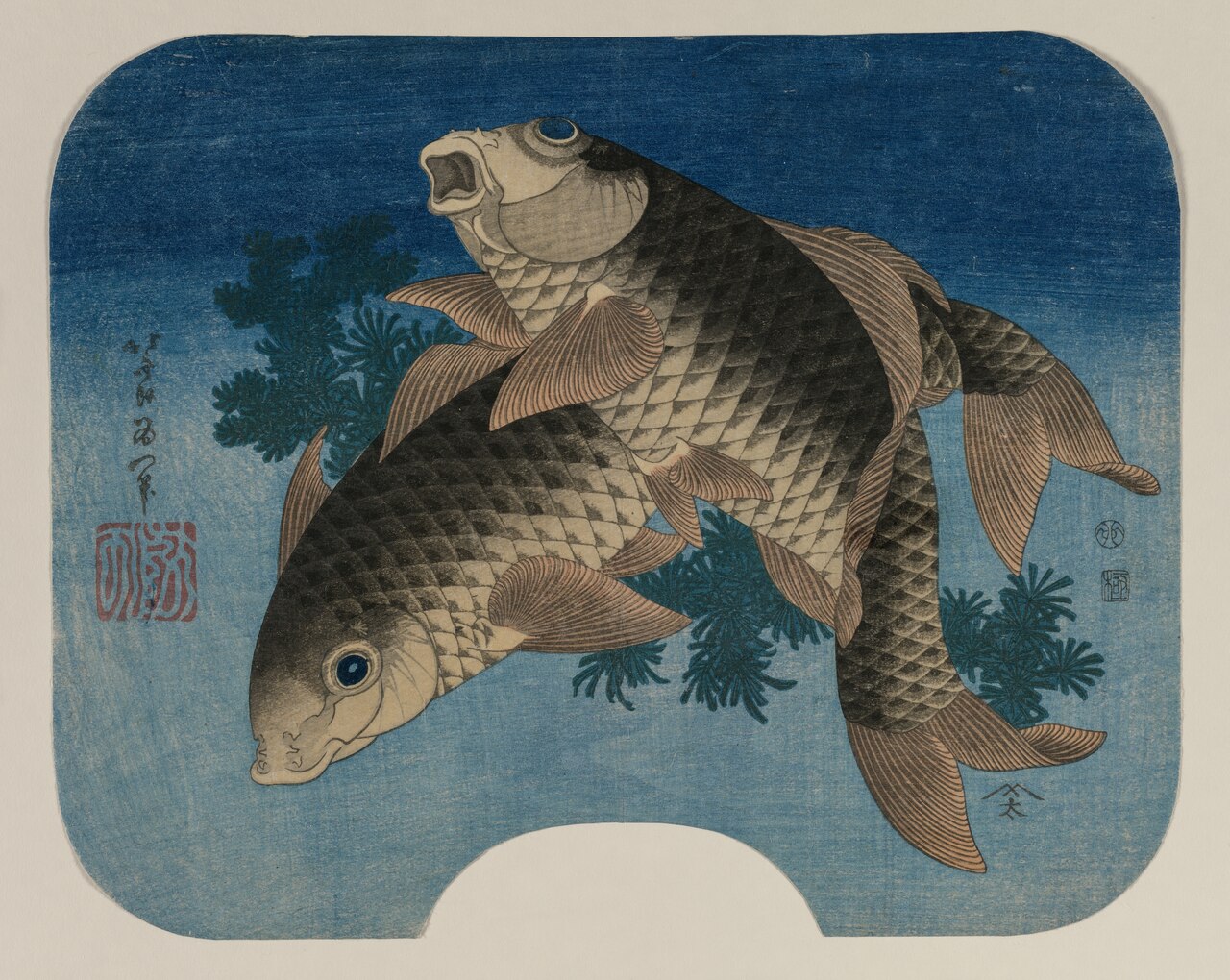
Ukiyo-e — literally 'pictures of the floating world' — emerged in the urban culture of Edo (present-day Tokyo) during the seventeenth century, rooted in the pleasures and spectacles of merchant-class life: kabuki theatre, the licensed pleasure districts, sumo wrestlers, famous landscapes. The woodblock printing technique allowed artists to produce images in large editions at low cost, making art genuinely popular in a way European painting rarely was. Masters such as Hokusai (1760–1849) and Hiroshige (1797–1858) developed the tradition to its expressive peak — Hokusai with his bold, restless dynamism in the *Thirty-Six Views of Mount Fuji* series, Hiroshige with his luminous, atmospherically precise depictions of the Tokaido Road and the seasons.
The door between Japan and the West had been forcibly opened by American Commodore Perry's mission in 1853, ending two centuries of Japanese isolation. By the 1860s, Japanese goods — fans, screens, lacquerware, and above all woodblock prints — were arriving in Paris and London in volume. The timing was fateful: it coincided exactly with the moment when a generation of French painters were looking for exactly the kind of pictorial freedom the prints offered. Claude Monet began collecting Japanese prints in the 1870s and eventually owned over 200, hanging them throughout his house at Giverny. Vincent van Gogh copied Hiroshige compositions in oil paint. Henri de Toulouse-Lautrec borrowed the bold poster-ready flatness of ukiyo-e for his images of Montmartre. James McNeill Whistler organised entire rooms — and entire exhibitions — according to Japanese principles of harmony and simplification.
Concept and philosophy
The core insight that ukiyo-e offered Western painters was that three-dimensional illusionism is a convention, not a necessity. Western painting since the Renaissance had been built on the premise that the painter's job was to create convincing depth on a flat surface — through perspective, chiaroscuro, atmospheric recession. Ukiyo-e demonstrated that a picture could be organised instead as a pattern of flat colour areas separated by crisp contour lines, with space implied through overlap and placement rather than rendered through tonal gradation. The visual logic was completely different, and it was liberating.
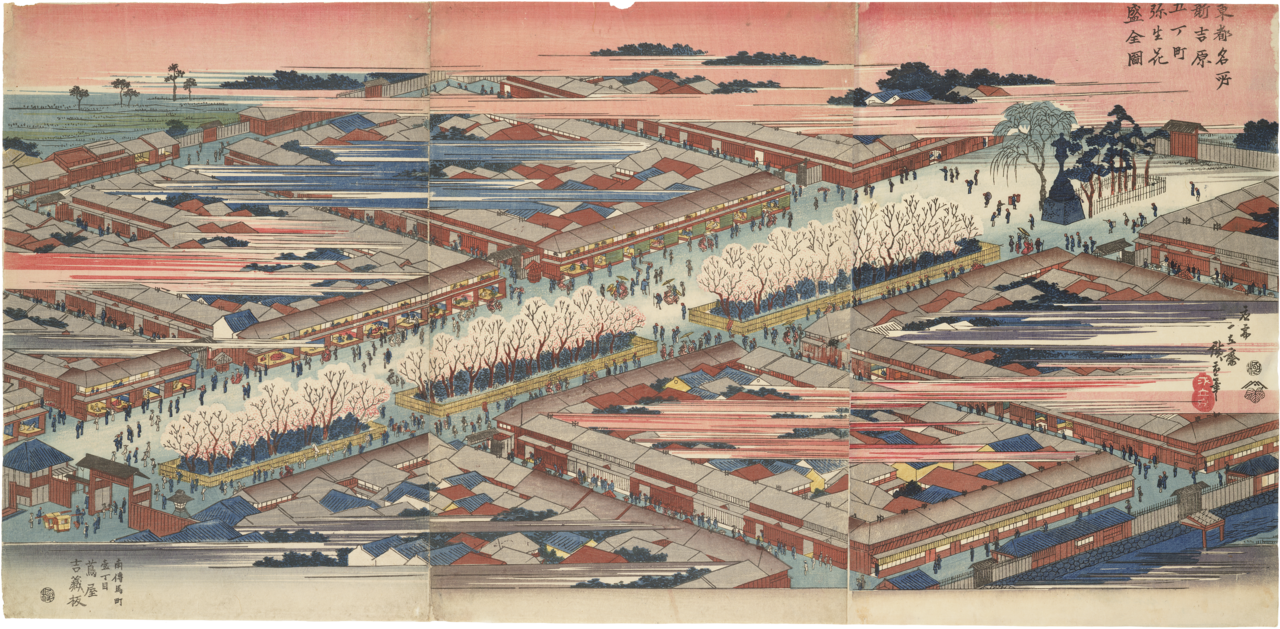
Beyond flatness, Japanese prints offered Western artists a new grammar of composition: asymmetric rather than centred, with subjects placed off-axis, important elements cropped at the edge, empty space used as an active compositional force. Hiroshige would place a branch diagonally across the entire foreground, cropping it bluntly at the frame edge — a device that looked arbitrary by Western academic standards and felt bracingly fresh to anyone trained in those standards. The high viewpoint — looking down on a scene from above — appeared constantly in ukiyo-e and was adopted enthusiastically by Edgar Degas and Toulouse-Lautrec for their images of dancers, cafés, and circus performers.
Ukiyo-e also validated the everyday as serious subject matter: ordinary people doing ordinary things — actors performing, travellers on a road, women arranging their hair — rendered with the same formal care that European academic painting reserved for gods and heroes. This democratisation of subject matter chimed perfectly with the Impressionist project and helped accelerate the move away from history painting toward scenes of modern urban and suburban life.
How to recognise it
When you see a painting influenced by Japonisme, look for these departures from the Western academic tradition.
- Flat areas of unmodulated colour — Instead of the gradual tonal modelling used to create volume in Western painting, ukiyo-e-influenced works use broad, even zones of a single colour with minimal shading — often separated by a clear outline. Van Gogh's *Portrait of Père Tanguy* (1887), with its Japanese prints visible on the background wall, shows this clearly.
- Bold, decisive contour lines — Forms are defined by emphatic outlines rather than being carved out of shadow the way Baroque and Renaissance figures are. The line carries the image; the colour fills it in. This is the opposite of the tonal priorities of most Western academic painting.
- Asymmetric, off-centre composition — Subjects are placed to one side, near the edge of the frame. Empty space — sky, water, a plain ground — is given equal weight with the depicted subject. The compositional centre of gravity shifts away from the geometric balance that characterises Renaissance and Baroque arrangements.
- Cropped foreground elements — A branch, a boat, a figure is cut abruptly at the picture edge, as if the frame were a window that happened to be positioned there — rather than a stage carefully composed for the viewer. Degas was particularly influenced by this, cropping dancers and racehorses in ways that felt startlingly photographic.
- High viewpoint and unconventional perspective — The bird's-eye view or steep downward angle that appears constantly in ukiyo-e landscape prints was adopted by Impressionist and Post-Impressionist painters looking for an alternative to the horizon-line perspective inherited from the Renaissance. Toulouse-Lautrec's café and theatre scenes use this device extensively.
- Decorative linear pattern — Waves, foliage, fabric, and water are rendered as repeating linear patterns rather than as naturalistic textures — giving the picture surface a decorative energy that European painting tended to suppress in favour of illusionism. Hokusai's famous wave is the iconic example: it is simultaneously a crashing wave and a rhythmic graphic design.
Anecdotes and curiosities
Hokusai's Great Wave was never meant to be a standalone image — it was print number one in a series of forty-six. The *Thirty-Six Views of Mount Fuji* series (begun around 1830) was expanded to forty-six prints when public demand proved overwhelming. *Under the Wave off Kanagawa* — the Great Wave — opened the series and happened to become the most widely reproduced artwork in human history. Hokusai was in his early seventies when he made it. He reportedly said he would not reach his artistic peak until he was 110; he died at eighty-nine.
Van Gogh copied Japanese prints in oil paint as a form of study. In 1887, having immersed himself in the Japanese print collection at the Paris art dealer Siegfried Bing's shop, Van Gogh made careful oil copies of two Hiroshige prints — *Plum Park in Kameido* and *Sudden Shower over Shin-Ohashi Bridge* — adding decorative calligraphic borders in imitation of the Japanese originals. He described Japan as 'a country where art is in the blood of the people' and spoke of wanting to create a kind of southern French equivalent. His time in Arles was consciously framed as his own 'Japan.'
Monet's garden at Giverny was designed as a living Japanese print. The water-lily pond was created in 1893, after Monet had been collecting Japanese prints for two decades. The wooden bridge arching over the pond was modelled directly on bridges he had seen in Hiroshige's prints. He spent the last twenty-seven years of his life painting the pond's surface in different lights and seasons, producing the series of large-format *Water Lilies* paintings that now fill two oval rooms at the Orangerie in Paris.
Toulouse-Lautrec's poster for the Moulin Rouge was so heavily influenced by Japanese design that Parisians initially assumed it was Japanese work. The 1891 *Moulin Rouge: La Goulue* poster uses a cropped dancer in the foreground, bold silhouetted figures in the middle ground, and flat areas of black that function as both figure and ground simultaneously — all devices lifted directly from ukiyo-e. The poster was plastered across Paris overnight and caused a sensation; some viewers apparently asked where the Japanese artist had come from.
Legacy and influence
Japonisme was the first major instance in Western art history of a non-European visual tradition fundamentally reshaping how Western painters thought about the act of painting itself — not just borrowing decorative motifs but questioning the philosophical premises underlying the entire Western pictorial tradition since the Renaissance. The abandonment of three-dimensional illusionism in favour of flat colour and bold line that ukiyo-e encouraged fed directly into Synthetism (Gauguin), Cloisonnism, and ultimately into twentieth-century abstraction. Matisse, whose colour fields and simplified forms owe an enormous debt to this lineage, sits at the far end of a path that ukiyo-e helped open. In graphic design, poster art, illustration, and animation — above all in the mid-twentieth-century American and European absorption of manga and anime — the influence of Japan's woodblock tradition continues to shape visual culture worldwide. The prints that arrived as disposable wrapping paper in the 1850s are now among the most expensive objects at auction and among the most reproduced images in the world.
2 artists in this movement
Frequently asked questions
What is ukiyo-e?
Ukiyo-e (pronounced oo-kee-yoh-eh) means 'pictures of the floating world' in Japanese — 'floating world' being a Buddhist-inflected term for the transient pleasures of urban life. It refers to a tradition of Japanese woodblock printing and painting that flourished from the seventeenth to the nineteenth century, depicting subjects drawn from the pleasure districts of Edo: kabuki actors, courtesans, famous landscapes, and scenes of everyday bourgeois life. The woodblock technique allowed prints to be produced in large editions at low cost, making ukiyo-e genuinely popular art rather than elite patronage art.
Why did Japan suddenly influence Western art in the 1860s?
Japan had enforced near-total isolation from the West since 1635. When American Commodore Matthew Perry sailed into Tokyo Bay in 1853 and forced Japan to open its ports to foreign trade, a century-long dam broke. Japanese export goods — fans, ceramics, lacquerware, and especially cheap woodblock prints used as packing material — flooded European markets almost immediately. The timing was perfect: French painters were at that moment looking for alternatives to the academic tradition, and the prints offered exactly the set of visual freedoms they needed. By the 1870s, ukiyo-e collecting was a passion among the Parisian avant-garde.
What makes Hokusai's Great Wave so famous?
Katsushika Hokusai's *Under the Wave off Kanagawa* (c.1831) achieves something rare in art: it is simultaneously a specific, observed image — fishing boats caught under a breaking wave with Mount Fuji visible in the distance — and a near-abstract graphic design of extraordinary force. The curling claw-like foam of the breaking wave, the tiny boats dwarfed beneath it, and the serene cone of Fuji in the background create a composition of almost mathematical elegance. The print was made with only three pigments — Prussian blue, white, and a pale grey — yet conveys an overwhelming sense of colour, movement, and scale.
How do you recognise a Hiroshige landscape?
Utagawa Hiroshige is distinguishable from Hokusai by his atmospheric softness: where Hokusai is bold and energetic, Hiroshige favours misty distances, falling snow, rain streaks rendered as parallel diagonal lines, and the quieter effects of weather and season. His famous *One Hundred Famous Views of Edo* series uses dramatic foreground cropping — a branch of blossoming plum, a hanging curtain — to frame the middle-distance view, creating a sense of the viewer looking through a frame within the frame. His colour is typically more muted and atmospheric than Hokusai's graphic intensity.
Why is Japonisme important for modern art?
Japonisme was the first moment at which a non-European visual tradition fundamentally changed the underlying logic of Western painting — not by providing decorative motifs to borrow but by demonstrating that perspective, tonal modelling, and centred composition were conventions rather than laws. Once ukiyo-e showed that flat colour, bold outline, and asymmetric design could produce images of great beauty and expressiveness, the door was open to Gauguin's Synthetism, Matisse's colour fields, and the entire lineage that leads to abstraction. Modern art as we understand it is inconceivable without the shock of Japan.