Utagawa Hiroshige
The poet of rain, snow and twilight who taught the West how to look at a Japanese road, a Japanese bridge and a Japanese sky.
Style and technique
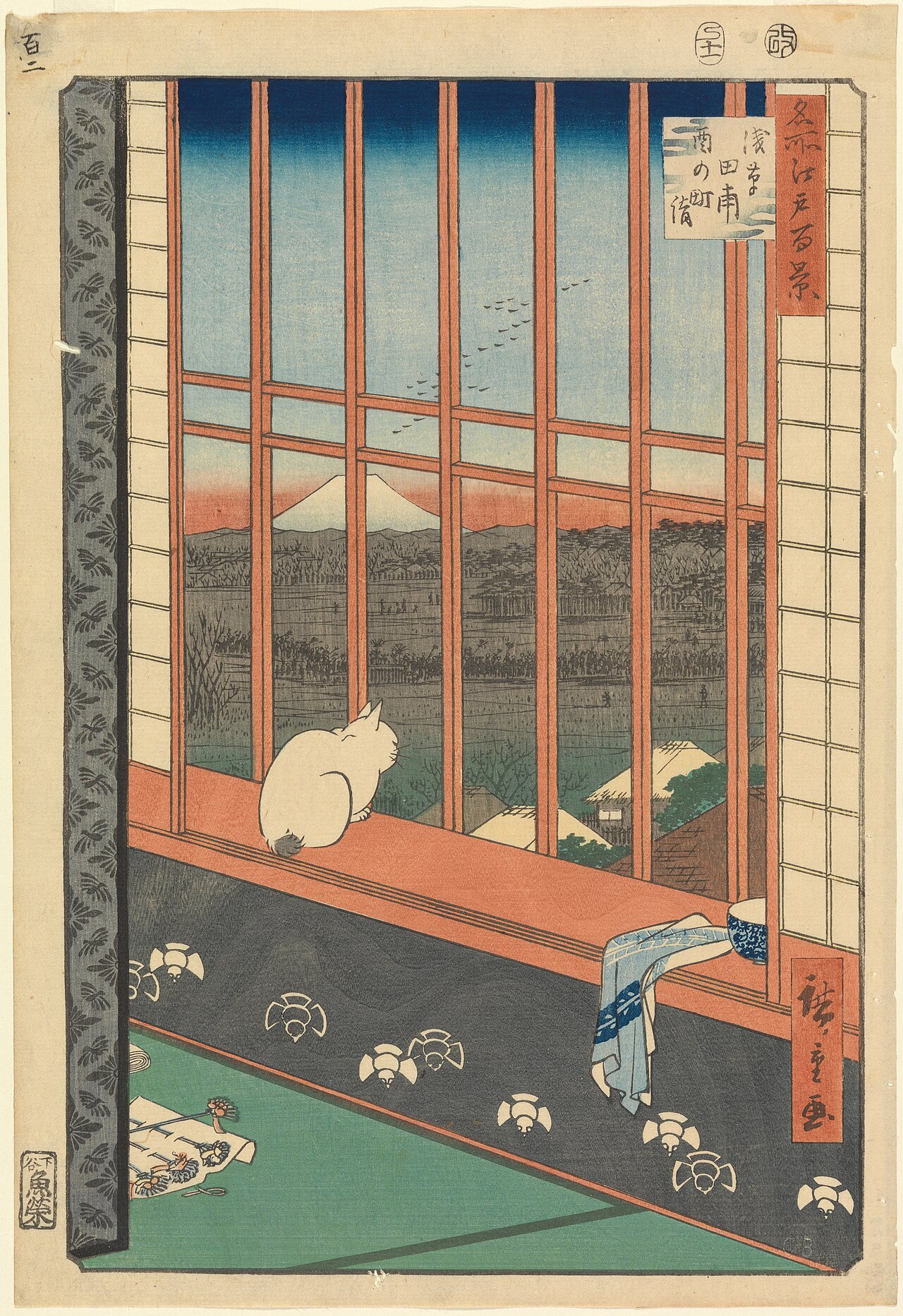
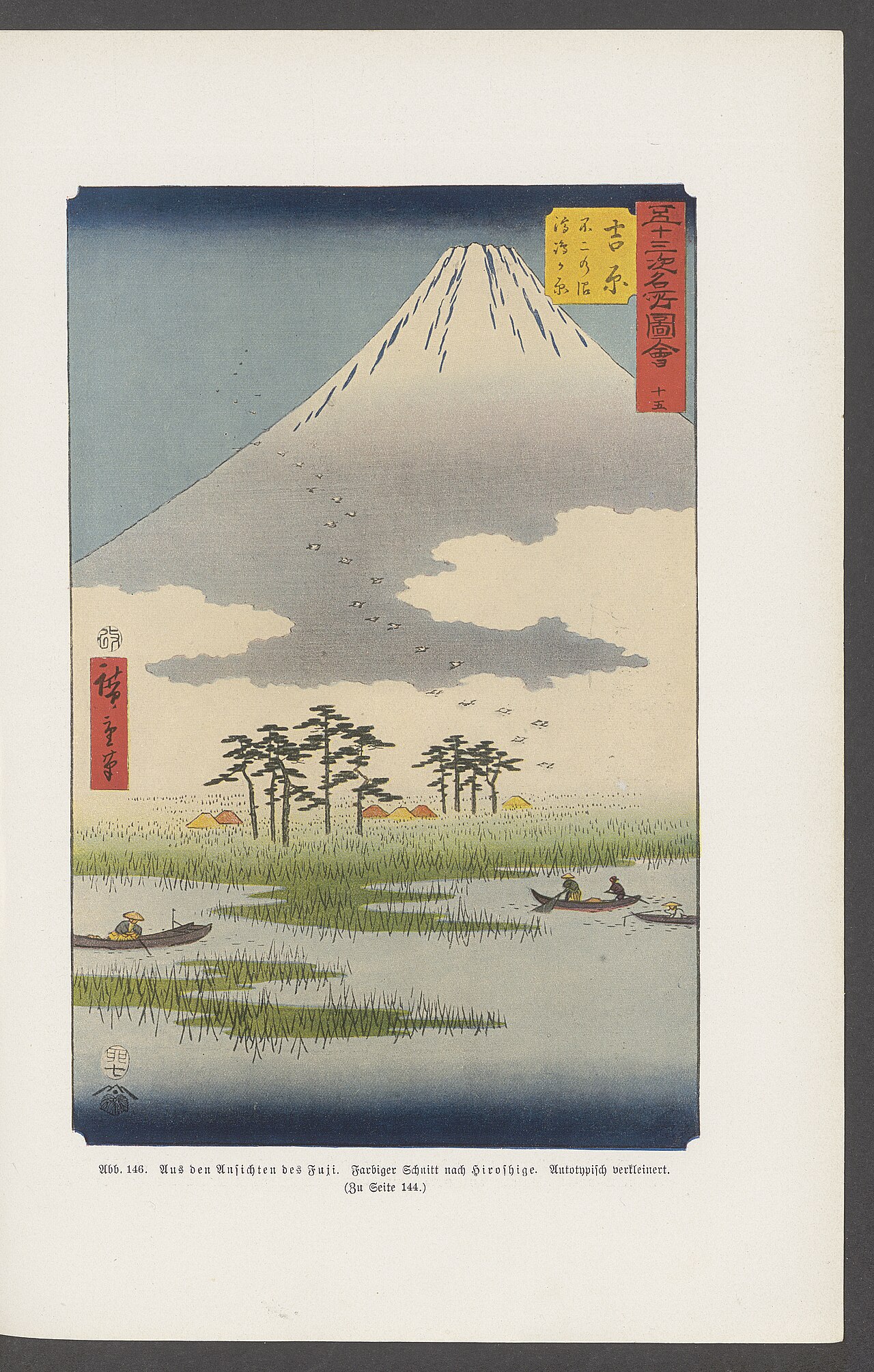
Hiroshige is the artist who taught the woodblock print how to feel the weather. Before him, ukiyo-e prints had been mostly about people — actors, courtesans, beautiful women in beautiful kimonos. Hokusai had begun pulling the genre toward landscape with his Thirty-six Views of Mount Fuji in the early 1830s, but Hokusai's mountains are sculpted, geometric, almost diagrammatic. Hiroshige does something different. He empties the road, lowers the horizon, slants the rain across the entire surface of the sheet, and lets a single human figure — a courier, a pilgrim, a porter under a straw cape — stand in for all of us inside that weather.
The technique that makes this possible is the bokashi gradient — a graduated wash of colour rubbed by hand into the woodblock before each impression. A Hiroshige sky is almost never a flat blue. It is a deep indigo at the top fading to pale blue at the horizon, or a slate grey thickening to black, or a bar of pure Prussian blue narrowing into the dusk. Each print required several blocks (one per colour) and the bokashi was wiped onto each block fresh, by the printer, every single sheet — which is why no two impressions of the same Hiroshige are ever quite identical.
Four fingerprints make a Hiroshige unmistakable.
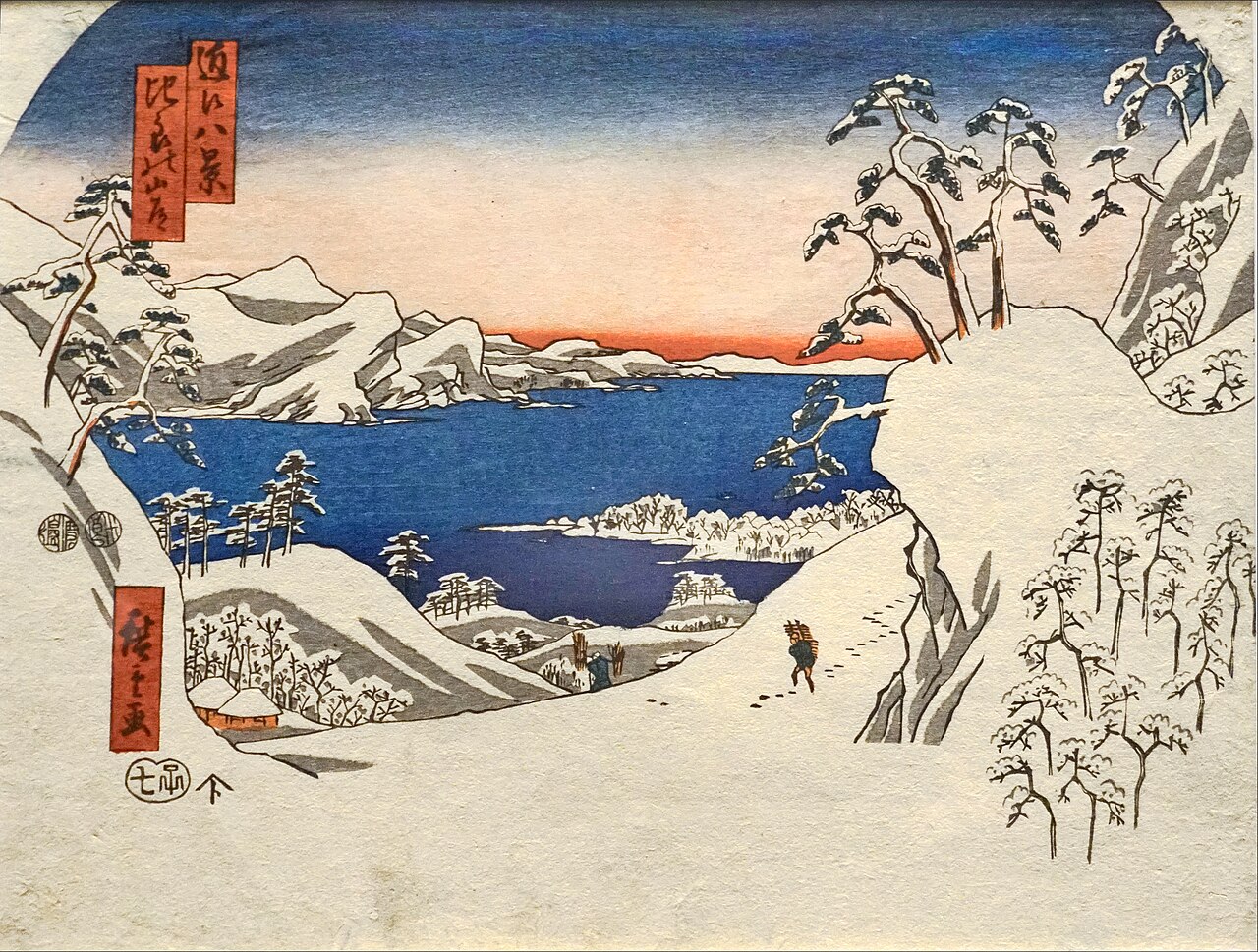
Weather as the subject. Rain, snow, fog, the wind in pine trees, the moment before a storm. The travellers in the foreground are almost incidental; the storm is the protagonist. Long diagonal lines cut across the print as actual rain — black hairline strokes carved into a separate block — a device almost no one had used before him.
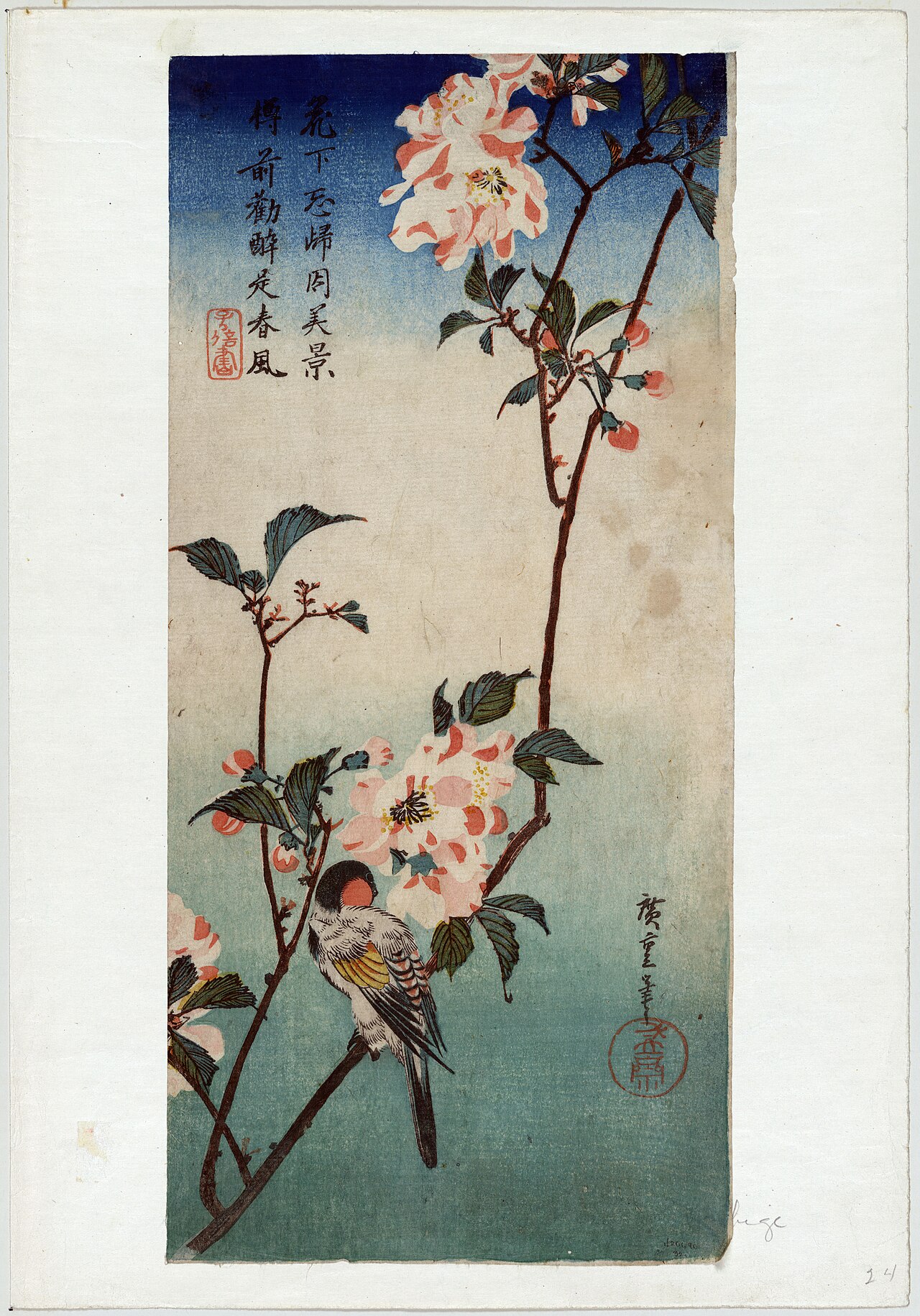
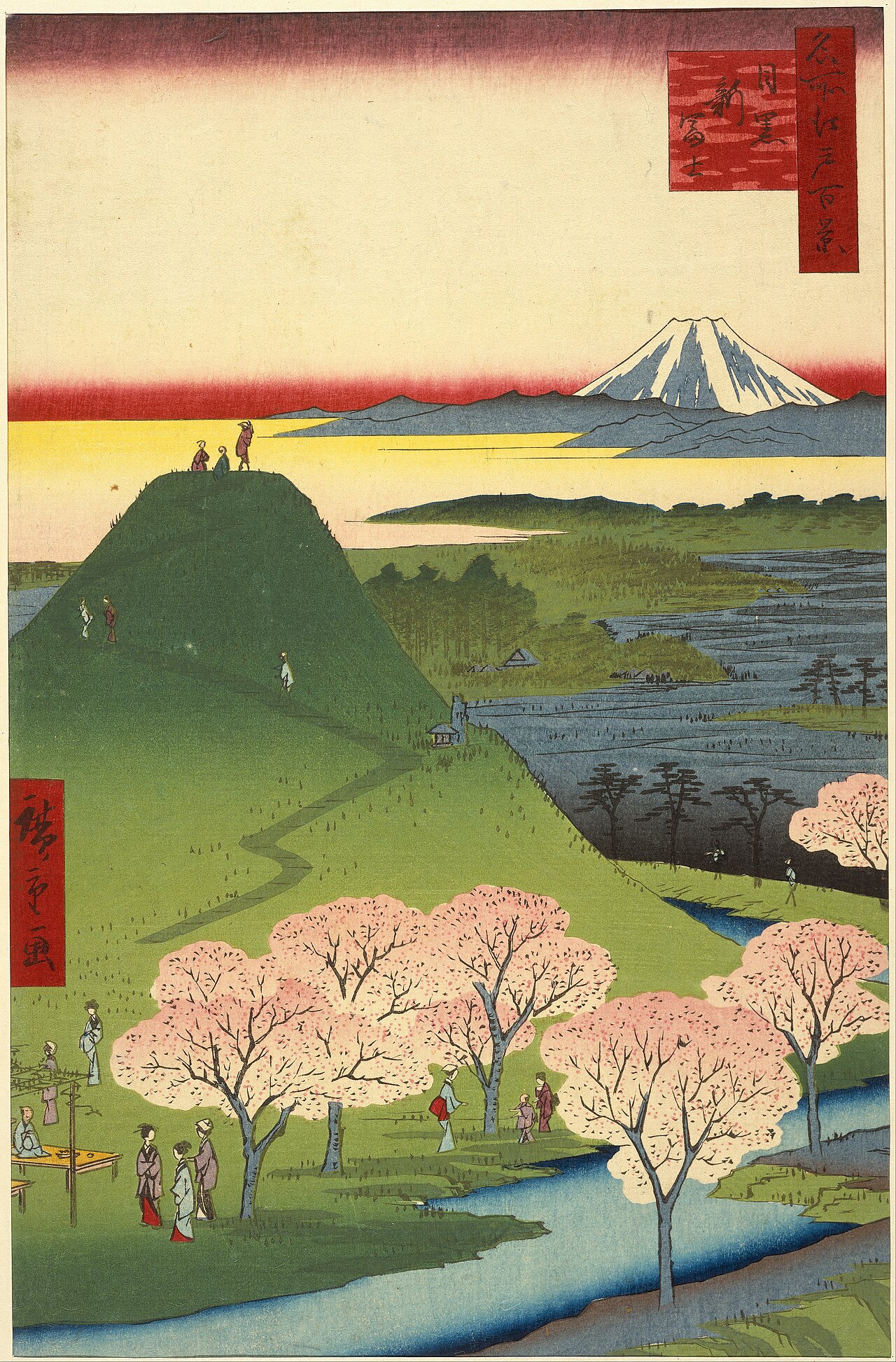
The bokashi gradient. Skies, water, distant hills, the inside of a snowdrift — all are built from soft, hand-rubbed transitions of colour rather than outline.
Radical foreground / background jumps. A massive plum branch fills the front of the picture; behind it, tiny human figures wander a far garden. A bridge fragment crops the bottom of the sheet; a city stretches into the distance. The eye is forced to leap, the way the Western eye leaps when looking through a window.
Empty roads, soft melancholy. His Tōkaidō stations are not crowded scenes. They are usually one or two travellers, a tea-house, a stretch of wet road, the impression that you have just arrived somewhere quiet at the end of a long day.
He was born into the Edo firefighter caste, a hereditary samurai-rank post — and there is something of that profession in the work: a steady, unsentimental attention to weather, smoke, water, the shape of a roof. He did not paint heroic mountains. He painted the road home in the rain.
Life and legacy
He was born in Edo in 1797, into the household of an Edo fire warden named Andō Gen'emon — a hereditary low-ranking samurai post attached to the firefighting brigade that protected Edo Castle. The family lived inside the firefighters' barracks at Yayosu Quay. The post was modest but stable, and it would normally have passed from father to son. Hiroshige's birth name was Andō Tokutarō.
His childhood ended early. In 1809, when he was twelve, both his mother and father died within a few months of each other, and the boy inherited the fire-warden post. He carried out its duties as a teenager. But he had been drawing since he was a small child, and around the age of fourteen, having been refused by the more famous Utagawa Toyokuni studio, he was accepted as an apprentice by Utagawa Toyohiro — a quieter, more lyrical print designer than his namesake rival, and the master who would shape Hiroshige's gentler temperament. Within a year Hiroshige had been given the artist name Utagawa Hiroshige by his teacher, combining the school name 'Utagawa' with one character from Toyohiro's name.
For most of the 1820s he worked steadily on the standard ukiyo-e subjects of the day — actor portraits, beautiful women, illustrated books — and barely made a living. He kept the firefighter post until 1823, when he passed it to his son and a guardian, freeing himself to design prints full-time. Toyohiro died in 1828 and Hiroshige declined to take over the studio, choosing instead to develop his own line in landscape.
The turning point came in the autumn of 1832. Hiroshige was selected — the exact circumstances are still debated — to accompany an official shogunal delegation travelling from Edo to Kyoto along the Tōkaidō, the great coastal highway with its 53 post-stations. The journey took roughly two weeks on foot and on horseback, through Mount Fuji's foothills, along the Pacific shore, across the Ōi river, into the misty pine forests of Hakone. He filled sketchbooks with what he saw — a courier crossing a bridge in driving rain at Shōno, snow falling on the mountain pass at Kameyama, spring rain at Tsuchiyama. Back in Edo he and the publisher Hōeidō turned the sketches into the print series 'The Fifty-three Stations of the Tōkaidō', published between 1833 and 1834. It was a sensation. The series sold in tens of thousands of impressions, made his name across Japan, and effectively invented the modern travel print.
For the next twenty-five years he poured out landscape series almost without stopping — 'Famous Views of Kyoto' (1834), 'Eight Views of Ōmi' (1834), the 'Sixty-nine Stations of the Kisokaidō' (begun jointly with Eisen, 1835–1842), several rival Tōkaidō series, plus bird-and-flower prints and fan paintings. His final and most ambitious series, 'One Hundred Famous Views of Edo', was begun in 1856 when he was nearly sixty, in the years after the great Ansei earthquake of 1855 had devastated the city. He worked on it as a kind of love letter to the Edo he had been born into, finishing 118 plates plus a title sheet before his death.
In 1856 he also took Buddhist vows as a lay monk, shaving his head and dressing in priest's robes, although he kept working as a painter. He had married twice and outlived his first wife; his second wife and his stepson would survive him.
In the autumn of 1858 the great Ansei cholera epidemic swept through Edo, killing tens of thousands. Hiroshige caught the disease and died on 12 October 1858, aged sixty-one. He left a death poem:
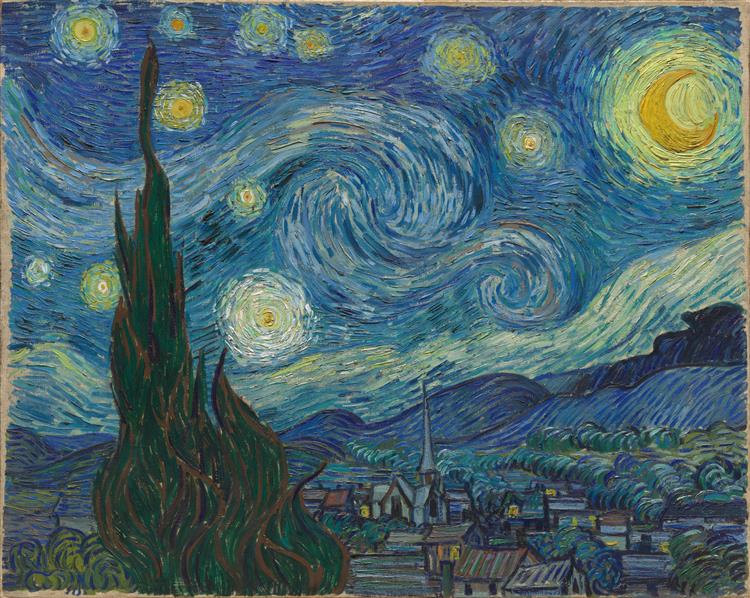
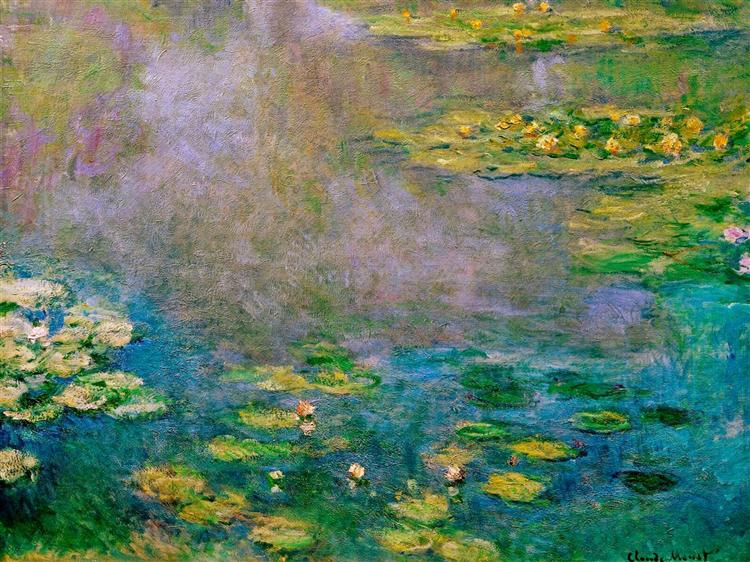
His prints had reached Europe almost in his own lifetime, used as wrapping paper for porcelain shipments to Paris and London in the 1850s and 60s. By the 1870s the wrapping paper had been pulled out, framed and pinned to studio walls. Vincent van Gogh copied two Hiroshige prints in oil in 1887 — 'Plum Garden, Kameido' and 'Sudden Shower over Shin-Ōhashi Bridge and Atake' — translating the woodblock blacks into thick green and orange brushstrokes around the edges. Claude Monet hung dozens of Hiroshige prints in his dining room at Giverny, where they still hang, and built his Japanese footbridge and water-lily pond directly under their influence. The American James McNeill Whistler took the empty fog and twilight of Hiroshige's Edo views and turned them into his Nocturnes — the misty Thames riversides of the 1870s that scandalised Ruskin. The current that runs from Hiroshige into late nineteenth-century European painting is one of the great quiet revolutions in art history, and it began in the rain, on a wet road, somewhere outside Edo.
Five famous paintings
Sudden Shower over Shin-Ōhashi Bridge and Atake 1857
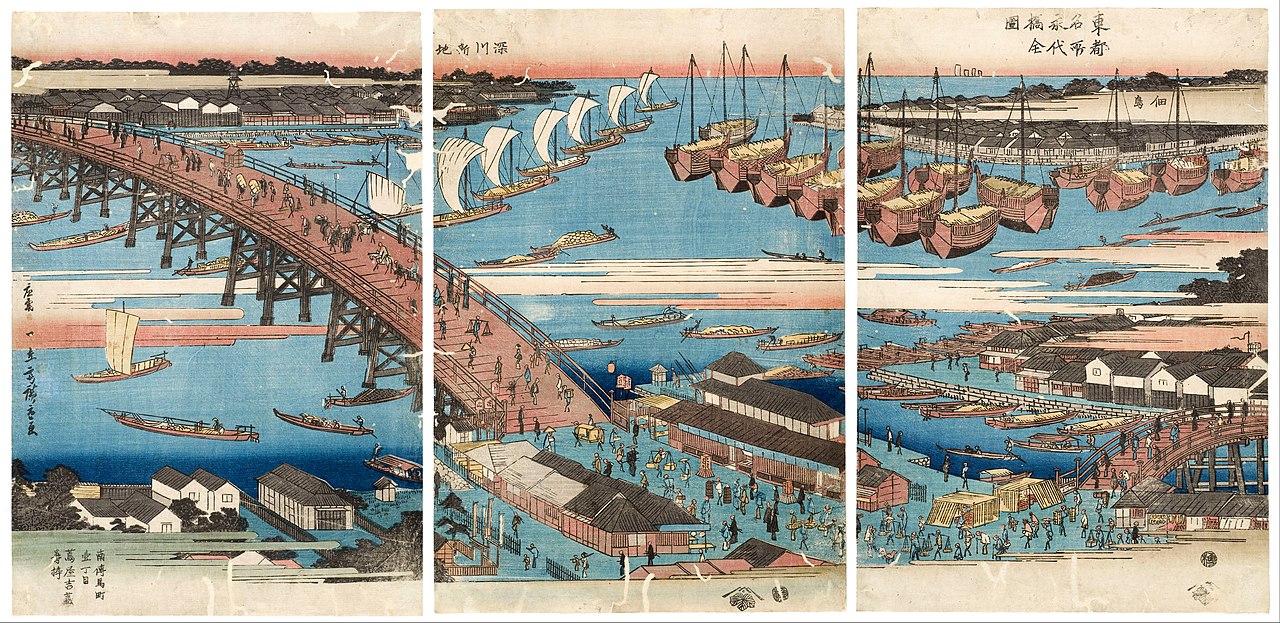
Plate 58 of the 'One Hundred Famous Views of Edo', designed in the summer of 1857, the year before Hiroshige's death. The sheet (vertical ōban, roughly 36 × 23 cm) shows the wooden Shin-Ōhashi (New Great Bridge) crossing the Sumida River near the Atake district, caught in a sudden summer downpour. Six small figures hurry across — a man pulling his straw cape over his head, a porter carrying matting, a woman with an umbrella — while the rain itself, carved as hundreds of straight black lines across two separate blocks at slightly different angles, slants violently across the entire surface. The far bank is reduced to a flat dark band of bokashi grey, the water to vertical streaks of indigo. Vincent van Gogh copied the print in oil in Paris in 1887, framing his version with imaginary Japanese characters borrowed from another sheet, and the painting now hangs in the Van Gogh Museum in Amsterdam. The print itself is held in major impressions at the Brooklyn Museum, the British Museum and the Museum of Fine Arts in Boston, and is routinely cited as the most influential single image in the history of Japanese-European exchange.
Horikiri Iris Garden 1857
Plate 64 of the 'One Hundred Famous Views of Edo' (vertical ōban, roughly 34 × 22 cm), one of the gentlest and most painterly sheets in the series. The Horikiri district north-east of Edo was famous for its irises, and Hiroshige builds the print almost entirely from the foreground flowers themselves: three or four enormous purple-blue iris blossoms loom at the front of the sheet, taller than the human figures, their petals built from a single soft bokashi wash from violet to white. Behind them a shallow pool reflects two visitors — a woman in a striped kimono and a child — as a thin line of small figures crosses a wooden walkway in the distance. The sky is rubbed from pale blue to a soft pink at the horizon. The composition again uses the radical near/far jump that fascinated Van Gogh and Monet: a flower the size of a face in the foreground, an entire garden reduced to a far ribbon. Major impressions are held at the Brooklyn Museum, the Museum of Fine Arts in Boston and the British Museum, and the print is one of the works that hung at Monet's house at Giverny.
Tsuchiyama — Spring Rain 1834
Station 49 of the 'Fifty-three Stations of the Tōkaidō', published by Hōeidō between 1833 and 1834, the series that made Hiroshige's name (horizontal ōban, roughly 23 × 35 cm). The sheet shows a small daimyō procession — a feudal lord's retinue with their tasselled spears — crossing a wooden bridge over a swollen mountain stream at Tsuchiyama, the 49th post-station on the Tōkaidō, in a steady spring rain. Black hairlines of rain slant across the entire sheet at a single sharp diagonal. The travellers' wide straw hats and oiled-paper capes are bowed against the weather; behind them the wooded hill of Suzuka Pass dissolves into a single bokashi wash of grey-green. There is almost no detail and almost no colour — wet earth, wet wood, wet sky — and the result is one of the most atmospheric sheets in nineteenth-century Japanese art. The print circulated in tens of thousands of impressions and reached Paris by the 1860s; superb examples survive at the Museum of Fine Arts in Boston, the Brooklyn Museum and the Edo-Tokyo Museum.