Albrecht Dürer
He brought the Italian Renaissance home to Germany — and turned the printing press into a fine-art medium.
Style and technique
Dürer was the first printmaker to be considered an equal to painters, and he was the first artist on either side of the Alps to make the self-portrait a subject worth taking seriously. The two facts are linked. He was, in his bones, an obsessive self-promoter who understood that printing — fast, cheap, reproducible — could carry his name across Europe in a way painting alone could not. He turned both the woodcut and the engraving from craft trades into vehicles for fine art, and signed every print with his famous monogram AD.
Four fingerprints make a Dürer unmistakable.
Astonishingly precise line. Whether engraving copper or drawing in pen, Dürer's line is hair-thin, perfectly controlled, and packs in detail at almost microscopic density. Step close to one of his prints and you find textures — fur, feathers, bark, stone — rendered in tens of thousands of crosshatched marks.
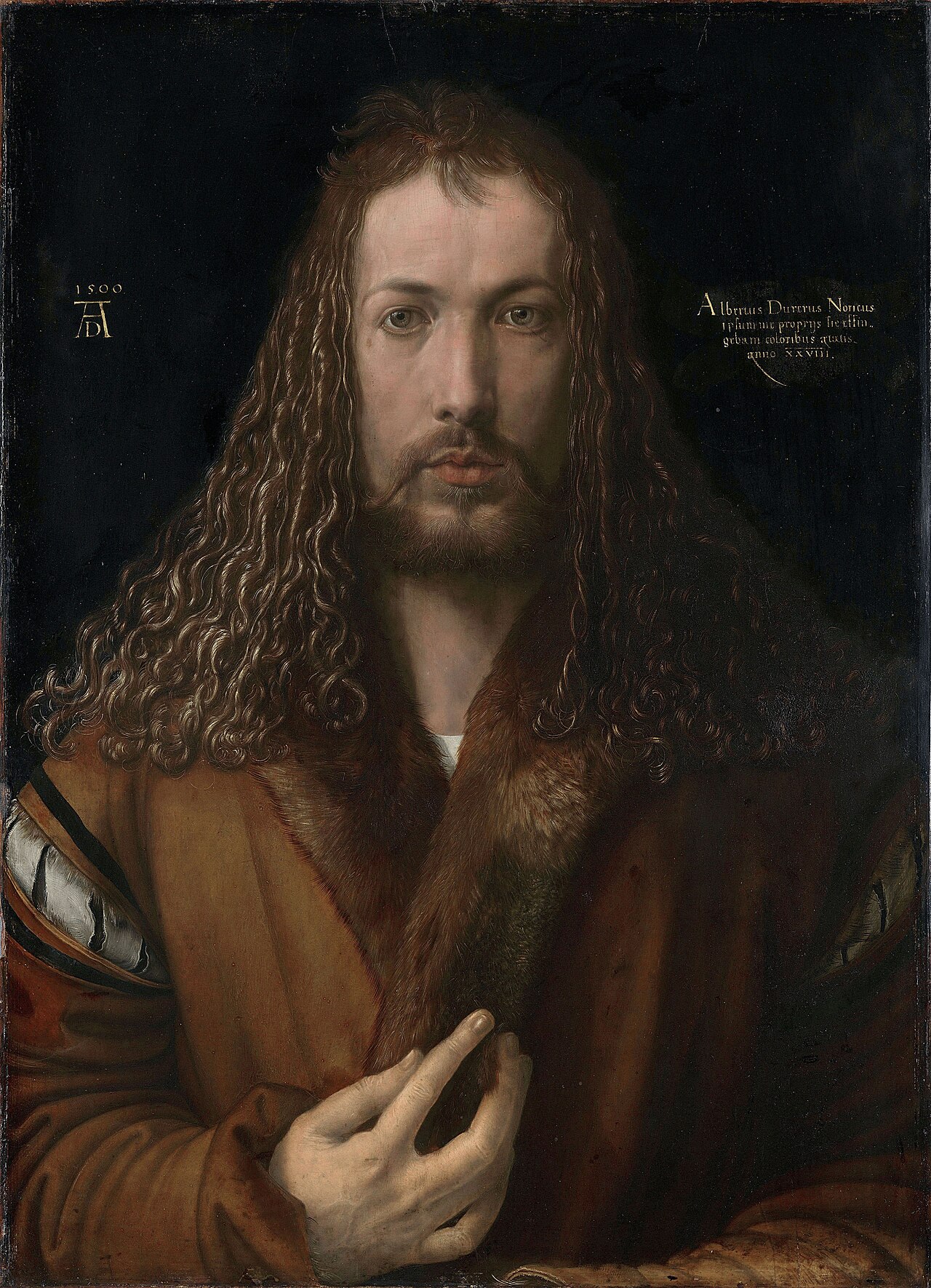
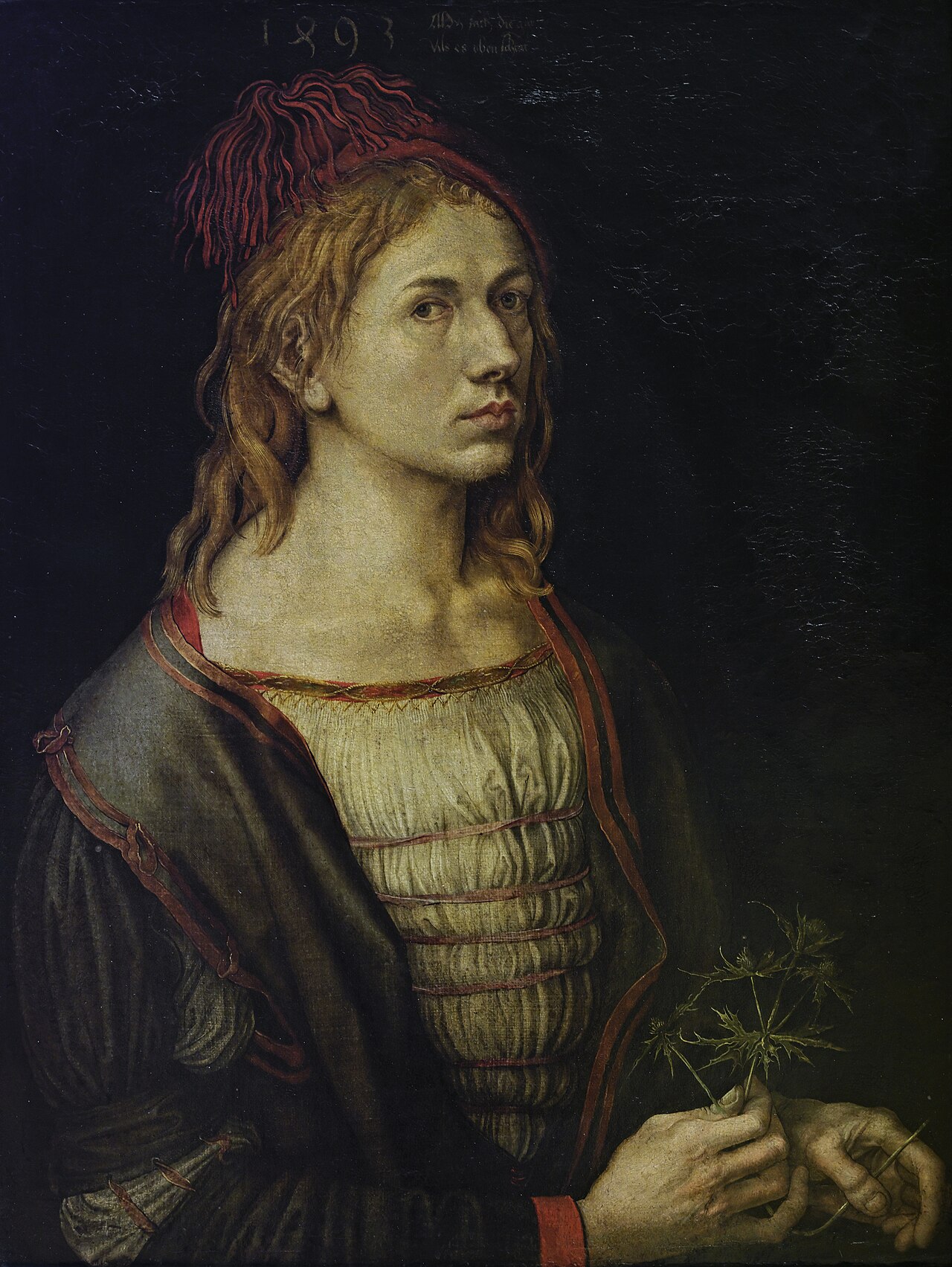
Self-conscious self-portraits. He painted at least three formal self-portraits across his career, each more ambitious than the last. The 1500 self-portrait in Munich shows him in three-quarter view with long curling hair, in a frontal pose previously reserved for images of Christ — a deliberate, slightly blasphemous claim about the dignity of the artist.
Northern detail meets Italian theory. He travelled to Italy twice (1494-95 and 1505-07), studied Mantegna and Bellini, came home and tried to graft the Italian theory of ideal proportion onto the meticulous detail of the Northern tradition. The result is recognisable on sight — figures with classical poses but Northern faces, in landscapes filled with German trees and Alpine villages.
Watercolour landscapes. On his travels he made small watercolour landscape studies — a Tyrolean valley, a quarry, a hare, a piece of turf — that are essentially the first independent watercolours in Western art. They were not made for sale or display; they were made because he was a working draughtsman who looked at things very hard.
Life and legacy
Albrecht Dürer was born in Nuremberg on 21 May 1471, the third of eighteen children of a Hungarian-born goldsmith. Most of his siblings died in infancy. The family workshop trained him from boyhood — a goldsmith's training is essentially a draughtsman's training in miniature, and it set the foundation for his lifelong precision with the burin and the pen. He drew his first surviving self-portrait at thirteen — a silverpoint drawing now in the Albertina in Vienna — already remarkably accomplished.
At fifteen he transferred to the workshop of the painter Michael Wolgemut, the leading Nuremberg woodcut producer of the day. Wolgemut had just illustrated the famous *Nuremberg Chronicle* — a printed history of the world with 1,809 woodcut illustrations, the most ambitious book published anywhere up to that date. Dürer learned woodcut from Wolgemut and almost certainly contributed cuts to the Chronicle anonymously.
In 1490 he set off on the customary German *Wanderjahre*, his journeyman travels. He spent four years moving through cities — Strasbourg, Basel, possibly Colmar where he had hoped to meet Martin Schongauer, the great German engraver who had inspired him as a boy (Schongauer had died just before Dürer arrived). He returned to Nuremberg in 1494, married Agnes Frey at his father's arrangement (the marriage seems to have been distant rather than warm), and almost immediately set off again — this time to Italy.
Back in Nuremberg in 1495 he began producing prints at a furious rate. The Apocalypse woodcut series of 1498 — fifteen large prints illustrating the Book of Revelation — was a commercial sensation across Europe. Dürer published it himself, sold it through agents in city after city, and made a fortune. It was the first printed book in which the artist (not the publisher) was the principal author and copyright-holder. By 1500 he was the most famous artist in northern Europe and almost certainly the wealthiest German painter of his day.
In 1505 he returned to Italy for two years, this time staying mostly in Venice. He was treated as a celebrity. The Venetian painter Giovanni Bellini, then in his eighties, asked to meet him and famously requested to see the brush Dürer used to paint hair so finely. (When Dürer handed him an ordinary brush, Bellini was said to have been amazed.) Dürer wrote home to his friend Willibald Pirckheimer that he was treated like 'a gentleman' in Venice, where he was respected for his intellect rather than his guild membership.
In 1512 the Holy Roman Emperor Maximilian I commissioned a series of enormous propaganda prints celebrating his reign — the *Triumphal Arch* and the *Triumphal Procession*, both designed by Dürer and printed in editions running to hundreds of sheets that were assembled into wall-size collages. They are among the largest woodcut compositions ever produced.
In 1520 he travelled to the Netherlands to negotiate the continuation of his pension under Maximilian's grandson, the new emperor Charles V. He kept a meticulous travel diary that survives almost intact. In it, he records meeting Erasmus, attending the coronation of Charles V at Aachen, and — characteristically — counting every meal he ate and every coin he spent. On the return journey through the marshes of Zeeland, he saw what he thought might be a beached whale and made a long detour to find it; he caught a fever there from which he never fully recovered.
The last years of his life were dominated by his theoretical writings. He wrote treatises on measurement, on fortifications, and especially on human proportion — the latter unfinished at his death and published posthumously in 1528. He had absorbed the Italian humanist project of trying to find mathematical rules for the ideal human body, and tried to systematise it for a Northern audience.
He died in Nuremberg on 6 April 1528, aged 56, of complications from the fever caught in Zeeland. He had no children. His widow Agnes lived for ten more years, selling prints from her husband's stock to support herself. She is buried beside him in the Johannisfriedhof in Nuremberg, in a tomb that still stands and that is visited by thousands of art lovers every year.
Five famous paintings
Self-Portrait at Twenty-Eight 1500
Painted in 1500, when Dürer turned 28. He shows himself frontally — hair flowing in long ringlets, hand raised toward the throat in a gesture borrowed directly from medieval images of Christ. The pose was, in 1500, a deliberate provocation: full frontal portraits were almost exclusively reserved for sacred images. Dürer signs the painting with his AD monogram and the inscription 'Thus I, Albrecht Dürer of Nuremberg, painted myself with everlasting colours, aged 28 years' — a claim about the artist as a kind of secular saint, on the edge of blasphemy. The painting hangs in the Alte Pinakothek in Munich and is the most reproduced of his three formal self-portraits.
Adam and Eve 1507
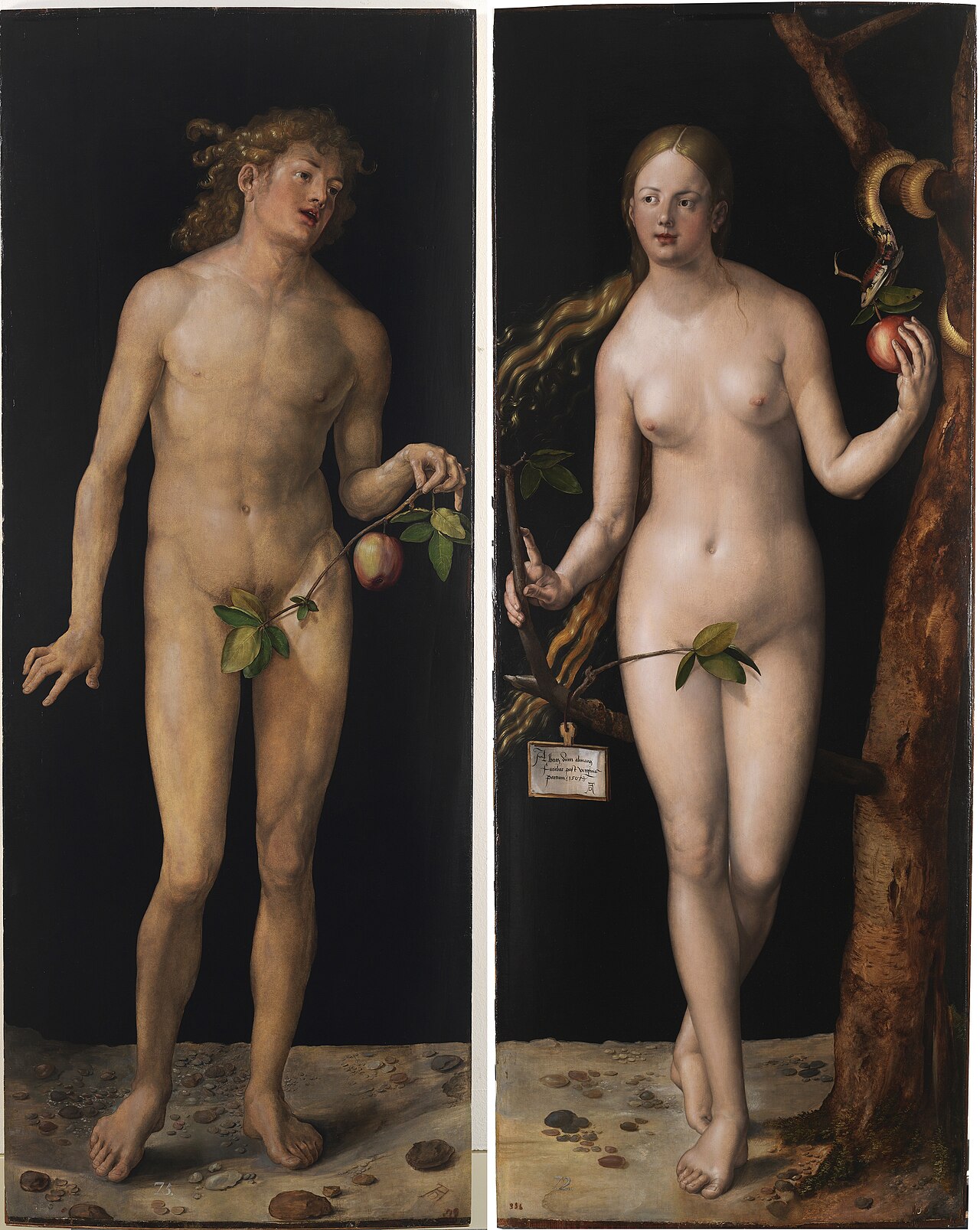
Two oil panels, each about 209 × 81 cm, hanging side by side in the Prado. Painted just after Dürer returned from his second Italian trip, they are his first life-size nudes and one of the first life-size pairs of Adam and Eve in northern European painting. He treats the human body as Italian-Renaissance idealised form: Adam takes his pose from the Apollo Belvedere that Dürer would have known through prints; Eve stands in classical contrapposto, weight on one leg, the other relaxed. But he builds them in northern oil glaze with a precision no Italian could match — every strand of hair, every veined leaf, every reflection in the apples is microscopically painted. The white cartouche on the branch behind Eve is signed in Latin: Albertus Durer alemanus faciebat post virginis partum 1507 — Dürer claiming his place beside the Italians while announcing himself, defiantly, German.
Young Hare 1502
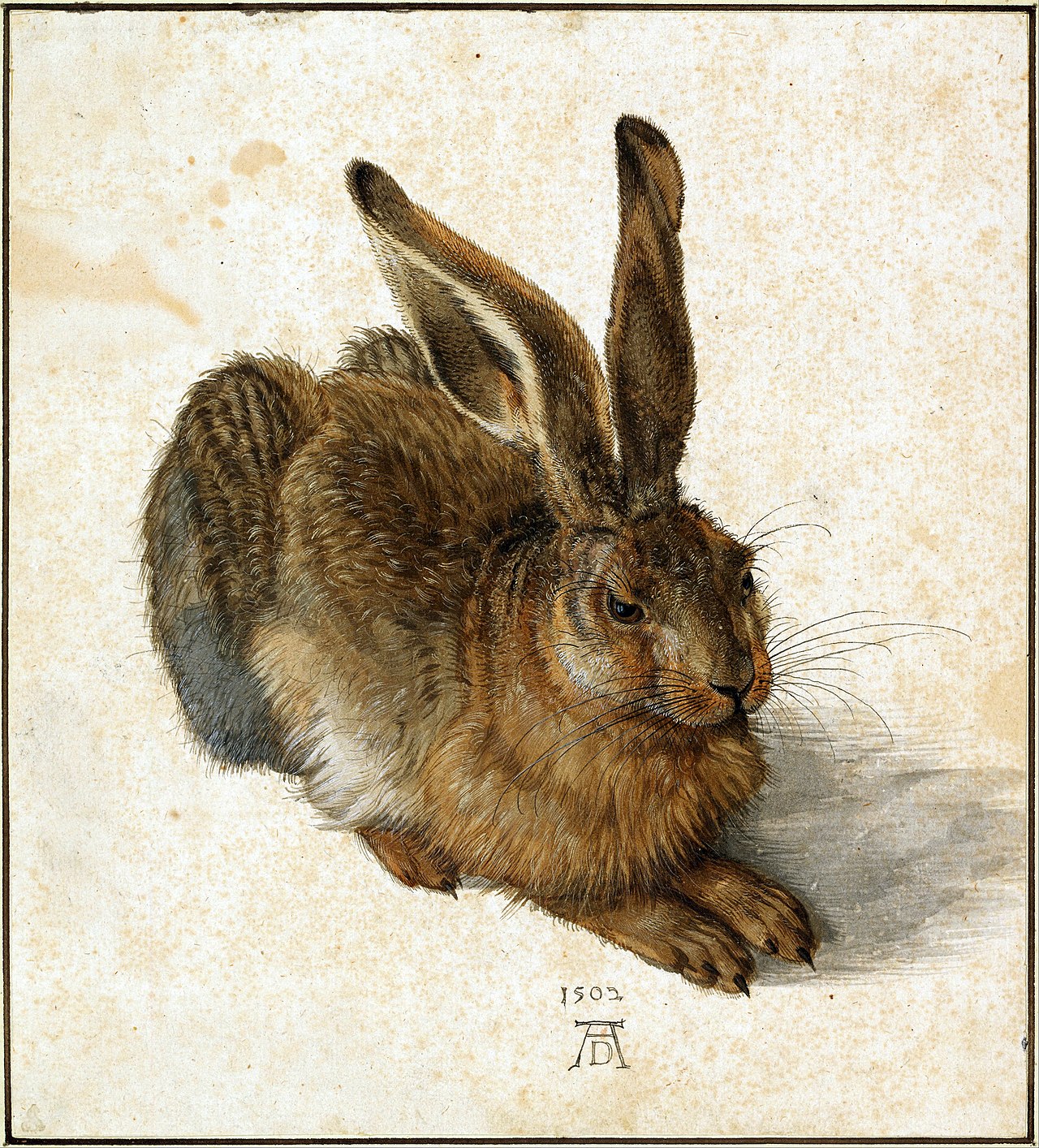
A small watercolour-and-gouache study of a brown European hare, painted in 1502, signed and dated. Roughly 25 by 23 cm. The fur is rendered with thousands of single strokes of body colour, eye reflecting a window with crossed bars (showing the studio Dürer was in). The hare itself is treated with the gravity Italian Renaissance painters were giving to gods. The watercolour was not commissioned — Dürer made it for himself, and it stayed in his studio until his death. It hangs today in the Albertina in Vienna and is, by some distance, the most famous of his nature studies.
Self-Portrait at 26 1498
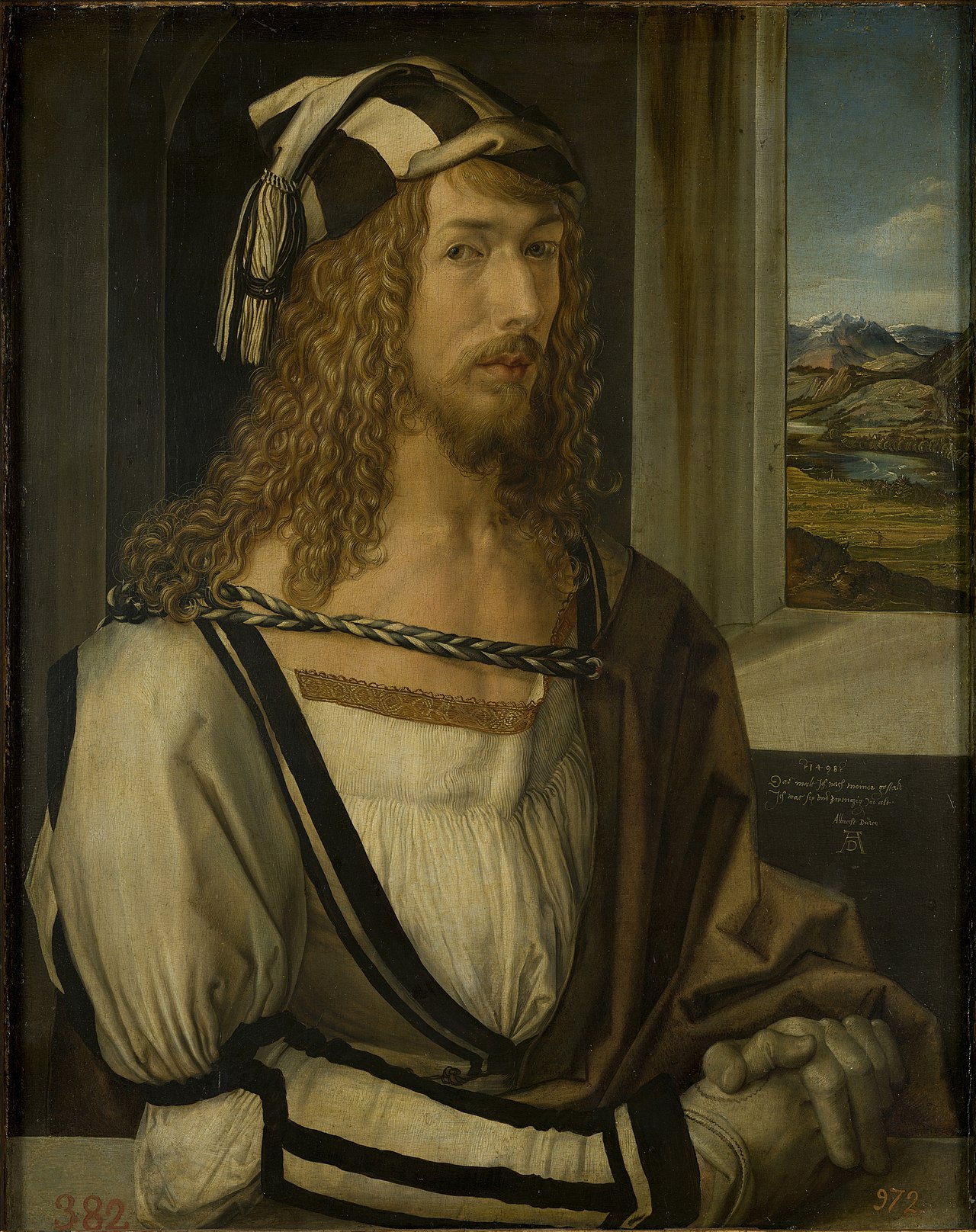
Oil on panel, 52 × 41 cm, Prado. The first self-portrait in Western painting in which the artist presents himself unmistakably as a gentleman of leisure, not as a craftsman at work. Dürer wears Italian fashion — a striped silk doublet, fine kid gloves laid casually across the parapet, his hair waved against the cheek — having returned the previous year from his first Venetian journey. Through the window behind him, the Alps he had crossed on muleback rise above a small town. The inscription on the upper right dates the work to 1498 and gives his age as twenty-six; he signs with the famous AD monogram he had begun to use on his prints. The portrait is a quiet declaration: a young master claiming a social standing for the painter that German tradition had not yet been willing to grant him.
The Four Apostles 1526
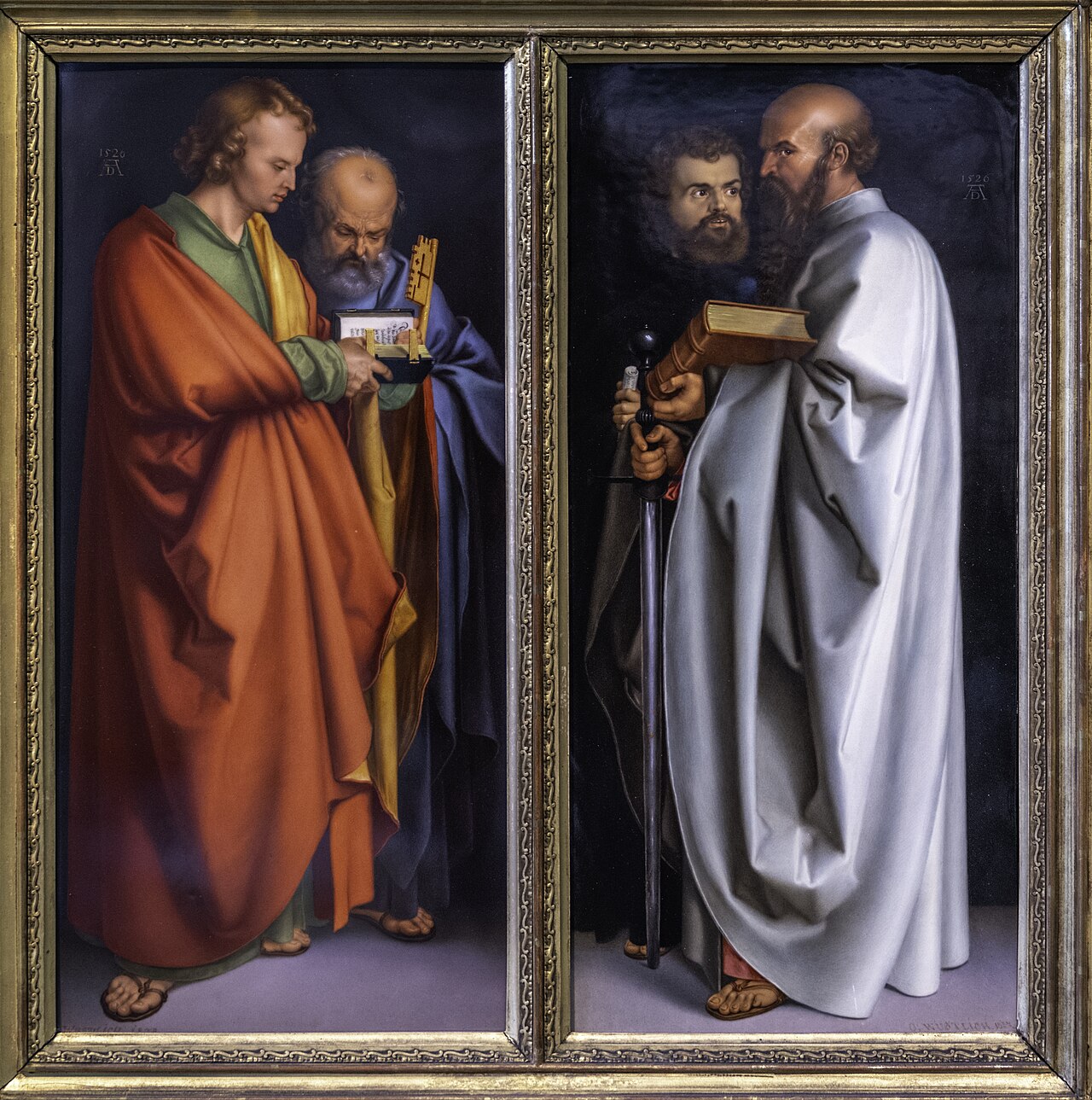
Dürer's last great painting, completed in 1526 and given by him as a gift to the city council of Nuremberg. Two large panels, each just over 2 metres tall, depict pairs of apostles and evangelists — John and Peter on one panel, Mark and Paul on the other. The figures are heavy, monumental, drawn with his late-period interest in classical proportion. The colours are sober. Inscribed below the figures are passages from each saint's writings, in a German translation Dürer himself selected — the city was by then officially Lutheran, and Dürer had moved with Nuremberg into the Reformation. The panels are now in the Alte Pinakothek in Munich, having been bought from Nuremberg by the Bavarian elector in 1627.