Hieronymus Bosch
He painted hell as if he had been there — and made the most strangely modern paintings of the entire 15th century.
Style and technique
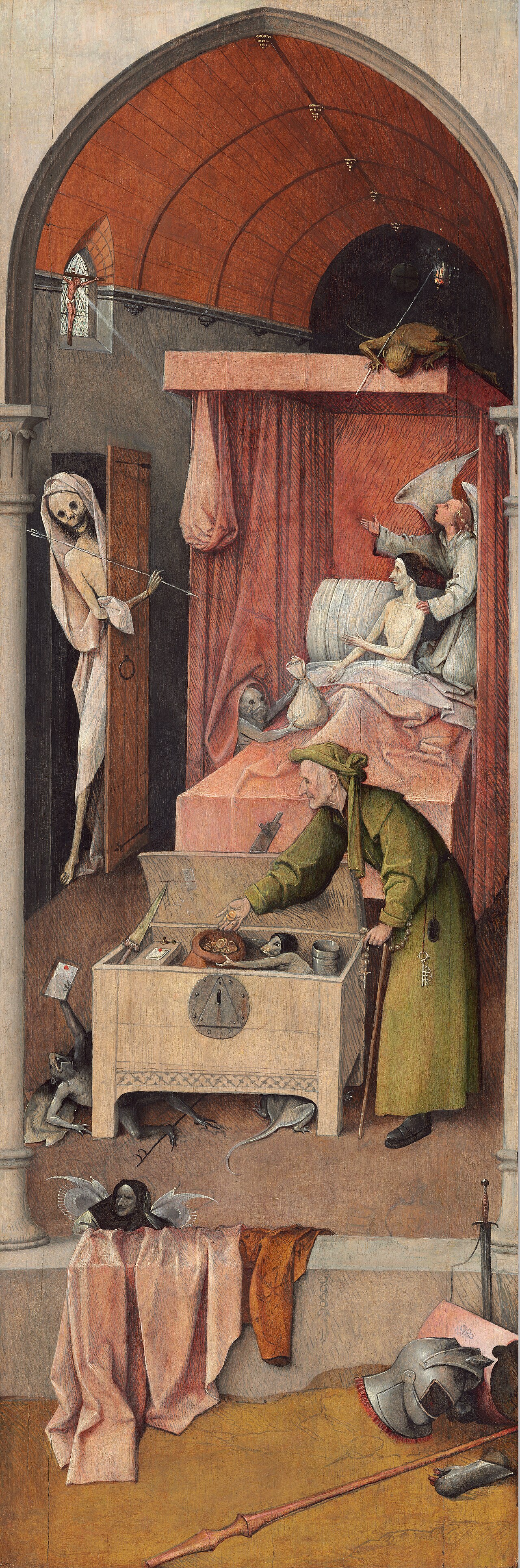
Bosch painted monsters. Every image he made — even the apparently calm scenes of saints in landscapes — is populated with hybrid creatures, half-animal half-human, or half-human half-vegetable, swallowing one another, riding fish, sprouting trumpets from their backsides, marching out of broken eggshells. No painter before him had used the surface of an altarpiece to imagine such a thoroughly disturbed world. His audience in 1500 found it riveting; the Spanish king Philip II spent a fortune collecting his work; the Surrealists in the 20th century discovered him as their godfather.
Four fingerprints make a Bosch unmistakable.
Hybrid creatures. Animals fused with people, fish with knives, knives with feet. The visual language is closer to a fevered medieval bestiary than to Italian Renaissance figure painting.
Triptych format. Most of his best-known works are altarpieces with a central panel and two folding wings: paradise on the left, the everyday world or sin in the centre, hell on the right. He treated the format like a cinema-goer treats a screen: each wing tells a different chapter of one moral story.
Tiny scale, dense surface. Step up close to a Bosch and you see hundreds of small figures, each with its own perfectly crisp brushstrokes. There is no painter in 15th-century Europe who packs more visual incident per square centimetre.
Cool, dry colour. Bosch's palette is mostly chalky pinks, pale blues, soft greens, with occasional spots of bright red or orange (typically at the moment of horror — a flame, a wound, a demon's tongue). He doesn't go for the rich saturation of his Italian contemporaries. Everything looks slightly dried out.
His paintings were considered eccentric in his lifetime but never heretical: the Catholic Church seems to have understood them as orthodox warnings about sin and damnation, dressed in unusual visual language. After his death he was widely copied, and Pieter Bruegel the Elder built his early career producing engravings deliberately marketed as 'Bosch'.
Life and legacy
He was born around 1450 in 's-Hertogenbosch (literally 'the Duke's Forest'), a prosperous market town in the Duchy of Brabant — now in the southern Netherlands, then part of the Burgundian and later Habsburg lands. He never left it. The family name was van Aken (the family had originally come from Aachen, a generation or two earlier); 'Bosch' was a stage name he adopted to identify himself with the town. He signed his pictures 'Jheronimus Bosch'.
His grandfather Jan van Aken, his father Anthonius, and several uncles and cousins were all painters in 's-Hertogenbosch. Bosch grew up inside a working family workshop. He apprenticed with his father; nothing else is known of his training.
In 1481 he married Aleid van de Meervenne, the daughter of a wealthy local burgher. The marriage was clearly advantageous — Aleid brought a substantial dowry, including a house on the central market square — and seems to have been happy. They had no children. Bosch lived in his wife's house, in the centre of his small town, for the next thirty-five years.
In 1486 he joined the Brotherhood of Our Lady, an unusually pious lay confraternity in 's-Hertogenbosch that brought together both Catholic clergy and prominent townsmen. He remained an active member for the rest of his life. The Brotherhood commissioned several altarpieces from him for their chapel in the cathedral and recorded his name in their account books — the only contemporary documentation we have of his career.
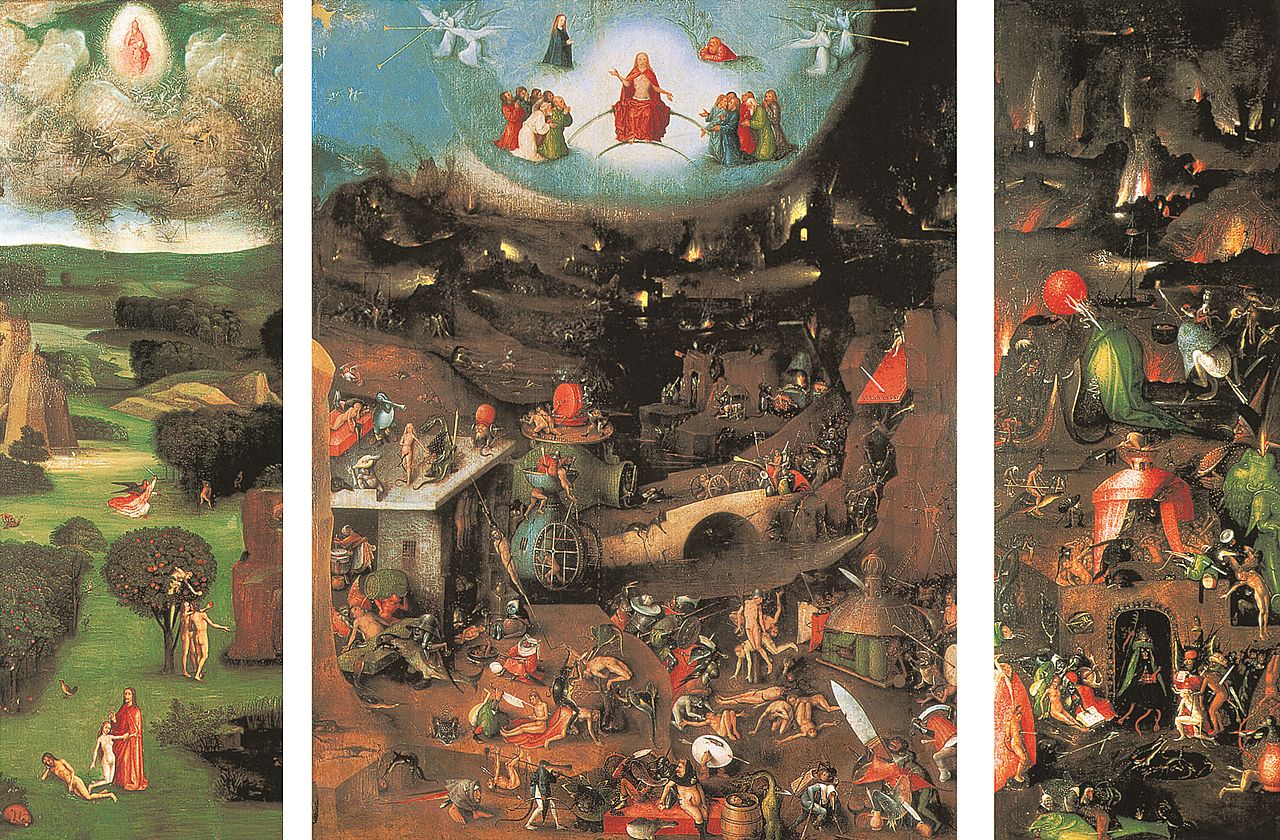
The great paintings he is now famous for were almost all produced in the last twenty years of his life: 'The Garden of Earthly Delights' (around 1500), 'The Haywain Triptych' (around 1510), 'The Last Judgement' triptych (around 1500-1505), 'The Temptation of Saint Anthony', 'The Ship of Fools'. Most of them ended up in Spain because Philip II, who came to the Spanish throne in 1556, was an obsessive Bosch collector. The reason is itself contested. Philip II was a deeply religious man, and Bosch's apocalyptic Catholicism appealed to him personally; some art historians have also speculated that he saw in Bosch's hellscapes a satisfying vision of what would happen to Protestants. Whatever the reason, by the late 16th century the largest Bosch collection in the world was hanging in the Escorial outside Madrid. Most of those paintings are now in the Prado.
Bosch died on 9 August 1516, aged about 65 or 66. The Brotherhood of Our Lady held a requiem Mass for him in the cathedral. His widow Aleid lived on for two more years, then sold the house and the workshop. The painters who had worked for him scattered.
Unlike most Renaissance painters, Bosch left almost no documentary trail behind. There are no surviving letters in his hand, no diaries, no biographical accounts written by anyone who knew him personally. His birth date is reconstructed from one self-portrait drawing in which he wrote his age. We know what he looked like — a thin man with sharp features and a long nose — only because of that drawing.
His most reliable legacy is the small remaining body of work itself: roughly 25 paintings definitely attributed to him, plus another twenty contested. Almost half of them are in the Prado in Madrid. The rest are scattered: the Lisbon temptation, the Vienna Last Judgement, several panels in Brussels and Rotterdam.
Five famous paintings
The Garden of Earthly Delights 1500
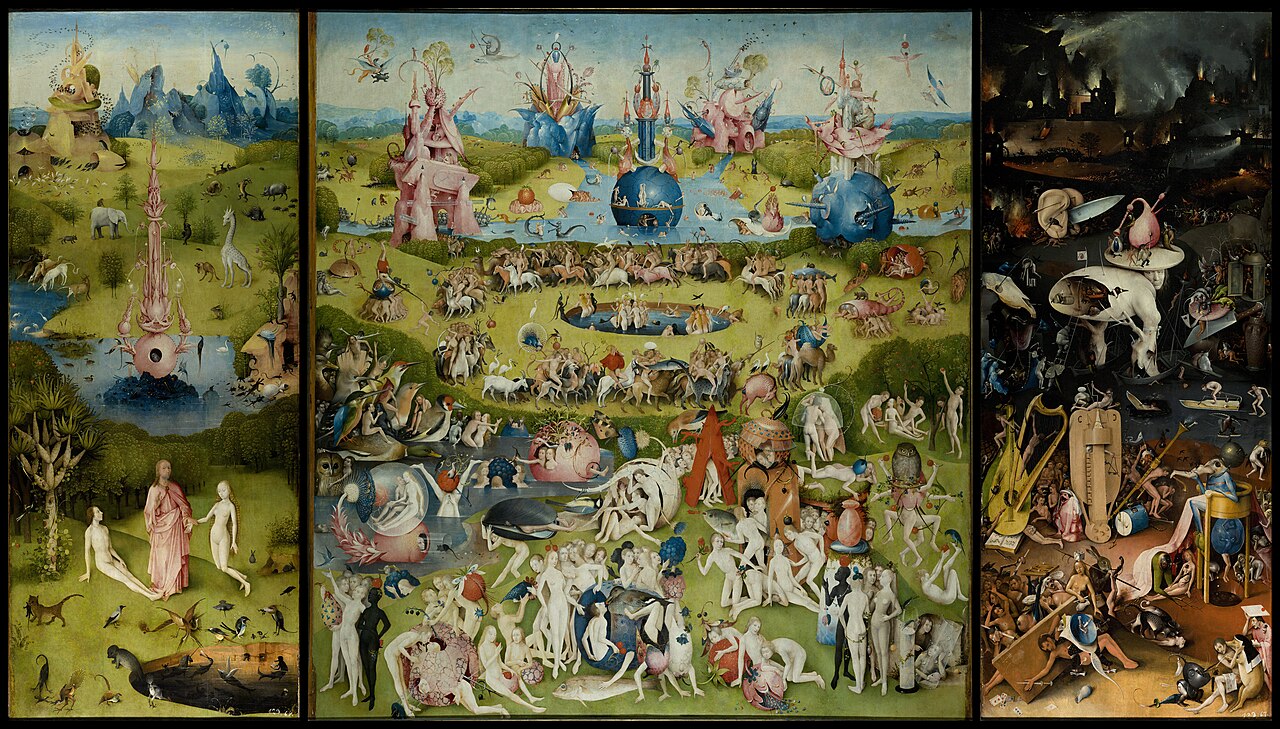
The most famous Bosch and one of the most strange and complete paintings of the entire late Middle Ages. A triptych painted around 1500, oil on oak panel, roughly 2.2 by 3.9 metres open. The left wing shows Paradise — God presenting Eve to a kneeling Adam, in a calm landscape filled with strange animals: a giraffe, a unicorn, hybrid birds. The centre panel is the Garden of Earthly Delights itself: hundreds of naked human figures, riding outsized animals, eating outsized fruit, climbing in and out of glass orbs and shells. The right wing is Hell — a frozen, smoking landscape where a man with a tree-trunk for legs has a tavern in his torso, knives have feet, and a giant pair of human ears with a blade between them rolls forward crushing the damned. The painting was almost certainly intended as a moralising warning against the temptations of the flesh, and is now in the Prado in Madrid.
The Haywain Triptych 1515
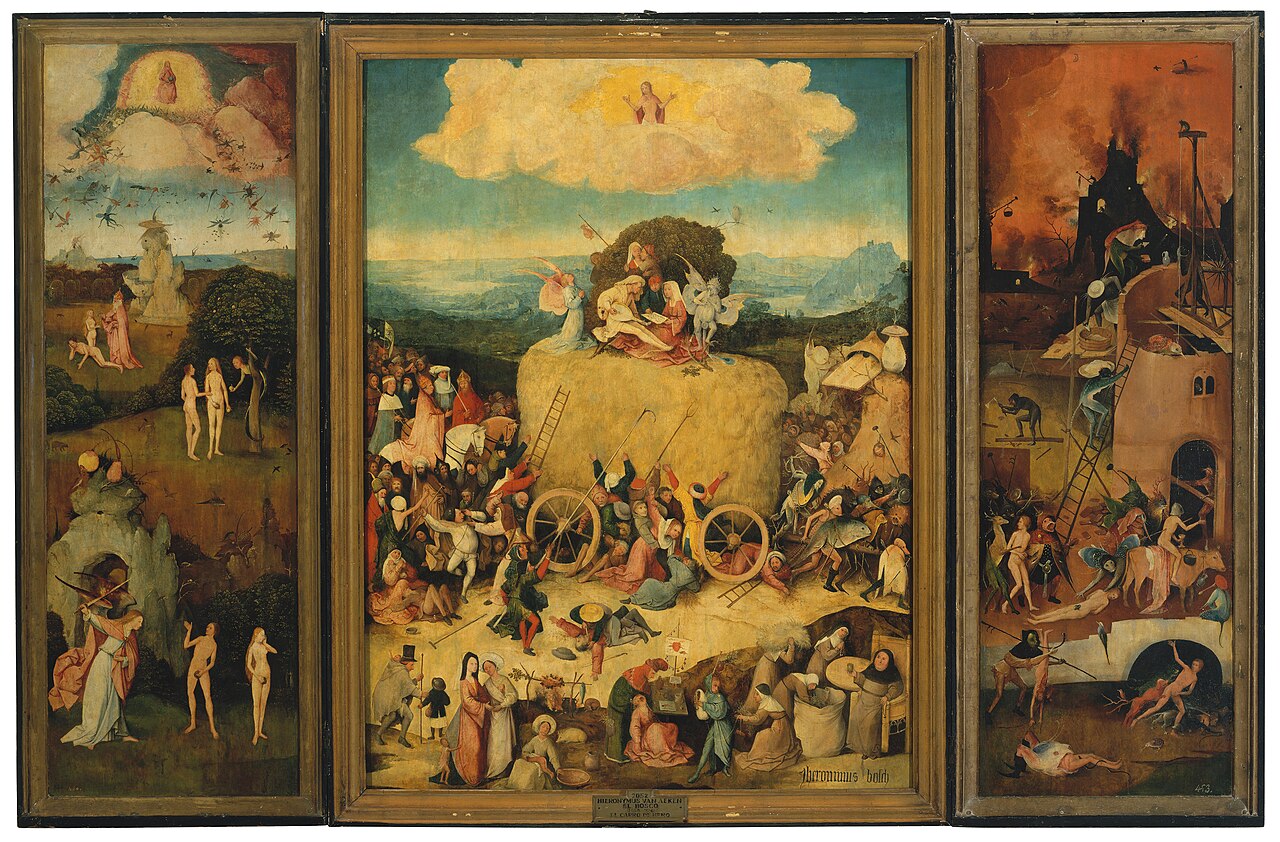
Oil on panel, central panel 135 × 100 cm, wings each 135 × 45 cm, now in the Prado. Bosch's allegory of human greed turned into a Flemish proverb: the world is a haystack, and each person pulls from it what he can. The central panel shows a giant cart of hay drawn by demonic beasts; on top, oblivious lovers embrace beside a singing angel and a blue devil; below, all of humanity — peasants, monks, nobles, and even a pope on horseback — claws at the hay, fights, and trips beneath the wheels. The left wing depicts the Fall of the rebel angels and the expulsion from Paradise; the right wing, hell as a construction site for new circles of torment. Closed, the wings show a peddler defending himself from a snarling dog on a barren road — the path of life. The triptych collapses cosmology, theology and proverb into a single vertical reading from heaven to hell.
The Temptation of Saint Anthony 1501
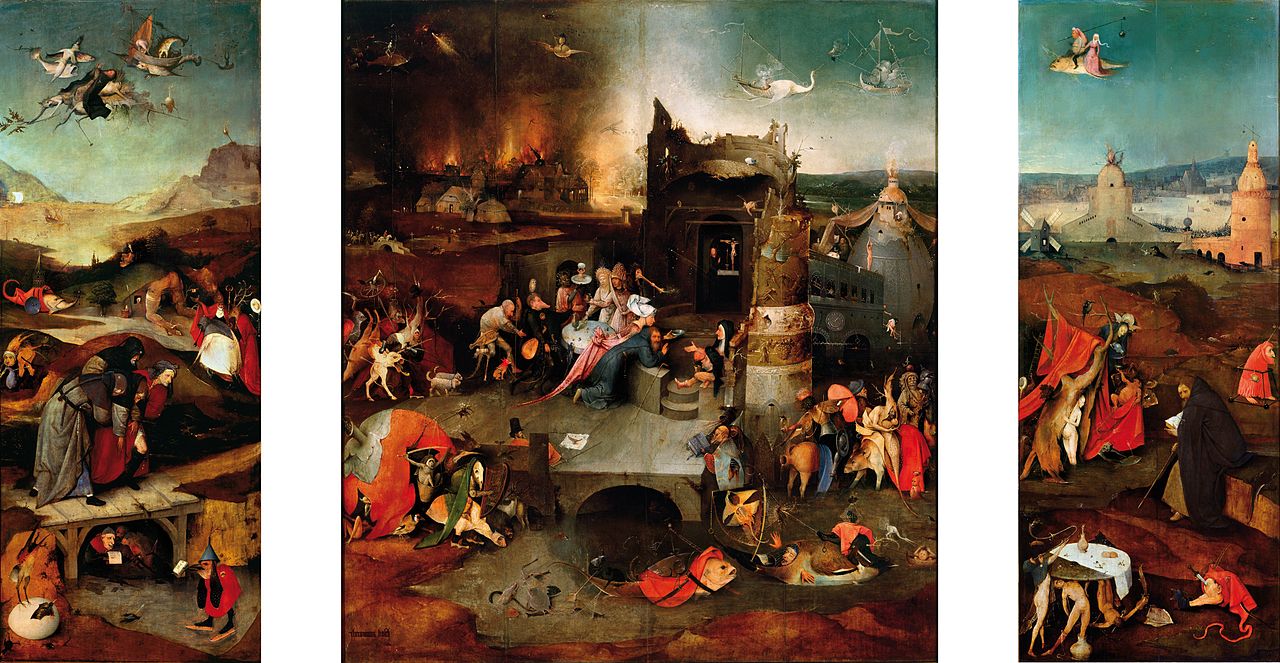
Oil on panel, central panel 131 × 119 cm, wings each 131 × 53 cm, Museu Nacional de Arte Antiga, Lisbon. The most theatrical of Bosch's surviving triptychs and the favourite of Philip II, who acquired it for the Spanish court. Saint Anthony kneels at the centre, undisturbed amid a riot of demonic distractions: a black mass officiated by a fox-priest, a flying fish-galleon overhead, a hollow tree-figure with a man's head emerging from it, miniature scenes of theft and lechery in every corner. Both wings continue the assault — the left shows demons carrying the saint through the air; the right depicts him meditating in a desert of wreckage. Painted around 1501, the triptych is closer to a moving picture than a panel: the eye cannot rest, every figure is busy with malice or temptation, and the saint at the centre is the still point that holds it together.
The Ship of Fools 1500
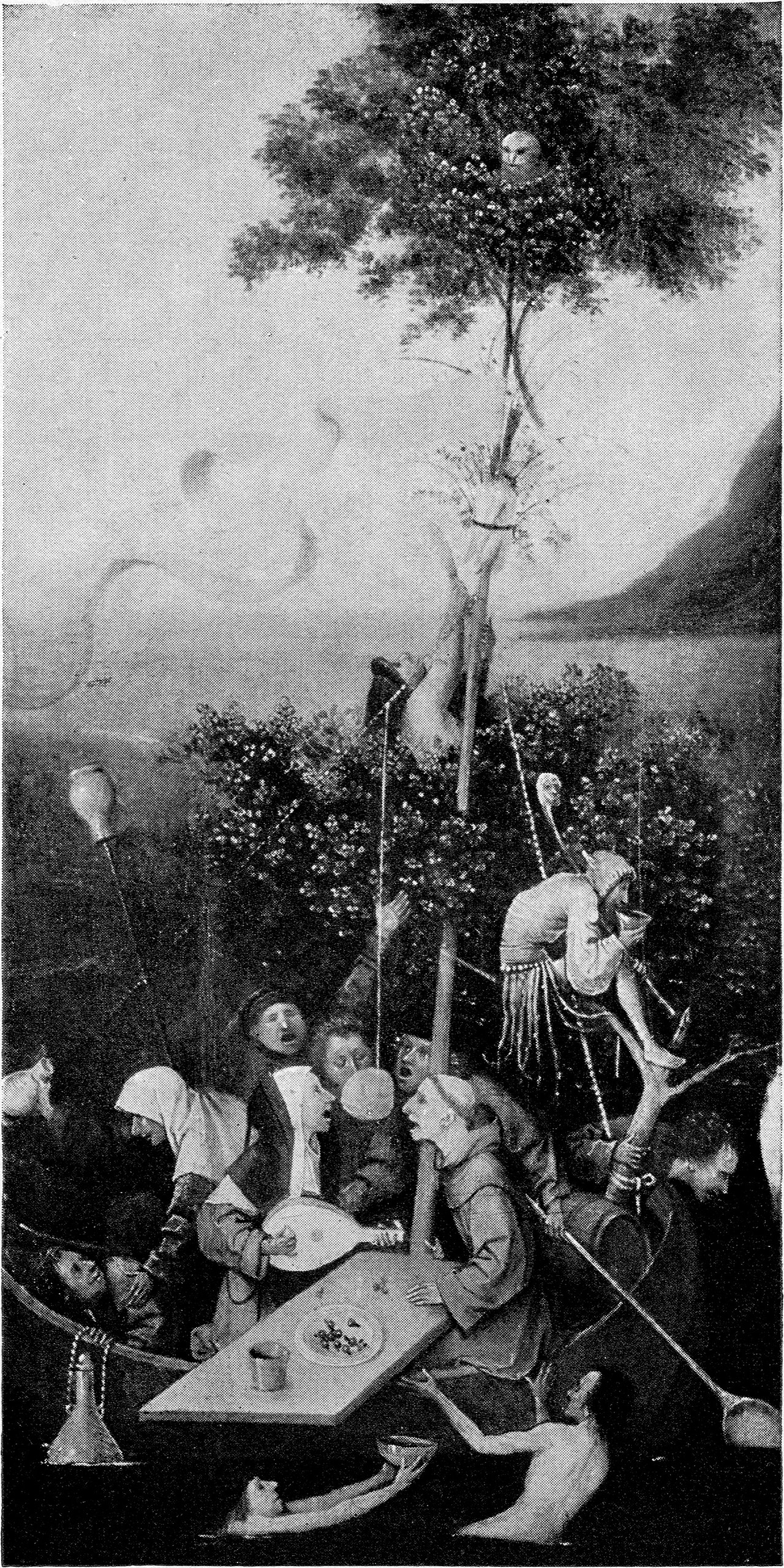
Oil on panel, 58 × 33 cm, Louvre. A vertical fragment from a dismembered triptych whose other surviving piece, the Allegory of Gluttony and Lust, hangs in Yale's Art Gallery. A monk and a nun lead a singing group on a narrow vessel; one drunkard vomits over the side; another swims after a wine pot bobbing in the water; a peasant climbs the mast for the goose tied above. The painting is a visual cousin of Sebastian Brant's satirical poem Das Narrenschiff, published in 1494, but Bosch's version was painted independently and the connection is only thematic. The boat has no rudder, no sail and no destination — humanity drifting on its own appetite, oblivious that the moralists in the foreground are the worst-behaved of the lot.