Leonardo da Vinci
He left only fifteen paintings — and changed how the human face would be painted for the next five hundred years.
Style and technique
Leonardo painted very few works. By careful count, only fifteen surviving paintings are firmly attributed to him — fewer than many of his contemporaries produced in a single year. He could draw and paint better than anyone in Florence by his early twenties; he simply couldn't bring himself to finish things. Many of the panels he did finish, he then kept reworking for decades — the Mona Lisa travelled with him for sixteen years, from Florence to Milan to Rome to France, and was still being adjusted on the day he died.
The technique he is most famous for is sfumato — Italian for 'smoke'. Instead of drawing a hard line between two zones of colour, Leonardo blended them through dozens of almost invisible glaze layers, so the transition becomes a soft veil. The corner of the Mona Lisa's mouth is the textbook example: there is no edge, only an infinitesimally graded gradient that the brain reads as a half-smile that keeps shifting.
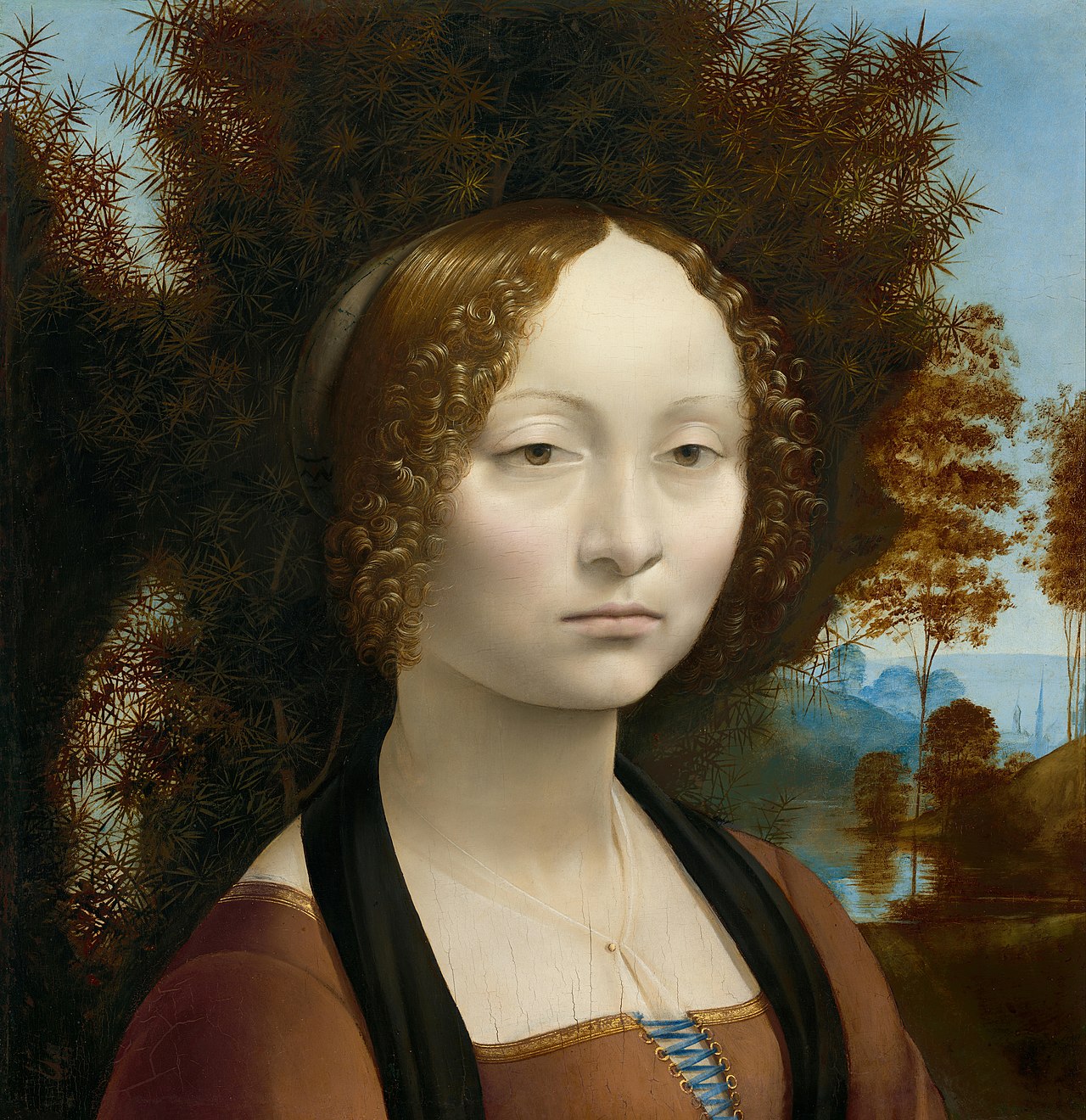
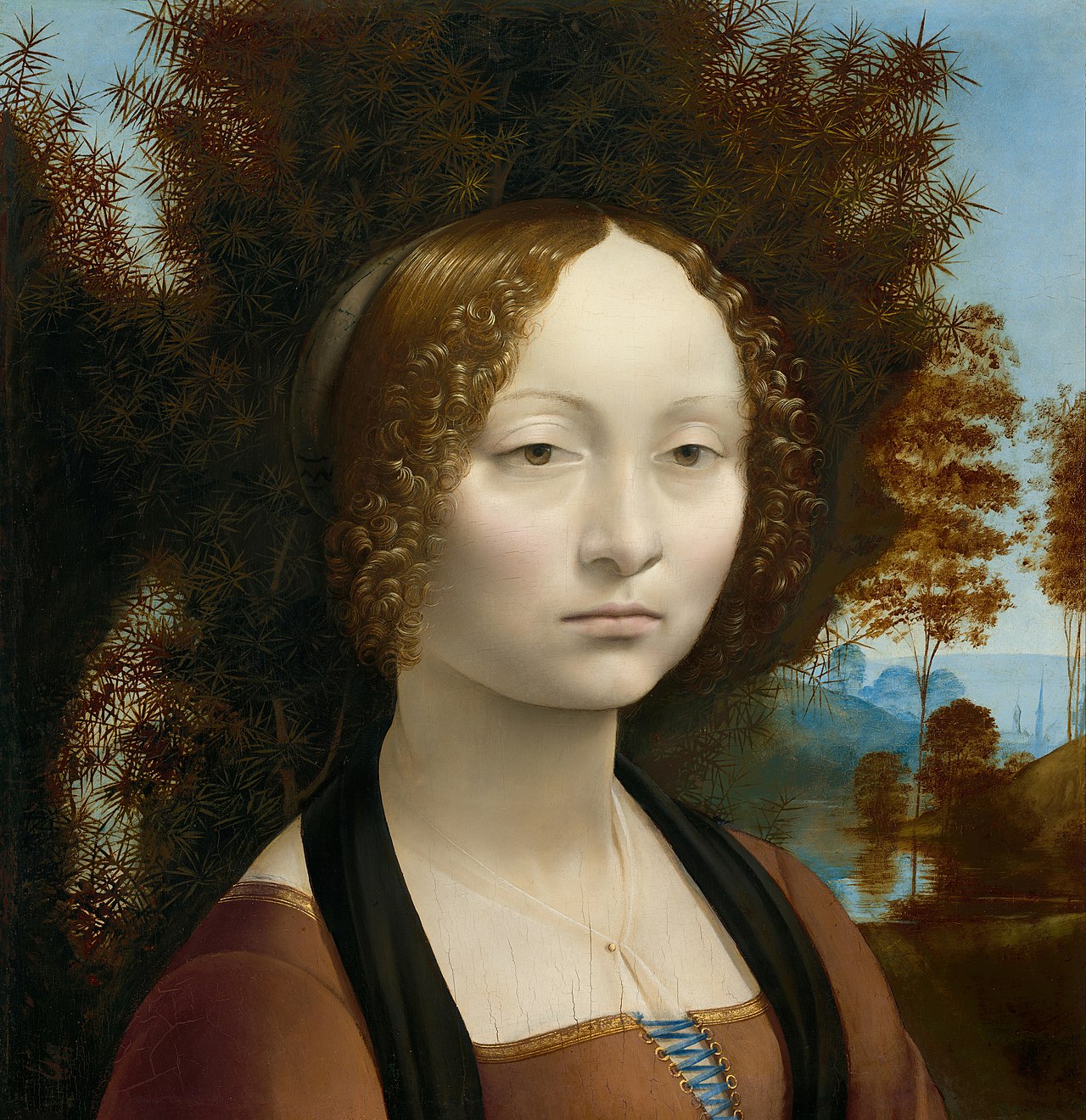
Four fingerprints make a Leonardo recognisable.
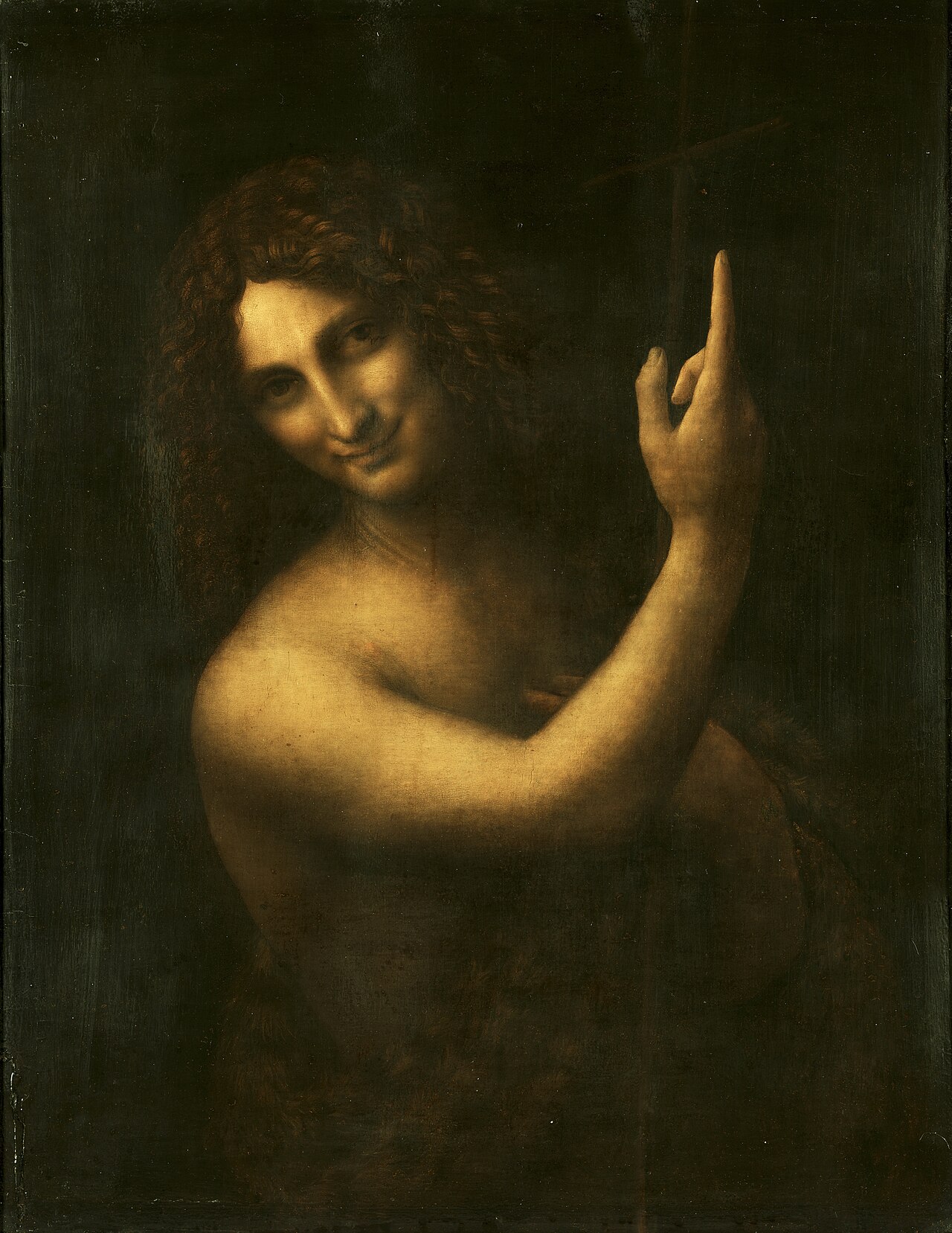
Sfumato. Faces and forms emerge from a smoky atmospheric background, never sharply outlined. Up close it looks almost out of focus.
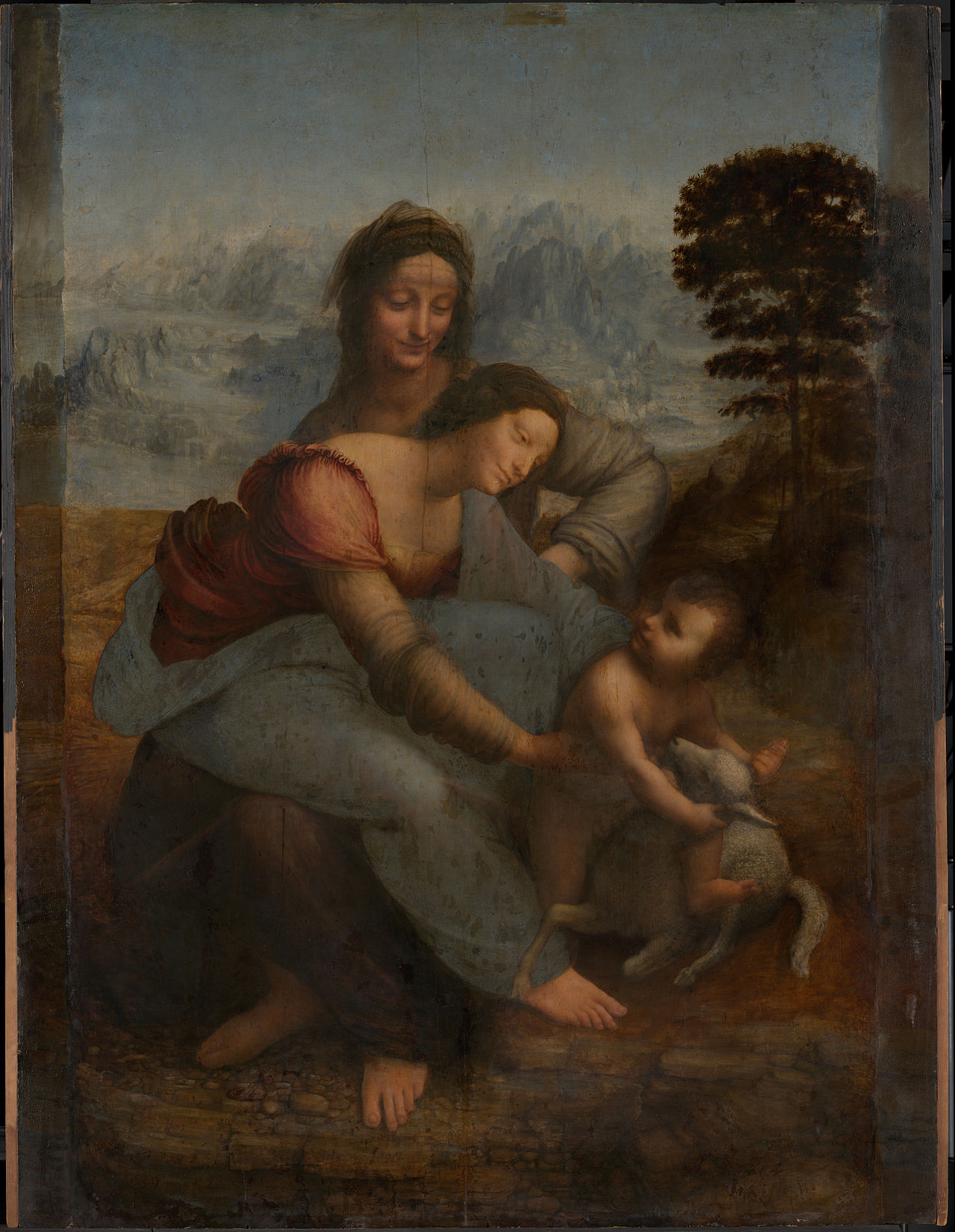
Pyramid composition. His group scenes are built around a central triangle — Madonna and child seated, the Last Supper organised around Christ — borrowed from Florentine tradition but pushed further. Stable geometry on the surface; complex psychology inside.
Hand gestures as language. Hands carry the meaning. Each apostle in the Last Supper reacts with a different hand: pointing, recoiling, grasping, opening palm down. Leonardo studied gesture as a form of speech.
Atmospheric landscapes. His backgrounds are always misty mountain ranges receding to a blue horizon — a technique called aerial perspective that he codified. Distant peaks fade to pale blue; closer hills are warm brown. He was the first to write about why this happens optically.
He was also the most extraordinary draughtsman in the history of Western art. His notebooks — about 7,000 surviving pages of mirror-written observations on flight, anatomy, water, machines, the eye, the womb — are studied today by engineers, biologists, and art historians as the closest thing the Renaissance has to a record of one mind thinking through almost everything.
Life and legacy
He was born on 15 April 1452 in or near Vinci, a village in the hills west of Florence. His father, Ser Piero da Vinci, was a young notary; his mother, Caterina, was probably a peasant woman or possibly an enslaved servant of Middle Eastern origin (recent scholarship is inconclusive). They were not married. Leonardo grew up illegitimate, raised in his grandfather's household, and the social handicap shaped his early career — he could not attend a university or join most professional guilds.
What he could do was draw. Around 1466, when he was 14, his father took some of his sketches to the Florentine sculptor and painter Andrea del Verrocchio, who took him on as an apprentice. Leonardo lived in Verrocchio's bottega for over a decade. The famous (and probably apocryphal) story is that when the young Leonardo painted one of the angels in Verrocchio's 'Baptism of Christ', the older master was so unsettled by how much better the apprentice's brushwork was than his own that he gave up painting entirely.
In 1481 he secured a major commission, 'The Adoration of the Magi' for a monastery near Florence, and abandoned it half-finished. The same year he wrote a remarkable letter to Ludovico Sforza, Duke of Milan, applying for a court position. The letter ran for nine paragraphs explaining his skills as a military engineer — bridge-builder, tunneler, designer of armoured vehicles — and concluded almost as an afterthought: 'Also, I can do painting and sculpture.' He got the job.
Leonardo lived in Milan from 1482 until 1499, attached to the Sforza court. There he painted 'The Last Supper' on the refectory wall of Santa Maria delle Grazie (1495–1498), and also began to develop the long obsession with anatomy, hydraulics, and flight that fills the notebooks. The Last Supper began deteriorating almost as soon as he finished it — he had used an experimental tempera-on-dry-plaster mixture instead of true fresco, and the wall absorbed and rejected the paint within thirty years.
In 1499 the French invaded Milan, the Sforza fled, and Leonardo headed back to Florence via Venice. The next decade was the most restless of his life. He served briefly as military engineer to Cesare Borgia (the famously ruthless son of Pope Alexander VI). He returned to Florence and painted the lost mural 'The Battle of Anghiari' for the Palazzo Vecchio — also a technical disaster, also abandoned. He began the Mona Lisa around 1503 for a Florentine merchant, and never delivered it.
In 1513 he moved to Rome at the invitation of Pope Leo X. Michelangelo and Raphael were both there too. Leonardo was 61, the oldest of the three, and treated by his younger rivals with a mixture of awe and impatience — he kept getting distracted by experiments with mirrors, plant grafting, and hydraulics. He produced almost no painting in Rome.
In 1516 the new King of France, François I, invited him to live at the small chateau of Clos Lucé near Amboise. Leonardo accepted, packed up the Mona Lisa, the 'Saint John the Baptist' and the 'Virgin and Child with Saint Anne', and rode across the Alps in his sixties with all three under his arm. He was given a generous pension and the title 'First Painter, Engineer and Architect to the King'. He spent his last three years at Clos Lucé designing royal pageants and reworking those three paintings.
He died on 2 May 1519, aged 67, in the chateau's small chamber. The legend that François I held his head in his arms as he died is almost certainly a 19th-century romantic invention. The factual record is that Leonardo left his notebooks and the three paintings to his pupil and longtime companion Francesco Melzi, who carried them back to Italy. The Mona Lisa eventually entered the French royal collection and is now in the Louvre, where about 30,000 visitors a day file past her every morning.
Five famous paintings
Mona Lisa 1503
The portrait was commissioned around 1503 by Francesco del Giocondo, a Florentine silk merchant, for his second wife Lisa Gherardini. Leonardo never delivered it. He worked on it for the next sixteen years, carrying the panel with him from Florence to Milan to Rome to France, glazing the surface in dozens of sessions. The face is built up in layers of sfumato so thin that no individual brushstroke is visible at any magnification. The smile sits at the corner of the mouth, where the gradient is most graded — look directly and it dissolves; look slightly to one side and it returns. The painting is small (77 × 53 cm) and hangs in the Louvre behind two centimetres of bulletproof glass. It was stolen by an Italian carpenter in 1911, recovered two years later in Florence, and only became the most famous painting in the world after the theft made it front-page news on every continent.
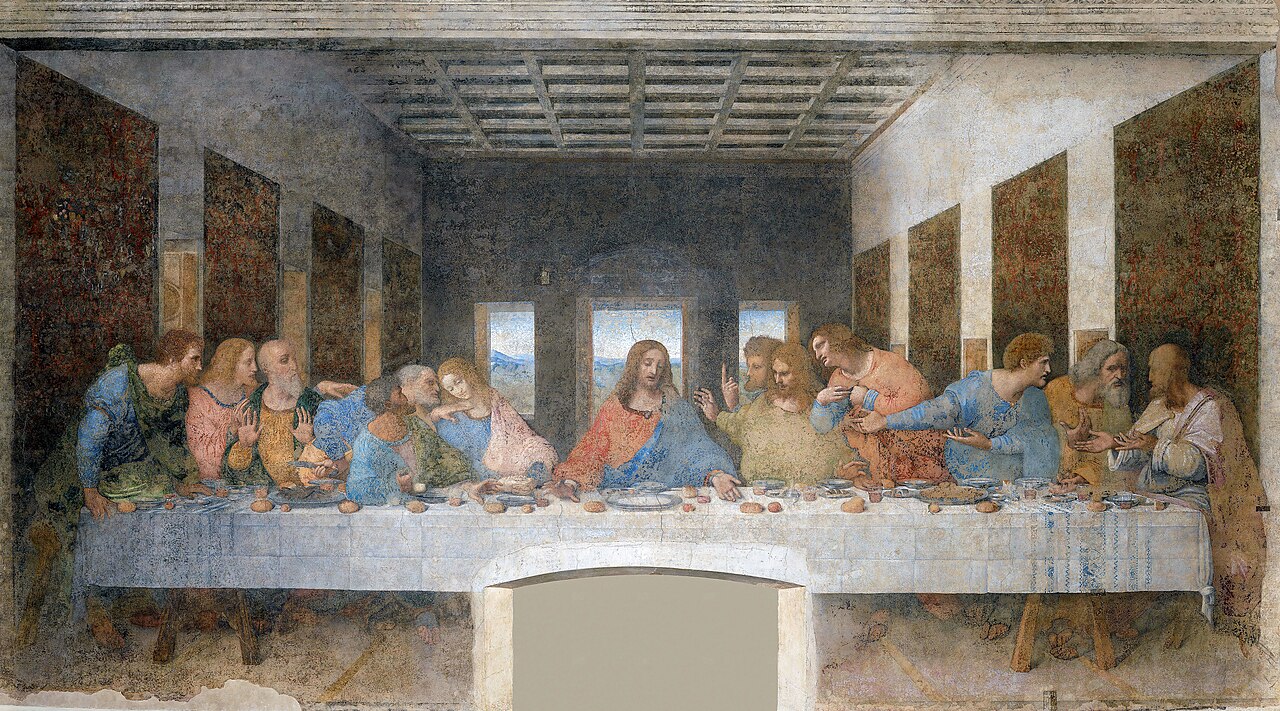
The Last Supper 1498
Painted on the back wall of the refectory of Santa Maria delle Grazie in Milan, between 1495 and 1498. Christ has just told the twelve apostles that one of them will betray him; Leonardo paints the instant after the words have been said. The composition arranges the apostles into four groups of three, each reacting differently — Peter leans forward in anger, John recoils, Judas clutches a money bag in shadow, Philip points at his own chest in disbelief. Leonardo made the technical mistake of painting in tempera on dry plaster rather than wet fresco, hoping for finer detail; the wall began absorbing and shedding paint almost immediately. By 1517 it was already deteriorating; by 1700 most of it was lost. What survives today is the result of a 21-year restoration completed in 1999. The room is still in active use as a refectory, now climate-controlled, and visitors enter in groups of twenty for fifteen minutes at a time.
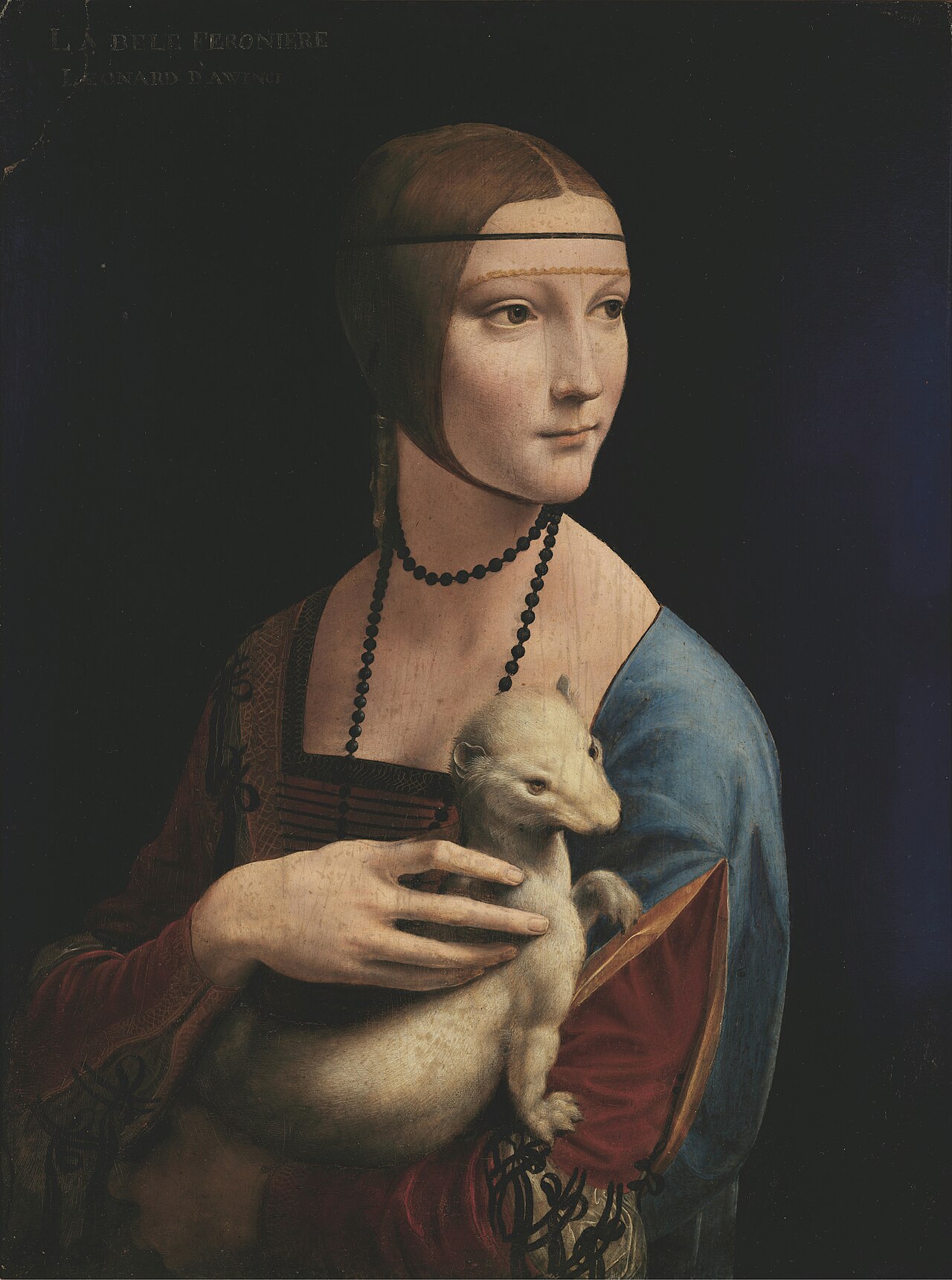
Lady with an Ermine 1490
Painted around 1490 in Milan during Leonardo's first decade at the Sforza court. The sitter is Cecilia Gallerani, the 16-year-old mistress of Ludovico Sforza, the Duke of Milan. The white animal in her arms is an ermine — a heraldic symbol of the Duke (his nickname was 'l'Ermellino') and a pun on her surname (Greek 'galé' means weasel-like animal). The painting marks the moment Leonardo invented the modern psychological portrait: instead of the conventional profile pose used for centuries, he twists Cecilia's body away from the viewer and snaps her head back as if she has just heard someone enter the room. The ermine mirrors her gesture exactly. Today it hangs in the Czartoryski Museum in Krakow, having survived two World Wars partly because the Nazis liked it enough not to destroy it.
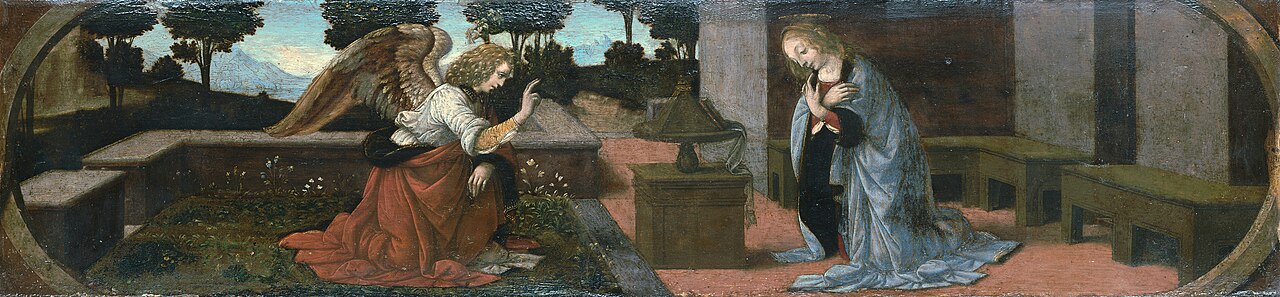
The Annunciation 1475
An early Leonardo, painted around 1472-1475 when he was barely twenty and still working in Verrocchio's bottega. The panel is unusually wide (98 × 217 cm) and was probably designed to be set above a doorway in a Florentine convent. The Archangel Gabriel kneels on the left, having just landed, his lily of purity still in his hand and his wings made from real bird-wing studies Leonardo had been doing in his notebooks. Mary, on the right, is interrupted at her reading; her hand is raised in a gesture of surprise. The misty mountain landscape behind them, the careful botanical accuracy of the garden flowers, and the perspective experiments in the marble lectern are all signs of the technical experimenter Leonardo would become. The painting is in the Uffizi in Florence.