Amedeo Modigliani
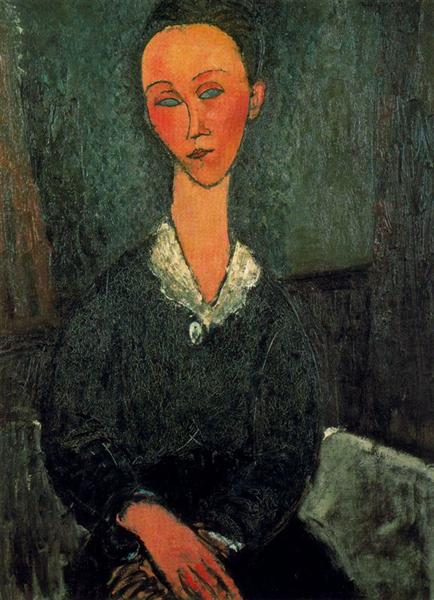
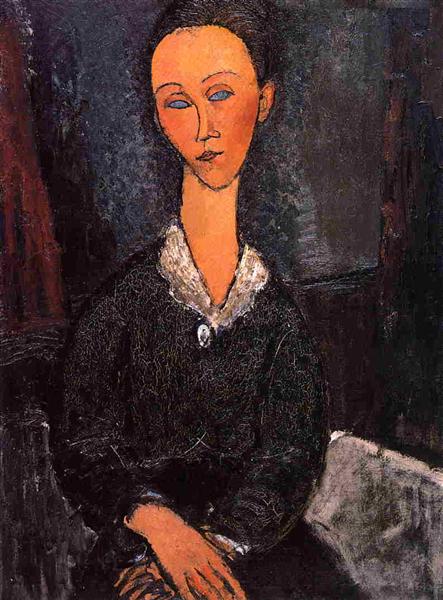
He painted people as they felt from the inside — the elongated neck, the tilted head, the sightless eyes that look inward.
Style and technique
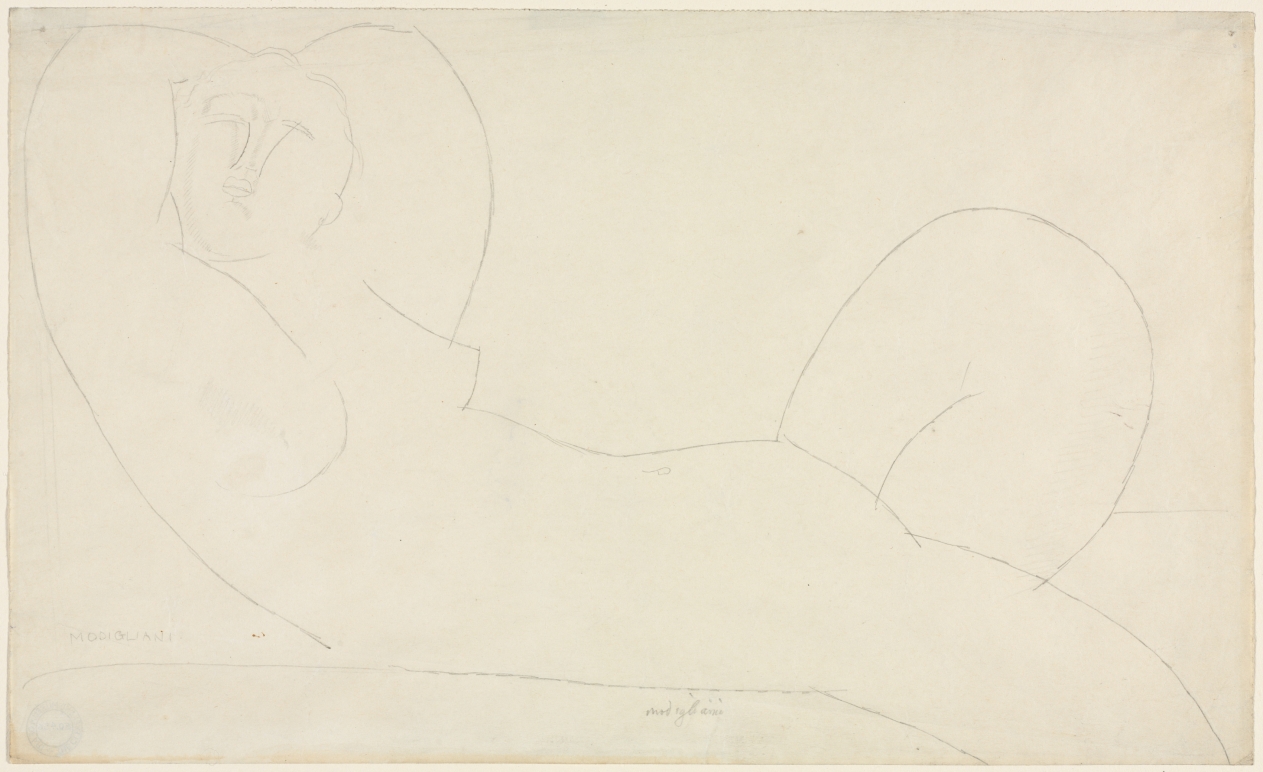
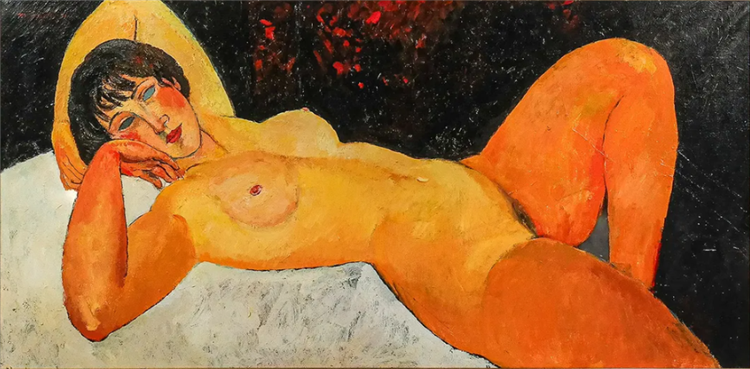
Modigliani made exactly one kind of painting for most of his career: the human figure, usually single, usually in three-quarter portrait or reclining nude format, with a face that seems to have been derived from non-European sculpture and a body that has been stretched gently beyond anatomical accuracy into something closer to emotional truth.
The faces are the signature. The nose is elongated, often slightly turned to one side; the eyes are almond-shaped and frequently painted with one or both irises blank — no pupil, no reflection, no window to the soul in the conventional sense. The neck is too long; the shoulders slope. The figures occupy their canvases with a specific quality of physical presence that is simultaneously intimate and remote. They are close and they are elsewhere.
The elongation is not distortion for its own sake but a formal strategy: by departing from anatomical proportion in a consistent, system-like way, Modigliani produced faces and bodies that carry emotional weight without narrative specificity. You know these faces are real people — they have been observed, sat for, recorded — but they have been transformed into a register that is halfway between portrait and icon.
His direct sources were African and Oceanic sculpture, which he encountered at the Trocadéro in Paris and which confirmed his intuition that non-naturalistic form could carry greater spiritual and emotional authority than the academic figure painting he had trained in. He was also deeply influenced by Cézanne's simplification of form and by the Sienese painters of the thirteenth and fourteenth centuries, whose elongated figures he had seen as a young man in the churches of central Italy.
Four fingerprints: the elongated oval face with almond eyes and long nose, the sightless or inward-turned eye that refuses conventional portraiture's claim to reveal character, warm, earthen colour fields behind the figure that flatten spatial depth, and a consistent elegance of contour that gives even the most casual pose the quality of a work carefully designed.
Life and legacy
Modigliani was born on 12 July 1884 in Livorno, a port city in Tuscany, the fourth child of a Jewish Italian family that had fallen into financial difficulty around the time of his birth. He grew up reading Dante, Nietzsche, and the Italian Symbolist poets, absorbing a cultural atmosphere that valued intensity, beauty, and artistic seriousness as near-religious commitments.
His health was poor from childhood — he suffered from pleurisy at fourteen, which left a lasting weakness in his lungs, and tuberculosis was diagnosed by his twenties. He studied painting in Livorno, Florence, and Venice, where he encountered the great tradition of Italian figure painting and began to understand what he would spend his career departing from.
He arrived in Paris in 1906, settled in Montparnasse, and spent fourteen years there in conditions that ranged from precarious to desperate. He made friends quickly — Picasso, Soutine, Rivera, Max Jacob — and moved through the Paris avant-garde with a combination of charm, beauty, and volatility that became legendary. He drank, he took drugs, he gave away his drawings for meals, he was extravagant when he had money and dignified when he didn't.
His years as a sculptor, from roughly 1909 to 1914, produced a series of stone heads that are among the most original works of the century, but the effort of stone-carving strained lungs already compromised by tuberculosis, and he eventually returned to paint. The portrait and nude paintings that followed — the main body of work on which his reputation rests — were produced in a compressed period of roughly six years, from 1914 to his death.
His dealer was Paul Guillaume, then the young Polish dealer Léopold Zborowski, who took him on in 1917 and organised the show at the Berthe Weill gallery whose nude paintings caused such scandal that the police shut it down on opening night: the first time, Modigliani noted with satisfaction, a painting exhibition had been closed by the police.
In 1917 he met Jeanne Hébuterne, a young art student who became his partner and the mother of his daughter. She was nineteen when they met; she was twenty-one when, the morning after his death, she threw herself from a fifth-floor window.
His posthumous reputation moved quickly. Within years his work was collected and celebrated worldwide.
Five famous paintings
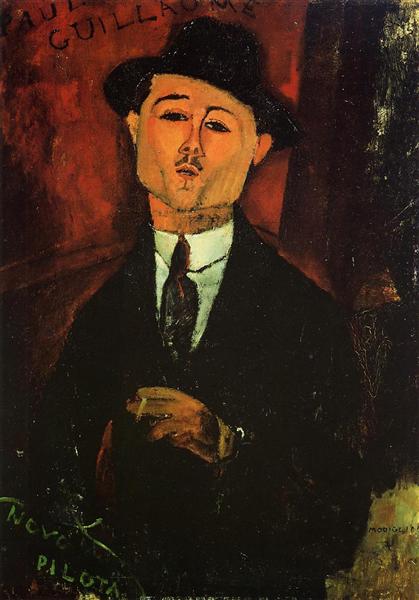
Paul Guillaume, Novo Pilota 1915
Oil on cardboard, 105 × 75 cm, Musée de l'Orangerie, Paris. The young art dealer Paul Guillaume — twenty-three when this was painted — was Modigliani's first serious champion: he bought work, paid the rent, and lent the studio space where Modigliani painted between 1914 and 1916. The inscription scratched in the wet paint at upper left reads PAUL GUILLAUME NOVO PILOTA — "Paul Guillaume, the new pilot" — a public declaration that this dealer would steer the new School of Paris. The sitter is shown in the formal three-quarter pose of a Renaissance portrait, but Modigliani has lengthened the face into the almond-eyed mask he had been carving in stone the year before. The colour is restricted to ochre, black and rust — almost a sculptor's palette translated to paint.
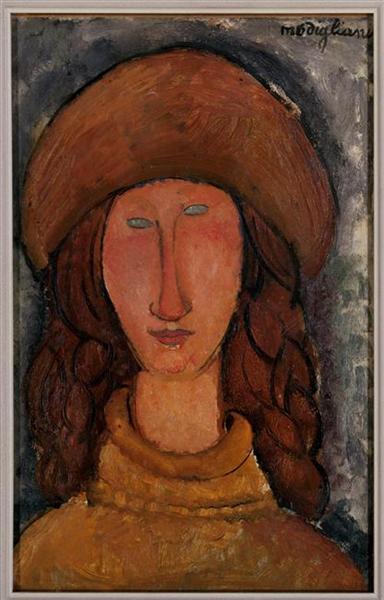
Portrait of Jeanne Hébuterne 1919
One of the last and most beautiful of the many portraits he painted of his partner Jeanne Hébuterne in the final years of his life. She is shown in three-quarter view, her dark hair simply arranged, her long neck and tilted head carrying the characteristic Modigliani elongation. The background is a warm ochre; the figure is simply dressed. The face has the characteristic blank eyes — both irises unpainted — giving the portrait a quality of inward absorption that is entirely different from conventional portraiture's outward-directed gaze. He painted her dozens of times; this is among the most serene.
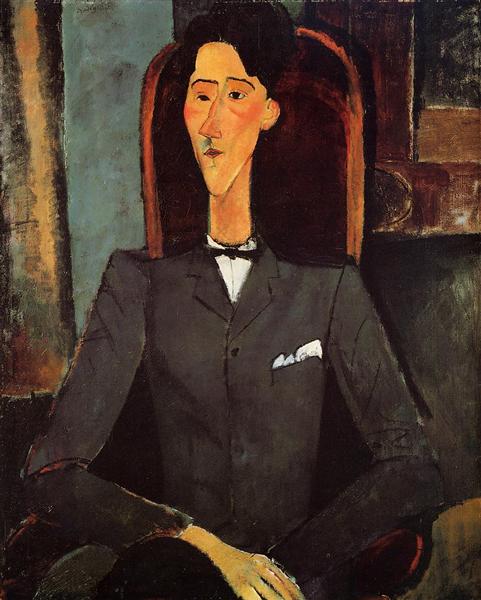
Portrait of Jean Cocteau 1916
Oil on canvas, 100 × 81 cm, Henry and Rose Pearlman Foundation (on loan to Princeton University Art Museum). Painted in the autumn of 1916 in the studio Modigliani then shared with the dealer Léopold Zborowski. Cocteau, who was twenty-six, had just published Le Potomak; he would shortly stage Parade with Picasso, Satie and Diaghilev. Cocteau later wrote that the portrait "does not resemble me, but it resembles Modigliani — which is better." The narrow tie, the high white collar, the casual handkerchief in the breast pocket: a young dandy of the avant-garde. Modigliani has stretched the head into a long oval and tilted it on the column of the neck — the African-mask geometry he had absorbed from Brâncuși transposed onto a Parisian intellectual. The colour is reduced to deep blue, oxblood and the warm putty of skin.
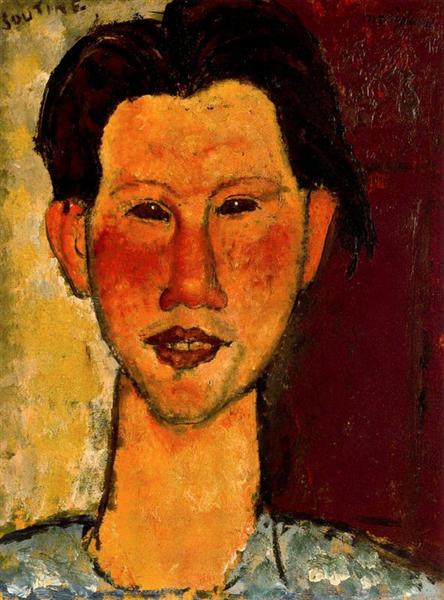
Portrait of Chaim Soutine 1916
Oil on canvas, 100 × 65 cm, Stavros Niarchos Collection. One of several portraits Modigliani made of his closest friend in Paris — the Lithuanian-born painter Chaim Soutine, who lived for periods in Modigliani's studio and shared his poverty and his addictions. The two were inseparable in Montparnasse: Soutine was awkward, dirty, fluent only in Yiddish and broken French, and Modigliani was the one who took him to galleries and corrected his table manners. The portrait fixes Soutine head-on, the broad face filling the canvas, the eyes doubled by Modigliani's signature pupil-less mask but kept clearly individual — heavy lids, full lips, the surly intelligence Soutine carried. The signed inscription SOUTINE at upper left names the sitter as bluntly as a label. After Modigliani's death in 1920, Soutine kept this canvas with him for the rest of his life.
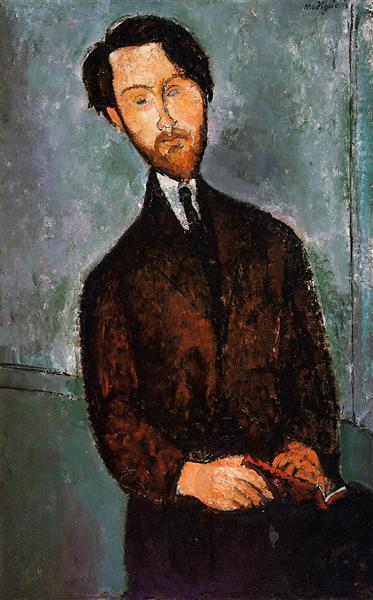
Portrait of Léopold Zborowski 1916
A portrait of his dealer and friend, who took him on when he was at his most difficult and remained loyal to the end. Zborowski is shown in three-quarter view, wearing a dark suit, his hands visible. The face is characteristic Modigliani — long, slightly angular, with one eye slightly higher than the other — but there is a warmth in this portrait that distinguishes it from his more formal commissions. The background is a plain warm brown. The painting is one of several he made of Zborowski and his circle — domestic portraits that have the feel of people comfortable being seen.