Marc Chagall
He painted memory as if gravity were optional and love the only law of physics.
Style and technique
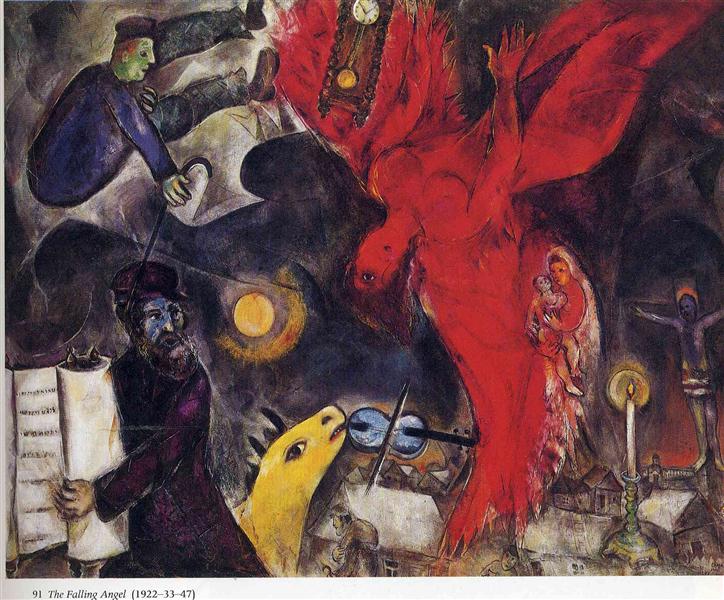
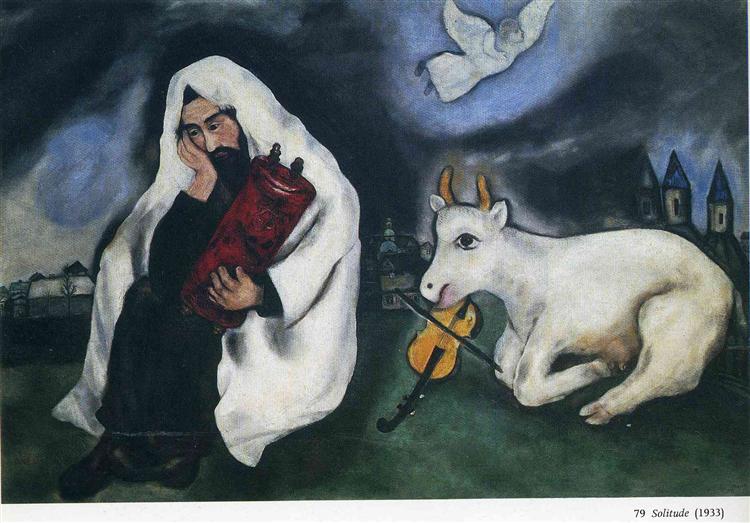
Chagall's visual world operates under its own laws of physics. People float above rooftops. A green violinist plays on a building. A goat sits in a living room. A pair of lovers ascend over a small Russian town. These are not Surrealist violations of reality but images of emotional truth: love feels like levitation; memory has the compression of a dream; the sacred interpenetrates the everyday without announcement.
He absorbed everything Paris had to offer — Cubist fragmentation, Fauvist colour, the formal lessons of Cézanne — but used none of it quite the way it was intended. Cubism for him was not a tool for analysing form but a way of compressing multiple memories and times into a single image. The layers of his paintings often show Vitebsk, his childhood, his first wife Bella, his Jewish community, and Paris simultaneously, the way a dream shows them.
His colour is warm, jubilant, and deeply personal. He had his own blues — the specific deep blue of a night sky over a small Jewish town in Belarus — and his own reds and greens that carry specific emotional charges his work taught viewers to recognise. The colours are not symbolic in a fixed way; they are moods.
Four fingerprints: the floating, gravity-free figure, the compression of multiple times and places in a single scene, the warm, deeply saturated palette with that specific Chagall blue, and the recurring cast of figures — lovers, musicians, animals, religious objects — that make his work immediately recognisable across a career of almost eighty years.
Life and legacy
Chagall was born Moishe Shagal on 7 July 1887 in Vitebsk, in what is now Belarus, the eldest of nine children in a poor Hasidic Jewish family. His father carried herring barrels for a fish merchant; his mother ran a small grocery. The shtetl — the small Jewish town with its particular mix of poverty, religious life, and vivid community — was the world of his childhood and the inexhaustible visual source of his entire career.
He studied art in Vitebsk and then in Saint Petersburg, where Jews needed special permits to live. He found his way to Paris in 1910 through a scholarship from a patron, and arrived to find Cubism, Fauvism, and the Parisian avant-garde at their most energetic. He moved into the Ruche, a circular artists' residence in Montparnasse, where Leger, Archipenko, Modigliani, and dozens of others were working.
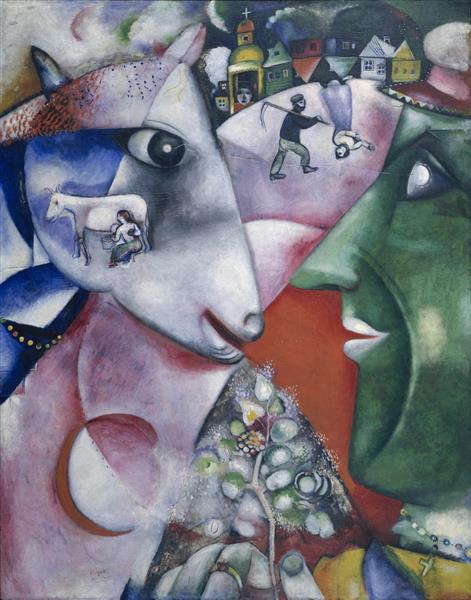
'I and the Village' (1911) was his Paris breakthrough: the Cubist vocabulary absorbed and transformed into something unmistakably personal — two faces in profile (a man and a cow) peer at each other across the canvas, with tiny inverted figures in the background, a milking woman visible within the cow's cheek. The image is both logical and completely unexpected.
He returned to Russia in 1914 to marry Bella Rosenfeld, his childhood sweetheart, and was stranded by the outbreak of war. He remained in Russia through the Revolution, was appointed Commissar of Art in Vitebsk, and founded an art school there — but was deposed from the directorship when Malevich arrived and converted all his students to Suprematism. He moved to Moscow, where he painted murals for the State Jewish Theatre.
He returned to Paris in 1923 and began the long middle period of his career: continued development of his Vitebsk imagery, large-scale works, commissions for illustrated books, sustained recognition.
Bella died of a virus in 1944 while they were living in wartime exile in New York. The loss devastated him; he did not paint for nine months. He eventually met Valentina Brodsky, whom he married in 1952, but the presence of Bella — as a floating figure, a bride, a memory — never left his work.
His major public commissions include the stained glass windows of Reims Cathedral, the ceiling of the Paris Opéra (1964), the windows for the United Nations building in New York, and a set of twelve stained glass windows depicting the twelve tribes of Israel in the Hadassah Medical Centre in Jerusalem.
Five famous paintings
I and the Village 1911
Chagall's most complete early statement: a large canvas — 192 by 151 centimetres — assembling the visual vocabulary of his Vitebsk childhood through a Cubist compositional structure. A green-faced man and a white cow face each other across a diagonal; within the cow's cheek, a small milking scene is visible. Upside-down houses, a woman in mid-air, a man with a scythe compose the background. The town is everywhere and nowhere simultaneously, the way it lives in memory. The painting was made in Paris in 1911, a year after his arrival, the first time he was far enough from home to begin transforming it into myth. It is in the Museum of Modern Art in New York.
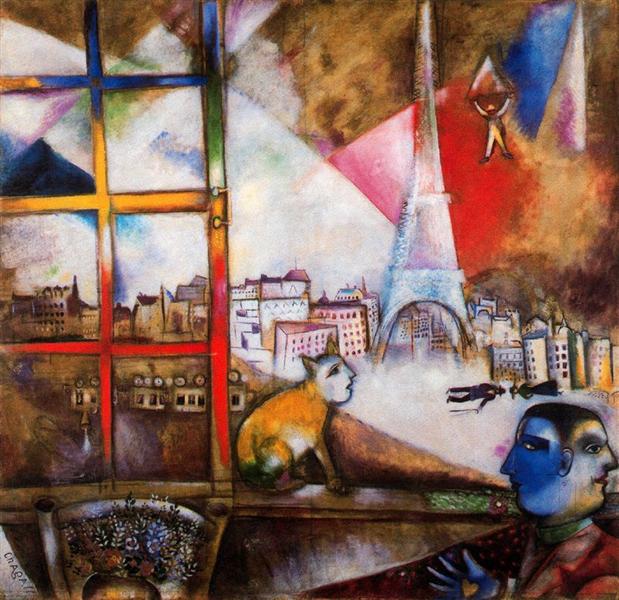
Paris through the Window 1913
A figure, half-human and half-cat, sits in a window frame with the Eiffel Tower visible behind and below. The sky over Paris is inverted — the sunlit side below the horizon line, the dark above. A couple floats upside down in the lower sky. A parachutist descends. A train runs on the windowsill. Chagall was painting Paris with the same dream-compression he would later apply to Vitebsk: two worlds in one window, Russia and France, memory and present, the visual logic of feeling rather than optics. The painting is in the Solomon R. Guggenheim Museum in New York.
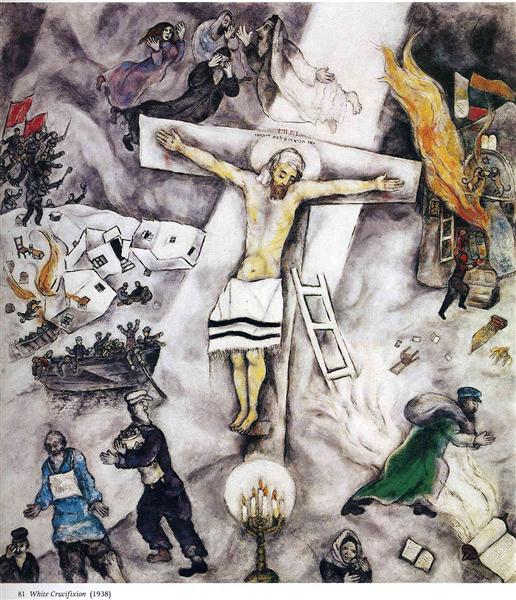
White Crucifixion 1938
Painted in the year of Kristallnacht, this is Chagall's most directly political major work. Christ on the cross wears a Jewish prayer shawl as a loincloth; around him, scenes of the destruction of Jewish life in Europe — a burning synagogue, fleeing refugees, a burning village, an overturned Torah. A menorah burns at the foot of the cross. The figures fleeing at the corners are from various times — some ancient, some contemporary. Christ as a Jewish martyr; the crucifixion as an image of ongoing Jewish suffering. The painting was shown in 1938 and caused discussion about the propriety of representing Christ as a Jew. It is in the Art Institute of Chicago.
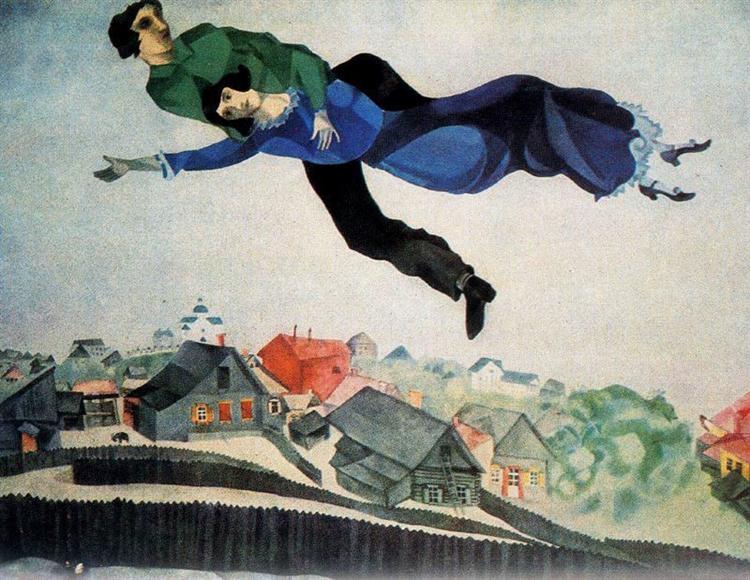
Over the Town 1918
Chagall and Bella levitate over Vitebsk, their hands barely touching, their bodies horizontal in the air above the rooftops and streets of the town below. The painting was made during the period of revolutionary upheaval in Russia, but its subject is entirely personal: the sensation of love as weightlessness, the way being with someone you love removes the ordinary gravity of things. The town below is precisely rendered — the wooden houses, the streets, a goat in a yard — and the lovers above it are equally precise. Love and a specific place, held simultaneously, the one making the other possible. It is in the Tretyakov Gallery in Moscow.