Pablo Picasso
He could paint like Raphael at fifteen and spent the rest of his life unlearning it.
Style and technique
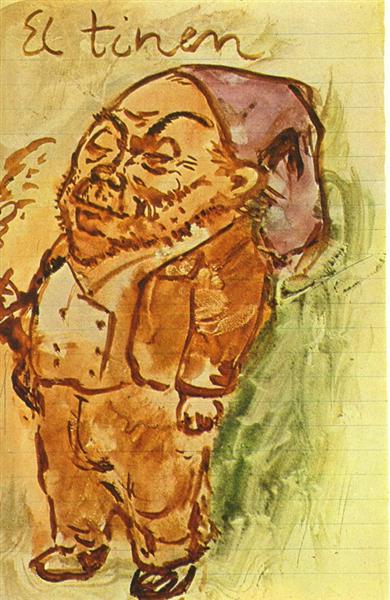
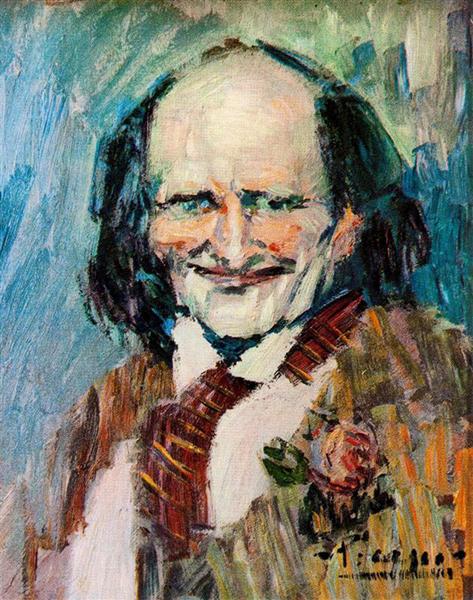
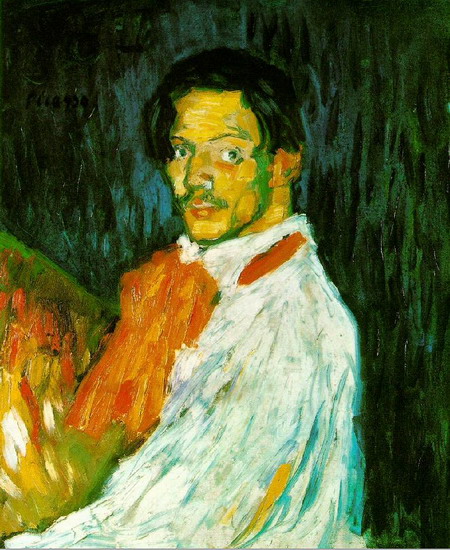
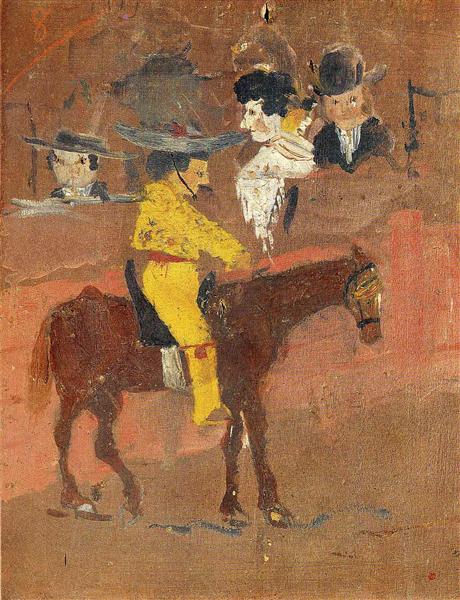
There is no single 'Picasso style'. He invented and abandoned at least seven of them across a career of seventy years. That restlessness is itself the style. Where most painters spend a lifetime refining one voice, Picasso changed voices roughly every decade — and the changes are so distinct that you can date a painting to within a year just from the way the eyes are placed.
The simplest way to look at his work is by period. The early academic years in Málaga and Barcelona, until 1900, are virtuoso classical drawing. The Blue Period (1901–1904) is melancholic, cold-toned, full of beggars and saltimbanques. The Rose Period (1904–1906) softens into pinks and circus performers. African-influenced work begins in 1906 after he sees the Iberian and African masks at the Trocadéro. From there, with Georges Braque, he invents Cubism between 1907 and 1914, in two waves: the harsh fragmented Analytic Cubism, then the flatter, collage-driven Synthetic Cubism. After WWI he flips to a Neoclassical phase of huge, statue-like figures. Then comes Surrealism in the 1930s, the anti-war masterpiece Guernica in 1937, and a long late phase of erotic, ceramic, and 'old master' studies that runs until his death.
Despite the variety, four fingerprints recur.
Both eyes on the same side. Picasso's faces, from Cubism onwards, almost always show the eye in profile and the eye in three-quarter view at the same time. It is the single most recognisable signature in 20th-century art.
Geometry over realism. Bodies are built from cones, cylinders, planes. Cézanne taught him this; he industrialised it.
Sharp, dark contour lines. Even in his lightest pieces, he draws the outline first and lets the colour fill afterwards. Compare to Matisse, whose colour does the drawing — they were rivals, and the contrast was deliberate.
Pictorial puns. A vase becomes a face becomes a guitar becomes a bull. Many of his paintings reward staring: there are always two readings, never one.
His output is impossible to summarise. He left an estimated 50,000 works — paintings, drawings, prints, sculptures, ceramics, set designs, costumes. Three full lifetimes of work in one. He died at 91 with a brush in his hand.
Life and legacy
Pablo Ruiz Picasso was born in Málaga, Spain, on 25 October 1881. His father, José Ruiz, was an academic painter and a curator at the local museum. By the time Pablo was seven, José was teaching him to paint pigeons; by the time he was thirteen, José had recognised that the boy already drew better than he did and, according to family legend, gave Pablo his own palette and brushes and stopped painting himself.
The family moved to A Coruña and then to Barcelona, where José secured a teaching post at the School of Fine Arts. Pablo took the entrance exam — which most students prepared for over a month — in a single day, at fourteen. He was admitted. He was too young, too small, and too gifted; classical training bored him almost immediately. By 1900, aged 19, he had taken his first trip to Paris, the city that would become the centre of his life for the next 70 years.
The early Paris years were brutally poor. He shared an unheated studio in Montmartre called the Bateau-Lavoir — a creaking wooden building full of artists, prostitutes, models and rats. His best friend, the Catalan poet Carles Casagemas, killed himself in a Paris café in 1901 after a failed love affair. Casagemas's death triggered Picasso's Blue Period: three years of paintings dominated by cold blue tones, in which he painted the poor, the blind, the abandoned, and himself. 'The Old Guitarist' (1904) is the great work of that phase.
In 1904 he met Fernande Olivier, his first long-term partner. Pink replaced blue. Saltimbanques and harlequins replaced beggars. The Rose Period was warming into something new when, in 1907, he made the painting that broke twentieth-century art in half — 'Les Demoiselles d'Avignon'. It depicts five women in a Barcelona brothel, their faces transformed into African masks, their bodies cut into hard angles. He showed it to a few friends and then hid it in his studio for nine years. Matisse thought it was a hoax. Braque thought it was a punch to the stomach. Within months, Braque and Picasso were working alongside each other on what would become Cubism — they later said they were 'roped together like mountain climbers'.
WWI separated them. Braque enlisted; Picasso, a Spanish citizen, did not. After the war Picasso married a Russian ballerina, Olga Khokhlova, and shifted into a Neoclassical phase of huge bathers and serene Madonnas. Olga gave him a son. He left her, more or less, for Marie-Thérèse Walter, whom he had met outside a Galeries Lafayette in 1927 when she was 17 and he was 45. The next decade produced his most erotic and most violent paintings.
In April 1937, the Spanish Civil War was a year old. The Nazi air force, fighting alongside Franco's Nationalists, bombed the Basque town of Guernica on a market day. Picasso, who had been commissioned to paint a mural for the Spanish pavilion at the Paris World's Fair, locked himself in his studio and painted Guernica in five weeks. It is 3.5 metres tall and 7.8 metres wide, in nothing but black, white and grey, like a newspaper photograph. It is the most powerful anti-war painting ever made. He sent it to MoMA in New York for safekeeping, with the instruction that it must never return to Spain until democracy did. It returned, finally, in 1981, six years after Franco's death.
During the Nazi occupation of Paris (1940–1944) he kept his studio open and refused to leave. A Gestapo officer, looking at a postcard of Guernica on his desk, asked: 'Did you do this?' He replied, 'No, you did.'
After the war he moved south, joined the Communist Party, took up ceramics in Vallauris, fathered children with two more partners — Françoise Gilot and finally Jacqueline Roque — and worked on. He died on 8 April 1973 in his villa at Mougins, aged 91, after a heart attack at dinner. His last words to his wife, reportedly, were 'drink to me, drink to my health, you know I can't drink any more'.
Most of Picasso's output is now spread across the Musée Picasso in Paris, the Reina Sofía in Madrid (which holds Guernica), and a much smaller museum in Barcelona dedicated almost entirely to his early years.
Five famous paintings
La Vie 1903
The masterpiece of the Blue Period and one of the most autobiographical paintings of his early career. A naked young couple stands at the left; a clothed mother holding an infant stands at the right; between them, two studies of a couple curled together. The young man is a portrait of Carles Casagemas — Picasso's best friend, who had killed himself in a Paris café two years earlier — and the painting is a meditation on his death. Picasso painted it over an earlier canvas of his own; X-rays show that he himself was originally the male figure before he replaced his own face with Casagemas's. It is now in the Cleveland Museum of Art.
The Old Guitarist 1904
An emaciated, blind old man bent almost double over a brown guitar. Everything else in the painting is blue: cold, mournful, almost sub-aquatic. The figure was painted in late 1903 and into 1904, in the studio at the Bateau-Lavoir, and he reused an older canvas to do it — under infrared scans, you can see the ghost of a young woman with a child looking out from under the man's neck. The painting captures the Blue Period at its most distilled: the colour is the mood. It hangs in the Art Institute of Chicago.
Self-Portrait with Palette 1906
Painted in the summer of 1906 in the village of Gósol, in the Catalan Pyrenees, where Picasso retreated for several months. The face is simplified to its planes — eyes flat, jaw blocky, almost a mask. He had recently been studying Iberian sculpture at the Louvre; the influence shows. This is the painting in which the future cubist starts to emerge. A year later he would paint 'Les Demoiselles d'Avignon' and the world would change. Today this self-portrait hangs in the Philadelphia Museum of Art and is the bridge between everything that came before in his work and everything that came after.