Ana Mendieta
She pressed her body into the earth, into fire, into water — and left a space shaped like herself.
Style and technique
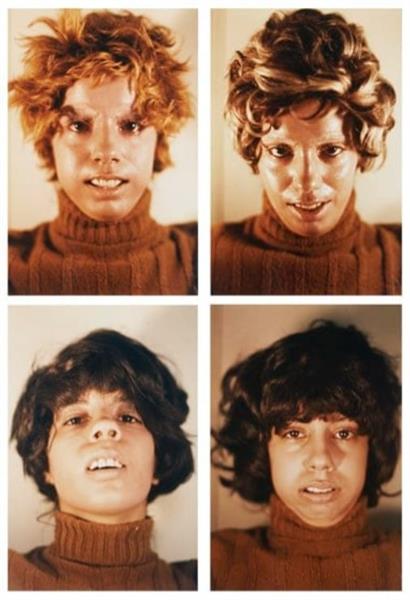
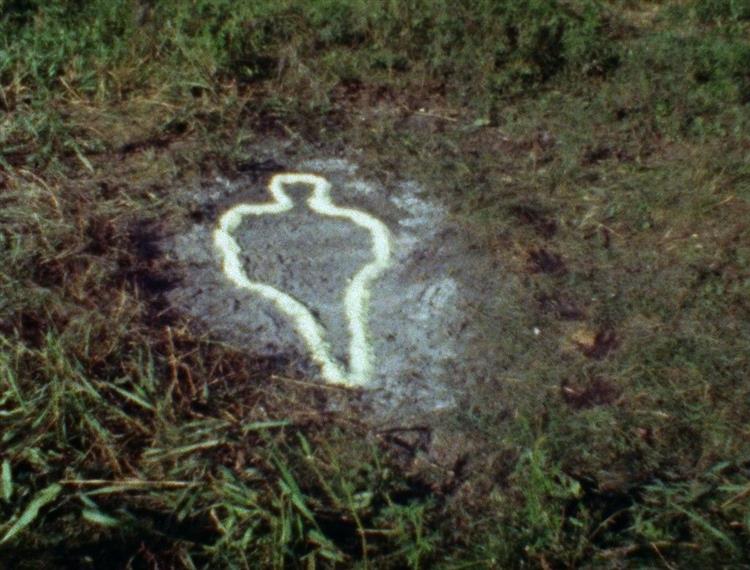
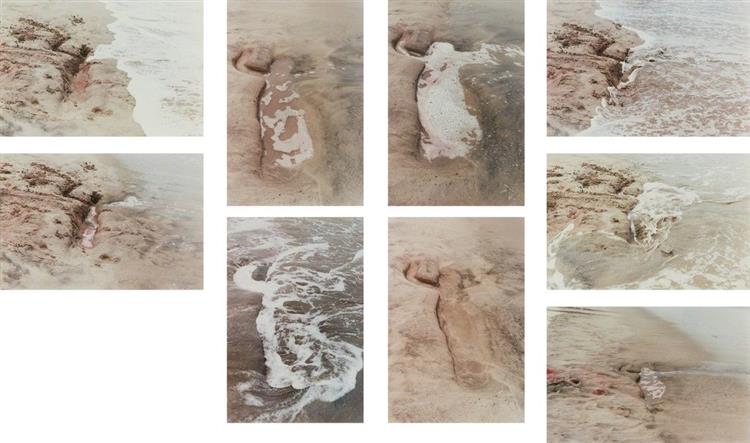
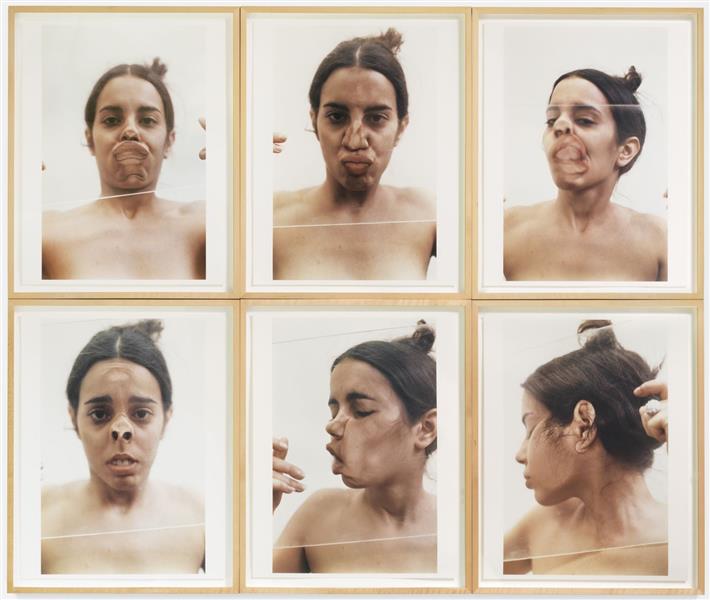
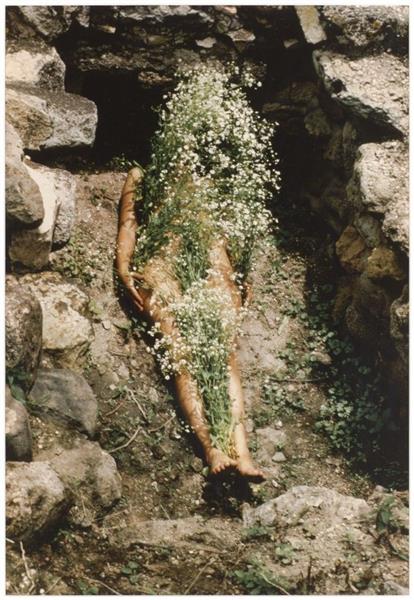
Mendieta's work is almost entirely about the relationship between a body and a landscape — between a self and the earth that receives it. In the Silueta (Silhouette) Series, which she developed from 1973 onward and which constitutes the core of her practice, she pressed her own body into mud, sand, grass, or snow; arranged flowers or fire around its shape; carved the outline into earth; and then photographed and filmed the result. What remains after the body leaves is a human absence shaped exactly like a human presence.
The silhouette is the central formal idea: the body as measure, as trace, as wound in the landscape. The traces she left were never permanent — they were washed away by rain, burned, absorbed. She documented them obsessively in photographs and Super 8 film, which are now the primary form in which the work exists. The ephemerality is not incidental but essential: the work insists that the body's relationship with the earth is temporary and therefore precious.
Her sources were multiple and explicit: she acknowledged the Afro-Cuban religious tradition of Santería, with its understanding of the body as a site of spiritual force and its connection to the earth through offerings and ritual. She also drew on pre-Columbian cultures, on feminist body art, and on her own experience as an exile — a Cuban woman in the United States, separated from her homeland and searching for a way to make her body belong to the land it stood on.
Four fingerprints: the body's negative as the primary visual form — the shape left after the body withdraws, natural materials — earth, grass, fire, water, flowers — as the medium rather than paint or clay, Afro-Cuban spiritual reference woven through the imagery without being illustrative, and the female body as both subject and instrument of the work, never objectified but always active.
Life and legacy
Mendieta was born on 18 November 1948 in Havana, Cuba, into a privileged family that opposed the Castro government. In 1961, when she was twelve, her parents sent her and her sister Raquelin to the United States through Operation Peter Pan — the US-sponsored programme that removed children from Cuba to be raised by American Catholic charities. She would not see her parents again for several years and would never fully return to Cuba.
She was placed in a series of foster homes and institutions in Iowa, a transition from Havana to the American Midwest that she later described as a formative experience of displacement and alienation. She eventually studied at the University of Iowa, where she enrolled in the MFA programme in intermedia art under Hans Breder. The Iowa programme was one of the few in the United States in the early 1970s that took seriously the new performance and conceptual art practices that were emerging, and Mendieta worked within this context with great intensity.
The Silueta Series began in 1973. Over the following decade she made more than two hundred silueta works in sites across Iowa, Mexico, and Cuba — when she was able to return — pressing, carving, arranging, burning, and flooding the landscape with the shape of her own body. The works were documented in photographs and on Super 8 film.
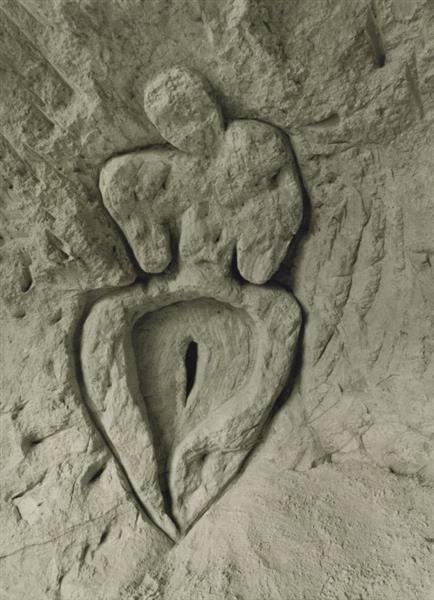
She moved to New York after completing her degree and began to receive serious recognition in the art world. She received a Rome Prize fellowship in 1983, which brought her to Italy for two years. In Rome she began making sculptural works — carved stone figures — that suggested a new direction for her practice.
Her influence on subsequent art — particularly on body art, feminist practice, and the intersection of identity and landscape — has been immense and is still growing.