Cy Twombly
He made paintings that look like someone was thinking on the canvas — and the thinking was about everything classical civilisation had left behind.
Style and technique
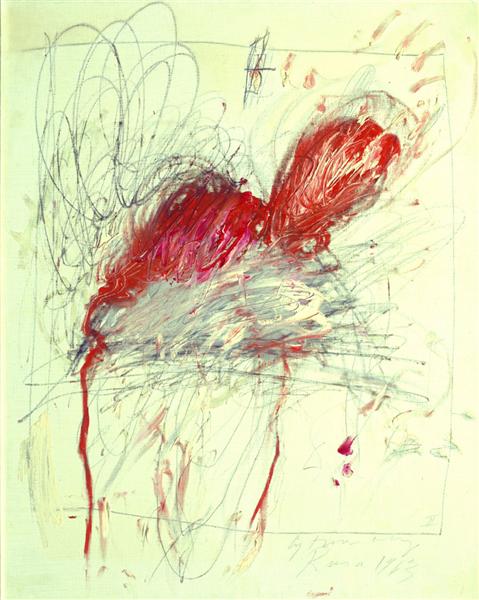
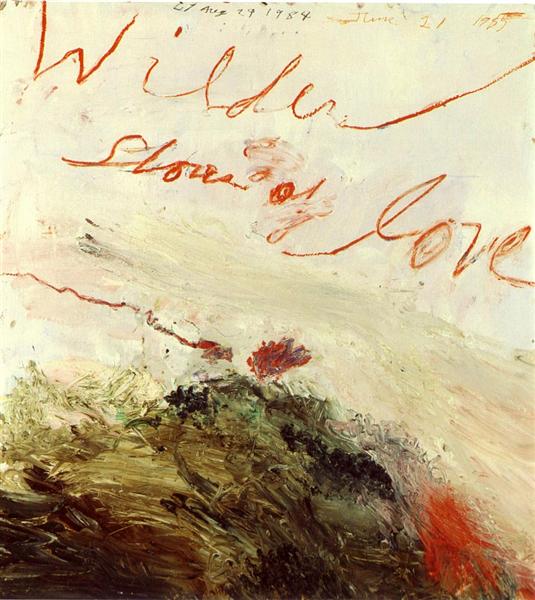
Twombly's paintings operate in a space between writing and drawing, between gesture and symbol, between the legible and the purely visual. His surfaces are covered with marks that look like handwriting but usually aren't, numbers that seem to count something but don't, loops and scrawls and erasures and overpainting that give the impression of a mind working through something — not the finished result of thought but the process itself.
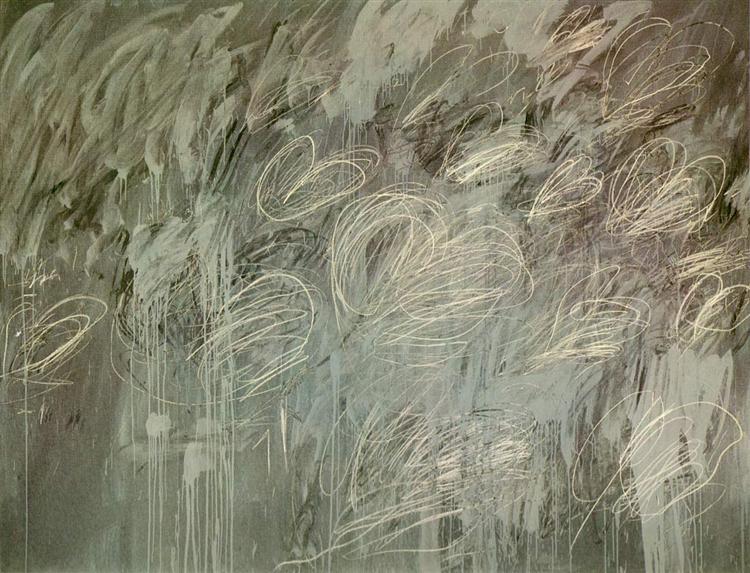
The most characteristic early paintings — the grey ground works of the late 1960s — have a specific visual quality that no other painter had achieved: the grey chalkboard surface, over which pencil and crayon scrawls loop and repeat, has the look of schoolroom exercises and simultaneously of ancient inscriptions. The marks feel both childish and archaic, both casual and deliberate.
His references are consistently classical: the titles invoke Homer, Virgil, Catullus, the battles of the Trojan War, the myths of Ovid, Mediterranean geography. But the paintings are not illustrations of these references; the classical world functions as an emotional register, a set of associations that give the marks their weight without prescribing their meaning. A scrawl over grey paint means something different if the canvas is called 'Achilles Mourning the Death of Patroclus' than if it has no title at all.
Four fingerprints: scrawled pencil or crayon marks over painted grounds that look simultaneously like handwriting and pure gesture, classical titles and references that provide emotional context without determining meaning, layered surfaces of multiple paint applications — erasure, overpainting, smear — that give the canvas the quality of an excavation site, and large scale that makes the marks body-scale, as if written by someone standing rather than sitting.
Life and legacy
Twombly was born on 25 April 1928 in Lexington, Virginia, where his father was a professional baseball player who later became a coach at Washington and Lee University. He showed artistic ability early and began studying painting in the late 1940s, eventually arriving at the Art Students League in New York and then at Black Mountain College in North Carolina.
Black Mountain was the decisive educational experience. He arrived in 1951 and met Robert Rauschenberg, who became a close friend and travelling companion. Franz Kline and Ben Shahn were teaching there; the atmosphere was experimental and anti-traditional. Twombly also had access to the college's extraordinary library, which is where the classical references — the reading of Greek and Latin poetry in translation — began.
He and Rauschenberg travelled to Europe and North Africa together in 1952–1953, and the contact with Rome — its accumulated surfaces, its textures, its light — left an immediate mark on his work. He returned to New York but found the art world atmosphere increasingly hostile to what he was doing: the gesture that looked too casual, the surface that looked too unfinished, the references that seemed too literary.
In 1957 he moved to Rome permanently, which was the most consequential single decision of his career. Rome gave him distance from the New York art world and a physical environment whose accumulated history was directly legible in its surfaces. He would spend the rest of his life primarily in Italy.
His American reputation fluctuated through the 1960s and 1970s — respected but not fully understood, easier to appreciate in Europe than in New York. The grey chalkboard paintings of 1966–1971 were particularly divisive: they looked either like the most sophisticated painting being made or like nothing at all, depending on what you were looking for.
The later work — the large colour paintings, the 'Quattro Stagioni' series, the rose paintings — is warmer and more overtly beautiful than the grey works, and it found a wider audience. By the 1990s he was widely regarded as one of the most important painters of his generation.
Five famous paintings
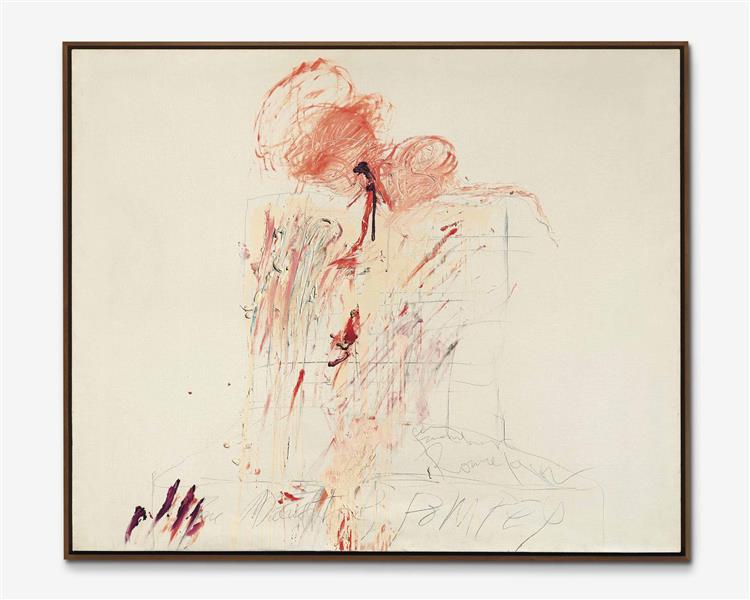
Leda and the Swan 1962
A painting from the period when he was developing his most radical approach to classical myth. A large white canvas covered with scrawled marks — looping, red-pink crayon strokes that seem to enact something sexual and violent simultaneously, a tangle of gesture that is both abstract and obscurely narrative. The title specifies the myth — Zeus as swan, Leda as victim — but the painting does not illustrate it; instead it makes the surface carry the emotional and physical force of the myth in purely gestural terms. The red marks on white have the quality of traces, of something that happened and left its record. It is in the Museum of Modern Art in New York.
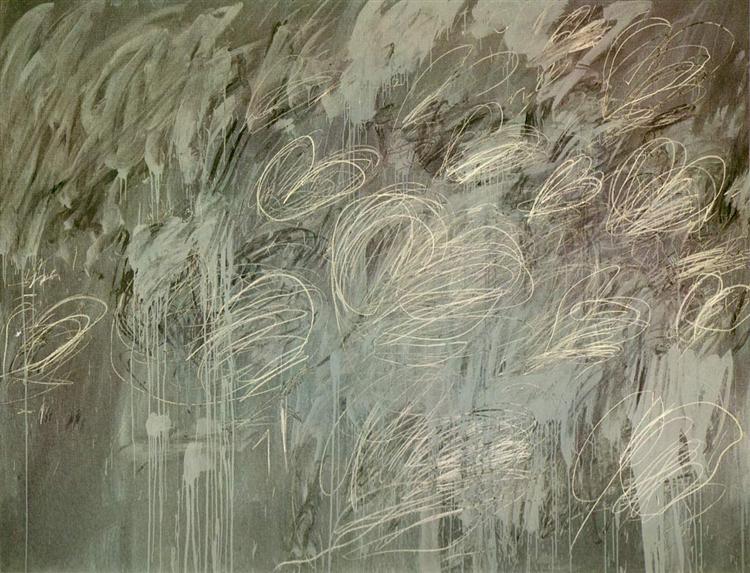
Blackboard 1968
One of the key works in the grey series — a large grey-painted canvas covered with looping pencil lines in continuous, rhythmic curves from left to right, row after row. The loops are not perfectly regular; each one varies slightly in scale and pressure, and the cumulative effect is both meditative and slightly hypnotic. The 'Blackboard' paintings were misread on first appearance as merely decorative or childish, but they repay sustained attention: the consistency of the mark, the way the loops accumulate without resolving into a composition, the grey ground that absorbs rather than reflects light. They are among the most formally rigorous works he made.
Achilles Mourning the Death of Patroclus 1962
A large canvas — almost four metres wide — covered with black scrawls, smears, and text fragments on a cream-grey ground. The scene the title invokes is the emotional climax of the Iliad: Achilles, learning of the death of Patroclus, his closest companion, howls with grief. The painting does not depict this howl; it enacts something analogous to it — the marks are violent, raw, broken, crossing and recrossing without resolution. Red paint is smeared in one area. The words and numbers that appear are not legible narrative; they are marks of thought overwhelmed by feeling. The painting is in the Cy Twombly Gallery at the Menil Collection in Houston.
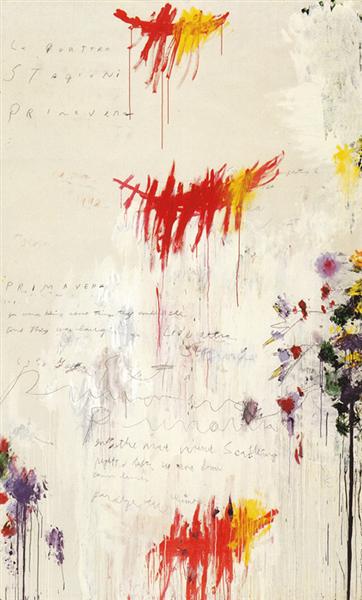
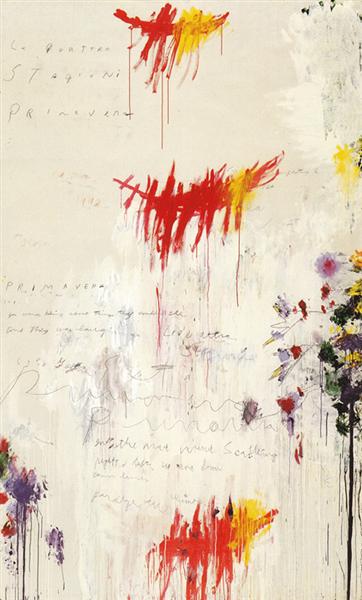
Quattro Stagioni 1993
A series of four large canvases representing the four seasons — this is one of the most colour-rich and visually opulent works he made. The canvases use oil paint applied in heavy, gestural marks of yellow, green, red, and grey, with words and numbers scrawled through the paint. The four-part structure allows each season its distinct emotional register: the spring canvas is bright and green, the summer hot and golden, the autumn warm and heavy, the winter grey and still. The series was acquired by the Tate Modern in London and is among the most celebrated works of his late career.