Robert Rauschenberg
He put a stuffed goat through a tyre, called it art, and the history of painting had to reorganise itself around the question he raised.
Style and technique
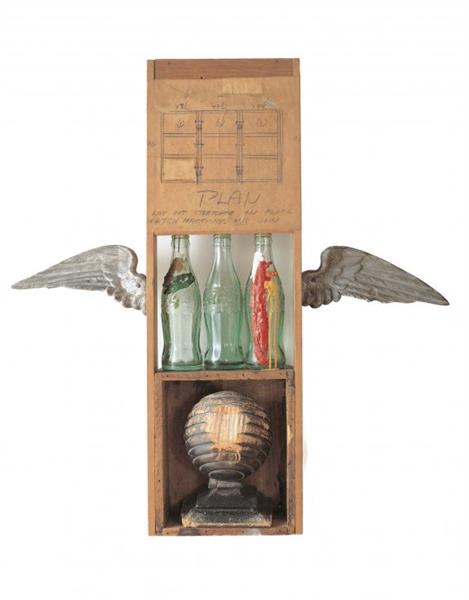
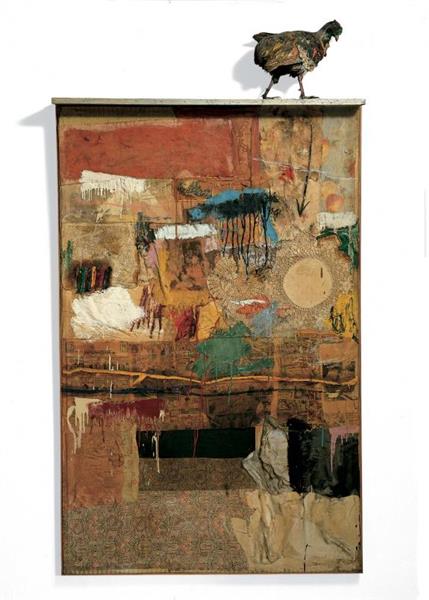
Rauschenberg's central contribution to twentieth-century art is the Combine — a word he invented to describe works that are neither painting nor sculpture but both simultaneously. A Combine begins with a painted or otherwise worked surface — canvas, cloth, cardboard — and incorporates objects, photographs, newspaper clippings, clothing, and three-dimensional found materials that project outward from the surface or stand independently beside it. The result is a work that cannot be classified by the existing categories of painting or object.
The Combines were made between roughly 1954 and 1964 and represent his most original contribution. They work by juxtaposition without hierarchy: a Combine surface places images and objects side by side without suggesting that any one element is more important than another. A photograph of an eagle, a patch of Abstract Expressionist paint handling, a newspaper headline, a passage of cloth — all coexist at the same level of attention. The viewer's eye moves between them making connections, and the connections it makes are its own.
His relationship to Abstract Expressionism was critical and affectionate. He admired the commitment and the physicality; he was impatient with the mythology of individual expression and the heaviness of subject matter. The Combines made the Abstract Expressionist gesture one element among many — a patch of dripping paint among the newspaper clippings and the tyre.
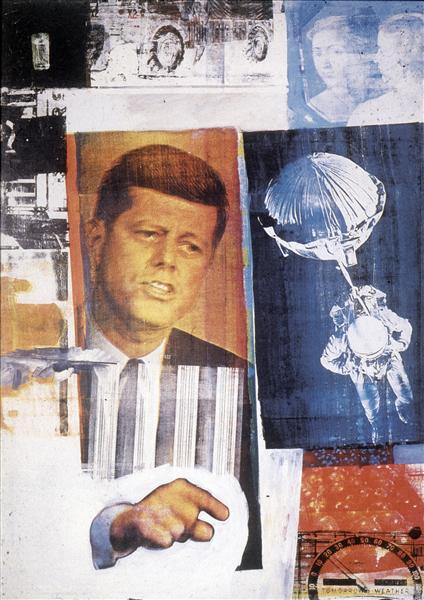
Four fingerprints: the Combine — the merger of painted surface and real objects in a single work, silkscreen transfer in the later works, in which found photographs are transferred onto the canvas surface as if the world's visual material could be printed directly into painting, a democratic attitude toward materials — nothing is too cheap, too trashy, or too ordinary to be included, and scale and visual density — the Combines are typically large and packed with incident.
Life and legacy
Rauschenberg was born on 22 October 1925 in Port Arthur, Texas, a small oil refinery town on the Gulf Coast. He grew up in a fundamentalist Christian household — his parents were members of the Church of Christ — and had no significant exposure to art until he encountered it accidentally at a Los Angeles museum during military service, finding that paintings communicated what he had not found words for.
After military discharge he studied briefly in Kansas City, then in Paris, then at Black Mountain College in North Carolina in 1948–1949. Black Mountain was transformative: he studied with Josef Albers, whose rigorous colour experiments gave him a foundation in formal analysis even as his own practice would run in completely different directions. He also met John Cage, the composer whose ideas about chance and found sound would parallel his own approach to found imagery.
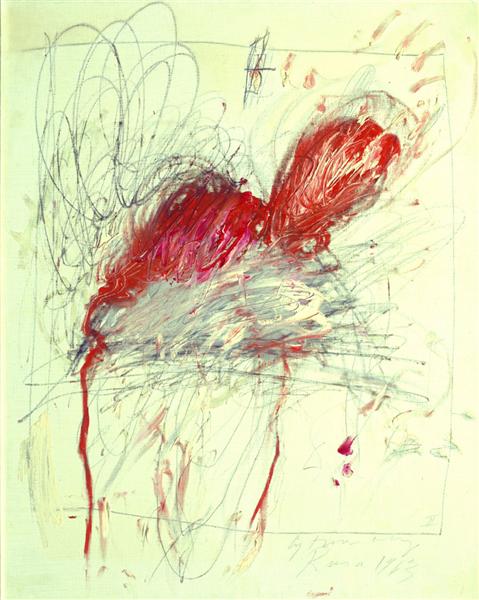
At Black Mountain he also met Cy Twombly, with whom he traveled to Europe and North Africa in 1952, and, in New York, Jasper Johns, with whom he lived and worked in close proximity through much of the 1950s. The Rauschenberg-Johns relationship — personally and artistically — is one of the most important in postwar American art; each challenged the other in ways that produced some of both artists' most important work.
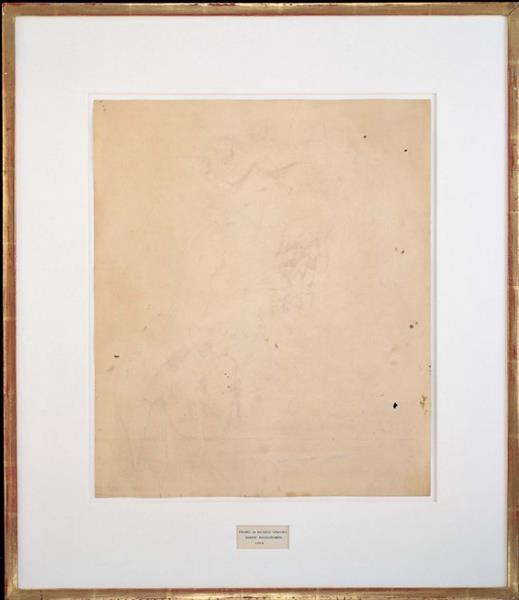
The Erased de Kooning Drawing (1953) — in which he spent a month erasing a drawing by de Kooning until nothing was left — is his most conceptually radical act. By turning artistic destruction into an artwork, he raised the question of what art is at the most fundamental level: is the erasing as much a creative act as the drawing?
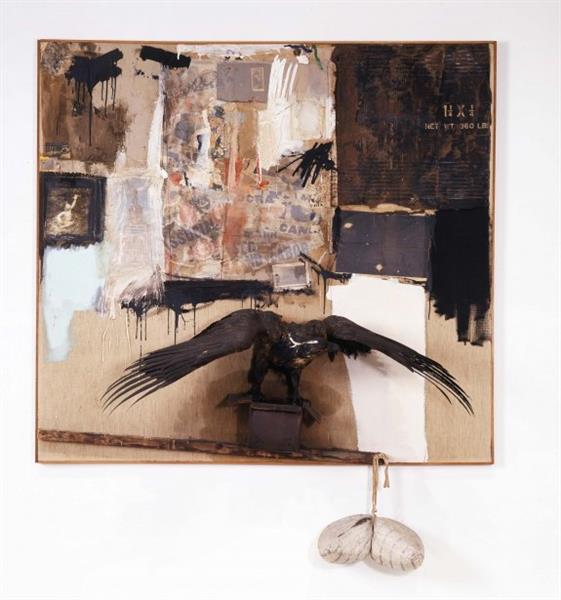
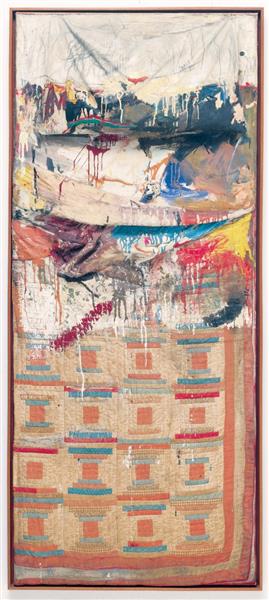
The Combines followed — 'Bed' (1955), 'Monogram' (1959), 'Canyon' (1959) — accumulating found objects and painted surfaces into works that had no precedent and required new critical vocabulary. He won the Grand Prize for Painting at the Venice Biennale in 1964, the first American to win it, and the recognition transformed his international reputation.
Through the 1960s and 1970s he worked in increasingly varied media — silkscreen, performance, collaboration with engineers and scientists in the 'Experiments in Art and Technology' (EAT) initiative — and in his final decades produced enormous works that incorporated imagery from travels across Asia, Africa, and Latin America.
Five famous paintings
Monogram 1959
His most famous Combine — and perhaps the most famous single work in the history of American art after 1945. A stuffed Angora goat, its body passing through a car tyre, stands on a painted surface of canvas, wood, and collaged materials. The goat has been painted around its face with broad strokes of red and blue; the tyre circles its middle like a skirt or a trophy ring. The absurdity is complete, the visual invention absolute, and the question it raises — what exactly is this object and what does it mean? — has no single answer. It is in the Moderna Museet in Stockholm.
Bed 1955
A quilt and pillow — an actual bed's surface — hung vertically and treated as a painting surface: the lower portion is painted with broad strokes of red and black paint, the paint dripping down into the quilt's fabric. The top portion of the quilt remains as found, its domestic pattern and worn fabric in direct contrast to the painted lower section. The work was Rauschenberg's own quilt, his own pillow. The most private domestic surface — the bed — made public, vertical, hung on a gallery wall. Whether the paint drips suggest blood, paint, something else, or nothing but paint dripping is a question the work refuses to answer. It is in the Museum of Modern Art in New York.
Erased de Kooning Drawing 1953
Rauschenberg asked de Kooning for a drawing that he could erase, explaining his intention. De Kooning gave him a drawing made deliberately difficult to erase — made in graphite, ink, and grease pencil. Rauschenberg spent about a month erasing it, leaving a nearly blank surface with faint traces. The result was framed and labelled 'Erased de Kooning Drawing, Robert Rauschenberg, 1953'. The work asks whether destruction can be creation, whether the act of erasing is as much a work of art as the act of drawing, and whether a work of art exists in the physical object or in the concept. It is in the San Francisco Museum of Modern Art.
Canyon 1959
A large Combine incorporating a stuffed eagle (a legally protected species whose ownership would eventually make the work difficult to sell or donate) projecting from a painted surface of photographs, newsprint, paint, and collage. Below the eagle, a rope hangs down to a flattened pillow on the floor. The eagle projects outward into the gallery space; the painting reaches outward, refusing to stay on the wall. The combination of the national bird — the symbol of American power — with the layered detritus of the everyday world is characteristic of Rauschenberg's democratic and slightly ironic relationship with American iconography. It is in the Museum of Modern Art in New York.
Retroactive II 1964
A silkscreen painting from the transitional period when he was moving from Combines to the screenprint technique. The canvas is covered with transferred photographic images — an astronaut in free fall, a glass of water, fruit, a parachute — and passages of paint that interrupt the photograph fields. The astronaut image was taken from press photographs of the early NASA space programme. The work combines the found photograph and the painted surface in a way that the Combines achieved with physical objects: the surface is simultaneously an image and a painting, a document and an aesthetic object. It is in the Sonnabend Collection.