Kara Walker
She took the silhouette — the most genteel form in American art history — and filled it with the history America most wants to forget.
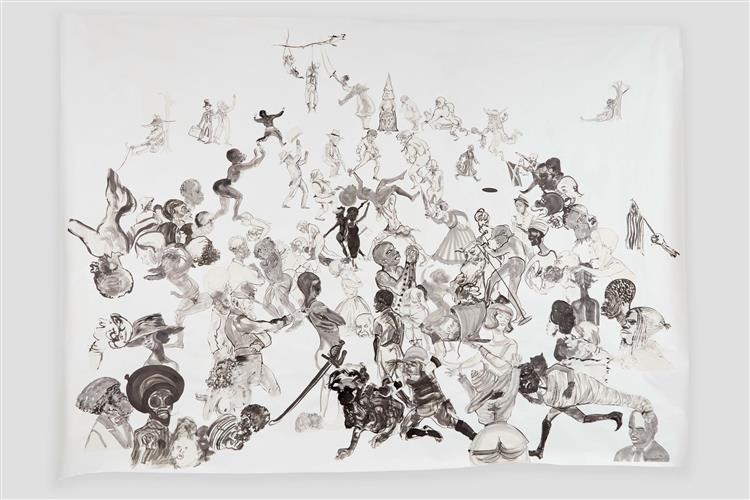
Style and technique
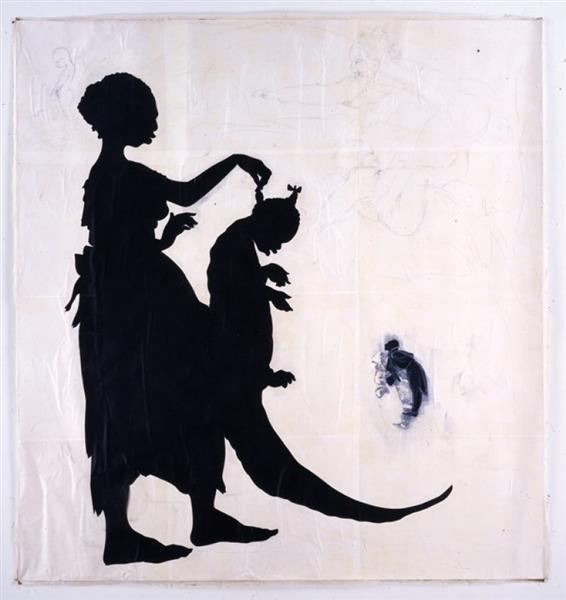
Walker's primary medium is the black paper silhouette — a form traditionally associated with eighteenth-century parlour portraiture, with cameos and keepsakes, with the refined and the domestic. She takes this genteel form and fills it with the imagery of the American antebellum South: slavery, sexual violence, racial caricature, the grotesque dynamics of power that the silhouette's clean black profile simultaneously reveals and obscures.
The silhouette is, technically, a shadow: a shape defined by absence rather than presence, a figure that has all its detail stripped away except its outline. Walker uses this property with extraordinary sophistication. Her figures are silhouettes, which means they are both definite and ambiguous: you can read their postures, their actions, their relationships — the domination, the submission, the violence — without seeing their faces. The racial typology is legible through the outline alone, which forces the viewer to be complicit in the reading: if you can identify who the figures are by their silhouette, you have the stereotypes in your head already.
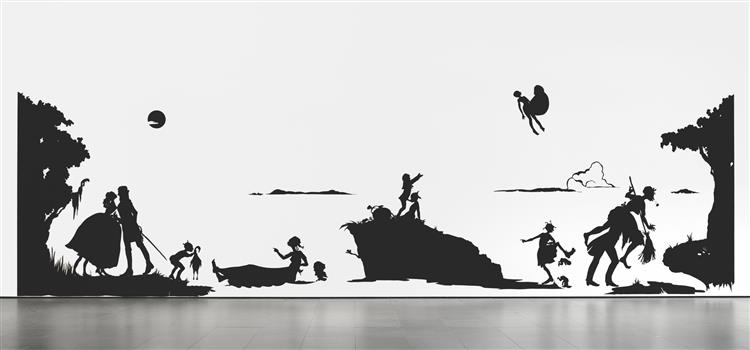
The large-scale installations — silhouettes cut from black paper and adhered directly to white gallery walls, sometimes extending sixty or seventy feet — work as panoramas: you move along them reading a narrative that does not resolve, that includes horror and comedy and pathos simultaneously, that refuses any single interpretive frame.
Four fingerprints: the black paper silhouette on white walls as primary medium, antebellum Southern imagery — plantations, enslaved people, masters, violence — as primary subject matter, the grotesque as a formal mode — figures and actions that are simultaneously comic and terrible, and large scale that makes the viewer physically surrounded by the work rather than facing it.
Life and legacy
Walker was born on 26 November 1969 in Stockton, California, where her father, a painter, taught at the University of the Pacific. She grew up in a predominantly white suburban environment in Atlanta, Georgia, where the family moved when she was thirteen — a move from West Coast California to the American Deep South that she has described as the central formative experience of her life.
She studied painting at the Atlanta College of Art and then at the Rhode Island School of Design, where she received her MFA in 1994. At RISD she made the first silhouette installations — works that took the antebellum South as their subject — and received a response that was immediate, intense, and not uniformly positive. Some established Black artists and critics found her imagery irresponsible, arguing that she was reinscribing racial stereotypes rather than critiquing them.
The controversy did not stop her career but became part of it: the argument about whether art can safely depict the imagery of racial oppression without perpetuating it has surrounded her work from the beginning and is itself one of the questions her work addresses. She received a MacArthur Fellowship in 1997, at twenty-seven — one of the youngest recipients in the programme's history — which signalled the mainstream art world's assessment of her importance.
Her major works have become central to the contemporary conversation about race and American history: 'Gone: An Historical Romance of a Civil War as It Occurred Between the Dusky Thighs of One Young Negress and Her Heart' (1994), the panoramic silhouette installation that established her reputation; 'A Subtlety, or the Marvelous Sugar Baby' (2014), a forty-foot-tall sphinx made of sugar in a former Domino Sugar factory in Brooklyn that drew an enormous public response.
She lives and works in New York.
Five famous paintings
Gone, An Historical Romance of a Civil War as It Occurred Between the Dusky Thighs of One Young Negress and Her Heart 1994
The breakthrough installation — a panoramic silhouette almost fifteen metres long installed on white gallery walls. The work depicts a series of scenes from the antebellum South in the style of a nineteenth-century illustrated romance: enslaved people, slaveholders, violence, sexual exploitation, and moments of surreal absurdity that complicate any single emotional response. The silhouette style makes the figures simultaneously cartoon-like and grave; the scale makes the narrative immersive rather than observed. The title's ironic invocation of 'Gone with the Wind' places the work in direct conversation with the mythology of the Southern plantation. It is in the Museum of Modern Art in New York.
Burn 1998
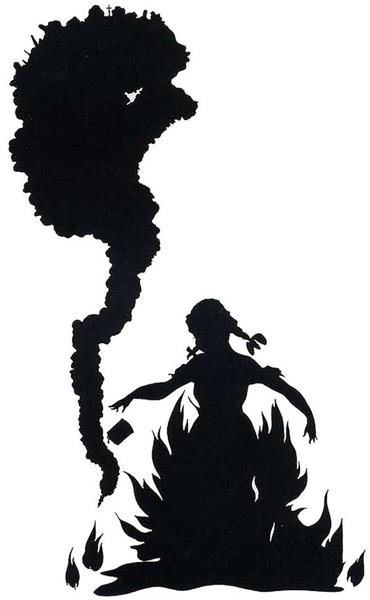
A print from her series working in a more condensed format — a single scene of figures and flames, the burn of the title both literal (fire, destruction) and figurative (the burn of humiliation, the burn of anger). Walker's print works carry the silhouette vocabulary into a smaller, more intimate format that loses none of the formal intensity. The image of fire recurs throughout her work as both historical fact — the burning of plantations, the burning of Black churches — and as metaphor for the uncontained energies that slavery and its aftermath have left in American culture.
An Unpeopled Land in Uncharted Waters 2010
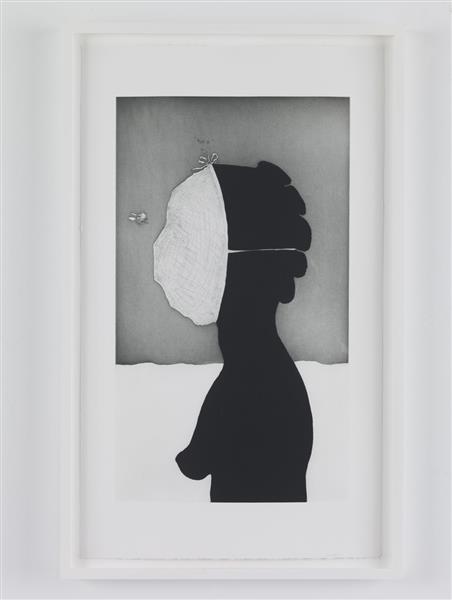
A large-scale print and installation exploring the history of the Atlantic slave trade — the ocean crossing, the Middle Passage, the violence of the journey. Walker extends her American antebellum subject matter outward to the Atlantic world, placing the American story within the larger story of colonial violence and forced migration. The water of the title is uncharted in both the geographic sense — the perilous crossing of the Atlantic — and the historical sense: the Middle Passage as a history that has been deliberately uncharted, unmapped, unacknowledged. The work is among her most formally complex and thematically ambitious.
Untitled 1996
A characteristically dense and disturbing scene from the mid-1990s period — silhouetted figures in the antebellum landscape, their relationships of power and vulnerability legible through posture alone. The grotesque quality of her early work is at its most acute here: the figures are simultaneously recognisable as human beings in specific situations and as formal elements in a visual language that approaches caricature. The tension between these two registers — the human and the formal, the tragic and the absurd — is central to what her work demands of its viewer.