Georges Seurat
He applied science to pleasure and turned a Sunday in the park into geometry.
Style and technique
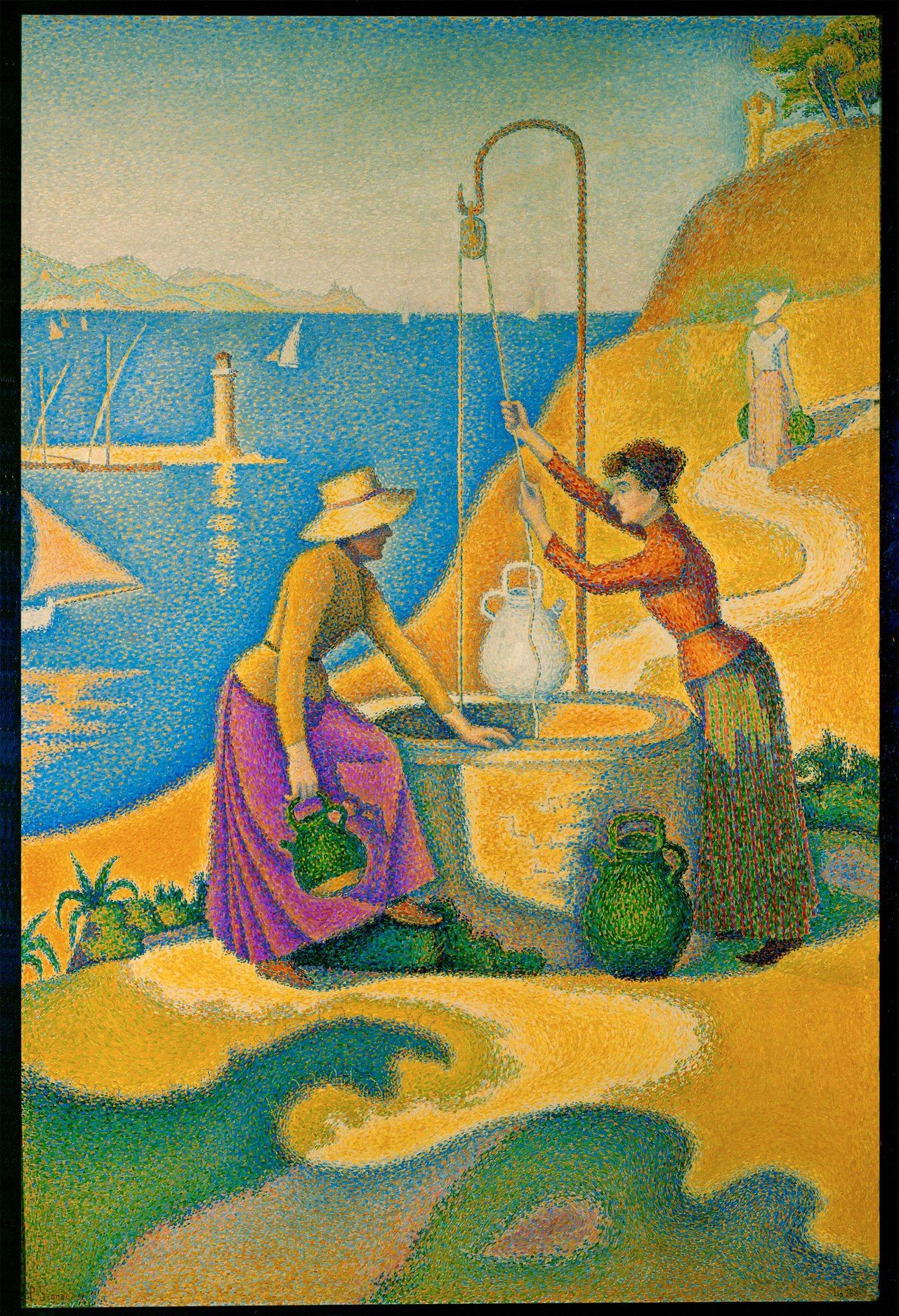
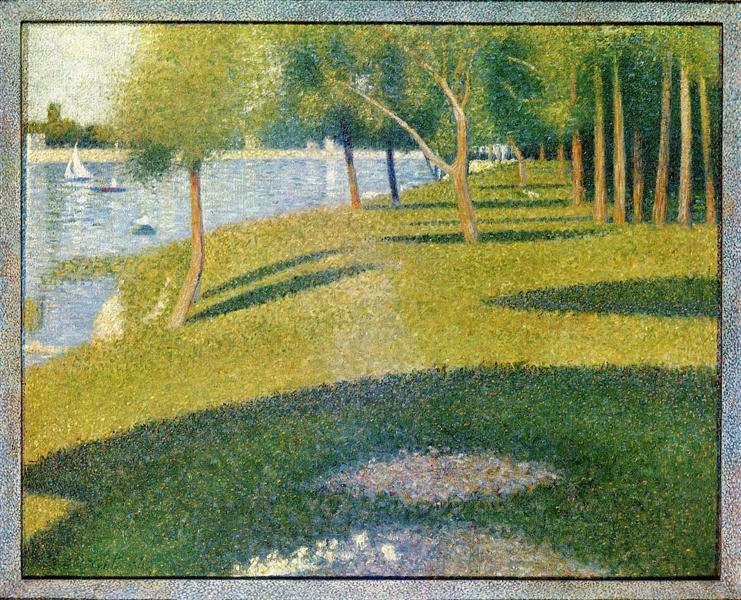
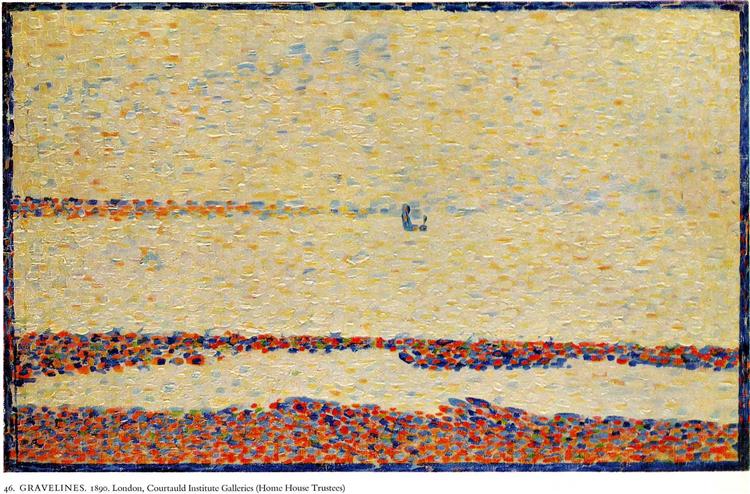
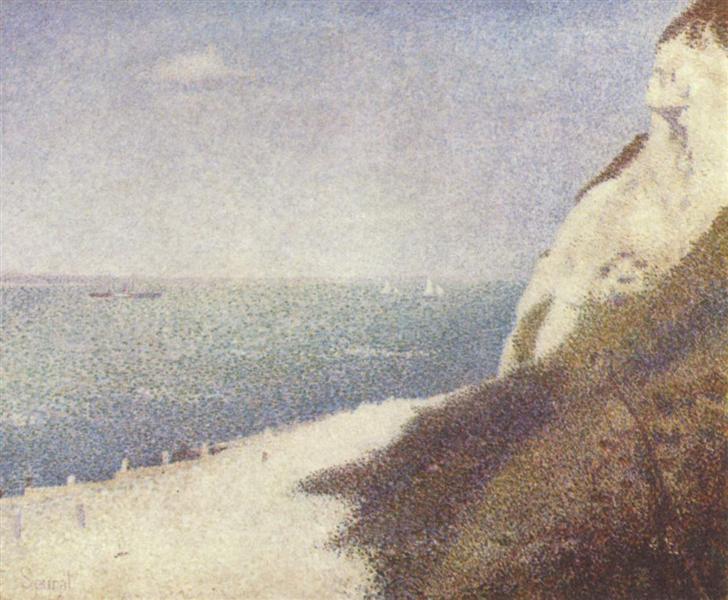
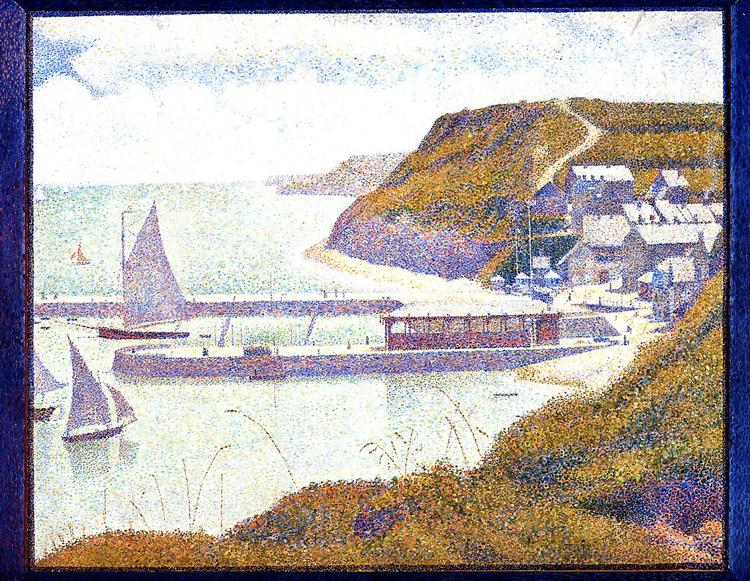
Seurat approached painting as a problem in optics. He had read Michel Eugène Chevreul's studies on colour contrast, Ogden Rood's 'Modern Chromatics', and the work of Hermann von Helmholtz, and he arrived at a systematic theory: that colours placed next to each other in small dots would mix in the eye of the viewer more luminously than if they were mixed on the palette. This optical mixing — the foundation of what he called Chromoluminarism and what others called Pointillism — was his central innovation.
The application in practice was demanding to an extreme. 'A Sunday on La Grande Jatte' took him two years and more than sixty preparatory studies. He covered every square centimetre of the canvas in thousands of tiny dots of pure colour, placed in specific patterns according to his theory. Up close the painting is an almost abstract mosaic. At the correct viewing distance — perhaps four to five metres — the dots blend into smooth surfaces of luminous, vibrating colour.
The formal consequence was stillness. Because every element of the painting required such careful, patient construction, and because the technique demanded that forms be built up dot by dot, Seurat's compositions have a quality of arrested time unlike anything in Impressionism. His figures do not move; they stand in the specific formal postures of silhouettes cut from paper.
His colour theory specified that warm colours — yellows and oranges — were emotionally stimulating, and cool colours — blues and greens — were calming. He also developed a theory of directional line: upward diagonals conveyed energy and happiness; horizontal lines conveyed calm; downward diagonals sadness. In his circus and café-concert paintings, he used these principles explicitly, tilting the composition upward to produce a sensation of gaiety.
He died at thirty-one. The body of work he left — only seven major canvases — was enough to change the direction of European painting.
Life and legacy
Seurat was born on 2 December 1859 in Paris, the son of a minor legal official. He was a quiet, systematic, secretive man even as a student at the École des Beaux-Arts, where he excelled at drawing and showed an early interest in the scientific literature on colour perception.
He completed his military service in Brest in 1880 and returned to Paris with the material for his first major painting: 'Une baignade, Asnières' (1884), a large canvas showing working-class men bathing in the Seine. He submitted it to the official Salon, where it was rejected, and instead showed it at the first exhibition of the Groupe des Artistes Indépendants in 1884 — the alternative organisation he had helped found.
'La Grande Jatte' began in 1884 and was exhibited at the eighth and final Impressionist exhibition in 1886. It was this show that split the Impressionist movement: Pissarro, who had been converted to Seurat's approach, brought him and his colleague Paul Signac into the exhibition over the objections of Degas and others. The response to the painting was intense — some critics immediately identified it as a revolution; others found it mechanical and cold.
He was meticulous about the borders of his knowledge. He did not discuss his private life publicly and kept his relationship with a young model, Madeleine Knobloch, entirely secret. He had a son with her in 1890. Almost no one in his artistic circle knew either of them existed.
The eight or nine paintings he completed are among the most carefully organised canvases of the nineteenth century. His theoretical writings were distributed among his followers — principally Signac, who published a major account of his ideas in 1899 — and his approach influenced the Fauves, the German Expressionists, and, through Delaunay and others, the development of twentieth-century abstraction.
Five famous paintings
A Sunday on La Grande Jatte (study) 1885
The preparatory study for Seurat's landmark canvas, painted at roughly a quarter of the final scale. On the island of La Grande Jatte in the Seine northwest of Paris, Parisians of various classes spend a Sunday afternoon in the parkland: couples walk, a man fishes, a woman sits with a monkey on a lead, children run. The composition is built on a mathematical distribution of figures across horizontal bands of shadow and light. This study, in the Art Institute of Chicago alongside the finished canvas, shows Seurat's method: the same composition, less elaborately dotted, used to test the spatial and tonal relationships before the final painting.
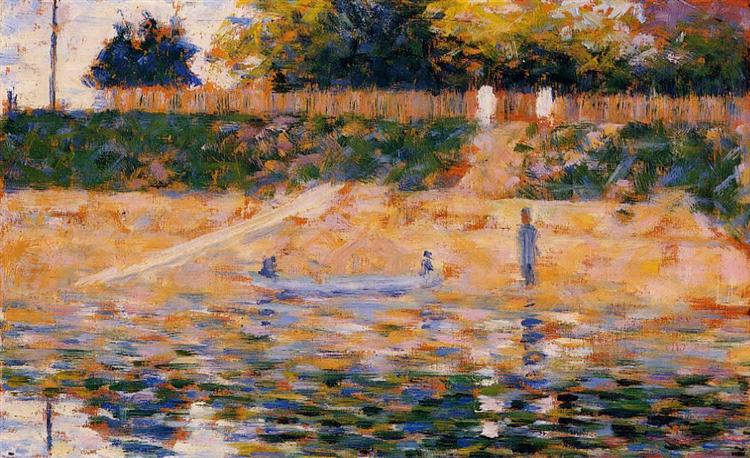
Bathers at Asnières (study) 1884
Seurat's first large-scale figure painting — 2 by 3 metres — showing working men and boys bathing in the Seine at Asnières, downstream from Paris. Unlike the bourgeois promenaders of La Grande Jatte, these are factory workers from the Clichy industrial suburb, visible in the background. The painting is a document of class geography: the same river, different social worlds on its banks. Seurat was still developing his Pointillist technique when he painted this — parts of the canvas use short brushstrokes rather than dots — so it sits at the transition between Impressionism and his mature method. It is in the National Gallery in London.
Young Woman Powdering Herself 1890
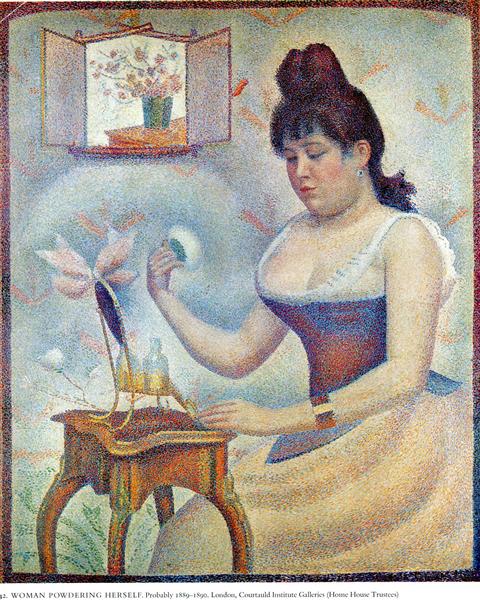
One of the few intimate domestic scenes in Seurat's work, and the most overtly personal: the woman is Madeleine Knobloch, his secret companion. She sits at a dressing table in a domestic interior, a powder puff in her raised hand, wearing a blue and white dress. The composition is built on a strict geometry of vertical and horizontal elements. When Seurat first exhibited the painting, the mirror in the left background showed a self-portrait; friends told him it was unseemly, and he replaced it with a vase of flowers. The painting is in the Courtauld Gallery in London.
The Lighthouse at Honfleur 1886
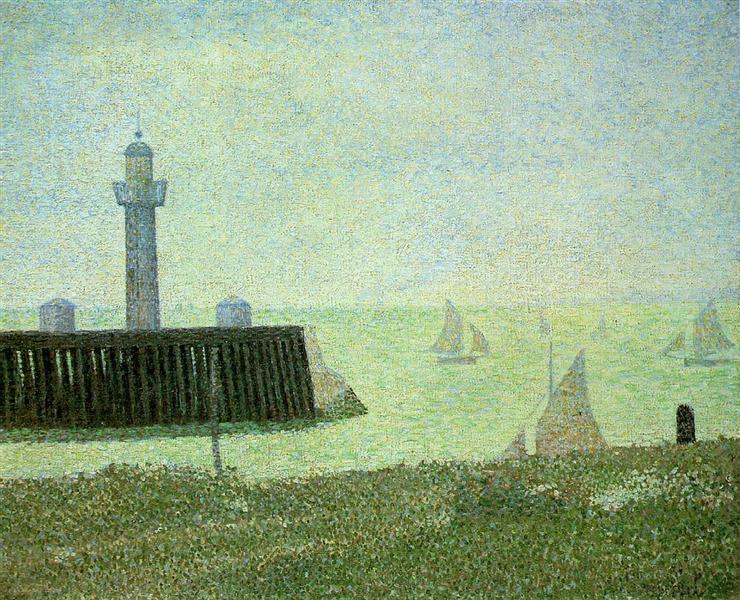
A seascape from his sustained coastal painting of the mid-1880s, when he spent summers on the Channel coast applying his Pointillist technique to outdoor marine subjects. The lighthouse stands at the left; the harbour entrance, the horizon, and a calm sea occupy the rest. The entire surface is covered in regular dots. What is remarkable is the quality of the light: the specific blue-grey of the Norman coast on an overcast summer day is rendered with a precision that rivals any atmospheric effect in Impressionist painting, despite — or because of — the systematic technique. The painting is in the Kröller-Müller Museum in the Netherlands.