Paul Cézanne
He spent forty years building paintings out of small patches of colour — and quietly invented modern art.
Style and technique
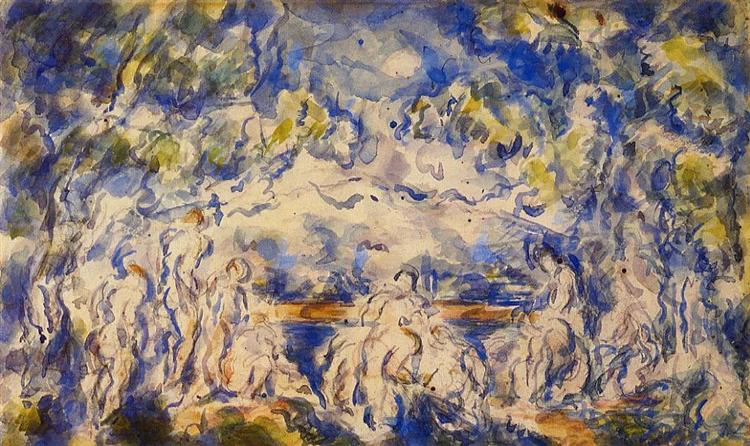
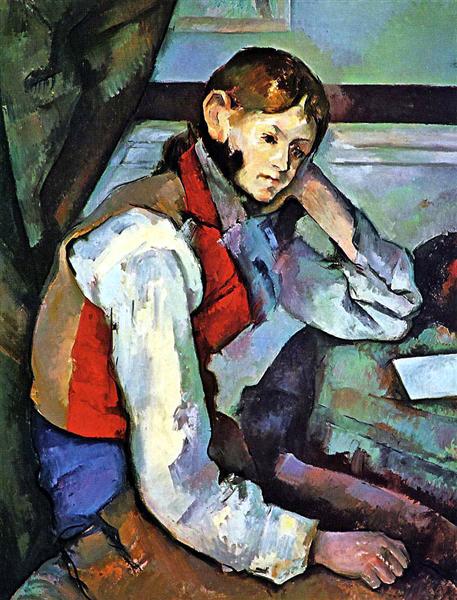
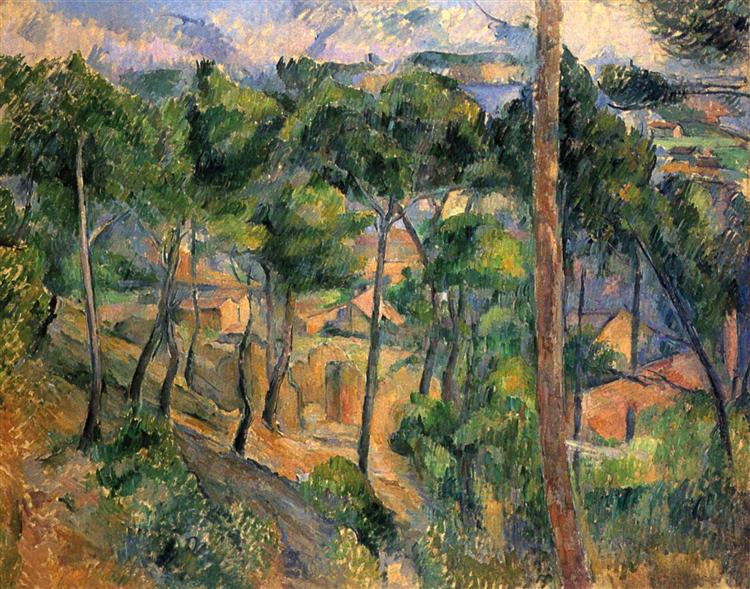
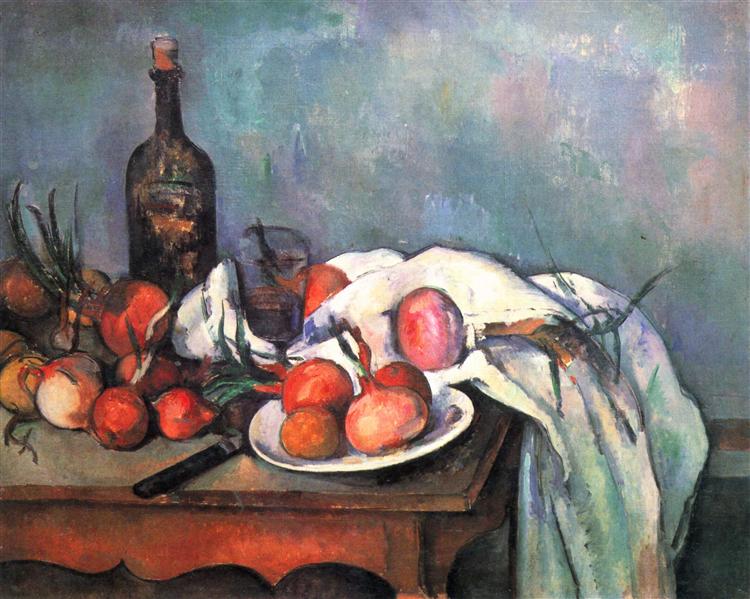
Cézanne built his paintings the way a stone-mason builds a wall: one small patch of colour at a time. Each brushstroke is a deliberate, parallel block — slightly thicker than an Impressionist stroke, slightly thinner than a Post-Impressionist contour — and each block describes both a piece of colour and a piece of structure at the same time. Step back from a Cézanne and the patches resolve into apples, a mountain, a face. Step closer and you see only the patches.
This sounds modest. It changed everything. The Impressionists had used short brushstrokes to record how the eye sees light. Cézanne used very similar strokes to record how the eye builds form. He flattened depth, ignored conventional perspective, treated every part of the painting (foreground, mid-ground, background) as equally important, and made the surface of the canvas itself a subject.
Four fingerprints make a Cézanne unmistakable.
Parallel patches of colour. Often called 'constructive brushstrokes'. Tilted slightly, all running in roughly the same direction, almost like rain falling diagonally across the canvas.
Tilted perspective. A bowl of fruit seen slightly from above; the fruit itself slightly from the side; the table edge from the front. Cézanne deliberately collapses multiple viewpoints into a single image — twenty years before Picasso did the same thing more violently in Cubism.
Geometric simplification. A face becomes a faceted oval. An apple becomes a sphere with a flat side. A pine tree becomes a stack of green wedges. Reality is reduced to underlying solids.
Limited but specific palette. Often built around dark blue-greens, ochres, terracottas, and a particular ash-violet of the Provençal sky. He used the same handful of pigments for forty years.
He is the connection point between Impressionism and Cubism, and almost every great painter of the early twentieth century cited him as the master they wanted to surpass. Picasso and Matisse both called him 'the father of us all'. Henry Moore said Cézanne had taught modern sculpture how to think. The 1907 retrospective in Paris, a year after his death, was the painting event that broke the twentieth century in half.
Life and legacy
Paul Cézanne was born in Aix-en-Provence, in the south of France, on 19 January 1839. His father, Louis-Auguste Cézanne, had started as a hat-maker and worked his way up to founding the only bank in Aix. By the time Paul was 20, the family was rich enough that Louis-Auguste could buy the Jas de Bouffan, a large country house with eighteen hectares of land just outside the city. The Cézannes lived there for the rest of Paul's father's life, and the chestnut avenue at the Jas would appear in dozens of his paintings.
At the local school, the Collège Bourbon, Paul met two boys who would shape his life. One was Émile Zola, a year younger, sickly, intensely literary. The other was Baptistin Baille, who would become a scientist. The three were inseparable as teenagers — long walks in the hills around Aix, swims in the Arc river, hours reading Hugo and Musset out loud. The friendship with Zola was the closest of Cézanne's life.
Louis-Auguste wanted Paul to become a banker or a lawyer. Paul wanted to paint. They argued for ten years. He went through law school in Aix, hated it, applied to the École des Beaux-Arts in Paris in 1861, was rejected, and started anyway as an unofficial student at the Académie Suisse — a rented atelier where any young painter could pay a few francs to draw from a model.
In Paris he reconnected with Zola — already a famous novelist — and met Camille Pissarro, the older Impressionist who would become his most important early teacher. He met Manet, Monet, Renoir, Degas. They were all in their twenties. None of them were yet famous.
The early Cézanne paintings (the 1860s) are dark, violent, almost gothic — black backgrounds, palette knife slabs of dark colour, scenes of murder, rape, and feverish allegory. The Salon rejected him every year for a decade. He met Hortense Fiquet in 1869, a model and seamstress eleven years younger than him; they had a son, Paul fils, in 1872. He hid the relationship from his father for years, terrified the allowance would be cut off. (When Louis-Auguste eventually found out, it was indeed cut off, and then quietly restored.)
Under Pissarro's influence in Auvers and Pontoise in the early 1870s, Cézanne lightened his palette and learned to paint outdoors. He showed at the first Impressionist exhibition of 1874 alongside Monet and Degas — and was the only painter the critics savaged worse than Monet. He kept working.
Little by little he began to paint his own thing. The constructive brushstroke appears around 1879. The radical tilted still lifes — apples in a bowl, a tilted plate, a slightly impossible table edge — start in the early 1880s. The Mont Sainte-Victoire series — the limestone mountain that dominates the eastern view of Aix — begins around 1882 and would not stop until his death twenty-four years later.
In 1886, two enormous things happened. Louis-Auguste died, leaving Paul a substantial inheritance, and Cézanne — at 47 — was financially independent for the first time in his life. The same year, Zola published *L'Œuvre*, a novel about a tortured, failed painter clearly modelled on Cézanne. Paul wrote a polite four-line note thanking him for the book. They never spoke or wrote again.
For the next twenty years, Cézanne lived almost entirely in Aix, in a deliberate semi-isolation. He worked from a small studio at Les Lauves, on a hillside overlooking the city, that he had built in 1902 (it is still there, still maintained, still open to visitors). He painted Mont Sainte-Victoire, the gardener Vallier, his housekeeper, the same bowls of fruit on the same wooden table, the same chestnut avenue, the same red roofs. He almost never showed in Paris.
His first proper solo exhibition was held by the dealer Ambroise Vollard in Paris in November 1895. Cézanne was 56. The young painters who saw the show — including a 14-year-old Picasso who would not visit Paris for several more years — never recovered.
In 1906 he was painting outdoors in October, in a violent thunderstorm, and was caught in the open for several hours. He collapsed on the road home, was carried back to his bed, and died a week later of pneumonia on 22 October 1906, aged 67. The funeral in Aix was attended by perhaps thirty people.
The 1907 retrospective at the Salon d'Automne in Paris, eleven months after his death, exhibited fifty-six of his paintings. Picasso went repeatedly. Matisse went repeatedly. Braque went and came home convinced of what he had to do next. The exhibition is sometimes named, retrospectively, as the moment that 20th-century painting started.
His studio at Les Lauves still has his coat hanging on the back of the door, his palette on the easel, the small wooden cupids and the empty wine bottles he used as models for still lifes still on the shelf. The house is open to the public.
Five famous paintings
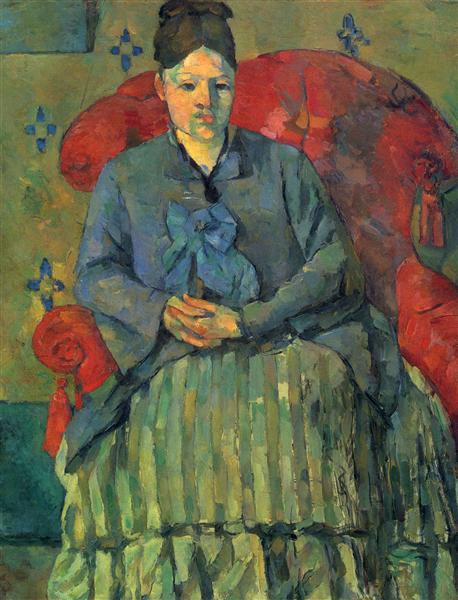
Madame Cézanne in a Red Armchair 1877
His partner Hortense Fiquet sits in a red velvet armchair against a striped blue-and-grey wallpaper. She is calm, almost expressionless, hands folded. The painting is one of perhaps thirty oil portraits Cézanne made of her over twenty years; she was, by some distance, his most patient model. The face is built up in his characteristic small parallel patches — barely modulated lights and shadows, no hard outlines, no flattering touch. Hortense apparently said of her many portraits that they were 'always cold and serious, like him'. It is one of the great Cézanne portraits and now hangs in the Museum of Fine Arts, Boston.
L'Estaque 1885
L'Estaque is a small fishing village just west of Marseille, where Cézanne painted on and off for two decades. He had been hiding there during the Franco-Prussian War of 1870 to avoid being drafted, and he kept coming back. This canvas — the village rooftops in the foreground, the sea sprawling out, an industrial chimney on the right hand side, the dry purple-blue mountains across the bay — is the kind of painting that Picasso and Braque would obsessively copy from twenty years later. They went to L'Estaque in 1908 specifically to paint Cézanne's view in their own way; the canvases they brought back are now considered the first paintings of Cubism. The original Cézanne is now in the Musée d'Orsay.
Harlequin 1890
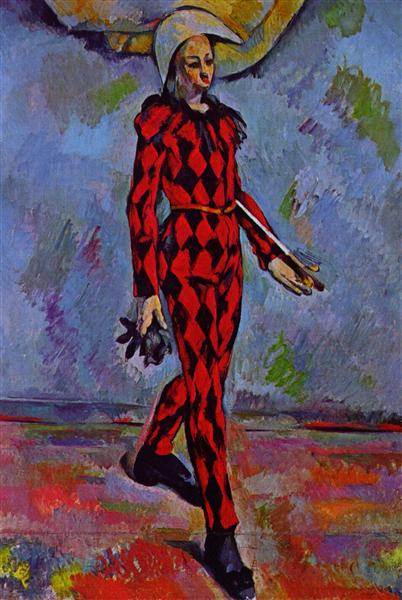
Cézanne's son Paul, aged eighteen, posed for this portrait dressed in a harlequin's diamond-patterned costume. The figure stands almost lifesize, in a strange tilted space, against a featureless yellow-grey background. The pose is borrowed from the *commedia dell'arte* costume tradition, but the painting itself is utterly modern — flat areas of red and black diamonds laid on with the same constructive patches Cézanne used for landscapes. Picasso saw it many times in the early 1900s and made his own series of harlequins through the Blue and Rose Periods. The painting is in the National Gallery of Art, Washington.
Still Life with Onions 1898
Five onions, a knife, a glass of red wine and a folded white cloth on a small table. Above the table, propped on the wall, is a corner of a glass bottle. Below the table, a single onion has rolled onto the floor. The whole composition tilts slightly forward — the table edge cuts diagonally, the cloth folds defy gravity, the bottle leans towards the viewer. Cézanne worked on his still lifes for weeks at a time, sometimes months; the apples in his more famous still lifes had usually rotted long before he had finished painting them, and he had to start over with new ones. This canvas is in the Musée d'Orsay, Paris.
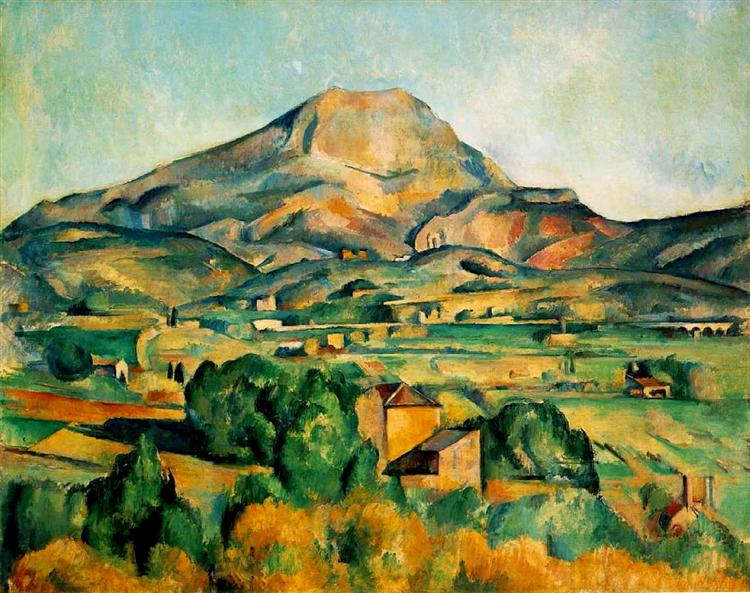
Mont Sainte-Victoire 1904
Cézanne painted Mont Sainte-Victoire — the limestone mountain east of Aix — at least sixty times across the last twenty-five years of his life. This version, painted from his studio at Les Lauves in 1904, is one of the latest and most abstract. The mountain is no longer a mountain but a stack of pale grey-blue patches against a pale orange sky; the foreground trees are clusters of green and ochre rectangles; the village in the middle distance is suggested with a dozen small house-like blocks of colour. Picasso, looking at the late Sainte-Victoire paintings in 1907, told Braque: 'This is what we have to do.' Several of the late versions are in the Pushkin Museum (Moscow), the Kunsthaus Zürich, and the Philadelphia Museum of Art.