Caspar David Friedrich
He turned the human back into the greatest view in landscape painting.
Style and technique
Friedrich's central invention is the Rückenfigur: the figure seen from behind. In painting after painting, a person — small, anonymous, their face hidden — stands at the edge of a vast landscape and looks into it. The viewer looks over their shoulder. There is no face to read, no expression to interpret, just the back and the world beyond. We identify with the anonymous figure completely because we are positioned to see what they see.
This was a formal solution to a philosophical problem. Friedrich believed that landscape was not merely scenery but spiritual experience — that standing before the sea, the mountains, or an ancient ruin was a form of confrontation with the infinite. Painting, he thought, could produce this confrontation in the viewer, but only if the viewer was properly positioned inside the image. The Rückenfigur creates that position.
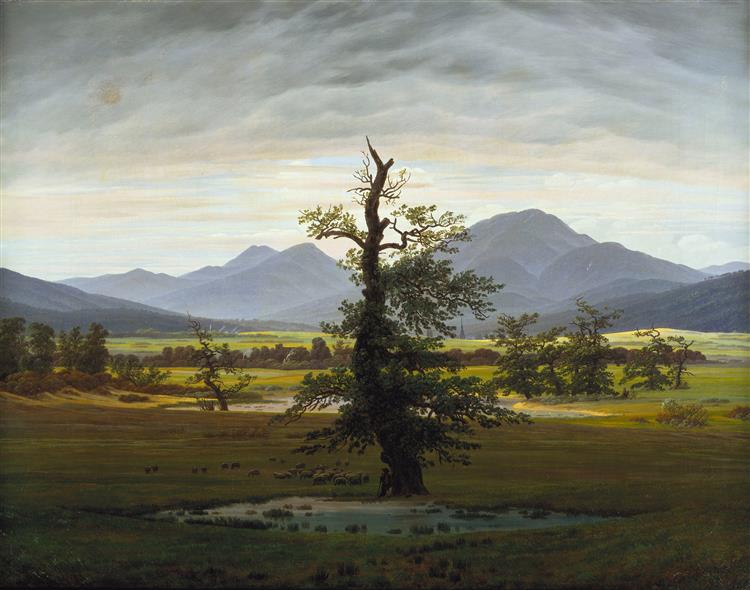
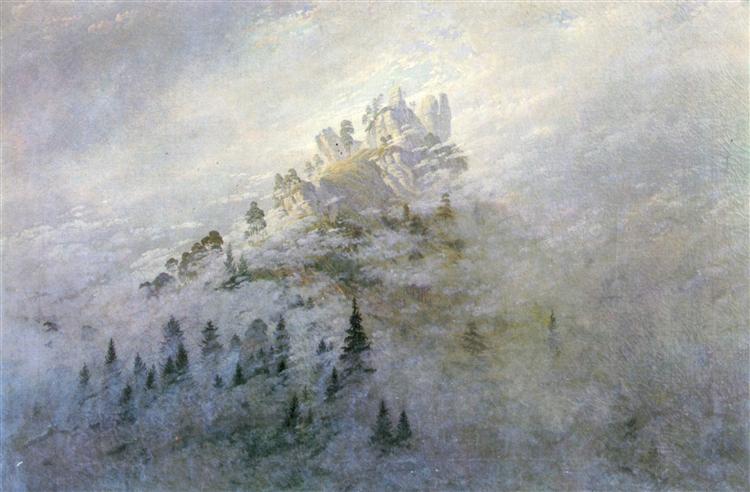
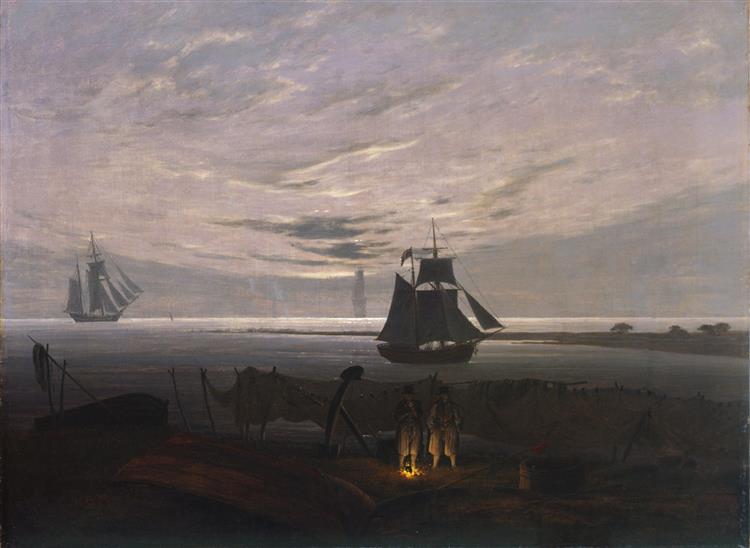
His light is unlike any other landscape painter's. It is not Constable's warm English noon or Turner's gaseous atmospheric dissolution. It is cold, specific, northern — the grey light of the Baltic coast at dawn or sunset, the blue of a sky clearing after snowfall, the particular amber of winter afternoon light over dark pine trees.
Ruins appear constantly in his work — specifically Gothic ruins, which carried a specific symbolic charge for German Romantics. A ruined Gothic church meant the fragility of human construction against the permanence of nature, the passage of time, the mortality of everything made by human hands.
Four characteristics identify his paintings: the miniaturised human figure against vast sky or water, the precise and patient rendering of trees, especially pines and oaks, a cool, grey-blue dominant light, and the sense that something has just happened or is about to happen in the landscape — a sunrise coming, a storm clearing, a figure about to walk over the edge.
Life and legacy
Friedrich was born on 5 September 1774 in Greifswald, a coastal town in Swedish Pomerania — now northern Germany. His childhood was marked by loss: his mother died when he was seven; at thirteen he watched his brother Johann fall through ice into a frozen lake while trying to rescue Caspar, and drown. The guilt from that accident seems never to have left him entirely.
He studied art first in Greifswald and then at the Copenhagen Academy, one of the finest art schools in northern Europe at the time, from 1794 to 1798. Copenhagen gave him technical draughtsmanship and a rigorous approach to composition, but his intellectual formation was decisively German — the Romantic philosophy of Schelling, the Protestant theology he had grown up with in Pomerania, and above all the landscape itself: the Baltic, the flat marshes, the limestone coast.
He moved to Dresden in 1798 and lived there for the rest of his life. Dresden was then a centre of German Romantic intellectual life — the philosophers, the poets, and the painters gathered there, and Friedrich found himself in the middle of a conversation about the spiritual dimensions of art that perfectly matched his own concerns.
His breakthrough came in 1808, when he exhibited 'The Cross in the Mountains' — known as the Tetschen Altarpiece — in his studio. The painting shows a crucifix on a mountain peak at sunset, framed in a painted Gothic arch. It was designed as an altarpiece but its subject was a landscape, not a religious narrative, and this provoked furious argument. Was landscape appropriate for altarpiece treatment? Was Friedrich claiming that nature was itself divine? He never fully answered these questions, but he kept asking them.
He married Caroline Bommer in 1818, aged forty-three; she was twenty-five. They had three children. His wife appears in several of his paintings as the female figure looking out to sea or into the distance, and their relationship was apparently one of genuine warmth and stability in an otherwise solitary career.
He died on 7 May 1840 in Dresden, aged sixty-five, largely forgotten. His reputation had collapsed in the 1820s and 1830s as German taste moved from Romanticism towards a more conventional academic painting. It was not until the early twentieth century — specifically the exhibitions organised by Berlin Secession artists around 1906 — that Friedrich was recovered as a major painter. Today he is the central figure of German Romantic painting.
Five famous paintings
The Monk by the Sea 1810
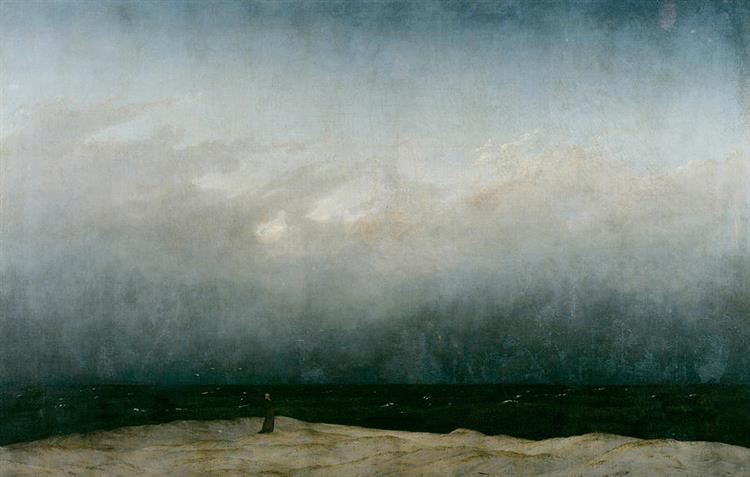
A tiny dark figure — a monk in a black habit — stands on a flat shoreline. The sky above him occupies five-sixths of the canvas: a cold, grey-blue layered sky with dark clouds at the upper edge. The sea is almost featureless. There is no boat, no horizon detail, nothing to hold the eye except the monk himself and the barely perceptible line between sea and sky. When it was exhibited in Berlin in 1810 the poet Heinrich von Kleist wrote that standing before it was like losing your eyelids — you could not look away but there was nothing specific to look at. It is in the Nationalgalerie in Berlin and is considered one of the key Romantic paintings.
The Sea of Ice 1824
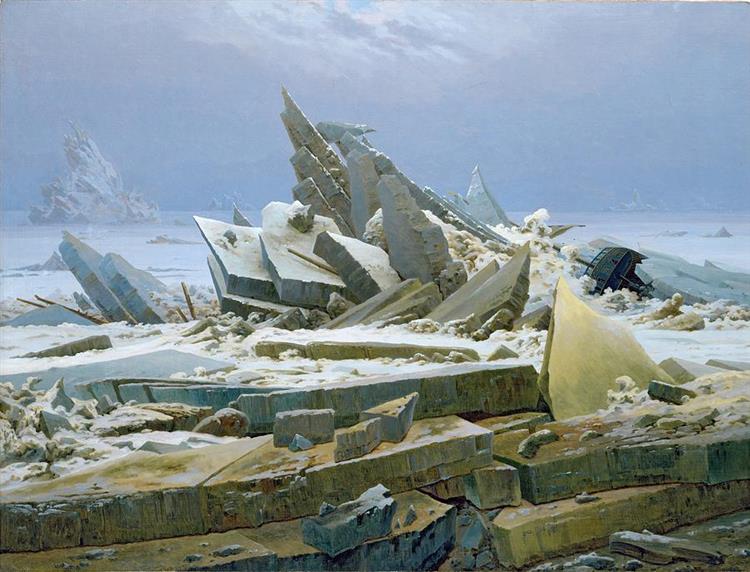
Also known as 'The Wreck of the Hope', this is Friedrich's most dramatic and literally violent composition. A ship — reduced to a fragment of hull — is being crushed by enormous angular slabs of pack ice that have been thrust upward by the pressure of the Arctic freeze. The ice dominates: slabs as big as houses tilted at sharp angles, pale blue-white in a cold grey light. There are no human figures. The ship is the human element, and it is destroyed. Friedrich was probably thinking of a specific Arctic expedition, but the painting works as a general image of nature's indifference to human ambition. It hangs in the Hamburger Kunsthalle.
Morning Mist in the Mountains 1808
An early painting, showing mountain peaks emerging from a sea of morning mist. A Gothic cross on a cliff in the middle ground is the only human element. The light is the specific cold gold of very early morning, before the full sun burns the mist away. The painting demonstrates Friedrich's fundamental compositional method: a foreground of dark, specific detail (the rocky cliff, the gnarled tree), a middle ground of symbolic form (the cross), and an infinite background of atmosphere (mist, sky, the suggestion of further peaks). It is in the Kunsthalle Bielefeld.
The Stages of Life 1835
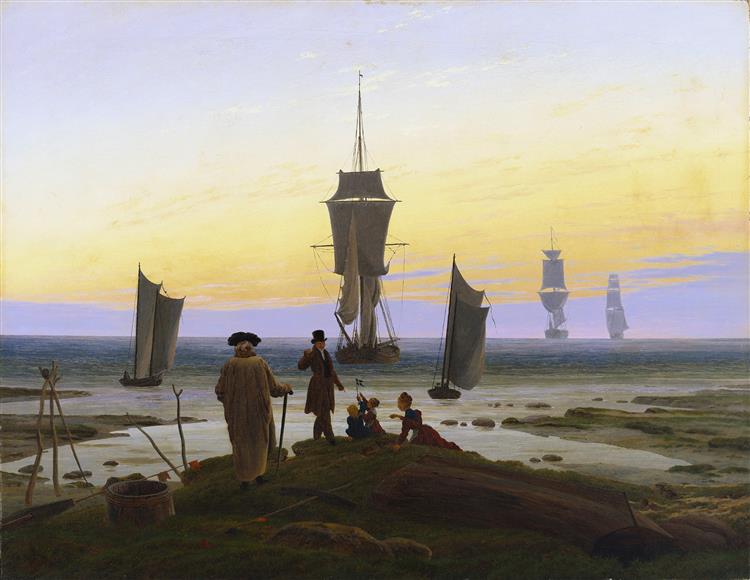
Painted after Friedrich's stroke, when he could no longer work freely in oil. Five ships at various distances from the shore correspond to five human figures on the beach at various stages of life — from the young children playing in the foreground to the old man in the middle distance whose back is to the viewer and who is closest to the horizon where the largest ship is receding. Friedrich himself is probably the old man. The painting is one of his most overtly allegorical and most personal: an artist approaching death, watching the boats sail. It hangs in the Museum der bildenden Künste in Leipzig.

Abbey in the Oakwood 1819
A procession of monks carries a coffin through the ruins of a Gothic cloister in a winter landscape. The trees are bare oaks, their stark silhouettes crossing against a cold evening sky. The ruined arches of the Gothic church rise in the background. Snow covers the ground; a few monks stand or kneel by an open grave. The painting is about death with an almost theological directness, but its atmosphere is so cold and precise that it avoids the sentimental. The oak trees — leafless, massive, ancient — are as present as the monks or the ruins. It hangs in the Nationalgalerie in Berlin, displayed alongside its companion piece 'The Monk by the Sea'.