J.M.W. Turner
He dissolved painting in light and left everything else to follow.
Style and technique
Turner began as a topographical watercolourist — a precise, professional trade in late eighteenth-century Britain, where architects and landowners wanted accurate records of buildings and estates. He was exceptionally good at it and used it to finance his real ambitions. By the time he was thirty he was already moving beyond topography into something that had no name yet: the painting of light itself as a subject.
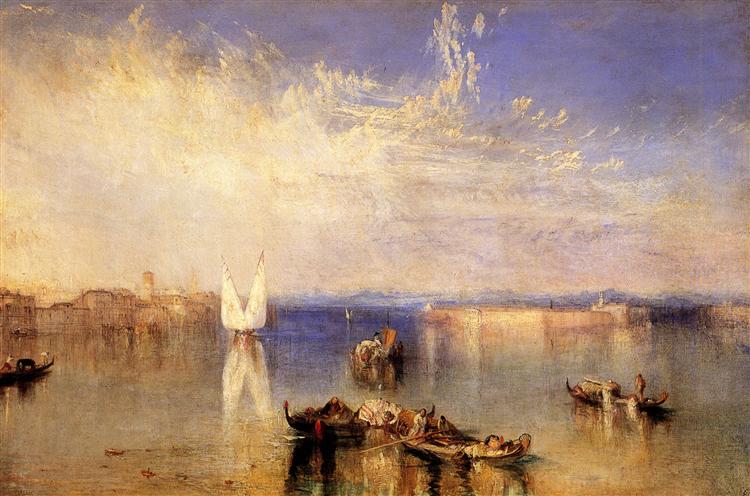
His central discovery — arrived at gradually through the 1810s and 1820s — was that atmosphere was more real than objects. Fog, mist, smoke, haze, spray, the specific quality of light in different weathers and at different hours: these were not obstacles between the viewer and the scene but the scene itself. The cliffs, the ships, the burning buildings were secondary to the air around them.
This was violently controversial. Critics accused him of painting 'tinted steam' and 'soapsuds and whitewash'. John Constable, his contemporary and rival, called him 'airy visions painted with tinted steam'. But John Ruskin, the great Victorian critic, published the first volume of 'Modern Painters' in 1843 specifically to defend Turner, arguing that his late work was the most truthful representation of nature ever produced.
The technique evolved visibly over decades. The early work is meticulous, the watercolour washes controlled and precise. By 1840 he was working on the canvas wet-in-wet, letting colours bleed into each other, sometimes wiping with rags or scratching with his thumbnail. He exhibited paintings that were barely more than sketches — thinly glazed, nearly empty — and added final details during the three-day 'varnishing days' before the opening of each Royal Academy exhibition.
Four fingerprints: light that comes from everywhere and nowhere simultaneously, the vortex composition (a swirling arrangement of colour and form around a central zone of intense brightness), tiny human figures overwhelmed by enormous natural forces, and colour relationships between yellow-white and deep black or blue that produce the sensation of radiance.
Life and legacy
Turner was born on 23 April 1775 above his father's barbershop in Maiden Lane, Covent Garden, London. His father, a cheerful and supportive tradesman, encouraged the boy's drawing from an early age, displaying his watercolours in the shop window. His mother suffered from severe mental illness and was eventually committed to Bethlem Royal Hospital — what was then called Bedlam.
He was admitted to the Royal Academy Schools at fourteen — the youngest student they had ever accepted. By fifteen he was earning money as a topographical draughtsman. By twenty-one he was exhibiting oils at the Royal Academy. By twenty-seven, in 1802, he was elected a full Academician — the youngest full member the Academy had produced.
The same year he traveled to France and Switzerland for the first time, crossing a Europe briefly at peace during the temporary armistice of Amiens. He filled sketchbooks with Alpine scenery and storm studies that would feed his work for decades. He returned to find himself already at the peak of the British art world.
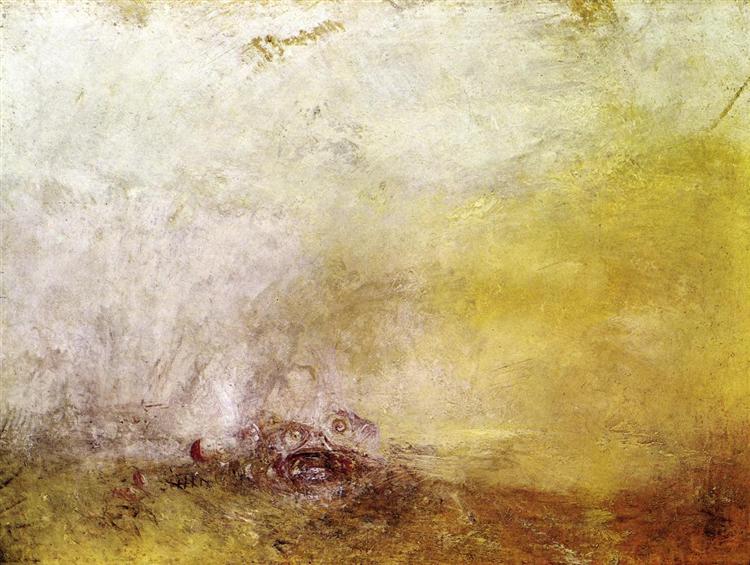
His ambitions were consciously competitive with the Old Masters. He studied Claude Lorrain and Richard Wilson — the major landscape tradition before him — and he studied them with the specific purpose of surpassing them. He left two paintings to the National Gallery in his will with the condition that they hang permanently beside two Claude Lorrains: 'Sun Rising through Vapour' beside Claude's 'Seaport' and 'Dido Building Carthage' beside Claude's 'Embarkation of the Queen of Sheba'. The National Gallery agreed and still honours this arrangement.
His personal life was determinedly mysterious. He never married. He maintained what appeared to be a relationship with Sarah Danby, a widow, and later with Mrs. Sophia Booth, a Margate landlady with whom he lived in his last decade under the assumed name of 'Mr. Booth'. He accumulated significant wealth through sales and careful investment but lived simply, his Twickenham villa and later his London house functioning as studios as much as homes.
His sketchbooks — nearly 300 of them, now in the Tate — are one of the great archives in the history of art. He filled them constantly, on every journey, in every weather: quick pencil notations of colour, light, and atmosphere that he would work up months or years later into finished paintings.
He died on 19 December 1851 in the Cheyne Walk house in Chelsea where he had been living as 'Mr. Booth'. He was found by his physician, who noticed he was failing, and died at around nine in the morning. His last words, reportedly, were 'The sun is God.' He was buried in St. Paul's Cathedral crypt, beside Sir Joshua Reynolds. He left around 300 oil paintings and 30,000 works on paper to the British nation.
Five famous paintings
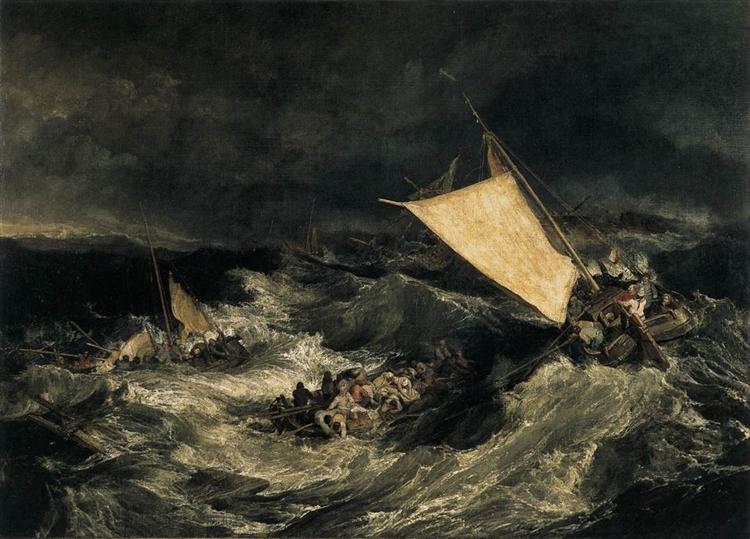
The Shipwreck 1805
An early Turner, still in the tradition of dramatic marine painting, but already showing what he was moving towards. A ship in severe distress breaks apart in a storm while small boats — lifeboats and rescue craft — struggle through the waves. The composition is organised around a vortex: the storm spirals around the centre of the canvas, drawing the eye into the boiling centre. The sky and sea merge at the horizon in a tangle of grey and white. This is the point where Turner begins to dissolve the boundary between water and air, between sky and sea, that most painters maintained carefully. The painting is in the Tate.
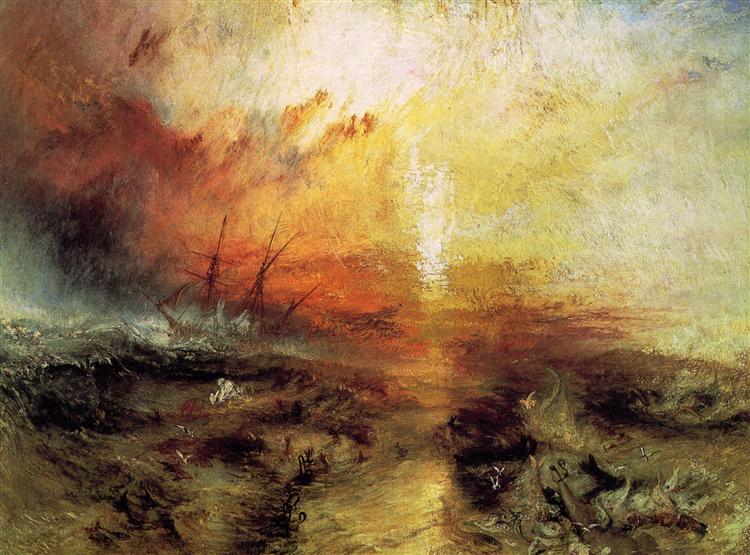
The Slave Ship (Slavers Throwing Overboard the Dead and Dying) 1840
Turner's most morally explicit major painting, and the one Ruskin bought for his father and later donated to the Museum of Fine Arts in Boston, where it still hangs. A slave ship sails through a violent sunset while in the blood-red water around its stern, the shackled bodies and severed limbs of enslaved people are being eaten by fish. The historical context is the Zong massacre of 1781, when the captain of a slave ship threw 132 enslaved people overboard to claim insurance. Turner shows the event as a natural and moral catastrophe simultaneously: the sunset is gorgeous and terrible, the water is beautiful and full of the dead.
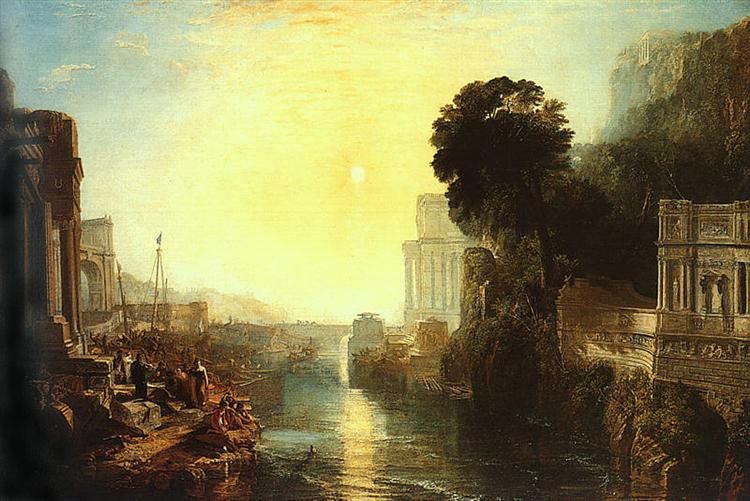
Dido Building Carthage 1815
Turner's most deliberate competition with Claude Lorrain, painted in 1815 and exhibited with a quotation from his own unfinished poem, the 'Fallacies of Hope'. Dido, Queen of Carthage, oversees the construction of her city — the legend from Virgil's Aeneid. The sun rises over a shimmering golden harbour, and the entire composition bathes in a warm, amber light that owes everything to Claude's golden afternoons. Turner knew it and intended the comparison. He left this painting to the National Gallery with the condition that it hang beside Claude's 'Seaport'. It has done so ever since.
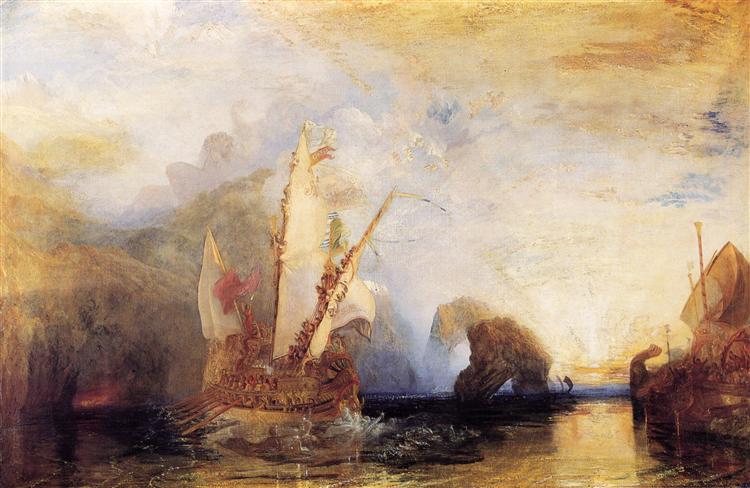
Ulysses Deriding Polyphemus 1829
Homer's 'Odyssey': Ulysses taunts the blinded Cyclops Polyphemus as his ship escapes across a glowing sea. The giant Cyclops is barely visible — a dark shape against an orange sky, more atmospheric disturbance than figure. The ship is elaborately rigged and catches the light brilliantly; the sea horses pulling Aurora's chariot appear in the dawn sky above. This painting marks a turning point: the mythological subject is less important than the extraordinary chromatic ambition — the orange sky grading into pink and yellow, the sea reflecting each shade — and the figures are secondary to the light that frames them.
Light and Colour (Goethe's Theory) 1843
One of Turner's most abstract late works, painted in response to Goethe's 'Theory of Colours' which argued that light and colour were more fundamental than form. The canvas is a vortex of yellow, white, and pale gold, with a circular shape at the centre — possibly a bubble, possibly the sun, possibly the mouth of a whirlpool. Tiny figures and the suggestion of a landscape appear at the edges but barely register. The painting is as close to pure abstraction as Turner ever came, and it was precisely this kind of work that critics mocked as 'tinted steam'. It hangs in the Tate.