William Blake
He saw angels in a tree at four and never stopped. His art is what happens when vision is the medium.
Style and technique
Blake was not primarily a painter but a visionary who used paint, relief etching, and watercolour as vehicles for a private mythological system that he invented, elaborated, and inhabited for his entire creative life. He is categorised as a Romantic, but his relationship with the movement is tangential — he rejected the Rationalism that Romanticism was reacting against, but he also rejected the pastoral naturalism that most Romantic painters pursued.
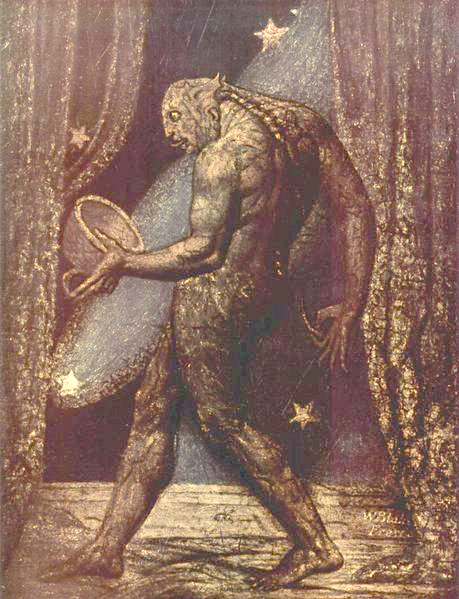
His visual style is directly connected to his training as an engraver, which he practised as a commercial trade throughout his life. The line is the foundation: clear, sinuous, energetic, enclosing forms that are simultaneously muscular and slightly wrong — limbs slightly too long, torsos too massive, the figures of his mythological system occupying a body type that has no equivalent in anatomical fact.
He admired Michelangelo and Raphael above all other painters and used their scale and compositional authority as a model — though his figures have a specific character that owes as much to his vision of spiritual reality as to any formal training. His colour, applied in thin watercolour washes over the engraved or drawn lines, is subordinate to the drawing rather than independent of it.
Four fingerprints: the strong, curvilinear outline defining massive figures against dense backgrounds, the human body at the limit of its scale — stretched, bent, compressed in ways that suggest spiritual rather than physical force, a specific visual mythology of named beings (Urizen, Los, Orc, the Zoas) whose forms and interactions constitute a complete alternative cosmology, and the integration of text and image in his illuminated books, where the printed words are incorporated into decorated pages as visual as they are literary.
Life and legacy
Blake was born on 28 November 1757 in Soho, London, the son of a hosier who ran a small draper's shop on Broad Street. He showed unusual gifts from early childhood — the visions he reported are well documented in family accounts — and his father, recognising his artistic inclinations, did not send him to school but arranged drawing lessons instead. At fourteen he was apprenticed to the engraver James Basire, a respected trade engraver whose commissions included work for the Society of Antiquaries. Seven years of training as an engraver gave Blake an intimate knowledge of copper-plate technique and an affinity with Gothic funerary monuments — he was sent by Basire to draw in Westminster Abbey and spent years among the medieval tombs.
He entered the Royal Academy Schools in 1779 and studied briefly under the history painter Giovanni Battista Cipriani. He was already forming his own views: he admired Raphael and Michelangelo, despised the fashionable painters of the day, and was convinced that the kind of detailed, atmospheric, 'blotting and blurring' naturalism of Reynolds and his circle was a form of spiritual corruption.
He married Catherine Boucher in 1782 — she was illiterate when they married; he taught her to read and to assist with his printing and colouring. They remained together for the rest of his life. He taught her his methods; she coloured and printed his work and kept the business functional during his frequent periods of financial difficulty.
In 1789 he published 'Songs of Innocence', produced in a technique he described as 'Illuminated Printing' — a method of relief etching on copper in which text and image were combined on the same plate, printed, and then hand-coloured. The resulting books were unique objects, each copy slightly different. 'Songs of Experience' followed in 1794; between them they constitute the most original contribution to British literary culture since Milton.
The years 1800–1803 were spent at Felpham, Sussex, at the invitation of the minor poet William Hayley, who employed him to engrave illustrations. The relationship was cordial but stifling; Blake returned to London with increasing clarity about his own mythological system, which he elaborated in the long prophetic books of his final decades — 'Milton', 'Jerusalem', the 'Four Zoas'.
He died on 12 August 1827 in London, aged sixty-nine, reportedly singing hymns on his deathbed. His wife Catherine died the following year, having continued his printing and colouring work until the end. His reputation was revived by Alexander Gilchrist's biography of 1863, from which point his standing has only grown.
Five famous paintings
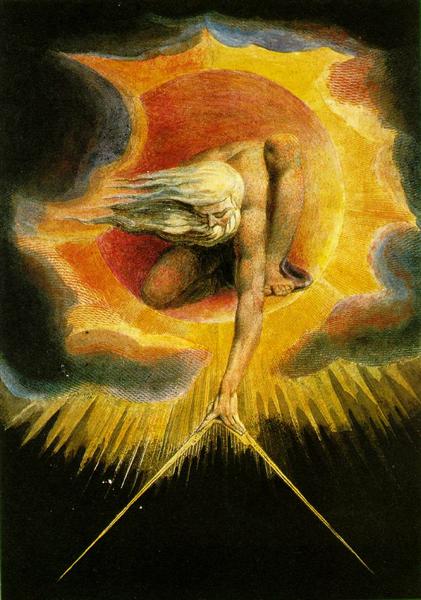
The Ancient of Days 1794
The frontispiece to 'Europe: A Prophecy', one of Blake's illuminated books. A massive male figure kneels in a blazing circular light, his left arm stretched downward and forward as he holds a large compass to a dark void below. The figure is Urizen — Blake's name for the demiurge, the false god of Reason and Law who created the material world by measurement and limitation. The compass is his instrument; the light from which he emerges is his domain. Blake considered this his supreme image and always kept a copy of it by him. It exists in multiple versions; one of the most complete is in the British Museum.
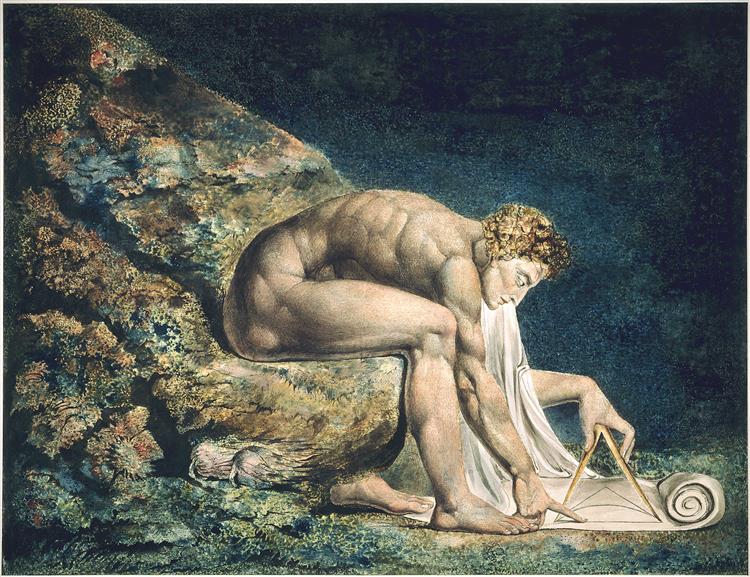
Newton 1795
A muscular, beautiful male figure crouches on a rock at the bottom of the sea — or the floor of a cave — and uses a compass to draw a geometric diagram. This is Blake's Isaac Newton: a figure of supreme physical perfection who has directed his entire being downward, into the measurement of the material world, and has thereby missed everything above and behind him. The rock he sits on is covered with organic forms of extraordinary detail — coral-like growths, leaves, miniature landscapes. He looks only at his diagram. The painting is a critique of scientific rationalism as spiritual blindness: all the beauty of the world behind him, and he cannot see it. It hangs in the Tate.
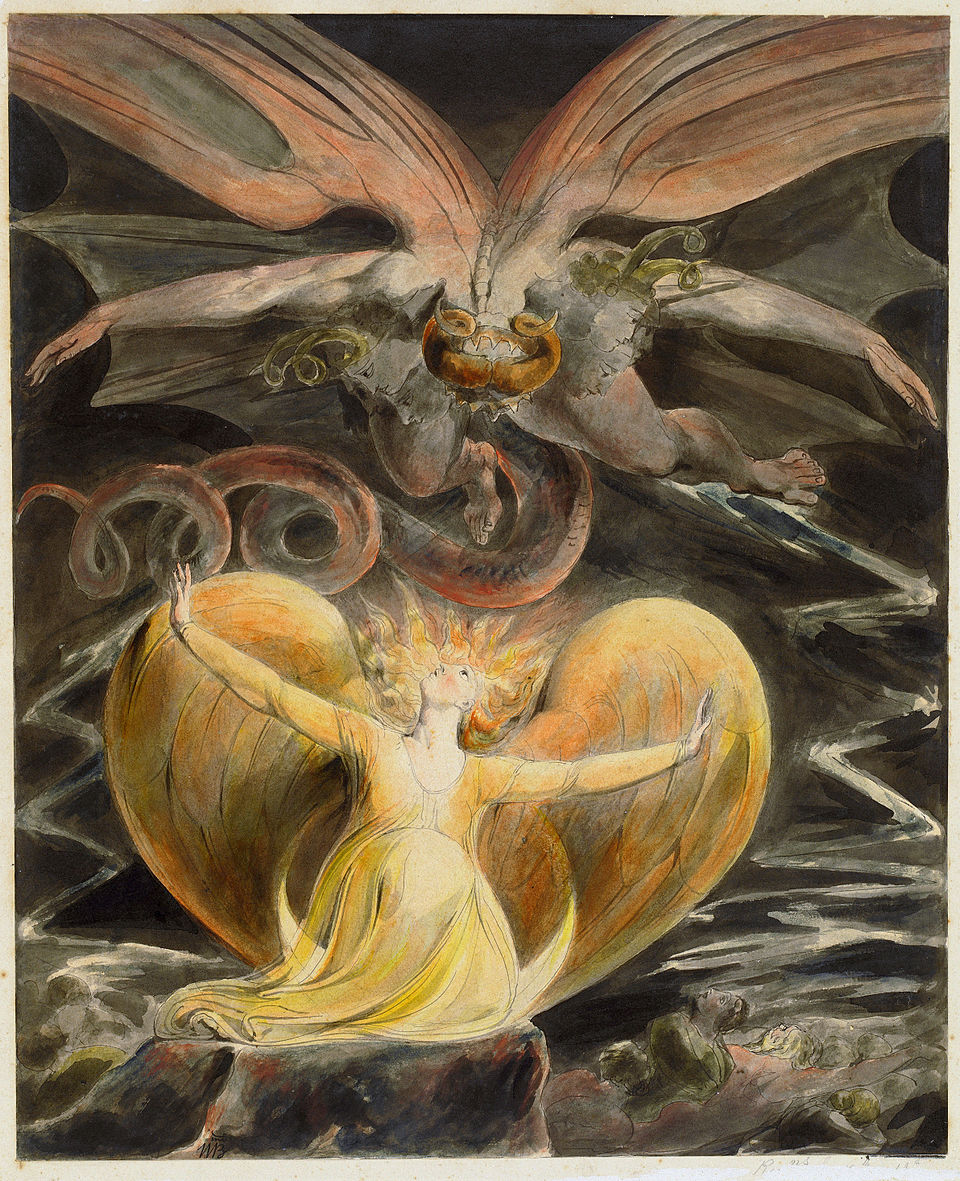
The Great Red Dragon and the Woman Clothed with the Sun 1805
A figure of vast, terrifying power — the Great Red Dragon from Revelation — stands with his back to the viewer, his wings spread to fill the upper canvas, his massive body coiled and tensed. Below him, small and vulnerable, the woman clothed with the sun reaches upward. The composition is organised around the contrast between the dragon's overwhelming physical presence and the woman's spiritual radiance. Blake painted this and several related works illustrating Revelation between 1805 and 1810. The series demonstrates his mastery of the single overwhelming figure — the muscular, impossible body that carries the full weight of apocalyptic vision.
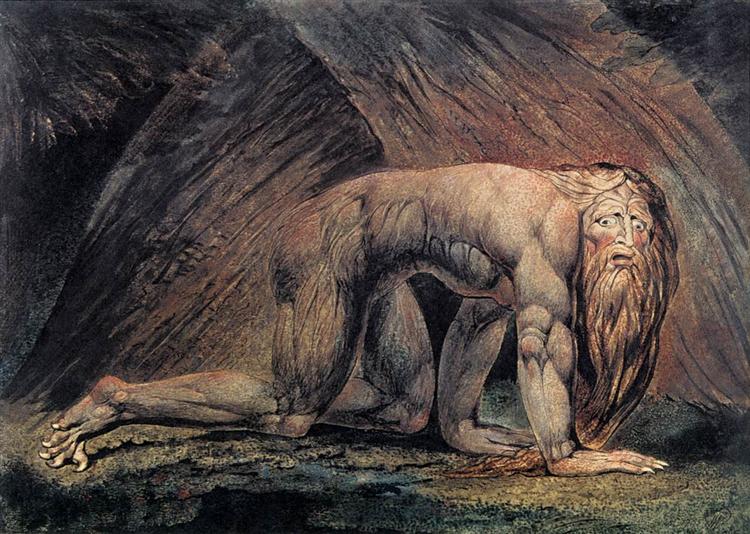
Nebuchadnezzar 1795
The Babylonian king Nebuchadnezzar, driven mad by God and reduced to eating grass like an ox, crawls on all fours away from the viewer. His body is contorted, his face turned over his shoulder to show an expression of animal terror, his grey beard and hair hanging forward. He is simultaneously physically magnificent — the musculature of his back and arms is rendered with great care — and spiritually destroyed. Blake printed this image multiple times as a large colour-print; it represents his sustained interest in the figure of the great man reduced, the powerful made bestial by pride. The Tate holds the finest version.
Elohim Creating Adam 1795
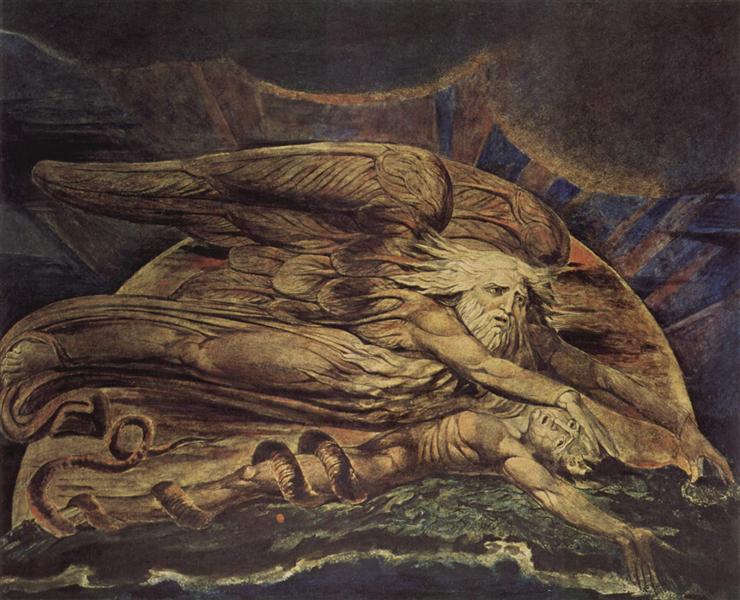
The creator God — Elohim, one of Blake's names for the demiurge — stretches over the prone form of Adam and presses him into the physical world. Adam's face is anguished; a worm winds around his leg, symbol of mortality and materiality. The composition is taken directly from Michelangelo's Sistine ceiling but the meaning is reversed: for Blake, the creation of the physical body was not a gift but an imprisonment — the entrapment of the spiritual in matter. The colour, in the large colour-print version, is characteristic: warm orange and gold for the divine light, cold green and brown for the earth that the newly physical Adam will inhabit.