Mark Rothko
He built cathedrals out of colour, then filled them with silence.
Style and technique
Rothko did not paint colour. He painted with colour to produce an emotional condition in the viewer that he described variously as tragedy, ecstasy, doom, and the sensation of being on the threshold of something vast and invisible.
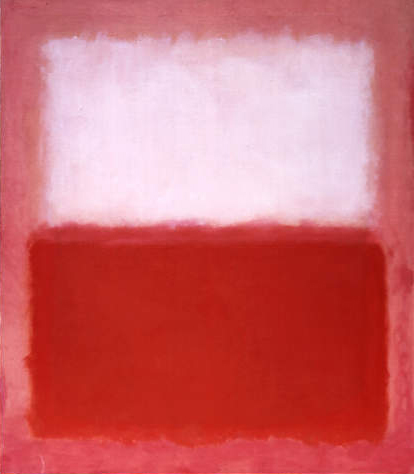
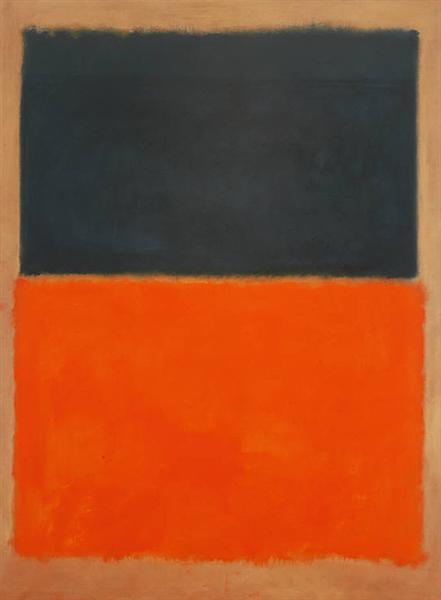
His mature canvases — arrived at through a decade of earlier work in figurative surrealism and myth — consist of two or three softly edged rectangles of colour stacked vertically on a vertical canvas. The rectangles are large; the canvases are larger still. A typical work from his peak period (1950–1968) is approximately 200 by 230 centimetres or bigger. Standing close, you are inside the colour rather than looking at it.
The specific technique produced his specific effect. He applied the paint in thin, luminous washes, layer over layer, building up a surface that glows from within — not reflected light but transmitted light, the same quality as stained glass or a fire seen through frosted glass. The edges of the rectangles are deliberately soft and blurred: no hard line separates one field from another. The two fields breathe into each other.
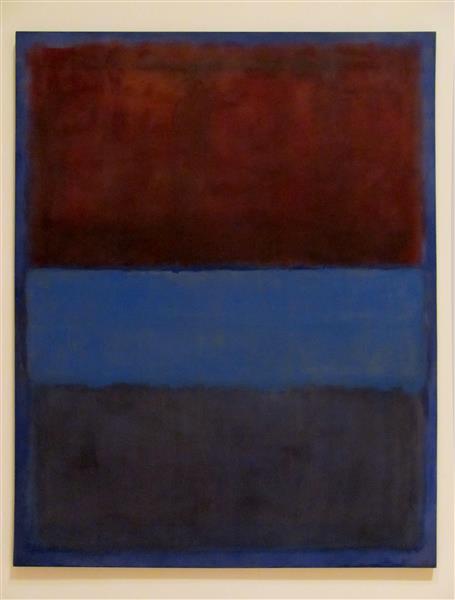
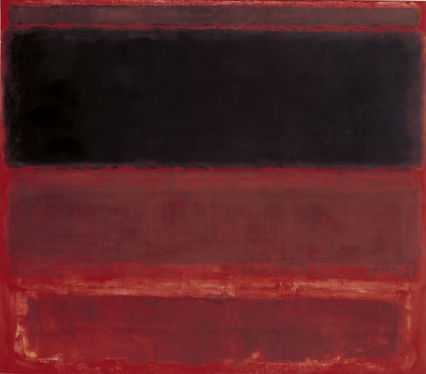
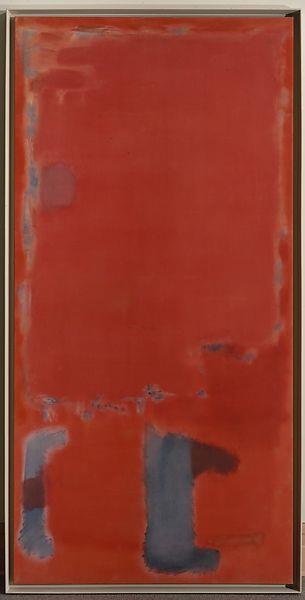
Four fingerprints: the stacked rectangles (almost always two or three, almost always vertical), the luminous, transparent paint surface, the deliberately ambiguous, poetic titles — 'No. 61 (Rust and Blue)', 'Four Darks in Red' — that refuse to fix the painting's meaning, and a darkening trajectory visible across his career: the early works are yellow and orange; the final works are dark red and black.
Life and legacy
Rothko was born Marcus Rothkowitz on 25 September 1903 in Dvinsk, in the Russian Empire — a city now called Daugavpils in Latvia. His family was Jewish, and his father, a pharmacist, emigrated to Portland, Oregon in 1913, with the rest of the family following the year after. His father died within months of their reunion.
He was educated in Portland and won a scholarship to Yale, where he lasted two years before dropping out in 1923 and making his way to New York. He discovered painting at the Art Students League under Max Weber, a painter who had studied with Matisse, and began the slow process of finding his direction.
His early work was figurative and Expressionist: city scenes, subway figures, children. In the 1940s he moved through a period of mythological subjects drawn from Greek tragedy and ancient ritual — the influence of Freud, Nietzsche, and his friendship with Adolph Gottlieb. These paintings were trying to locate universal emotional experience; the specific myth was a vehicle.
The transition happened between 1947 and 1950. The figures dissolved. The mythological subjects were replaced by what he called 'multiforms' — areas of colour that moved towards the stacked rectangle format. By 1950 he had arrived at his mature language.
The subsequent two decades produced the canonical body of work: thousands of paintings in oil and acrylic in the stacked rectangle format, moving from the warm oranges and yellows of the early 1950s through increasingly darker and cooler combinations towards the nearly black works of the final years.
The Seagram Murals commission (1958) was a decisive test. Rothko accepted $35,000 to paint large murals for the Four Seasons restaurant in New York, worked for nine months on the series, and then returned the money and withdrew the paintings — reportedly after visiting the restaurant and concluding that the wealthy diners eating there should not be given the privilege of his work. The paintings eventually went to the Tate in London and to the Kawamura Memorial Museum in Japan.
The Rothko Chapel in Houston, Texas — an ecumenical chapel containing fourteen of his large, dark, near-black canvases, commissioned by the de Menil family and opened in 1971 — is perhaps the most complete realisation of his ambition.
He was found dead in his studio on 25 February 1970, aged sixty-six, from an overdose of barbiturates and severed arteries in his arms. The executor of his estate, the gallery owner Frank Lloyd, was subsequently convicted of defrauding the estate of $30 million worth of paintings.
Five famous paintings
No. 61 (Rust and Blue) 1953
A large canvas — 295 by 232 centimetres — divided into three softly edged horizontal fields: a pale blue at the top, a rust-brown in the middle, and a darker rust-black at the bottom. The fields bleed into each other at their edges; no hard line separates them. Stood at Rothko's prescribed distance of 45 centimetres, the rust-brown field occupies your entire visual field. He described his paintings as producing an intimate, direct emotional encounter — not landscape, not object, but contact with something essential. This is in the Los Angeles County Museum of Art.
Four Darks in Red 1958
From the year he accepted and then withdrew the Seagram commission. The canvas is very large and very dark: four rectangular masses in deep red and near-black, stacked on a dark red field. The difference between the rectangles and the field is subtle — a slightly different tone, a slightly different edge quality — so the composition takes time to read. The effect is of approaching darkness rather than experiencing it: the rectangles are not black but are moving towards black. This is the beginning of his final trajectory, which would end in the nearly monochrome near-black canvases of the chapel series. It is in the Whitney Museum of American Art.
White Center (Yellow, Pink and Lavender on Rose) 1950
An early classic, made in the year he reached his mature format. The field is a warm rose-pink; two rectangles sit within it — a dark lavender at the top, a warm yellow at the bottom, and between them a white centre that seems to vibrate with a light of its own. The colours are lighter and more openly joyful than his later work. This painting was sold at Sotheby's New York in May 2007 for $72.8 million, then a record for post-war art. David Rockefeller had owned it for decades and displayed it in his bedroom. It is now in a private collection.
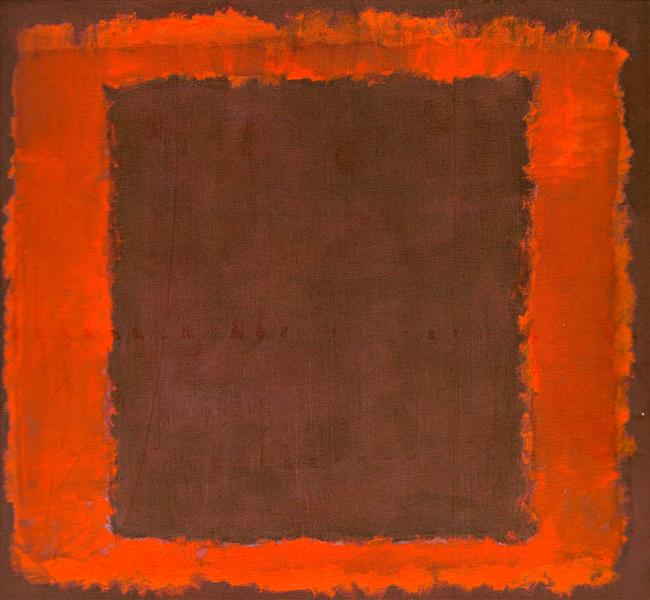
Seagram Murals (series) 1959
A set of canvases made for the Four Seasons restaurant in the Seagram Building in New York, from which Rothko eventually withdrew after visiting the completed restaurant and concluding that the social context was wrong. He had intended the murals to make the wealthy diners feel 'trapped in a room where all the doors and windows are bricked up'. The canvases — large, dark, red-orange with near-black rectangles — are among the most sombre things he made in his mid-career. Nine of the panels are in the Tate Modern in London, where they are given a dedicated room. Others are in the Kawamura Memorial Museum in Sakura, Japan.
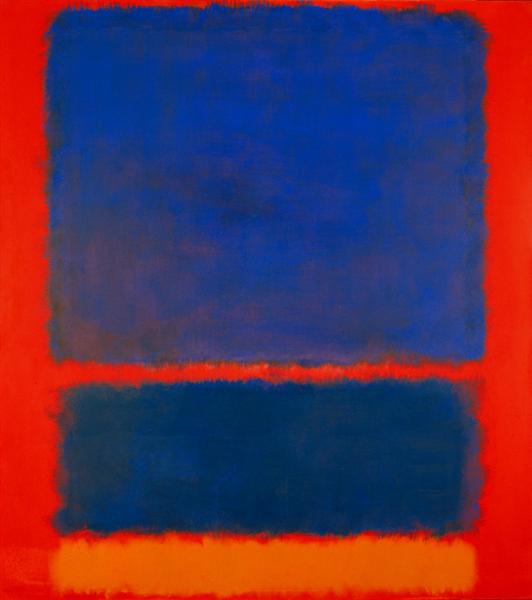
Blue and Grey 1962
A late work, from the period when Rothko was moving steadily towards the dark palette of the final years. Two large fields — a deep blue above, a grey below — on a near-black ground. The blue is still luminous; the grey is cool and still. The composition is simpler than the multi-rectangle earlier work: just two fields, the division between them barely marked, the ground bleeding in at the edges. The painting has the quality of sky seen from inside a cave: distant, luminous, and not quite accessible. It is characteristic of Rothko's ability to produce states of prolonged attention in front of canvases that give the viewer almost nothing to hold onto.