Jean Dubuffet
He decided that untrained art was more alive than trained art — and then spent forty years proving himself right.
Style and technique
Dubuffet made a decision in the 1940s that was radical in the context of postwar European art: he decided that the art of untrained people — the mentally ill, children, prisoners, outsiders — was more alive, more honest, and more powerful than the cultivated art of the academies and galleries. He called this art Art Brut (raw art), collected it systematically, and simultaneously made paintings that tried to incorporate its energy into his own practice.
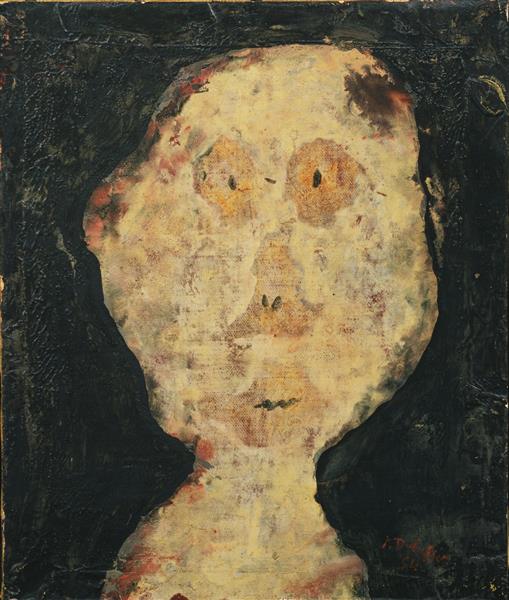
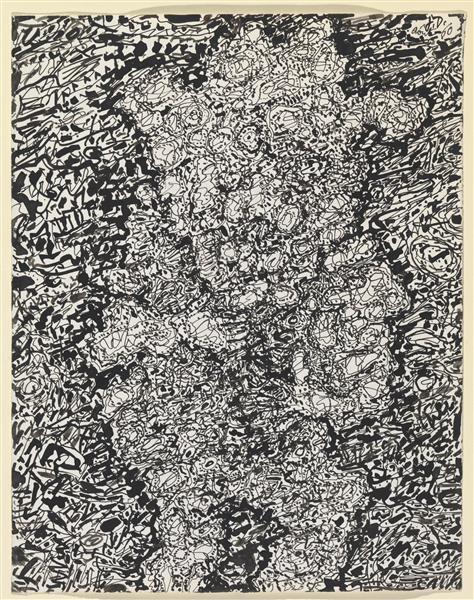
The result is a style that is deliberately ugly by conventional standards: figures scratched into thick impasto with a palette knife, surfaces built up with gravel, sand, and debris, images that look like the drawings of someone who has never been taught to draw. The crudeness is studied — he knew exactly what he was doing — but the studied crudeness is not ironic in the Pop Art sense. He genuinely believed that the conventional standards of Western art had become obstacles to perception, and that the way to restore painting's vitality was to start again from scratch.
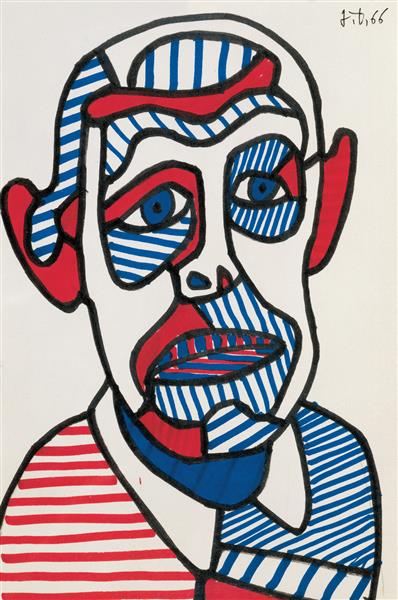
The formal intelligence underneath the apparent crudeness is considerable. His compositions are carefully organised; his use of colour — especially in the later Hourloupe cycle — is precise and systematic; his drawing, crude as it appears, has a consistency that distinguishes it from genuine naïve art. What he produced was not naïve painting but a sophisticated argument about what naïve painting reveals.
Four fingerprints: thick, scratched surfaces built up with sand, gravel, and tar mixed into paint, crude figurative forms — human figures that look like stick drawings elaborated by someone who has never studied anatomy, the accumulation of marks as a compositional principle, and the Hourloupe cycle of the later career, in which interlocking cell-like forms in red, blue, and white cover every surface.
Life and legacy
Dubuffet was born on 31 July 1901 in Le Havre, the son of a wine merchant. He studied art briefly in Paris but abandoned it after several months and entered his father's wine business. He spent the 1920s and 1930s running the wine trade — interrupted by periods of painting — without making a public commitment to art.
He began painting seriously for the last time in 1942, during the German occupation of Paris, when he was forty-one. The late start, combined with his deliberate rejection of the academic tradition he had briefly absorbed, gave his work a quality of willful naïveté that was central to his argument: he was choosing to paint badly — or rather, to paint outside the standards by which 'good' painting was measured.
His first exhibition in Paris in 1944 attracted outrage and attention in roughly equal measure. The portraits of that period — faces smeared and scratched into rough paint — looked like insults to the sitters rather than likenesses. Dubuffet maintained that they were the most honest portraits he could make.
He began collecting Art Brut in 1945, building an archive of works by psychiatric patients, prisoners, mediums, and others who had made art outside any professional or institutional context. The Collection de l'Art Brut, which he eventually donated to the city of Lausanne in 1971, is now one of the most important collections of outsider art in the world and a document of his life's second passion.
Through the 1940s and 1950s he developed the Hautes Pâtes technique — surfaces built up with oil paint mixed with sand, tar, broken glass, and other materials to produce a rough, geological texture — and the Texturologies and Materiologies, in which the surface itself, rather than any figure painted on it, became the subject.
The Hourloupe cycle, which began in 1962 and continued for over a decade, was the most extended single project of his career: a visual language of interlocking, jigsaw-like forms drawn in red ballpoint on white, subsequently scaled up to vast paintings, sculptures, and architectural environments. The forms have no referent in the visible world — they are neither figurative nor abstractly geometric — but they tile together with the inevitability of cells under a microscope.
Five famous paintings
The Busy Life 1953
A large canvas covered with a dense crowd of figures — pedestrians, buildings, vehicles — all rendered in the rough, scratched style of his mature technique. The city is shown as an accumulation of marks rather than a representation: each figure is a scrawl, each building a rough rectangle, the whole forming a visual texture of urban density. The painting has no centre, no hierarchy of attention — the crowd is the subject and the crowd extends in every direction. It is one of his most ambitious figure paintings and one of the most successful in demonstrating that crude individual marks can accumulate into complex social imagery.
Paris Circus 1961
A canvas from the transition between the Hautes Pâtes and Hourloupe periods, showing a circus scene in which figures and props are rendered with broad, childlike brushwork in bright colours — orange, red, blue, yellow — applied without modelling or shading. The figures are barely figurative: they are blobs and lines that suggest human bodies in action. The energy of the circus — the movement, the spectacle, the crowd — is conveyed through the sheer density and colour intensity of the marks rather than through any illusionistic technique. It is in the Tate collection in London.
Hourloupe 1967
A characteristic work from the Hourloupe cycle — the interlocking cell-like forms that Dubuffet developed from 1962 onward. The forms are drawn in red and black outline and filled with blue and white, creating a pattern of interlocking shapes that extends across the entire surface without beginning or end. The shapes suggest figures, architecture, landscape — or nothing at all, depending on where you look. The cycle was inspired by doodles he made while talking on the telephone: the automatic marks generated without conscious intention became the basis for a decade-long formal investigation. The word 'Hourloupe' was invented by Dubuffet — it suggests something threatening and strange.
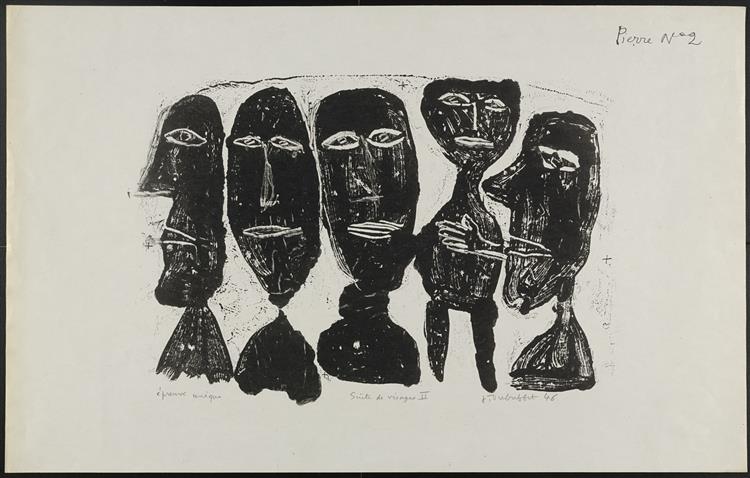
Suite des visages II 1946
Lithograph from the portfolio Les Murs ("The Walls"), 1946. Five faces lined up like prisoners in a row, each a black mask scratched out of dense ink — eyes are slits, mouths are gashes, the heads are shapes a child or a graffito-maker would draw on a wall, not the noble heads of academic portraiture. Dubuffet was forty-five when he made the print; he had only fully committed to art four years earlier, after twenty years running a wine wholesalers' business. Les Murs grew out of his fascination with the scratched walls of occupied Paris during the war, where graffiti, posters torn off, and stains formed an anonymous public art he believed was more alive than what hung in the museums. The masks here are the first appearance, in his graphic work, of the broad iconic frontal face that would dominate his painting through the 1950s.