Ernst Ludwig Kirchner
He painted the nerve-jangle of the modern city before anyone had named what it felt like.
Style and technique
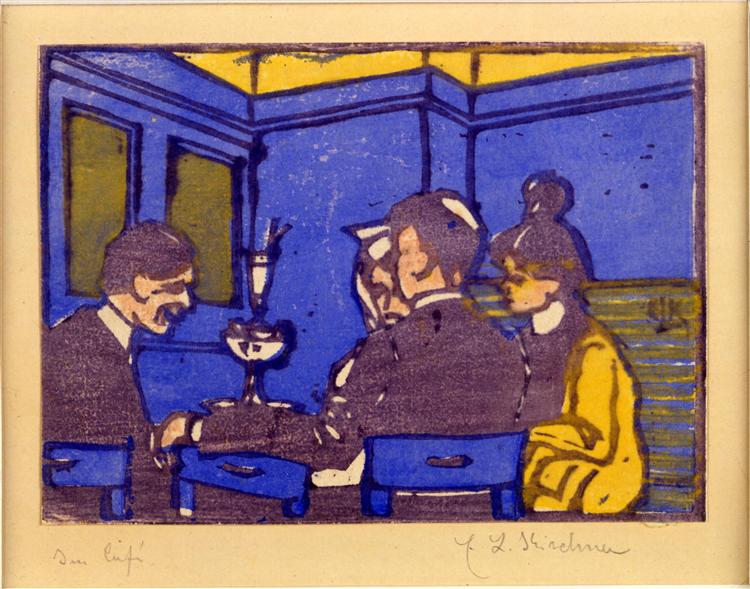
Kirchner's style is built on colour and line pushed beyond description into sensation. His early work in Dresden drew on the intense colour of Van Gogh and Gauguin, the psychological distortion of Munch, and the angular energy of African and Oceanic woodcarving, which he encountered in the ethnographic collection of the Dresden Museum in 1905. He synthesised these into a style of aggressive angular drawing and non-naturalistic colour that could only be described as German Expressionism — a term he helped define.
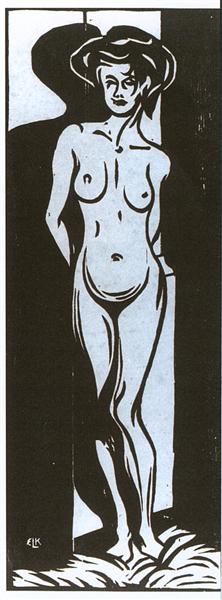
The Dresden work of 1905–1911 is characterised by bold, contrasting colours — oranges and greens, blue-blacks against lemon yellows — and figures that twist and extend beyond anatomical correctness to produce maximum emotional charge. He painted nudes in studio interiors with a frankness that shocked contemporaries, and beach scenes from the Baltic holiday resorts where the members of Die Brücke spent their summers living in a deliberately primitive, communal way.
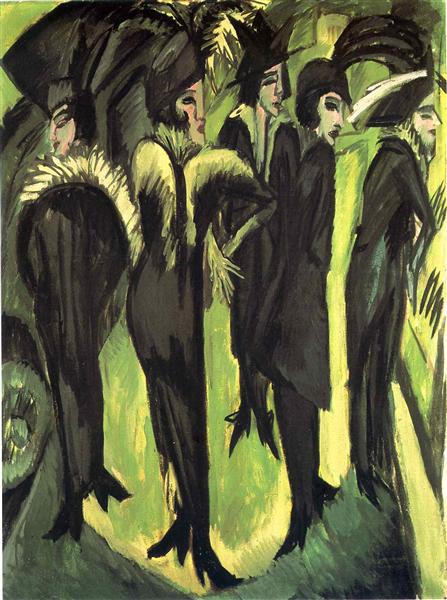
The move to Berlin in 1911 changed everything. The city — its streets, its cafés, its prostitutes, its electric lights, its traffic and noise — became his subject. The street paintings of 1913–1914 are the greatest depictions of urban anxiety in early twentieth-century art: elongated figures in angular dark clothes move through streets whose perspective is wildly distorted, their faces mask-like, their movements mechanical.
Four fingerprints: angular, elongated figures that carry the energy of woodblock prints, hot non-naturalistic colour in the early work and cold artificial colour in the Berlin period, a compositional tendency to compress and skew perspective, and a recurring cast of characters — the elongated woman in a feathered hat, the anonymous urban crowd, the naked body in its most exposed moment.
Life and legacy
Kirchner was born on 6 May 1880 in Aschaffenburg, Bavaria. He studied architecture in Dresden and Munich — completing his degree in 1905 — while teaching himself to paint through obsessive self-study. In 1905, with three fellow architecture students — Fritz Bleyl, Erich Heckel, and Karl Schmidt-Rottluff — he founded Die Brücke (The Bridge), an artist group named for a passage in Nietzsche's 'Thus Spoke Zarathustra' about the bridge between man and the future.
Die Brücke worked in a shared studio in a former butcher's shop in Dresden, printed their own exhibition catalogues as woodcuts, and invited members of the public to join their collective for an annual fee of twelve marks in exchange for a woodcut print. They were deliberate in their rejection of the established art world and its commercial structures.
The years in Dresden produced the work that established the Expressionist idiom: the nudes in studios and on the Saxon beaches, the street scenes in Löbtau, the portraits with their aggressively simplified drawing. He absorbed African carving directly — he kept a collection of objects from the Dresden museum and drew from them — and his woodcuts of this period are among the most powerful graphic works of the twentieth century.
In 1911 he moved to Berlin. The city was a shock and a revelation simultaneously. He threw himself into the street life of the Friedrichstadt quarter — the cafés, the dance halls, the streets where well-dressed women solicited. The Berlin street paintings of 1913–1914 are the peak of his career: 'Five Women in the Street', 'Street, Berlin', 'Friedrichstrasse', 'Potsdamer Platz'.
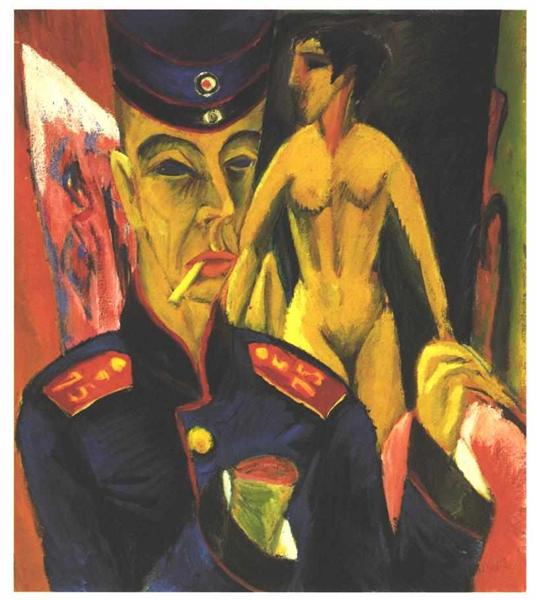
The First World War destroyed him physically and psychologically. He was called up in 1915, suffered a breakdown during training, and was invalided out with a morphine dependency and a neurological condition that permanently affected his right arm. He spent most of 1916–1917 in sanatoriums. The 'Self-Portrait as Soldier' (1915), showing him with a severed hand, was painted before his breakdown.
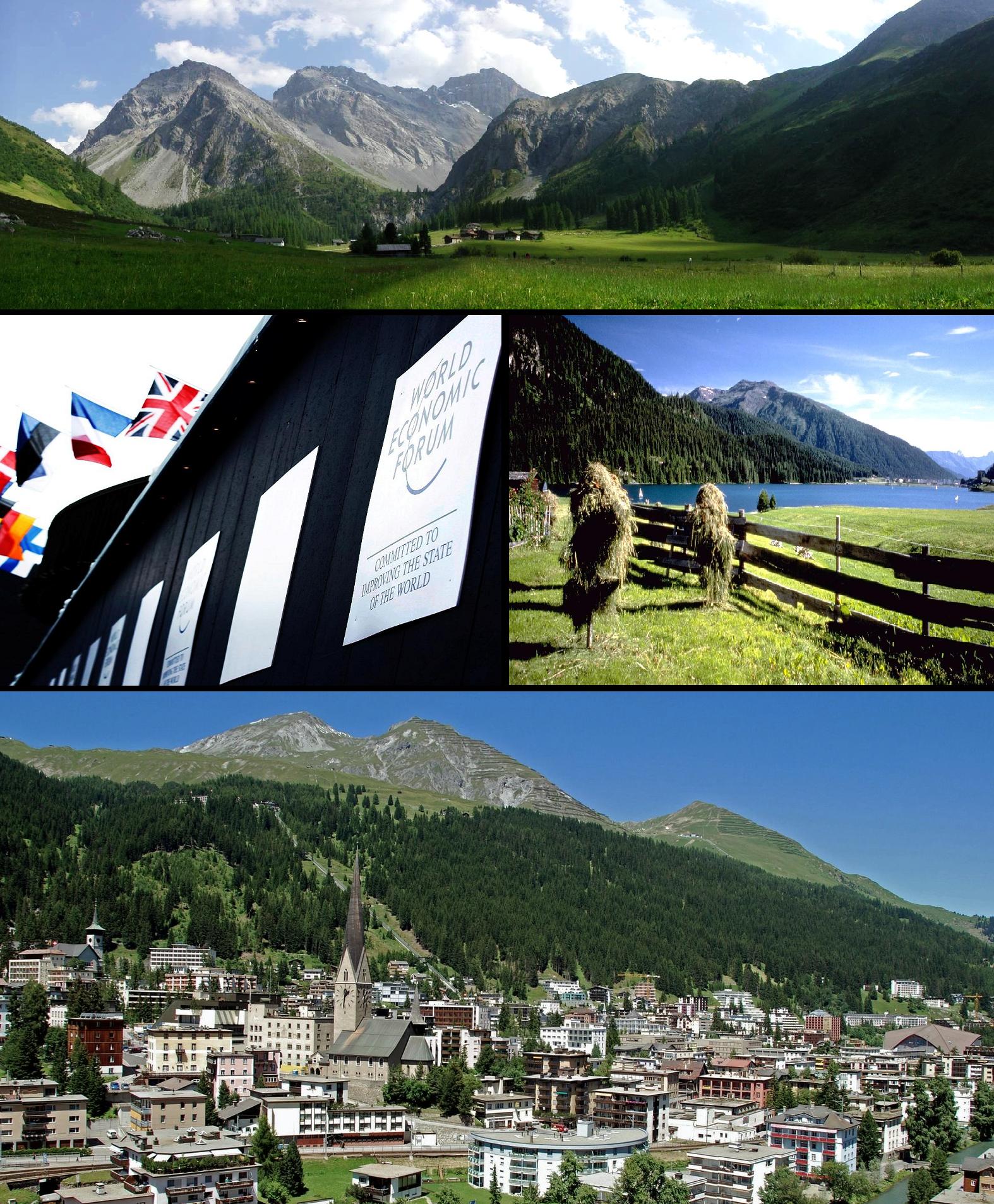
The Alpine work is entirely different from the city paintings: mountain landscapes, farmers, and the specific colour of high-altitude light — blues and whites that have a clarity the city work lacks. He recovered a kind of equanimity in Switzerland, though his writing is suffused with loneliness and concern about his declining reputation.
In 1937 the Nazis declared his work 'degenerate' and removed 639 of his works from German museums. His psyche did not survive it. He shot himself on 15 June 1938 near his house in Davos.
Five famous paintings
Five Women in the Street 1913
Five elongated women in heavy dark coats and feathered hats stand or move on a street in Berlin's Friedrichstadt quarter. Their faces are pale, mask-like ovals; their bodies are angular, their movements simultaneously mechanical and nervous. The street behind them is compressed into a sharp diagonal. The colours — black, grey-green, the pale face-colour — are cold and artificial. These are not portraits but types: the woman of the street, the respectable woman, the woman on the make. The painting is in the Ludwig Museum in Cologne and is the central image of Kirchner's Berlin period.
Self-Portrait as Soldier 1915
Kirchner shows himself in military uniform, cigarette in mouth, his right hand severed at the wrist, a bandaged stump. Behind him, a naked female model stands at an easel; the canvas on the easel is blank. He had not yet actually been injured — the painting anticipates the damage he feared military service would do to him as a painter. The stump is the loss of the painter's hand, the artist destroyed by the war machine. He had his breakdown during training shortly after painting this. The painting is in the Allen Memorial Art Museum in Oberlin, Ohio.
Alpine Landscape 1918
From his Swiss period, painted a year after settling in Davos. The mountain world — clear blue sky, bright snow, the specific hard light of altitude — required a complete recalibration of his palette from the dark electric tones of the Berlin streets. He found in the Alps a kind of subject matter that the Expressionist vocabulary could handle differently: the distortion in these landscapes is not psychological anxiety but physical reality — mountains really are that vertiginous, light really is that clear. The painting shows the change in his life as well as his art.
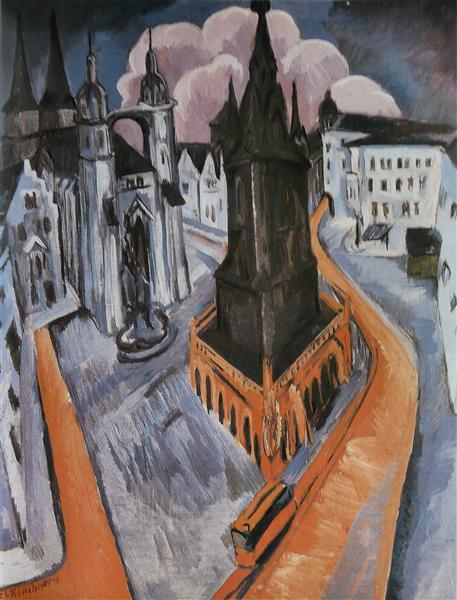
The Red Tower at Halle 1915
A red medieval tower in the city of Halle rises through a geometry of other buildings and streets. The perspective is violently distorted: the tower leans, the streets converge at impossible angles, the colour of the tower — a flat, intense red-orange — sits against a bright blue sky with the jarring quality of an alarm. Kirchner was producing this and the Berlin street paintings simultaneously, in a period when his mental health was under severe pressure. The formal distortion of the city that had begun in Berlin as an aesthetic choice was becoming, in 1915, a more direct expression of psychological disintegration.