Wassily Kandinsky
He heard colour and painted sound — and in doing so, invented abstraction.
Style and technique
Kandinsky claimed to have invented abstract painting through a specific incident: returning to his studio one evening in 1908, he saw a canvas propped sideways against the wall and was overwhelmed by its beauty — its forms and colours — before recognising it as one of his own landscape paintings. The accidental absence of subject matter had revealed the pure power of colour and form. He spent the next decade working out the implications.
His theoretical framework — articulated in 'Concerning the Spiritual in Art' (1911) and 'Point and Line to Plane' (1926) — argued that colour, form, and their relationships had direct psychological and spiritual effects independent of any represented subject. Yellow was aggressive; blue was passive and spiritual; red was confident. Vertical lines were cold; horizontals were warm; diagonals were dynamic. These were not metaphors but properties — colour and form as a direct physical language that bypassed the intellect and acted on the soul.
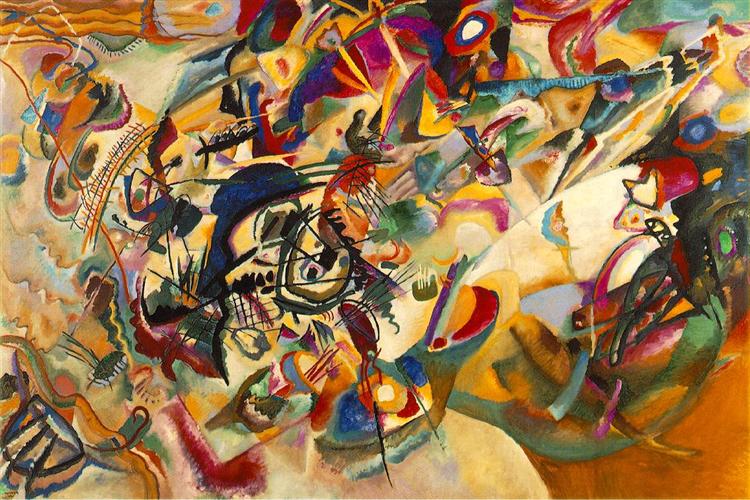
He had synaesthesia: he experienced colour and sound as related sensations, and he described painting in musical terms. His major series — 'Impressions', 'Improvisations', 'Compositions' — named after musical forms. 'Composition VII' (1913), his most ambitious pre-war canvas, was painted after a month of preparatory studies that ran into the dozens.
Four fingerprints: the curved, gestural line of the early work that suggests landscape and organic form even in abstraction, the dense chromatic activity in which colours interact, oppose, and resolve across the canvas surface, a Bauhaus geometric vocabulary in the later work — circles, triangles, grids — and the musical analogy as an organising principle.
Life and legacy
Kandinsky was born on 16 December 1866 in Moscow, the son of a tea merchant. He studied law and economics at Moscow University, graduating in 1892 with strong academic prospects. He was already interested in music — he played the cello and the piano — and in art, but his professional path was set.
Everything changed in 1895, when he attended an exhibition of French Impressionism in Moscow and saw a Monet haystack painting. He failed to recognise its subject immediately and was struck by the power of its colour and form. This experience — combined with a performance of Wagner's 'Lohengrin' that moved him with its colour-like qualities — turned him decisively towards art. In 1896, at thirty, he turned down a law professorship at Tartu University and moved to Munich to study painting.
Munich was a good choice. He studied under Franz von Stuck, encountered the Art Nouveau movement, and formed the 'Phalanx' exhibiting group in 1901. He travelled extensively — to North Africa, Holland, and repeatedly to Paris — and absorbed Fauvism and the colour ideas of Matisse and Delaunay. His companion from 1903 was the painter Gabriele Münter, with whom he lived in Murnau, Bavaria, painting the town and the surrounding Bavarian landscape.
The years in Murnau (1908–1914) are the transition years. The landscapes become increasingly abstracted; the colour increasingly non-descriptive; the line increasingly detached from its representational function. In 1911 he co-founded the 'Blaue Reiter' (Blue Rider) group with Franz Marc, produced the first edition of the almanac, and published 'Concerning the Spiritual in Art'. The same year he made what he sometimes called the first purely abstract watercolour.
The First World War sent him back to Russia, where he remained until 1921, teaching at the new state art schools and encountering the Russian Constructivists, whose geometric rigour influenced his subsequent work.
He emigrated to Paris in 1933 and spent his final decade in Neuilly-sur-Seine, painting increasingly biomorphic and decorative work that combined his geometric vocabulary with the organic influence of Miró and the Surrealists. He died on 13 December 1944, aged seventy-seven.
Five famous paintings
Composition VII 1913
The largest and most ambitious of his pre-war canvases — 200 by 300 centimetres — and the culmination of his transition from representation to full abstraction. He made thirty preparatory studies for it over a month. The canvas is covered with a turbulent mass of colour: reds, blues, yellows, oranges, and blacks swirling and colliding across the surface. No single form dominates; there is no resting point. The painting was intended as a visual equivalent of the Apocalypse — not the destruction of the world but its transformation. It hangs in the Tretyakov Gallery in Moscow.
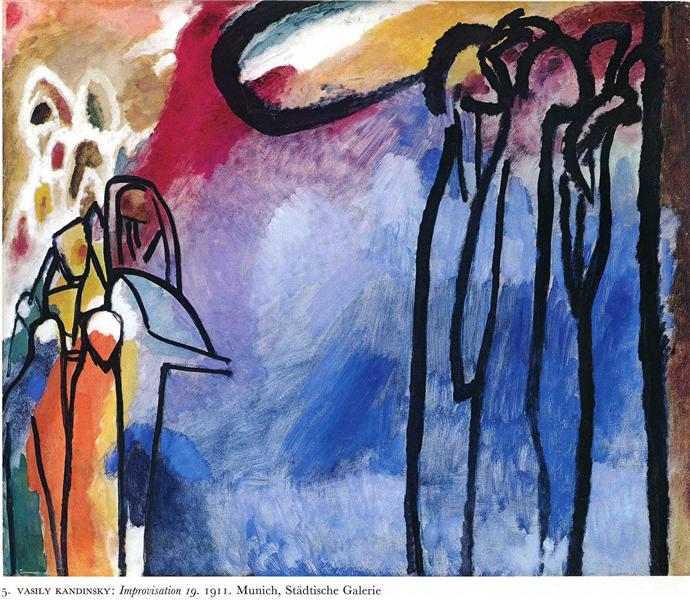
Improvisation 19 1911
One of the 'Improvisation' series — paintings made rapidly, from direct emotion, without extended preparation. Blue figures on horseback move through a landscape that is dissolving into pure colour and line. The representational elements — the riders, the horizon — are still dimly present but no longer necessary; the painting works as pure colour activity. This is the moment of transition: Kandinsky is not yet willing to abandon the figure entirely, but the figure is becoming a pretext rather than a subject. The painting is in the Städtische Galerie im Lenbachhaus in Munich, which holds the largest collection of his early work.
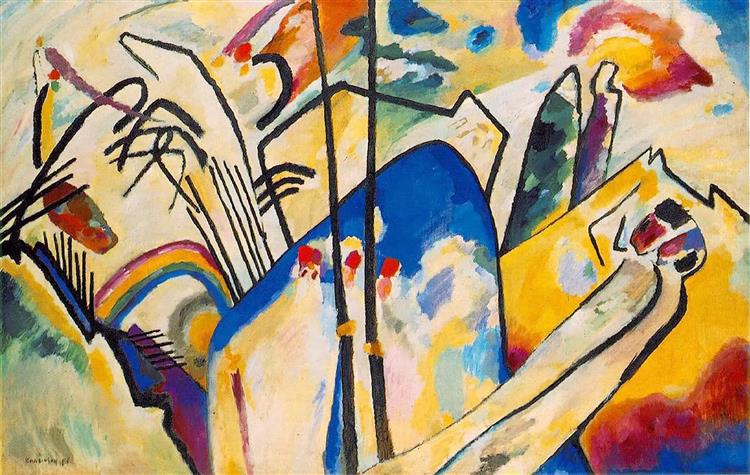
Composition IV 1911
A large canvas from the year of his transition to abstraction. The composition is still legible as landscape: a mountain, riders, a rainbow — elements borrowed from the Russian folk imagery and the Bavarian votive painting that surrounded him at Murnau. But the colour has separated from the forms; the blue of the mountain is not descriptive but emotional; the yellow of the sky is aggressive and active. The two black lines at the centre — he called them 'the quiet, unmoving, and cool' axis of the composition — show his emerging understanding of line as force. It is in the Kunstsammlung Nordrhein-Westfalen in Düsseldorf.
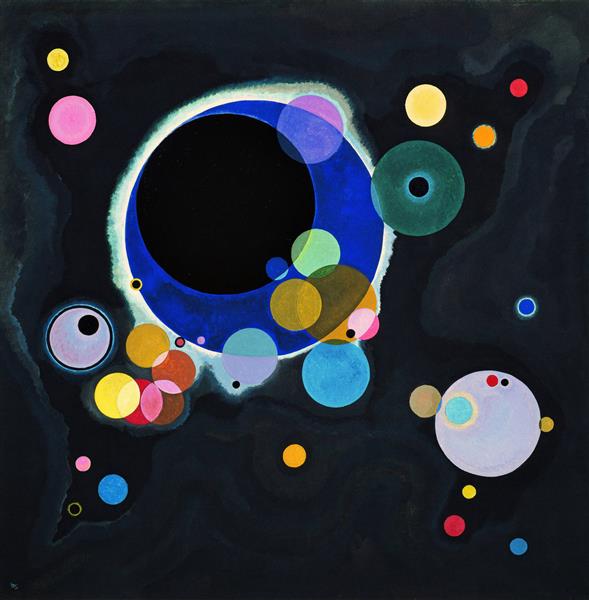
Several Circles 1926
A Bauhaus-period work, showing the geometric clarity of his 1920s style. A large deep-blue field contains numerous circles of different sizes, colours, and transparency — overlapping, layering, creating new colours where they intersect. The circles float without gravity, without spatial logic, without narrative. This is the purely formal vocabulary of Kandinsky's theoretical work made visible: the circle as the most perfect form, its colour relationships as direct spiritual experience. He regarded this canvas as one of his best works. It hangs in the Solomon R. Guggenheim Museum in New York.
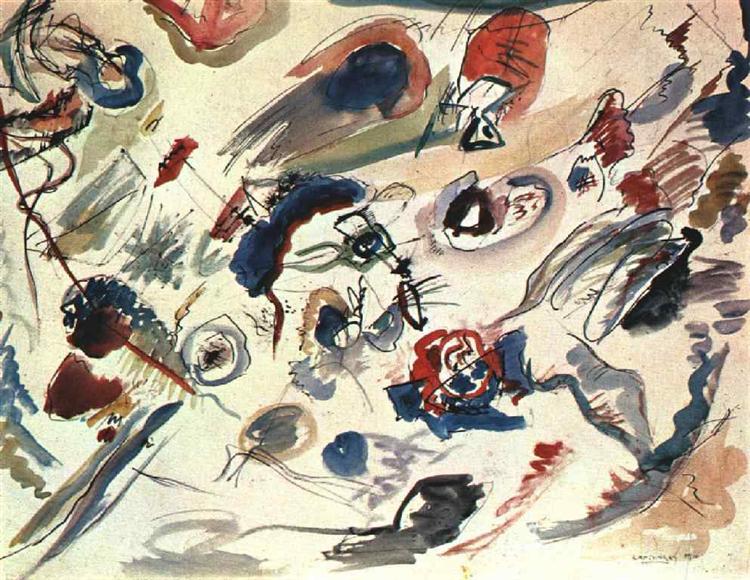
First Abstract Watercolour 1910
Kandinsky sometimes called this the first purely abstract work he made — though the date of 1910, inscribed on the paper, has been disputed by art historians who believe it was made and backdated in 1913. Whatever its precise date, it represents a key claim: a watercolour of improvised colour-forms with no representational reference whatsoever. Blobs and lines of colour — blue, yellow, red, black — spread across a white surface. There are no figures, no landscape, no objects. If the date of 1910 is accepted, it is the first abstract work in the history of Western painting. It is in the Musée National d'Art Moderne in Paris.