Frank Stella
What you see is what you see — and what you see is the painting thinking about itself.
Style and technique
Stella's career divides into phases so different they barely resemble each other, unified by a consistent underlying logic: the painting as a physical object whose form and content are identical. What the painting shows is exactly what it is; what it is determines what it shows.
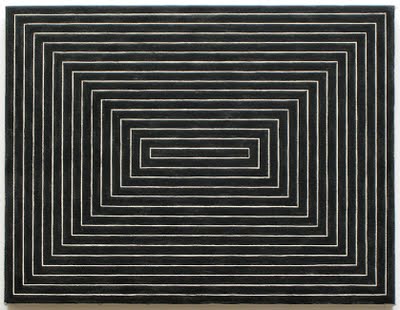
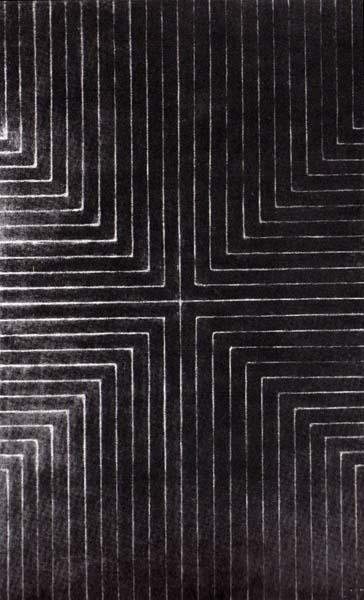
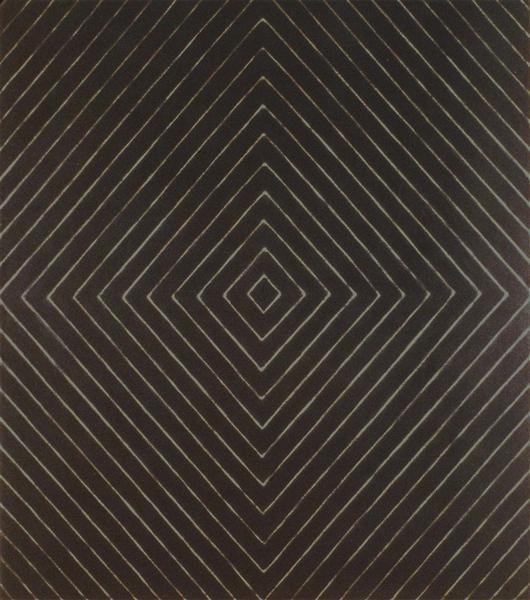
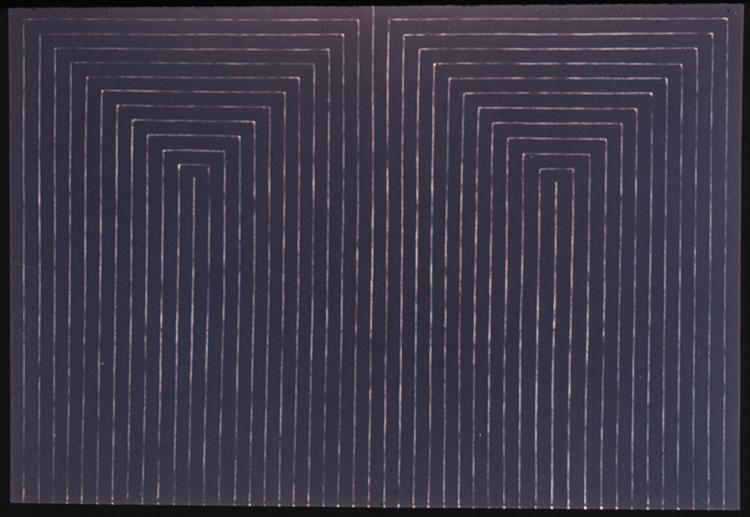
His Black Paintings (1958–1960), made when he was twenty-two and twenty-three, are the definitive Minimalist statement. Black enamel paint, applied in regular parallel stripes, follows the shape of the canvas from edge to edge. The composition is entirely determined by the shape of the support: no composition choices, no expressive gesture, no painterly decision not already dictated by the edges of the rectangle. Donald Judd said they were the best new paintings he had seen. Jasper Johns said they were extraordinary. The art world in 1959 was looking for an answer to Abstract Expressionism's subjectivity, and these quiet, mechanical black canvases were it.
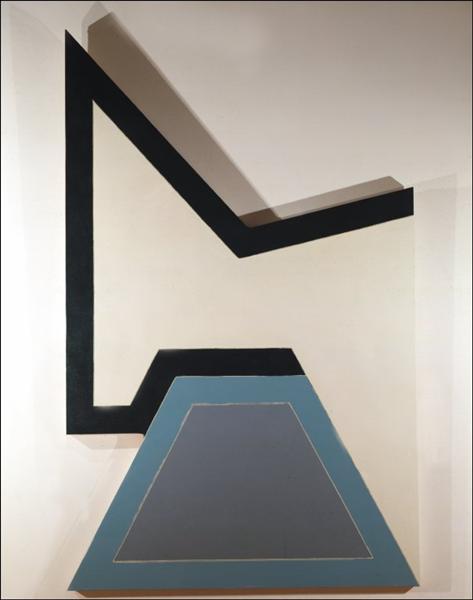
The Shaped Canvases of the 1960s followed: canvases cut into polygons, chevrons, trapezoids, whose painted stripes followed the new edges. The shape of the support is now part of the visual content rather than an invisible frame for it.
The work after 1970 became increasingly complex, three-dimensional, and colourful — eventually producing huge wall reliefs combining aluminium, fibreglass, and paint that looked more like sculpture than painting, and that deliberately violated most of his earlier principles. He was not interested in consistency.
Life and legacy
Stella was born on 12 May 1936 in Malden, Massachusetts, to a Sicilian-American father who was a gynaecologist. He studied at Phillips Academy in Andover, where he had his first serious painting education under the abstract painter Patrick Morgan, and then at Princeton University, where he studied art history and studio painting.
He arrived in New York after Princeton in 1958 and immediately encountered the New York art world at its most exciting — Abstract Expressionism was at its peak and simultaneously under pressure. He moved into a studio downtown and began the Black Paintings.
The Black Paintings are now in every major American museum, but at the time they were shown at the Museum of Modern Art's 'Sixteen Americans' exhibition of 1959 — Stella was twenty-three — the response was divided and confused. The works were almost nothing: black stripes on black-ground canvases, so regular they could have been made by a machine. Was this painting or refusal to paint?
It was both. Stella had made the 'anti-composition' painting: a picture whose every element was determined by rules that excluded personal choice. By eliminating the expressive gesture, the colour decision, the compositional arrangement — all the choices that made Abstract Expressionism personal — he had produced a painting that was purely about its own conditions.
His career after 1960 expanded the implications of this position: the Aluminium Paintings used metallic household paint; the Shaped Canvases established the polygon as the compositional unit; the Protractor series of the late 1960s reintroduced colour in complex geometric patterns based on a draughtsman's protractor.
He died on 4 May 2024 in New York City, aged eighty-seven.
Five famous paintings
Die Fahne Hoch! 1959
One of the Black Paintings, named after a Nazi marching song with deliberate provocation — Stella was playing games with the art world's self-seriousness. A large canvas, roughly three by four metres, covered with regular parallel stripes of black enamel paint separated by narrow channels of bare canvas that follow the edges inward. The composition is entirely self-generating: the rectangle of the canvas determines the pattern of stripes with no intervention from the artist's taste. The result is something that is simultaneously hypnotic, cold, and completely self-explanatory. It is in the Whitney Museum of American Art.
The Marriage of Reason and Squalor, II 1959
Another of the Black Paintings, this one showing a slight variation in the stripe pattern — the stripes here form a concentric rectangle rather than following from the outer edge. The title is characteristic: grandiloquent, slightly sardonic, picked from a phrase in a newspaper and applied without irony. The painting itself is as austere as the others: black enamel, bare canvas channels, regular stripes. The pairing of 'reason' and 'squalor' in the title suggests Stella's awareness that his rigorous conceptual approach existed in a commercial and social world that was anything but rational. It is in the Museum of Modern Art in New York.
Tomlinson Court Park 1959
Named after a park in the Bronx, this is one of the earliest Black Paintings and shows the pattern at its most direct: concentric rectangular bands of black paint separated by thin lines of bare canvas, radiating inward from the rectangular edges. The name is mundane and geographic — a park, a place, no mythology. The painting strips everything away except the physical object: this particular rectangle of canvas with these particular stripes of paint on it. The logic is simple and the result is extraordinarily dense.
Harran II 1967
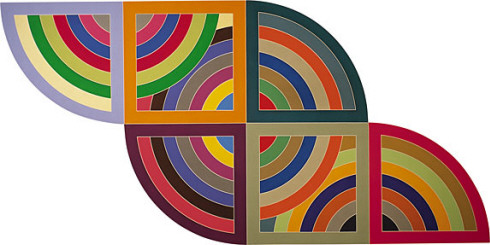
A shaped canvas from the 'Protractor' series — the most complex and colourful phase of Stella's 1960s work. The canvas is cut into an irregular polygon, and the surface is covered with interlocking curved bands of colour — oranges, pinks, purples, blues — derived from the arc of a draughtsman's protractor. The forms fill the shaped canvas completely; every element is determined by the polygon and the arc. The colour is more complex and more vibrant than any of his earlier work, and the shaped canvas ensures that form and content are again identical. The series titles are named for ancient cities in the Middle East.