Piet Mondrian
He reduced painting to its DNA: the right angle, the primary colour, and the white field.
Style and technique
Mondrian arrived at absolute abstraction through a twenty-year process of reduction. His early work — conventional Dutch landscapes, churches, seascapes — shows a painter of competent but not exceptional naturalism. From around 1908, influenced by Theosophy and then by Cubism, he began dismantling the representational conventions of his training, piece by piece, until only the essential elements remained.
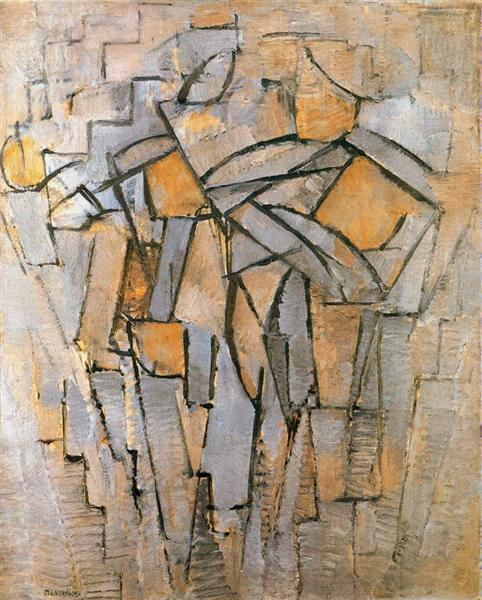
The process is visible in the tree series. The apple tree of 1908 is recognisable: branches, light, autumn colour. By 1912 the same motif — still nominally a tree — has become a Cubist lattice of intersecting arcs, the tree no longer visible in any single element but distributed across the whole composition. By 1914 he has moved on from trees entirely to the pier-and-ocean series, in which horizontal and vertical marks dissolve the subject into pure spatial rhythm.
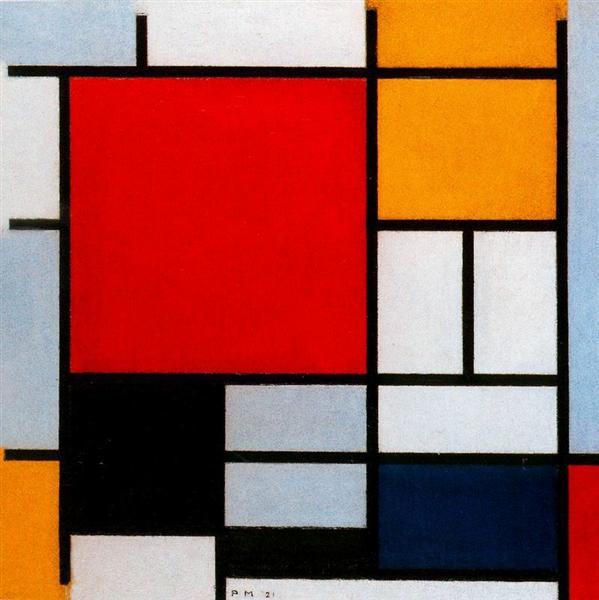
The De Stijl movement, which he founded with Theo van Doesburg in 1917, codified his conclusions into a doctrine: Neoplasticism. The principles were absolute: only straight horizontal and vertical lines; only the three primary colours (red, yellow, blue) plus black, white, and grey; no diagonal, no curve, no secondary colour, no representation. The goal was universal harmony through universal simplification.
Four fingerprints: the grid of black horizontal and vertical lines, flat primary colour fills against white, asymmetrical but balanced composition (the rectangles are never equal in size; balance is achieved dynamically), and a surface of total flatness — no brushstroke, no texture, no gesture.
Life and legacy
Mondrian was born on 7 March 1872 in Amersfoort, a small Dutch city east of Utrecht, the son of a strict Calvinist schoolteacher. His father was an enthusiastic amateur draughtsman and encouraged the boy's drawing from an early age. He trained at the Rijksacademie van Beeldende Kunsten in Amsterdam from 1892 to 1895 and spent the following decade producing conventional Dutch landscapes and church interiors, supplemented by income from private drawing lessons and natural history illustration.
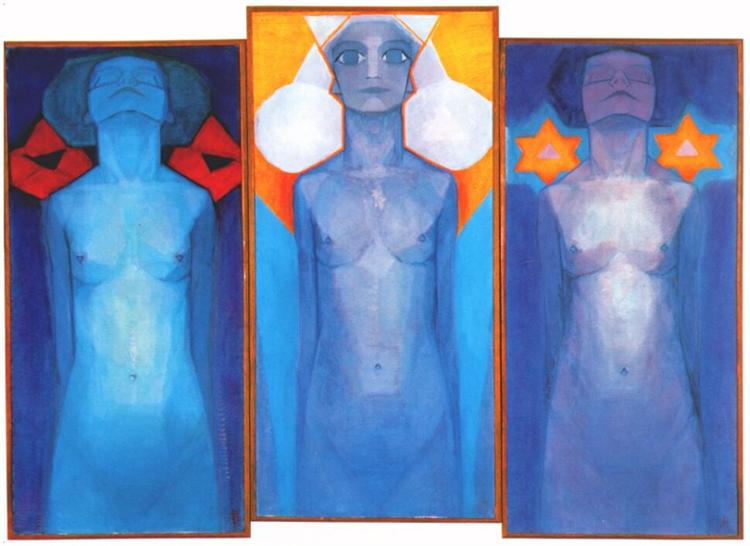
The turning point came in 1908, when he encountered Theosophy — the spiritual philosophy of Helena Blavatsky, which sought universal truths beneath the surface appearance of the physical world. Mondrian became deeply involved, and Theosophical ideas about the relationship between visible form and invisible spiritual essence drove his entire subsequent development.
He moved to Paris in 1911 and encountered Cubism directly. The Paris years (1911–1914) produced the transition from representation to abstraction — the Cubist tree paintings, the pier-and-ocean series. He returned to the Netherlands when the First World War broke out and remained there until 1919, during which time he developed Neoplasticism and co-founded De Stijl.
His mature compositional system was in place by around 1920 and he refined it for the next twenty-two years without essentially changing it. The variations within this extremely constrained vocabulary are subtle but real: the relative proportions of the rectangles, the varying thicknesses of the lines, the presence or absence of primary colour. No two compositions are the same despite their shared vocabulary.
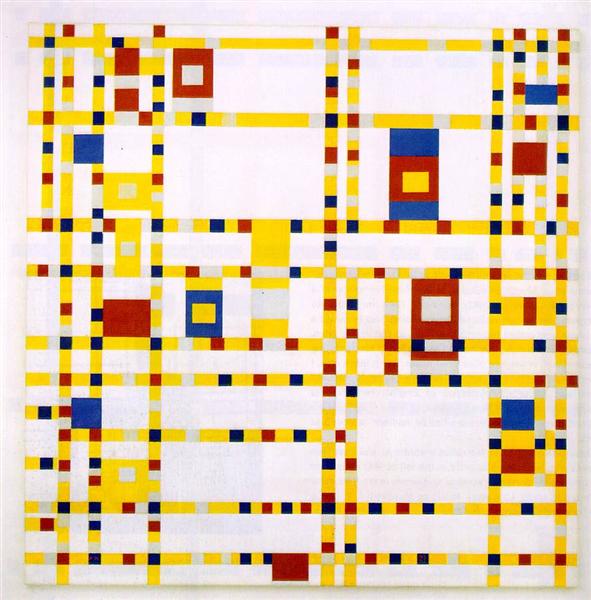
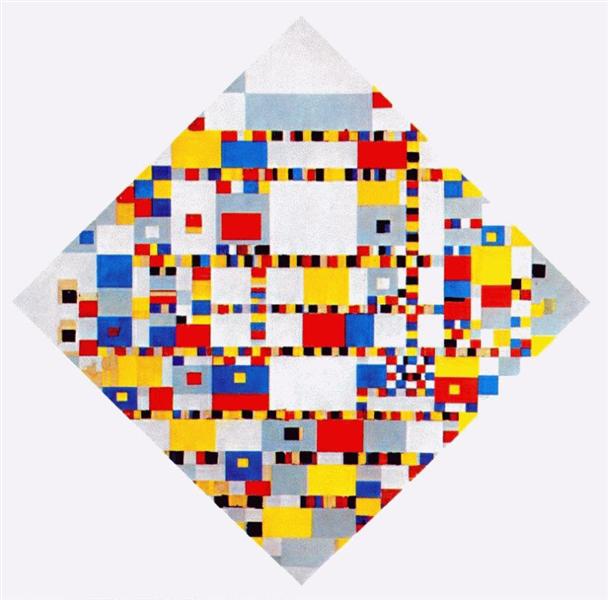
New York was a revelation. He loved jazz — specifically boogie-woogie — and the grid of Manhattan streets, and the American democracy of culture. The last two New York paintings — 'Broadway Boogie Woogie' (1943) and the unfinished 'Victory Boogie Woogie' (1944) — introduced yellow and then multi-colour segments into the lines themselves, breaking the austere black grid of thirty years in favour of something more rhythmic, more joyful, more alive. He died on 1 February 1944, of pneumonia, shortly before 'Victory Boogie Woogie' was finished.
Five famous paintings
Broadway Boogie Woogie 1943
The most joyful painting Mondrian ever made, completed in his Manhattan studio a year before his death. The black lines that had defined his work for twenty years are replaced by networks of small yellow, red, and blue squares that move across the white field in syncopated rhythms. The grid of Manhattan streets, the taxi-cab yellow of the cabs below his window, the rhythmic energy of boogie-woogie music he had discovered at the dance halls on 52nd Street — all translated into paint. He had been austere and systematic for decades; New York made him dance. The painting is in the Museum of Modern Art in New York.
Composition in Red, Yellow, Blue and Black 1921
A classic of Mondrian's mature De Stijl period: the white field divided by black lines into rectangles of varying sizes, two of them filled with red, one with yellow, one with blue. The composition is asymmetrically balanced — the large red rectangle at upper right is balanced by the smaller blue at lower left, while the yellow anchors the lower centre. No rectangle is the same size; no colour appears more than once. The system is simple and the result is something more than the system: the paintings have a specific quality of repose that no description quite captures. This is in the Gemeentemuseum in The Hague.
Grey Tree 1911
A transitional work from the tree series, painted in the year Mondrian arrived in Paris and encountered Cubism. A bare tree in winter is still clearly visible — the trunk, the branching structure — but the forms have been simplified into arcs and lines that begin to float free of their representational context. The palette is grey-ochre; the treatment of the background has the Cubist tendency to press all planes towards the picture surface. Compare this to the apple tree of 1908 and the fully abstract horizontal/vertical compositions of 1914: the tree is the bridge, the form from which abstraction emerged. It is in the Gemeentemuseum in The Hague.
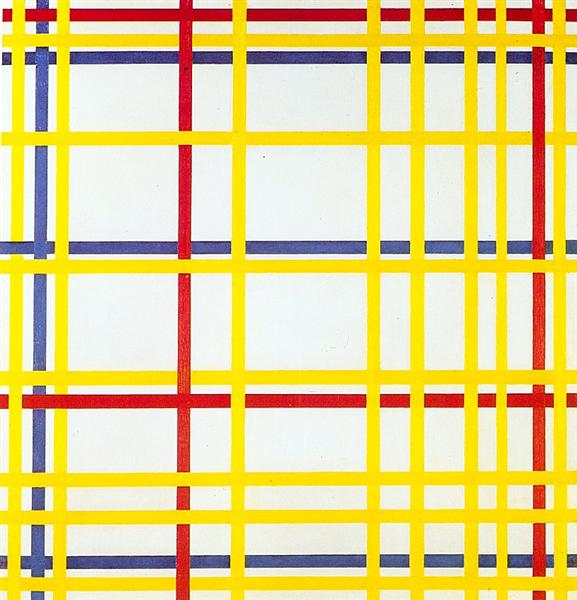
New York City I 1942
The first of the New York compositions, made in the year after his arrival in Manhattan. The black lines are replaced by coloured lines — yellow and blue — that cross and overlap in a dense grid. The composition is looser and more complex than his European work; the grid is more finely divided. Mondrian used adhesive tape to lay out the composition before painting, adjusting and readjusting the tape until the proportions were right. The coloured lines still suggest the grid of city streets and the movement of traffic, but the translation is formal, not illustrative. It is in the Museum of Modern Art in New York.
Victory Boogie Woogie 1944
Left unfinished at his death in February 1944, this large diamond-format canvas was Mondrian's final word. It was even more complex and more colourful than 'Broadway Boogie Woogie': a dense network of yellow lines interrupted at intervals by small squares of red and blue. He was still adjusting the adhesive tape on the canvas surface — repositioning the colour elements — when he was hospitalised with pneumonia. The painting passed to the collection of Victor Ganz and eventually to the Gemeentemuseum in The Hague, where it was acquired in 1998. The unfinished areas are documented and visible.