Frida Kahlo
She painted her own body — broken, doubled, pierced, in flower — for twenty-five years.
Style and technique
Frida Kahlo painted herself, again and again, for almost her entire career. Of her roughly 150 surviving paintings, 55 are self-portraits. She painted them small, often on metal sheets, with the obsessive precision of a religious icon. She said once that she painted herself because she was 'the subject I know best' — but the self she paints is never just a person. It is a body and a country and a wound, all at once.
A Kahlo is recognisable instantly. The face is direct, frontal, often lit straight-on like a passport photograph. The eyebrows are unbroken, painted as one strong line. The mouth is closed, sometimes with a faint moustache she never disguised. The eyes look directly at the viewer with no expression. Around this still face, everything else is symbolic: monkeys, parrots, jungle leaves, broken columns, nails driven into skin, hearts torn open and lying on rocks.
Four fingerprints make a Kahlo unmistakable.
The frontal stare. No smile, no profile, no soft-focus. She looks at you the way a saint in a Mexican retablo looks at a worshipper.
Mexican folklore. She borrowed the language of ex-voto retablos — small religious paintings on tin offered as thanks for surviving a disaster. Many of her paintings are essentially modern, autobiographical retablos.
Visible suffering. Broken columns instead of a spine, nails through skin, miscarried foetuses floating on cords, hearts on plates. She did not symbolise pain — she illustrated it.
Lush colour. Her palette is tropical: deep greens, blood reds, lapis blues, hot oranges. Even her saddest paintings are luminous.
She rejected the Surrealist label that the French poet André Breton tried to give her. 'I never painted dreams,' she said. 'I painted my own reality.' Today, Kahlo is read less as a Surrealist and more as the inventor of a deeply personal Mexican modernism — the first painter to put a woman's interior life, with no allegorical disguise, into the centre of the frame.
Life and legacy
Magdalena Carmen Frida Kahlo y Calderón was born on 6 July 1907 in the small house of blue walls on Calle Londres in Coyoacán, a district of Mexico City. She would later say she was born in 1910 — the year of the Mexican Revolution — because she felt 'born with the new Mexico'. Her father, Guillermo Kahlo, was a German immigrant photographer of Hungarian-Jewish ancestry; her mother, Matilde Calderón, was Mexican of Spanish and indigenous descent. Frida was the third of four daughters.
At six she contracted polio, which left her right leg permanently thinner than her left. She hid the leg under long skirts for the rest of her life. At fifteen she was admitted to the prestigious Escuela Nacional Preparatoria in Mexico City — one of only thirty-five girls among two thousand students. She wanted to be a doctor.
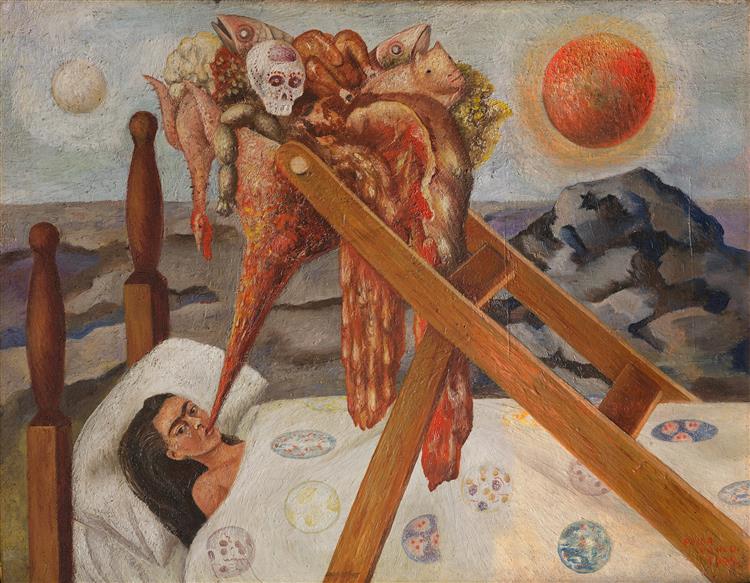
The details of the accident haunted her for the rest of her life. The wooden bus crashed into a streetcar at the corner of Calzada de Tlalpan and Cuauhtemocztin. A metal handrail broke off and pierced her body — entering through her hip and exiting through her vagina. Her spinal column was broken in three places, her pelvis in three, her right leg in eleven, her right foot crushed, her left shoulder dislocated. She was not expected to live. She lay in a body cast for months. To pass the time, her mother had a special easel installed over her bed, and a mirror placed on the underside of the canopy so she could see herself.
She began to paint herself.
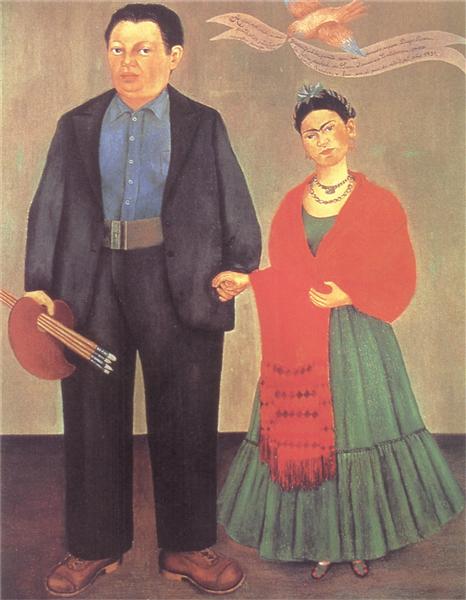
By 1928 she was walking again, painting seriously, and active in the Mexican Communist Party. There she met Diego Rivera, the most famous muralist in Mexico — twenty years older, three times married, enormously fat, charmingly ugly, already legendary. They married on 21 August 1929. Her mother described it as 'the marriage of an elephant and a dove'.
The marriage was a war. Rivera was constitutionally incapable of fidelity. He had affairs with their friends, with his models, even with Frida's younger sister Cristina. Frida had affairs of her own — with men (the exiled Soviet revolutionary Leon Trotsky, the photographer Nickolas Muray, the sculptor Isamu Noguchi) and with women (the singer Chavela Vargas, the painter Jacqueline Lamba). They divorced in 1939 and remarried in 1940. They never lived in the same house again.
Kahlo's body deteriorated steadily. She had at least three miscarriages. She underwent more than thirty surgeries on her spine and right leg. In 1953, the year before she died, her right leg was finally amputated below the knee. Her diary entry: 'Pies, para qué los quiero si tengo alas para volar.' (Feet, what do I want them for if I have wings to fly.)
That same year, April 1953, she had her first solo exhibition in Mexico City. She was so ill the doctors forbade her to attend. She came anyway, in an ambulance, and lay in her four-poster bed in the gallery for the entire opening, holding court while visitors filed past.
She died on 13 July 1954, aged 47, officially of a pulmonary embolism, possibly by suicide. The last entry in her diary, dated a few days before, reads: 'Espero alegre la salida — y espero no volver jamás.' (I joyfully await the exit — and I hope never to return.)
Her house in Coyoacán — La Casa Azul — is now the Frida Kahlo Museum, the most visited museum in Mexico. Her ashes are kept inside, in a pre-Columbian urn, in the bedroom where she was born.
Five famous paintings
My Birth 1932
Painted in 1932 after the death of her mother and a miscarriage in Detroit. A woman lies on a bed, her face covered by a white sheet, her legs spread; emerging from her body is the head of a baby — the head of Frida herself, with the unbroken eyebrow already drawn in. Above the bed hangs a portrait of the Mater Dolorosa, the weeping Virgin, with two daggers piercing her chest. There is no joy in this birth. Kahlo described it as a painting of how she imagined she had been born — alone, without her mother, into a world of pain. She kept it on her wall for years. Madonna later bought it; it is in her private collection.
Henry Ford Hospital 1932
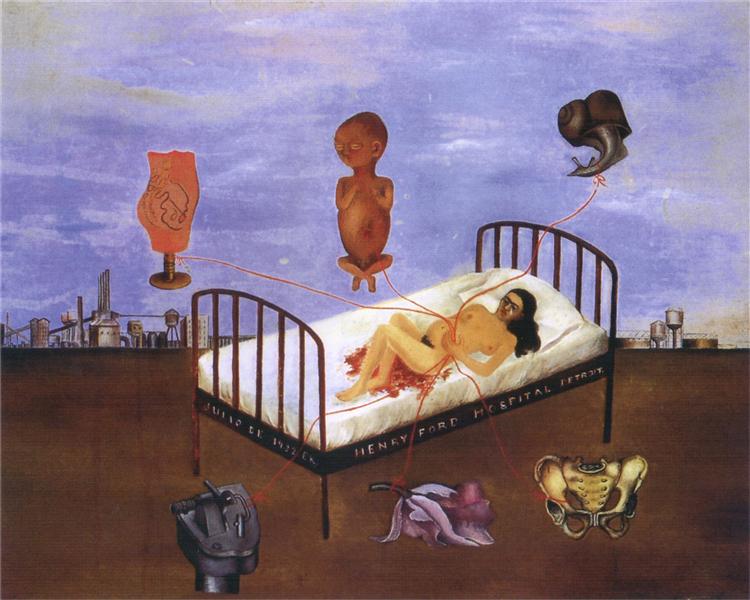
Painted on a small sheet of metal in the year Kahlo lost her second pregnancy at the Henry Ford Hospital in Detroit. She lies naked on a hospital bed, a tear on her cheek, blood between her legs, her belly still slightly rounded. Six umbilical-cord-like ribbons connect her to objects floating in the air around her: a foetus, a snail (representing the slowness of the miscarriage), an orchid given to her by Rivera, an autoclave, a model of a pelvis, and an industrial machine. The sky behind her is empty. Detroit's smokestacks are on the horizon. She was twenty-five. The painting is one of the first works in Western art to show a woman's miscarriage from the inside — without symbolism, without allegory, simply as it was.
What the Water Gave Me 1938
Frida lies in a bathtub. Her two feet stick out of the water at the far end — the right foot bandaged, with a crack splitting it from the toe upwards. Floating on the surface of the water is her entire life: the volcano Popocatépetl, a dead bird, her parents on their wedding day, two female lovers, a woman strangled by a noose drawn from her own hair, a skeleton, a Tehuana headdress, a tightrope walker. André Breton saw this painting in Paris and called it 'a ribbon around a bomb'. Kahlo herself called it 'images that float in water as I watch'. It is the closest she came to surrealism, and the closest any painting has ever come to a self-portrait of a person seen from the inside out.
The Two Fridas 1939
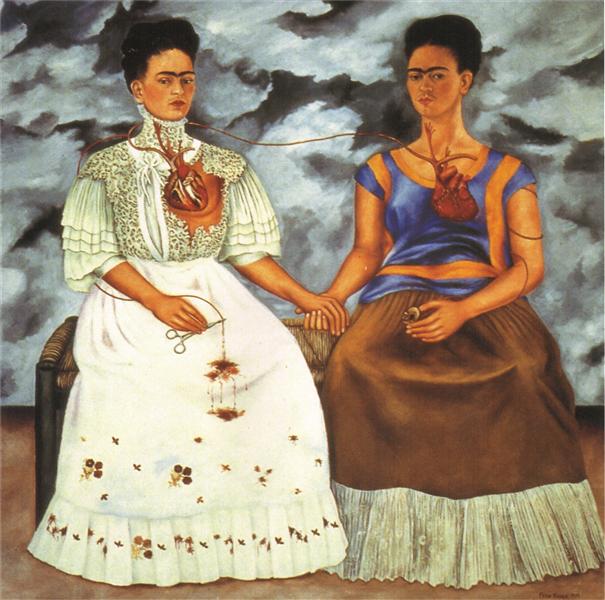
Painted in 1939 during her divorce from Rivera. Two Fridas sit holding hands on a stone bench against a brooding sky. The Frida on the right wears a Tehuana dress — the traditional Mexican costume Rivera adored — and her heart, visible through her open chest, is whole. The Frida on the left wears a European Victorian dress; her heart has been cut open, and an artery she is trying to clamp with surgical scissors drips blood onto her white skirt. A vein joins the two figures across their chests. The painting is huge — 1.7 metres square — far larger than her usual scale. It is, in plain terms, her self-portrait of the day she lost the love of her life. It hangs in the Museo de Arte Moderno in Mexico City.
Diego and I 1949
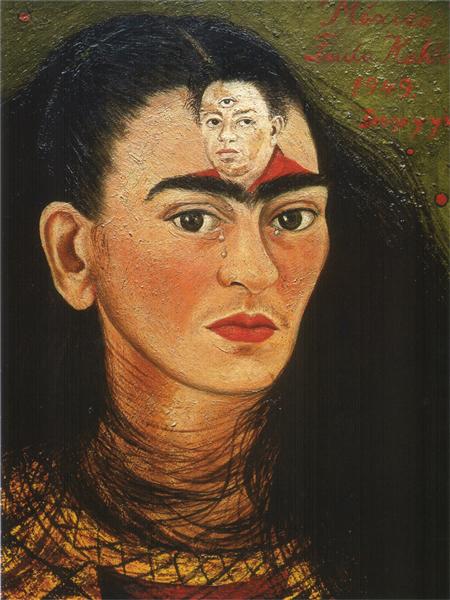
Painted at the very end of her career, four years before her death. A close-up of her face — almost cinematic — wet eyes, three tears running down. On her forehead, like a third eye, sits a tiny portrait of Diego Rivera, bald, fat, unmistakable. He looks straight ahead. She looks at the viewer. The painting is small, intimate, almost sweet — and almost the most heartbreaking thing she ever made, because she has stopped trying to disguise it: she loved him to the point of madness, and the painting is, simply, an admission. In November 2021 it sold at auction for $34.9 million, the highest price ever paid for a work by a Latin American artist.