René Magritte
He painted the visible world to make you doubt what visible means.
Style and technique
Magritte painted in a deliberately flat, commercial illustration style that resembles nothing else in Surrealism. Where Dalí's surfaces imitate the academic oils of the Spanish masters, and Ernst's invoke dark Romantic traditions, Magritte's paintings look like well-made calendar art: smooth, clean, evenly lit, technically accomplished but deliberately unpretentious. The style is the argument: if the image is painted in an ordinary way, the extraordinary thing it shows is more disturbing than if it were painted with drama.
His central technique is the conceptual violation: two things that cannot coexist are shown coexisting. Day and night appear simultaneously in 'The Empire of Light'. A painting of a landscape is placed in front of the actual landscape it depicts, so you cannot know which is the landscape and which is the painting. A glass of water sits on top of an open umbrella. A man in a bowler hat has an apple where his face should be.
None of these violations involve technical impossibility — they are all logically conceivable in some sense — but each violates a rule of ordinary visual experience that we hold so deeply we were not aware of holding it. Magritte's project was to surface these hidden rules by showing what happens when they are broken.
Four fingerprints: the bowler-hatted anonymous male figure (a recurring protagonist), the coexistence of irreconcilable visual elements in a single smooth space, a limited but very precise colour vocabulary — grey-blue sky, warm ochre interior, particular greens — and the careful attention to cast light and shadow on objects whose physical situation is impossible.
Life and legacy
Magritte was born on 21 November 1898 in Lessines, a small town in the Belgian Hainaut province. When he was fourteen, his mother drowned herself in the Sambre river. She was found days later, her nightgown wrapped around her face. Whether Magritte witnessed this discovery — and whether the image influenced his paintings of figures with covered or displaced faces — has been a matter of sustained biographical speculation that he himself never resolved publicly.
He studied at the Académie Royale des Beaux-Arts in Brussels from 1916 to 1918 and found work in the commercial illustration industry — advertising posters, wallpaper design, fashion illustration — that occupied him through much of the 1920s. He married Georgette Berger, his childhood sweetheart, in 1922. They remained married for the rest of his life and she appears in many of his early paintings.
He encountered the work of Giorgio de Chirico in a reproduction in 1923 — specifically 'The Song of Love' — and experienced what he described as a revelation: that painted objects could carry an emotional charge completely independent of any Expressionist or technical distortion. De Chirico's quiet, precise, uncanny spaces showed him a path.
He moved to Paris in 1927 and joined André Breton's Surrealist circle, though his relationship with the group was always somewhat uncomfortable. Breton wanted the unconscious; Magritte wanted logical propositions. He returned to Brussels in 1930 and lived there — in a rented house in the Jette suburb — for the rest of his life, painting in the front room while his wife Georgette embroidered in the same room.
The famous canvas 'The Treachery of Images' — a painting of a pipe beneath which is written 'Ceci n'est pas une pipe' (This is not a pipe) — was made in 1929 and encapsulates his whole project: the image is a representation, not the thing itself. The statement is logically true. The effect is a persistent, mild vertigo.
He died on 15 August 1967 in Brussels, aged sixty-eight, of pancreatic cancer. His last major work — 'The Enchanted Domain', a fresco cycle for the Casino of Knokke — was completed in 1953. His reputation, which had been eclipsed in Europe by Abstract Expressionism, underwent a major revival in the 1960s when Pop Art and Conceptual Art returned to his concerns.
Five famous paintings
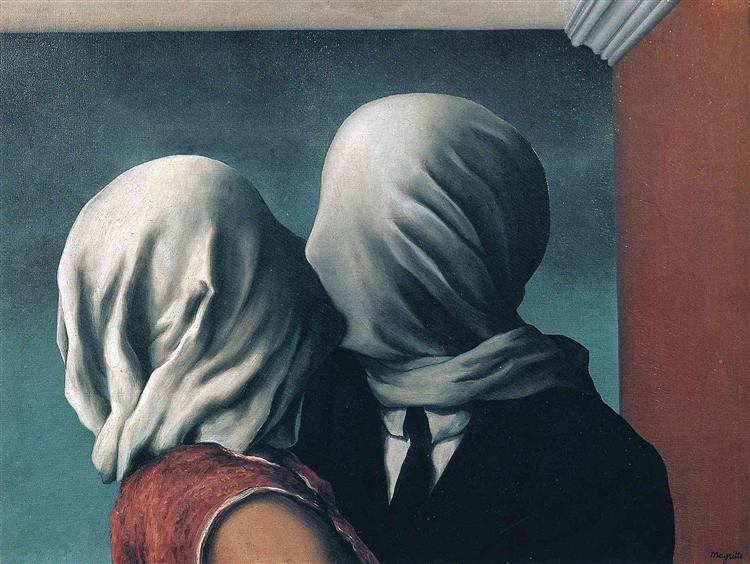
The Lovers 1928
A man and a woman embrace and kiss, but both their faces are completely covered by white cloth that wraps their heads. We cannot see their faces; they cannot see each other. The act of intimacy is performed by two figures who are simultaneously present and utterly absent to each other and to the viewer. The setting is a simple landscape under a grey sky; the figures are ordinary and close. The cloth covering the faces is the entire argument: love, identity, the inability to truly know another person, the cloth that separates us even in the closest proximity. There are two surviving versions; the most frequently reproduced hangs in the Museum of Modern Art in New York.
The Empire of Lights 1954
A house with illuminated windows sits in a dark street under a daylit sky — blue, with white clouds. Day and night coexist simultaneously. This is Magritte's most often-cited paradox because it is the most effortlessly achieved: the house and the street look entirely realistic; the sky looks entirely realistic; it is only their combination that is impossible. He made at least seventeen versions of this composition, varying in scale. The painting's influence on popular culture has been substantial: it is one of the images most cited by people asked to name a 'Surrealist' painting. The largest version is in the Musées Royaux des Beaux-Arts in Brussels.
The Human Condition 1933
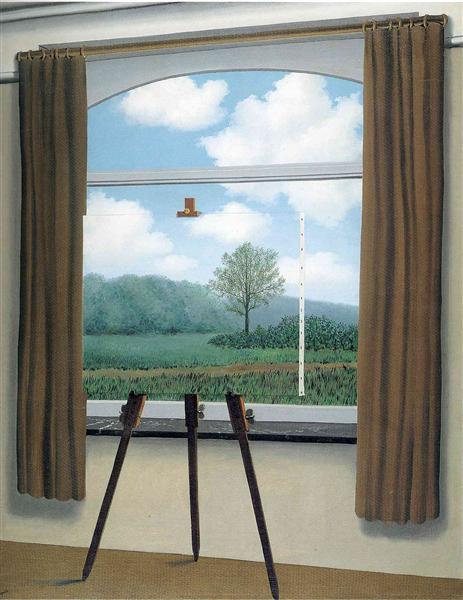
A painting on an easel stands in front of a window. The painting on the easel depicts exactly the section of landscape that the window would reveal if the painting were not there — but we cannot verify this, because the painting covers exactly the section we would need to look through the window to confirm it. Magritte wrote: 'I placed in front of a window, seen from a room, a painting representing exactly that part of the landscape which it hid.' The painting is about representation itself: the problem of knowing whether an image is accurate when the image always obscures the original. It is in the National Gallery of Art in Washington D.C.
Not to Be Reproduced 1937
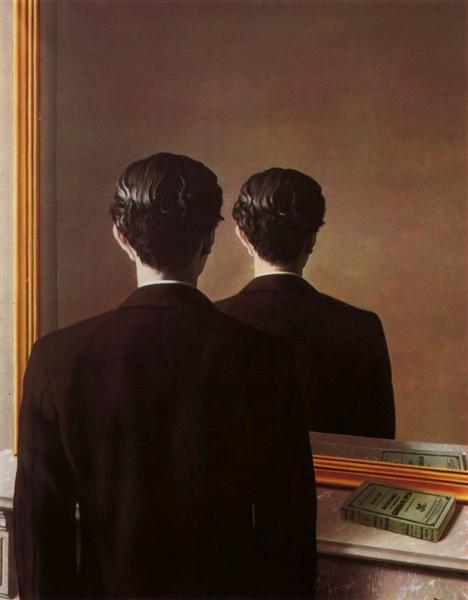
A man stands with his back to the viewer before a mirror. The mirror reflects — not his face, as it should, but the back of his head again. A book on the mantelpiece below (Edgar Allan Poe's 'Arthur Gordon Pym') is reflected normally. The title in French — 'La reproduction interdite' — adds another layer: this is a prohibition on reproduction, or an observation that reproduction of the self is not permitted, or both. The model was Edward James, Magritte's English patron, who commissioned the painting presumably knowing he would not see his own face in it. It is in the Museum Boijmans Van Beuningen in Rotterdam.
The Castle of the Pyrenees 1959
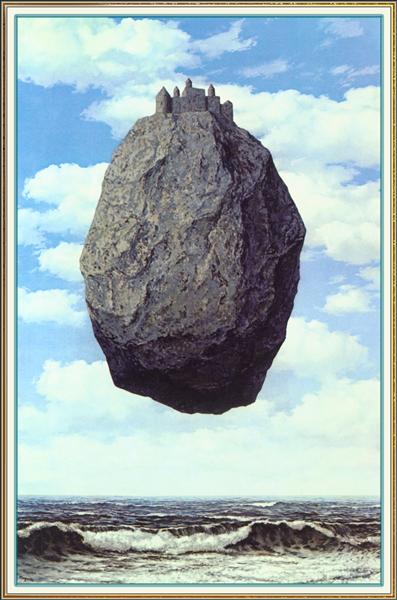
A vast rock floats in the air above a turbulent sea. On top of the rock sits a medieval castle. The scale is impossible — the rock is the size of a mountain, the sea is real water, the castle is ordinary stone. Magritte has simply removed gravity from one element of an otherwise physically consistent scene. The effect is less uncanny than many of his images because the components are so large: the size makes it feel like geology rather than magic, as if floating rocks were just a different kind of geological fact. It is in the Israel Museum in Jerusalem.