Salvador Dalí
Painted his own dreams with the precision of a Renaissance master and his moustache like a flag.
Style and technique
Dalí painted dreams with the obsessive precision of a 17th-century Dutch still-life master. That is the central paradox of his work and the reason it goes on being copied a hundred years later. The image is impossible — clocks dripping over branches, elephants on spider legs, an entire face built out of two grand pianos and a sleeping nude — and yet it is rendered as if photographed in good lighting, with every droplet, every reflection, every cast shadow exactly where the laws of optics would put them.
He called this technique the paranoiac-critical method: a deliberate strategy for inducing a mild hallucinatory state during painting, then transcribing what you see with academic exactness. The result is unsettling in a very specific way. Most surreal painting feels symbolic and a bit cartoonish; a Dalí feels like a photograph of something that cannot exist.
Four fingerprints make a Dalí instantly recognisable.
Hyper-real detail. Every surface is rendered as if real. Hair, fur, sand, polished wood, metal, water — all painted at the same level of finish. He studied Vermeer and Velázquez and worked from photographs.
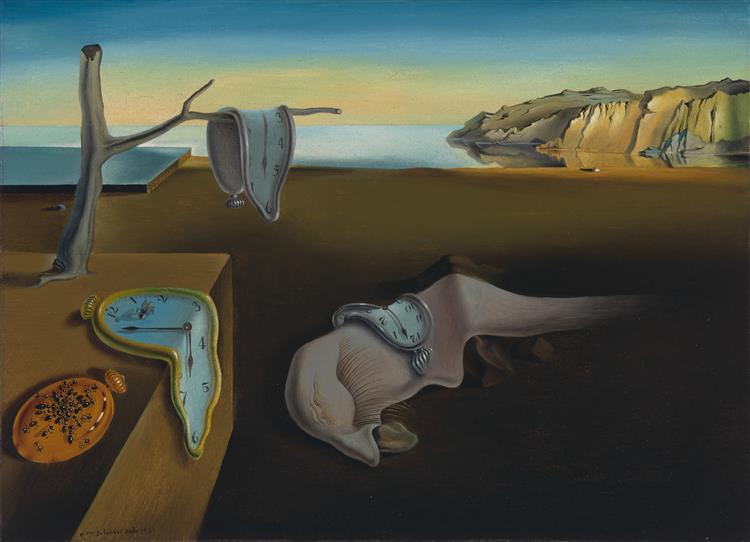
Soft, melting forms. The famous 'soft watches', but also soft monsters, soft bread, soft elephants. He claimed the inspiration came from a runny Camembert cheese on a Catalan summer afternoon. The melting motif appears in dozens of paintings.
Double images. A landscape that is also a face. A nude that is also a horseman. A bowl of fruit that is also a face of Voltaire. Look once and you see one thing; look again and you see another. He pioneered this in painting after experimenting with Arcimboldo, the 16th-century Italian who painted faces made of vegetables.
Catalonia in the background. The rocks of Cap de Creus, the dry plain of the Empordà, the lighthouse and the cliffs of Cadaqués — these landscapes appear as background in painting after painting, even ones supposedly set in dreams or other planets.
He started as a serious student of Cubism and Metaphysical Painting before embracing Surrealism around 1929. The Surrealist group expelled him in 1939 — partly for his admiration of Hitler, partly for his commercial ambition (André Breton's anagram for Dalí was Avida Dollars, 'eager for dollars'). He spent the next fifty years building himself into a one-man brand: paintings, sculptures, jewellery, advertisements, the Chupa Chups logo, set designs, films with Walt Disney and Luis Buñuel. The branding sometimes obscured the painting. The painting, when you finally look at it, is still extraordinary.
Life and legacy
Salvador Domingo Felipe Jacinto Dalí i Domènech was born in Figueres, a small town in northern Catalonia, on 11 May 1904. He was named after his older brother, also Salvador, who had died of stomach catarrh nine months earlier at the age of two. The parents took Dalí, aged five, to his brother's grave and told him he was the reincarnation of his dead older brother — an event he would refer to in print and in interviews for the rest of his life as the trauma that shaped his sense of self.
His father was a notary; his mother was the educated, religious daughter of a Barcelona haberdasher. The household was a strange mix of bourgeois respectability and creative tolerance. His mother encouraged him to draw constantly. He had his first solo show at fourteen, in the foyer of the local theatre.
In 1922 he enrolled in the Real Academia de Bellas Artes de San Fernando in Madrid, where he met two young men who would become his closest friends in his teens and twenties: the poet Federico García Lorca and the future filmmaker Luis Buñuel. The three lived in the Residencia de Estudiantes, a kind of Spanish equivalent of an Oxford college, and formed an intense triangle of friendship, intellectual exchange and unrequited longing — Lorca was almost certainly in love with Dalí, who was both fascinated and repelled by the prospect.
Dalí was expelled from the Madrid academy in 1926 for, in his own words, 'declaring that no professor was qualified to examine me'. He moved to Paris and met Picasso, who he had been worshipping from a distance since adolescence. He met Joan Miró, who introduced him to the Surrealist circle. He fell into the orbit of André Breton.
Then, in the summer of 1929, on a beach in Cadaqués, his father invited a Parisian intellectual couple to stay in the family villa: the poet Paul Éluard and his Russian wife Gala. Gala was ten years older than Dalí, married, and unconvinced. Within weeks she had moved permanently into his life. Within five years she had divorced Éluard and married Dalí. They stayed together for nearly fifty years.
The early 1930s in Paris were Dalí's most intense painting years. 'The Persistence of Memory' (1931) — the soft watches — went almost overnight from gallery curiosity to the most famous painting of the Surrealist movement. He moved to New York in 1934 for a show at Julien Levy's gallery, became an instant celebrity, and learned what a press release was for.
The Surrealists expelled him from their group in 1939. The reasons were a mixture of politics (he refused to denounce Hitler, expressed admiration for Catholic ritual, voted royalist), aesthetics (he was returning to academic technique while the others were experimenting with abstraction), and pure money (he was selling out window displays at Bonwit Teller, a New York department store, while the rest of them were arguing in cafés). The young André Breton coined the anagram 'Avida Dollars' — 'eager for dollars' — and it stuck.
Dalí and Gala spent the Second World War in the United States, mostly in California. He designed jewellery, advertisements, the dream sequence for Hitchcock's 'Spellbound' (1945), and a short animated film with Walt Disney ('Destino', begun in 1945, finally completed posthumously in 2003). He published an autobiography, 'The Secret Life of Salvador Dalí', that was already part fiction, part performance, part business plan.
They returned to Catalonia in 1948. Dalí declared himself reconciled with the Catholic Church and with Franco's Spain — a position which appalled the surviving Surrealists and many of his Spanish friends, but which gave him political cover to live freely on the Costa Brava. He bought a fisherman's hut in Port Lligat and turned it, room by room, into the famous Dalí house, which now stands as a museum next to the sea.
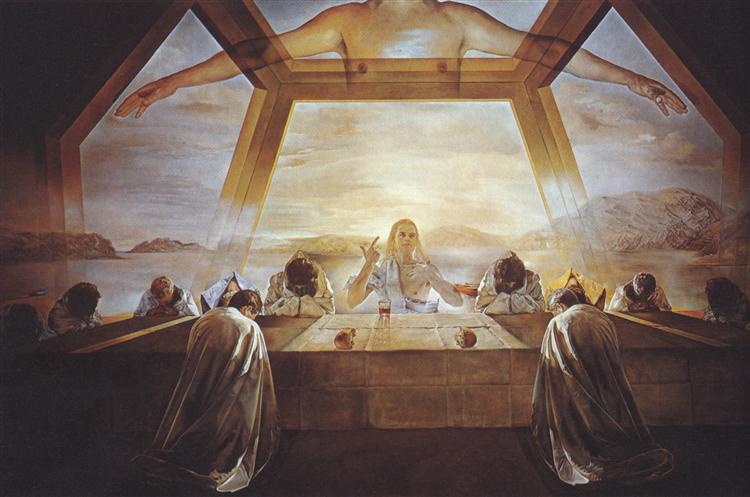
His later painting cycled through phases: 'nuclear mysticism' in the 1950s (the disintegration of matter, atom-shaped forms, religious imagery — 'Corpus Hypercubus', 'The Last Supper'); historical pageantry in the 1960s ('The Battle of Tetuán', 'The Hallucinogenic Toreador'); endless self-portraits, ad work and stunts in the 1970s.
In 1968 he conceived the Teatro-Museo Dalí in Figueres — a museum housed in his hometown's old theatre, which had been bombed during the Civil War. He spent the next sixteen years personally designing every room. It opened in 1974 and is now the second most-visited museum in Spain after the Prado.
Gala died in 1982. Dalí, aged 78, fell into a deep depression. He stopped painting almost entirely. He moved into the castle of Púbol, where Gala was buried, and lived there alone for two years.
In 1984 a fire in his bedroom — the cause was never fully explained — left him with severe burns. He moved back to a tower next to the Teatro-Museo in Figueres. He died there of heart failure on 23 January 1989, aged 84. His body was embalmed, dressed in his trademark robe, and entombed in the floor of the museum he had built.
In 2017, on the orders of a Spanish court, his tomb was opened to extract DNA for a paternity test. (The result was negative.) His moustache, the embalmer reported with some emotion, was perfectly preserved, still pointing upwards 'in the ten-past-ten position'.
Five famous paintings
Girl at the Window 1925
Painted when Dalí was 21, before he had ever met Picasso, before Gala, before Surrealism. His sister Ana María stands in profile, leaning out of an open window in the family summer house in Cadaqués, looking at the bay. The painting is in a quiet realist style — closer to Vermeer or to the early Spanish realists than to the Surrealist nightmares he would soon paint. It is a portrait of his closest childhood relationship, and one of the few paintings of his sister he ever made; their relationship broke down in the 1940s after he wrote unflattering things about the family in his autobiography. It hangs in the Reina Sofía in Madrid.
The Persistence of Memory 1931
Three soft watches drape over the branch of an olive tree, the corner of a wooden table and a strange biomorphic form on the ground. A fourth watch, swarming with ants, is closed and lies face-down. The cliffs in the background are the cliffs of Cap de Creus in Catalonia, painted from life. The painting is the size of a sheet of A4 paper — only 24 cm × 33 cm — much smaller than its fame would suggest. Dalí said the soft watches came to him while contemplating a runny Camembert cheese melting in the August sun and finished the canvas the same evening. It hangs in MoMA in New York and may be the most reproduced surrealist image ever made.
Premonition of Civil War 1936
Painted six months before the Spanish Civil War broke out, with a clarity that bordered on prophecy. A monstrous torso, made entirely of disjointed body parts — a hand crushing a breast, a leg twisted at an unnatural angle, a small face strapped underneath — looms over the dry plain of the Empordà under a low boiled-blue sky. Beans are scattered at the foot of the figure. Dalí described it as 'a vast human body breaking out into monstrous excrescences of arms and legs tearing at one another in a delirium of self-strangulation'. He titled it 'Soft Construction with Boiled Beans'; only later did the subtitle 'Premonition of Civil War' attach to it. It is in the Philadelphia Museum of Art.
Dream Caused by the Flight of a Bee Around a Pomegranate, One Second Before Awakening 1944
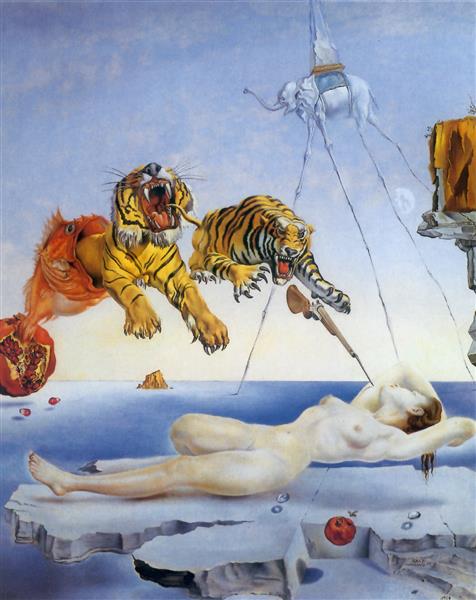
A nude woman — Gala — sleeps suspended above a flat rock. Below her, a pomegranate floats above a calm sea. A small bee orbits the pomegranate. From a second, larger pomegranate emerge in slow motion: a fish bursting out of the fruit, a tiger leaping out of the fish, another tiger leaping out of the first, and a bayonet that is about to prick the sleeping woman's arm and wake her. In the distance, an elephant on stilt-legs carries an obelisk. Dalí described the painting as a portrait of Gala dreaming the buzzing of a bee, and being woken from the dream one second before the bayonet touches her skin. It is in the Thyssen-Bornemisza Museum in Madrid.
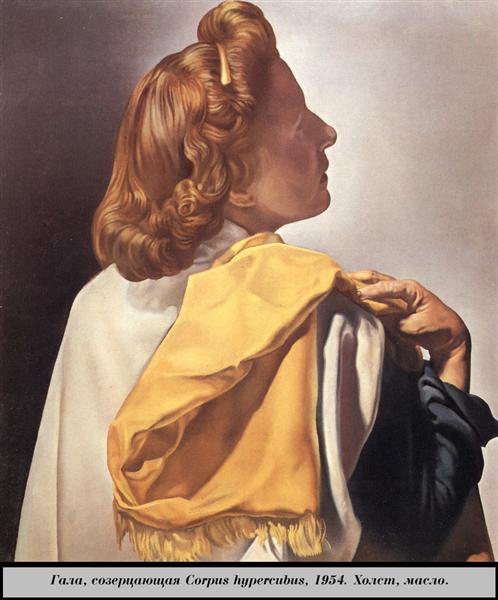
Corpus Hypercubus 1954
Dalí's most famous Catholic painting and a centrepiece of his 'nuclear mysticism' phase. Christ is crucified not on a wooden cross but on the four-dimensional unfolded shape of a tesseract — the geometric figure that, when folded back into four-dimensional space, forms a hypercube. The figure of Christ is muscular, eyes closed, suspended slightly in front of the cross with no nails. Below him, on a chequered floor, Gala stands as the Madonna, looking up. The science is borrowed from a 1940s American mathematician, Thomas Banchoff; the imagery is borrowed from Renaissance crucifixions; the result is unmistakably Dalí. It is in the Metropolitan Museum of Art in New York.