Henri Rousseau
He was a customs officer who painted jungles he had never seen, and they were more convincing than anything a trained painter produced.
Style and technique
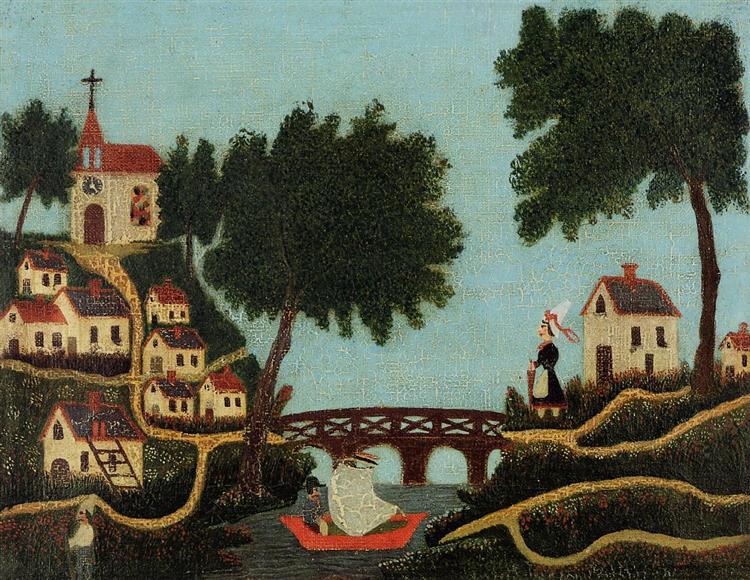
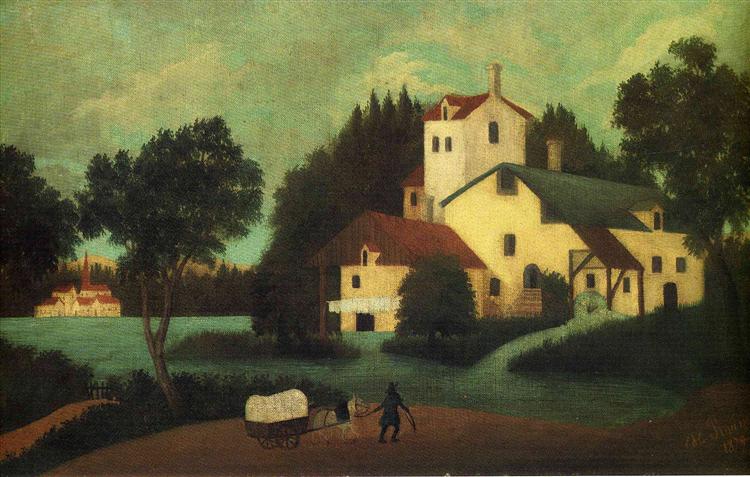
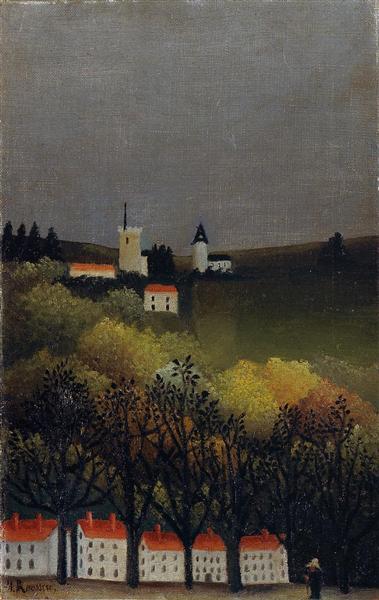
Rousseau never received formal artistic training and began painting seriously only in middle age, which produces a visual approach that has no equivalent in the European tradition. His style is often called naïve or primitive, but these words underestimate the specific qualities that make his work remarkable: the clarity of form, the unusual spatial arrangement, the extraordinary detail of botanical observation combined with a complete indifference to conventional perspective.
His jungle paintings are the most famous and most formally adventurous of his works. He had never visited a jungle — he claimed to have been to Mexico as a military bandsman, but this is disputed — yet his jungle interiors have a conviction that no reference to reality can fully explain. The leaves are too large, the scale is inconsistent, the figures are placed in the foliage with dreamlike illogic — and yet the overall effect is of a world complete in itself, a forest that exists independently of European jungle reality.
His compositional method was distinctive: he built pictures from distinct planar elements — a foreground of detailed leaves, a middle ground figure, a background of further foliage — layered one behind another without depth in the conventional perspectival sense. The effect is of a stage set rather than a landscape, and this quality of theatricality and unreality was immediately recognised by the Surrealists as ancestral to their own practice.
Four fingerprints: large, precisely observed leaves and botanical forms arranged without conventional depth, figures placed in landscape with dreamlike scale relationships, a flat, clear light that falls equally on everything without atmospheric gradation, and complete compositional confidence unaffected by academic conventions.
Life and legacy
Rousseau was born on 21 May 1844 in Laval, in northwest France, the son of a tinsmith. His education was ordinary and his early adult life unremarkable: he worked in a lawyer's office, served in the army during the Franco-Prussian War of 1870–1871, and in 1871 secured a post as an inspector at a Paris octroi — a customs and toll station at the city's gates where he collected taxes on goods entering the city.
This post, which he held until retirement in 1893, is the source of his nickname 'Le Douanier' (the customs officer). He was a minor bureaucrat who painted in his spare time, submitting works to the Salon des Indépendants from 1886 onwards. The Indépendants accepted all submissions without jury, which was the only reason his work could be shown — no jury-based exhibition would have accepted him.
His early Salon submissions were met with derision by critics, who found his painting clumsy, his perspective wrong, his compositions naive. He took this criticism as ignorance and continued. He genuinely believed himself to be a great painter — not out of arrogance but out of a complete inability to see what the critics saw as deficiencies. This blindness was, in retrospect, his greatest strength.
He retired from the customs service in 1893 at the age of forty-nine and devoted himself entirely to painting. The move to full-time work coincided with the jungle paintings that would become his most important contribution: 'Surprised!' (1891), showing a tiger in a tropical storm, was the first; the subsequent sequence of jungle scenes — 'The Snake Charmer', 'The Dream', 'The Hungry Lion' — constitutes one of the most original bodies of work in late nineteenth-century painting.
In the early 1900s the avant-garde discovered him. Picasso, Apollinaire, Delaunay, and the German Expressionists recognised in his work something that trained painting could not produce: a visual intelligence operating without the constraints of academic tradition, finding its own rules from scratch. He became a figure of genuine respect rather than condescension in the years before his death.
He died on 2 September 1910 in Paris, of complications from an infected leg wound, aged sixty-six. He died almost penniless, but his reputation was already secure.
Five famous paintings
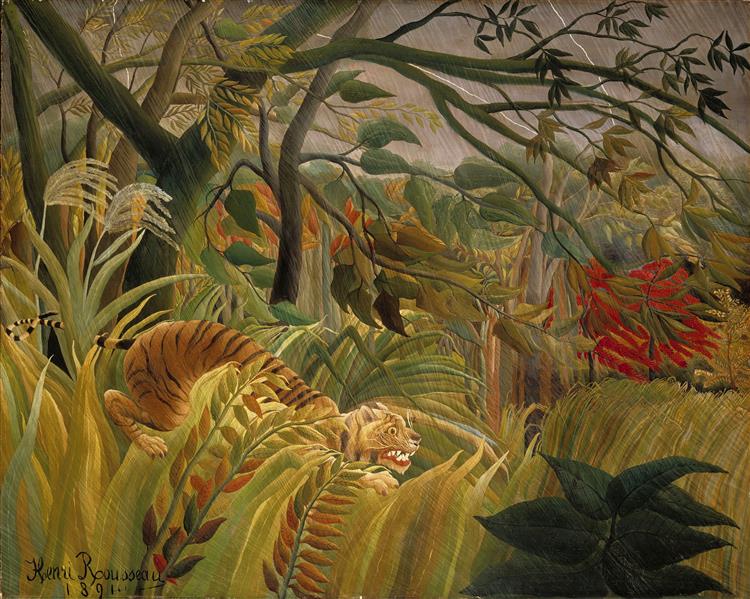
Tiger in a Tropical Storm (Surprised!) 1891
A tiger crouches in dense jungle foliage, every blade of grass and leaf rendered with obsessive precision, a tropical storm bent the grasses horizontally in the wind. The tiger itself is slightly awkward — its proportions are not quite anatomically correct — but it has a ferocious presence that anatomically correct animals in academic painting rarely achieve. The word 'Surprised!' in the title suggests the tiger is the one surprised — though by what is not clear. This was the first jungle painting and the one that established his reputation as something genuinely new in French art. It is in the National Gallery in London.
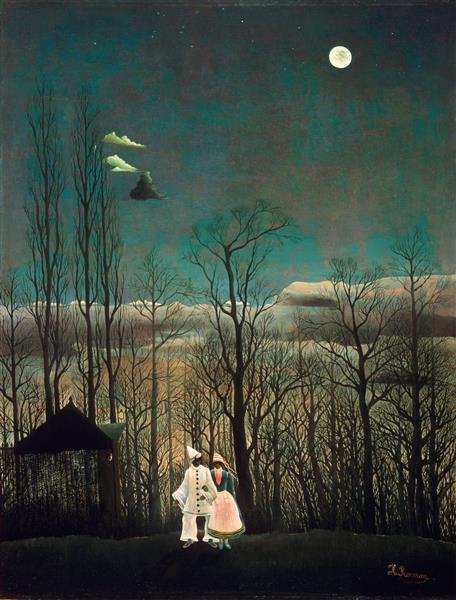
Carnival Evening 1886
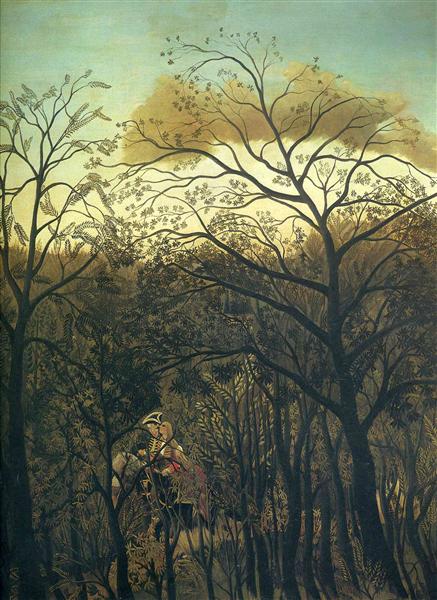
A man and woman in carnival costume stand in a clearing, a bare-branched winter forest around them, a full moon visible through the trees above. The figures are small; the forest is large. The costumes — a pierrot and a colombine, the traditional figures of Italian comedy — give the painting its quality of displacement: these theatrical characters have wandered into a real winter forest and stand in it with perfect, slightly bewildered equanimity. The moonlight is flat, illuminating everything equally, giving the scene its dreamlike quality. It is one of his earliest works and establishes the flat, theatrical space of all his subsequent painting. It is in the Philadelphia Museum of Art.
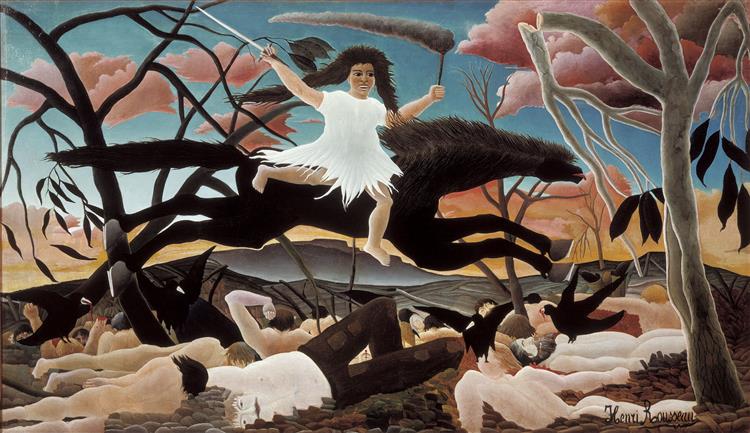
War (The Ride of Discord) 1894
A dark-haired figure on a black horse rides across a battlefield strewn with corpses and broken weapons, ravens circling above. The image of war as a horseback personification — allegorical rather than documentary — connects Rousseau to the European tradition of history painting, which he was attempting rather than parodying. The awkwardness of the horses, the figures arranged too evenly across the canvas, the ravens that hover above — all carry the quality of a vision rather than an observed event. He exhibited it at the Salon des Indépendants in 1894 with a verse: 'She passes by, leaving in her wake despair, tears and ruin, everywhere.' It is in the Musée d'Orsay.