Paul Klee
He made painting think like a poem and feel like a dream you almost remember.
Style and technique
Klee's work resists categorisation because it was produced at a rate of approximately two works per week for thirty years, and each of those works is in some sense an experiment. He was not a painter who found a style and refined it; he was a painter who treated each canvas or sheet as a new problem, each technique as a temporary hypothesis. The body of work he left — over 9,000 works — is one of the most diverse produced by any major twentieth-century artist.
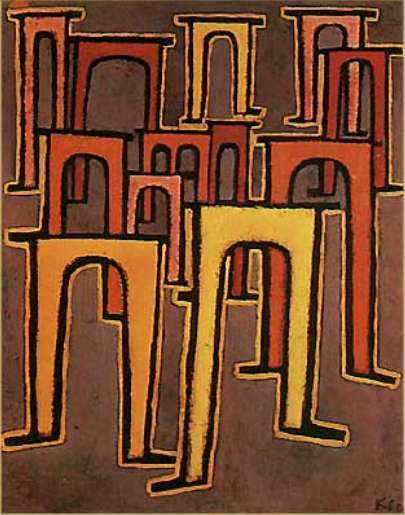
His central subject was the boundary between sign and image, the point where a drawn mark is simultaneously an abstract form and a recognisable thing. A line could be a stem and a symbol simultaneously. A small square could be a window in a town and a chromatic value simultaneously. His work inhabits the zone between the legible and the abstract and refuses to resolve into either.
He was a gifted musician — a professional-level violinist who played in the Bern municipal orchestra — and he brought a musician's understanding of rhythm, counterpoint, and theme-and-variation to his painting. His compositions are organised musically: a motif introduced, developed, varied, inverted, combined with another.
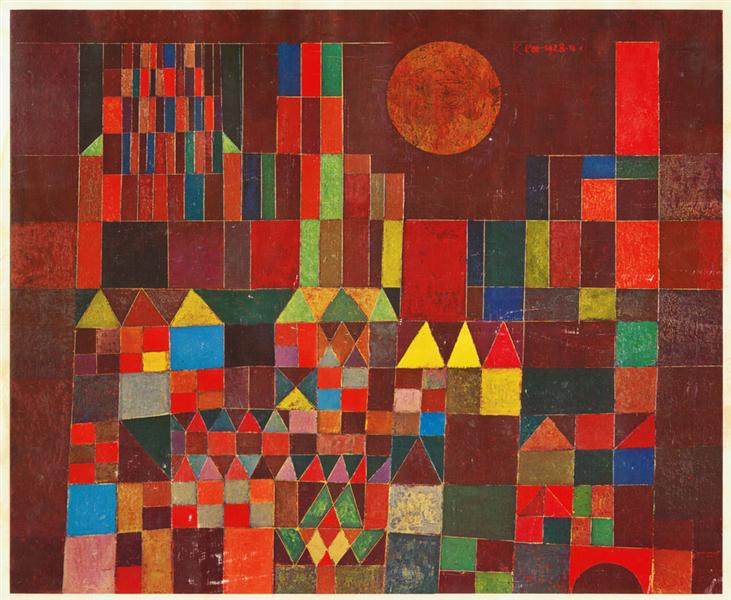
Four fingerprints: small scale (most of his works are intimate — some are postage-stamp size — rather than monumental), the grid or mosaic as a compositional structure, a specific palette that combines warm and cool tones in ways that produce vibration and depth, and a quality of tender, ironic intelligence in the choice of subjects and their treatment — there is always a joke somewhere, always a wisdom behind the joke.
Life and legacy
Klee was born on 18 December 1879 in Münchenbuchsee, near Bern in Switzerland, the son of a German music teacher and a Swiss mother. He grew up in a musical household, learned the violin from early childhood, and was performing publicly as a teenager. He considered a professional music career seriously before deciding on painting — a decision he never entirely made, since music remained a daily practice throughout his life.
He studied at the Munich Academy under Franz von Stuck — the same teacher as Kandinsky — from 1900 to 1901, then traveled to Italy for a year. He returned to Bern and spent several years in relative obscurity, supporting himself by playing in the Bern municipal orchestra and making satirical prints. He was working seriously as a painter and draughtsman but found almost no commercial success.
The turning point was 1911, when he met Kandinsky and the Blaue Reiter group in Munich and was included in their second exhibition. In 1914 he traveled to Tunisia with August Macke and Louis Moilliet. He had already been working in colour, but Tunisia showed him how warm, saturated colour could be combined in mosaics and patterns that generated their own spatial depth without conventional perspective.
He was called up for military service in 1916 and served in relatively comfortable auxiliary roles — painting camouflage on aircraft, transferring accounts — until the end of the war. He returned to Munich and was appointed to the teaching staff of the Bauhaus in Weimar by Walter Gropius in 1920.
The Bauhaus years (1920–1931) were among the most productive of his career. He taught the Preliminary Course and the bookbinding workshop and developed an elaborate theoretical framework for painting that he published as 'Pedagogical Sketchbook' (1925) and elaborated in his unpublished teaching notes. His own painting expanded simultaneously, drawing on the geometric precision of the Bauhaus environment while maintaining its ironic lightness.
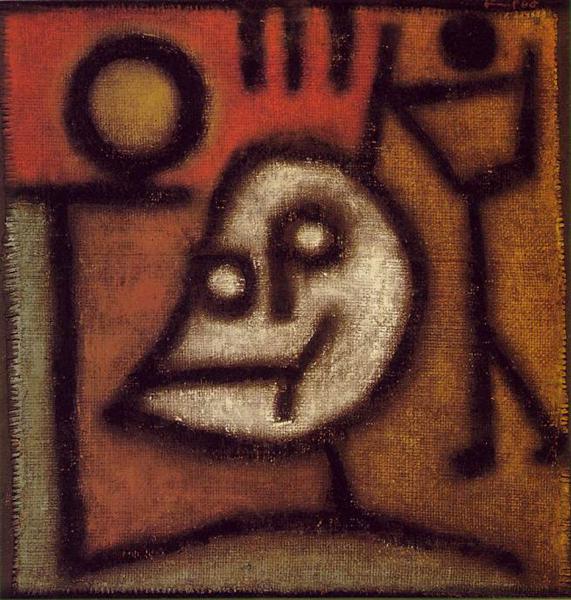
In 1935 he was diagnosed with scleroderma — a progressive connective tissue disease that gradually restricted the movement of his hands. He worked increasingly in large-scale works with simplified, impasted mark-making, the thick black lines of his final years requiring less manual dexterity than the fine, intricate marks of earlier work. He died on 29 June 1940 in Muralto, aged sixty, before his citizenship application to Switzerland had been processed. He had lived in Switzerland his entire life and died a German national.
Five famous paintings
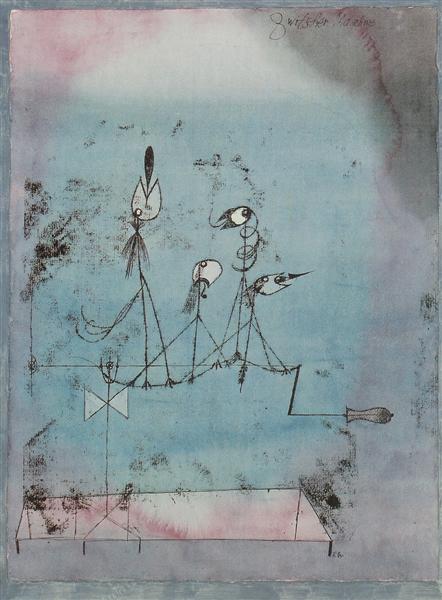
Twittering Machine 1922
A small pen-and-ink drawing with watercolour wash — 41 by 30 centimetres — showing four strange bird-like figures mounted on a wire cranked by a handle. It is both a machine and a system for making sound, both science-fiction and satire of science, both a drawing of birds and a drawing of something that has the form of a bird but belongs to a world of mechanical reproduction. The thin, precise lines against the blue-green ground are characteristic of Klee's Bauhaus period. The title adds the final dimension: the noise these mechanical birds make is twittering — the specific empty chatter of birds and of modernity. It is in the Museum of Modern Art in New York.
Angelus Novus 1920
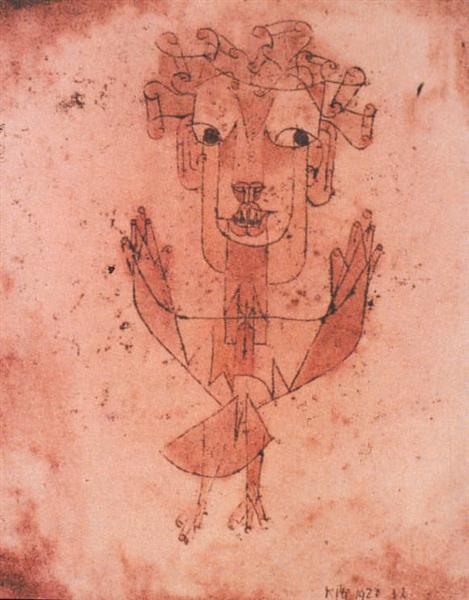
A monoprint — or mixed media on paper — showing a strange angular figure with a wide-open mouth, extended wings, and large eyes staring forward. It was bought by the philosopher and literary critic Walter Benjamin in 1921 and became the basis of his most famous passage: in 'Theses on the Philosophy of History' (1940), Benjamin described the Angel of History as a figure who looks back at the catastrophe of the past while being blown forward into the future by the storm of progress. The painting outlived Benjamin, who died fleeing the Nazis in 1940, and is now in the Israel Museum in Jerusalem.
Ad Parnassum 1932
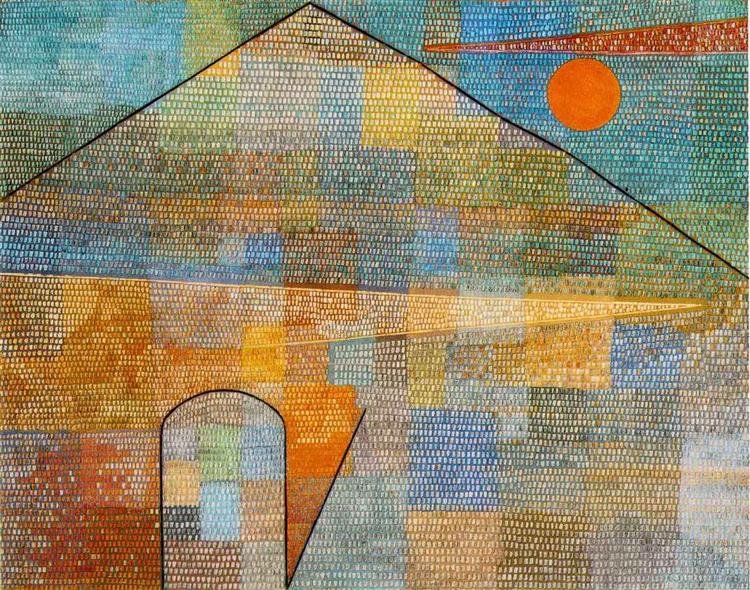
One of Klee's largest and most complex works — 100 by 126 centimetres — and one of the last major achievements of his Düsseldorf period before the Nazis dismissed him from his teaching post. The canvas surface is covered in tiny squares of paint, warm and cool tones alternating in a mosaic pattern, with a pyramid-like mountain form in the centre and two abstract blue rectangles — possibly doors or windows — at the lower edge. The title refers to the path to the Muses' mountain. The entire surface shimmers with a quality of transmitted light. It is in the Kunstmuseum Bern, the museum that holds the largest collection of Klee's work in the world.
The Goldfish 1925
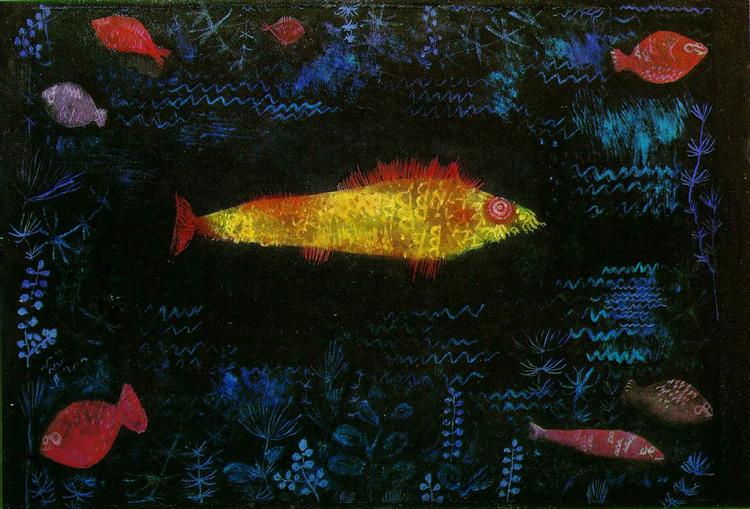
A gold and orange goldfish swims in a dark blue-green aquatic ground, surrounded by smaller creatures and plant forms. The fish is the light source: it illuminates the surrounding darkness by its own warm glow. The setting is an imaginary underwater world assembled from Klee's characteristic vocabulary — semi-abstract plant forms, small creatures, a layered background built from transparent colour washes. The painting is at once a children's book illustration and a serious meditation on the way a single luminous form organises the dark space around it. It is in the Hamburger Kunsthalle.
Death and Fire 1940
One of Klee's very last works, made in the year of his death as scleroderma had severely restricted his hands. A skull face — reduced to its most essential elements — stares from the centre of the canvas, the word 'Tod' (death) spelled out in the features of the face. Fire or sunset colours surround it. The lines are thick and impasted, the mark-making far simpler than his earlier intricate work — the disease forced a new simplicity that produces a different kind of power. The painting is simultaneously a self-portrait, a meditation on mortality, and a formal problem about how much a painting can remove and still communicate its subject. It is in the Zentrum Paul Klee in Bern.