Joan Miró
He reduced painting to pure sign and made it as exhilarating as a child's first word.
Style and technique
Miró's mature style is immediately recognisable and entirely his own: bold, organic, biomorphic shapes — blobs, crescents, filaments, spirals — in black, white, red, yellow, and blue, floating in fields of colour that suggest space without describing it. Stars appear constantly: sometimes a simple asterisk, sometimes a complex radiating form. Birds are everywhere. The human figure, reduced to symbolic shorthand — two circles for eyes, a line for a body, radiating tentacles for limbs — recurs across decades.
This language was not a simplification of observed reality but a new alphabet constructed from dream, sensation, and Catalan folk art. Miró built it in the 1920s through a deliberate and systematic destruction of conventional pictorial representation. He was influenced by Surrealism's programme of accessing the unconscious, but his method was less the automatic writing of Breton and more a willed regression to a state of unmediated visual thinking.
His colour is primary in the most literal sense: the three primaries — red, yellow, blue — plus black and white, used in large, flat, unmodulated areas. He was influenced by Matisse's colour but pushed further, eliminating the decorative complexity of Matisse's patterns in favour of pure colour fields.
Four fingerprints: the black outline containing flat fields of primary colour, biomorphic shapes that suggest eye, wing, limb, or star without fully committing to any of them, a specific blue that runs through his entire career as the colour of sky, sea, and imaginary space, and a quality of joy — his is among the least anxious bodies of work in twentieth-century art.
Life and legacy
Miró was born on 20 April 1893 in Barcelona, the son of a goldsmith and watchmaker. He grew up in Barcelona and in his grandparents' farm at Montroig del Camp, in the rural interior of Catalonia — a landscape that would remain a visual reference point for the rest of his life.
He studied at the Escola de Belles Arts de la Llotja in Barcelona and then at the Cercle Artístic de Sant Lluc, absorbing Fauvism and Cubism through reproductions and through the lively Barcelona art world of the 1910s. His early paintings — the farm at Montroig, a few portraits — have a compressed, intense detailing that owes something to Cézanne and to Catalan Romanesque art.
He moved to Paris for the first time in 1920 and immediately encountered the Surrealist circle: Breton, Éluard, Ernst, Picabia. He showed at the Salon d'Automne but sold nothing. He worked through alternating months in Paris and Montroig, the two poles of his life for the next decade.
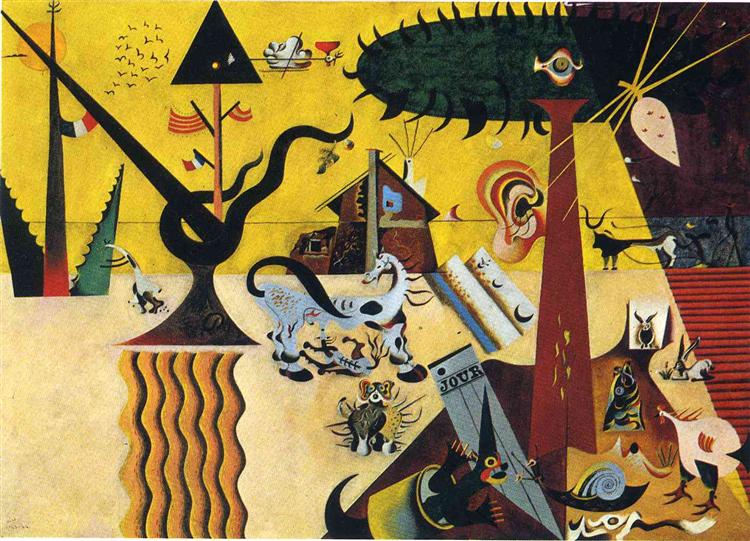
The breakthrough came between 1923 and 1925. In a period of sustained poverty and semi-hallucinatory concentration — he was sometimes going days with little food and working in cold rooms — he began producing works that bore no resemblance to anything before them. 'The Tilled Field' (1924), 'The Carnival of Harlequin' (1925), 'The Birth of the World' (1925): a new visual language, assembled from dream, childhood memory, and the visual vocabulary of Catalan folk decoration.
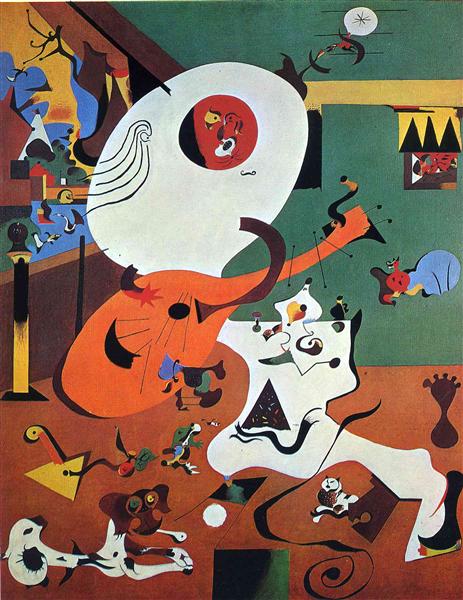
Breton included him in the first Surrealist exhibition in 1925, though Miró was always a somewhat independent member of the group. He spent the 1920s and 1930s in a rapid succession of projects: the 'Dutch Interior' series (1928, paintings after Old Master reproductions transformed into his own vocabulary), the large-scale theatrical work with the Ballets Russes, experiments in collage.
He spent the war in Normandy, then Palma, then Barcelona. The 'Constellations' series, made between 1940 and 1941 in the small Normandy town of Varengeville, are among the most tightly organised and emotionally compressed works of his career — dense fields of signs and symbols made under the immediate pressure of the German invasion.
After the war he returned to Barcelona and Majorca, working in increasingly large formats. He produced murals for UNESCO in Paris (1958), the Gaudí Foundation in Barcelona, and the Maeght Foundation in Saint-Paul-de-Vence, where a whole building was designed around his work. He died on 25 December 1983 in Palma, Majorca, aged ninety.
Five famous paintings
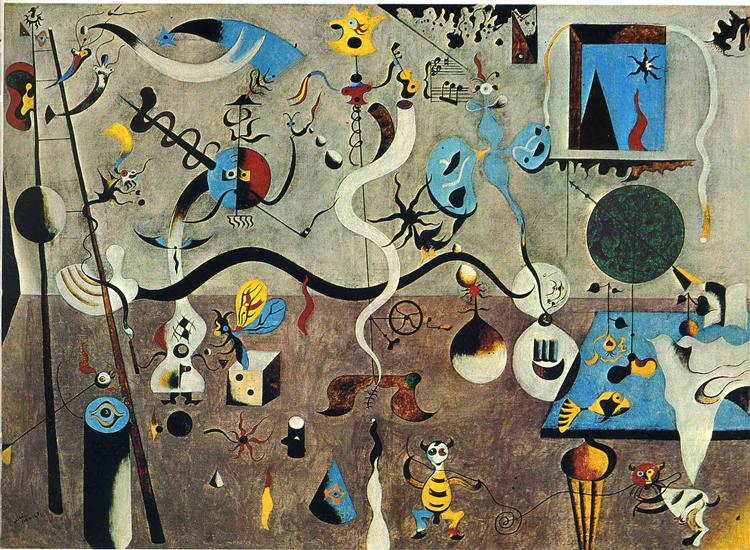
The Carnival of Harlequin 1925
Miró's first mature masterpiece, painted while he was going without food for days and experiencing what he described as visual hallucinations produced by hunger. A dense, festive interior full of miniature creatures, symbols, and biomorphic forms — a ladder, a guitar, a fish, a cat, floating eyes and spirals — all assembled in a flat, shallow space without conventional perspective. Everything is in motion; nothing is at rest. The painting invents the visual language that Miró would use for the rest of his career. He described it as 'exact transcriptions of a hallucination'. It is in the Albright-Knox Art Gallery in Buffalo.
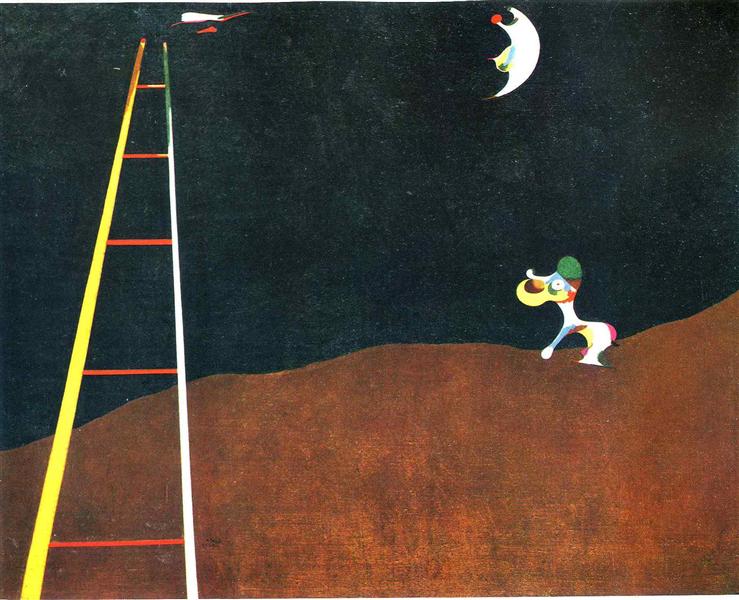
Dog Barking at the Moon 1926
Extreme simplicity: a dark ground divided horizontally into a brown lower half and a black upper half, with a crescent moon at the upper right. A spindly black dog stands at the lower left, one paw raised, its head tilted back in the direction of the moon. Between them, a yellow ladder rises from the ground towards the moon but falls short. The image is a folk fable, a dream fragment, and a formal exercise simultaneously: can a painting with two colours and three elements carry the full weight of its subject? Miró's answer is demonstrably yes. The painting is in the Philadelphia Museum of Art.
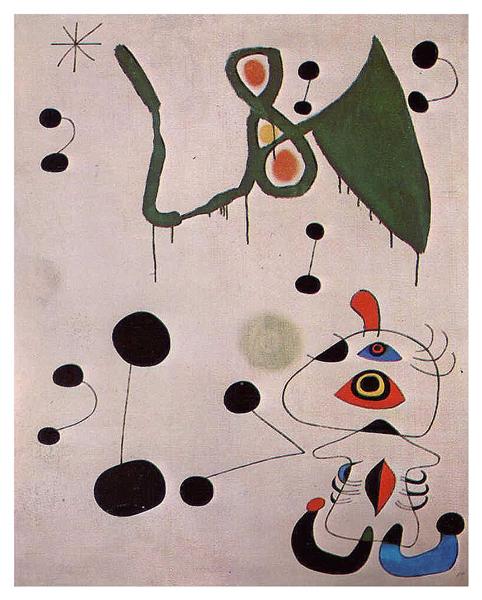
Woman and Bird in the Night 1945
A late work, painted after the war in the warm post-Constellations period. A large biomorphic woman-form dominates the left side, her body made from the organic vocabulary of Miró's signs. A bird — a star-shape with a long neck — occupies the right. The background is a warm dark blue: night. The forms are larger and more settled than in the dense Carnival; each element breathes. This is Miró's recurring theme — woman, bird, stars, night — in its most spacious form. The painting is characteristic of the large-format work that followed the war, when he had more canvas and more confidence in his sign-language.
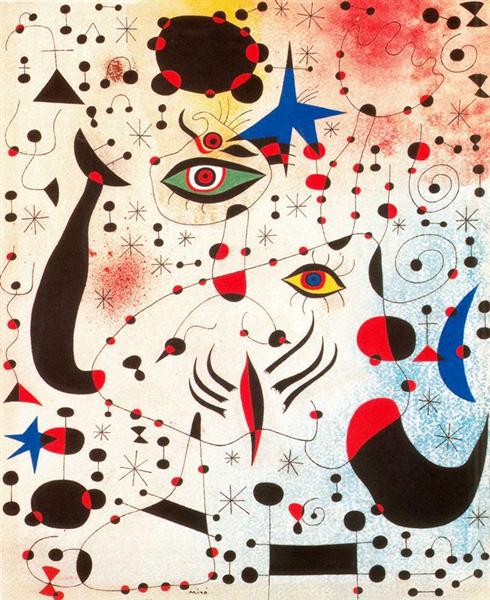
Ciphers and Constellations in Love with a Woman 1941
One of the 'Constellations' series, made in Varengeville in 1940–41 while German armies were advancing through France. A dense field of small signs, symbols, and biomorphic forms connected by thin lines cover the entire picture surface — no centre, no hierarchy, every element equally present. Stars, eyes, circular forms, ladders, crescents, spirals. The effect is of a visual field observed through a microscope or a night sky mapped as living matter. The series was made in gouache on paper, and there are twenty-three works. This one is in the Art Institute of Chicago.
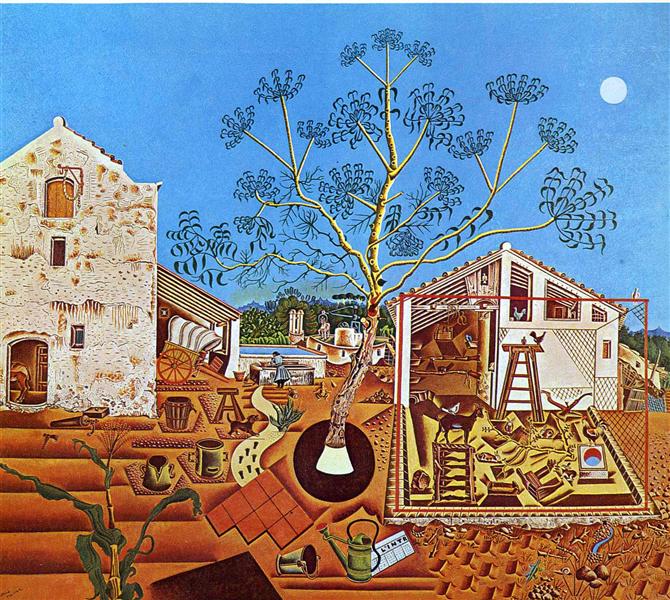
The Farm 1922
A transitional work, painted before his mature Surrealist language was developed, showing the farm at Montroig in painstaking descriptive detail. Every element of the farmyard — the stone wall, the watering can, the chicken, the dog, the tree — is rendered with a precise, slightly compressed attention that owes something to Douanier Rousseau and something to Catalan decorative art. The American poet and novelist Ernest Hemingway saw it in Paris in 1925 and bought it for $5,000 — then a significant sum. He kept it for the rest of his life and said it reminded him of everything he loved about Spain. It is now in the National Gallery of Art in Washington D.C.